](https://deep-paper.org/en/paper/2404.11095/images/cover.png)
Introduction
In the rapidly evolving world of Large Language Models (LLMs), we often focus on how well a model answers a question. But there is another side to the coin that is equally critical for training these models: how well can a model ask questions?
To align LLMs with human expectations, developers need massive datasets of high-quality, multi-turn dialogues. Manually collecting these conversations is expensive and slow. The solution? Use LLMs to generate the data themselves. One LLM plays the “System Agent” (the chatbot), and another plays the “User Simulator” (the human).
However, there is a catch. Current User Simulators are good at superficial chatting, but they struggle to drive a conversation deep. They tend to ask generic questions, failing to explore complex topics or challenge the system agent. They lack the underlying “rules” of how a good conversation flows.
Enter IDEAS (Inductive-Deductive Strategy Reuse), a new framework proposed by researchers to solve this problem. Inspired by human cognitive processes, this method teaches User Simulators to explicitly learn high-level conversation strategies from real human data (Induction) and then apply those strategies to create diverse, in-depth synthetic dialogues (Deduction).
In this post, we will break down how IDEAS works, how it mimics human reasoning, and why it produces superior training data for the next generation of AI.
The Problem: The “Generic User” Trap
Before diving into the solution, we need to understand the bottleneck in current data generation methods.
When we train an LLM to act as a user, we typically use “role-playing” prompts or fine-tune it on existing datasets. The model learns patterns—it knows that after a greeting comes a question. However, it implicitly learns these patterns without understanding the logic behind them.
Because the rules governing human curiosity are complex, these simulators often default to the most probable, safe, and frequently occurring patterns. The result? Instructional dialogues that are flat. They lack diversity and depth. They don’t push the System Agent to its limits, which means the resulting training data isn’t challenging enough to make the System Agent smarter.
The Solution: Mimicking Human Reasoning
The researchers observed that humans don’t just memorize dialogue patterns; they use Inductive and Deductive reasoning.
- Induction: When we observe many conversations, we induce general rules. For example, if we see someone asking “Is that source reliable?” and another asking “Can you prove that?”, we induce a strategy: Information Validation.
- Deduction: When we are in a new conversation, we deductively apply these strategies. If a chatbot gives us a dubious fact, we pick the Information Validation strategy and ask, “Where did you get that data?”
The IDEAS framework formalizes this process for LLMs.
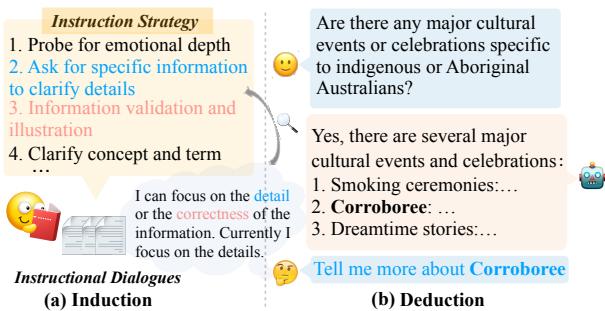
As shown in Figure 1, the process moves from specific examples to high-level strategies (Induction), and then applies those strategies to generate specific questions in new contexts (Deduction).
The IDEAS Architecture
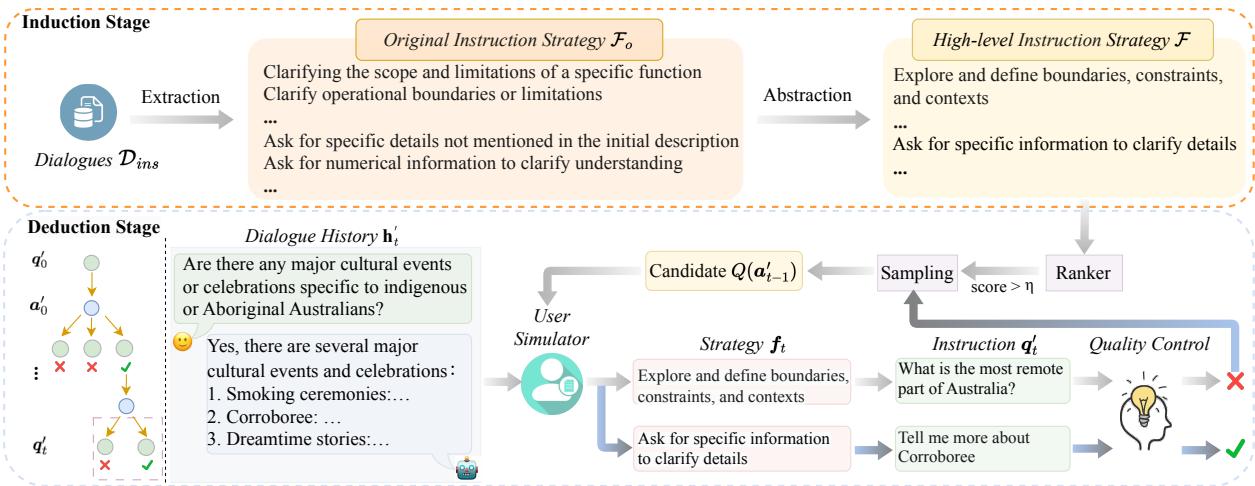
The method is divided into two distinct stages: the Induction Stage and the Deduction Stage. Let’s break down the architecture.
Stage 1: The Induction Stage
The goal here is to build a library of “Instruction Strategies”—high-level rules that guide how a user should interact.
Step 1: Strategy Extraction
First, the system looks at a dataset of real human-machine dialogues (\(\mathcal{D}_{ins}\)). For every turn in a dialogue where a human asks a question (instruction) based on previous history, the system (using GPT-4) analyzes why they asked it.
It extracts a natural language description of the strategy. For instance, if a user asks for a specific code snippet after a general explanation, the extracted strategy might be “Ask for specific implementation details.”
The extraction process follows this distribution:
\[ \mathbf { \Delta } f _ { o } \sim { \cal P } _ { \mathrm { E x t r a c t i o n } } ( \cdot | \mathbf { h } _ { t } , \mathbf { q } _ { t } ) , \]Here, \(f_o\) is the original strategy, \(h_t\) is the history, and \(q_t\) is the user’s instruction.
Step 2: Strategy Abstraction
The extracted strategies are often too specific to the original conversation (e.g., “Ask for details about the Python code”). To make them reusable, they need to be abstract.
The system clusters similar strategies using embedding similarity. If two strategies are semantically close (similarity \(> \epsilon\)), they are grouped together.
\[ \mathbf { C } _ { i } = \{ f _ { o i } \} \cup \{ f _ { o j } | \cos ( E ( f _ { o i } ) , E ( f _ { o j } ) ) > \epsilon \} , \]Once clustered, the system generalizes the cluster into a single High-Level Instruction Strategy (\(\mathcal{F}\)). This turns “Ask for Python details” and “Ask for Java details” into a universal strategy: “Request specific technical implementation.”
\[ \mathbf { \Delta } \mathbf { f } _ { i } \sim { \cal P } _ { \mathrm { A b s t r a c t i o n } } ( \cdot \vert \mathbf { C } _ { i } ) . \]Stage 2: The Deduction Stage
Now that the system has a pool of high-level strategies, it enters the Deduction Stage. This is where the User Simulator creates new data.
Step 1: Strategy Utilization (The Ranker)
When the User Simulator is given a new dialogue scenario, it shouldn’t just guess what to say. It should pick a strategy.
However, giving the LLM the entire list of strategies is inefficient (and exceeds context windows). Instead, the researchers introduce a Ranker. This is a BERT-based model trained to predict which strategies fit the current dialogue history.
The Ranker selects a subset of suitable strategies (\(Q'\)) that score above a threshold \(\eta\). From this subset, the system samples \(W\) candidates.
\[ \begin{array} { r l } & { Q ^ { \prime } ( \pmb { a } _ { t - 1 } ^ { \prime } ) \{ \pmb { f } _ { i } | \mathrm { R a n k e r } ( \pmb { a } _ { t - 1 } ^ { \prime } , \pmb { f } _ { i } ) > \eta \} , } \\ & { Q ( \pmb { a } _ { t - 1 } ^ { \prime } ) \mathrm { S a m p l e } ( Q ^ { \prime } ( \pmb { a } _ { ( t - 1 ) } ^ { \prime } ) , W ) , } \end{array} \]Step 2: Instruction Generation
The User Simulator (a fine-tuned LLaMA-2 model) receives the dialogue history and the short list of candidate strategies. It selects one strategy and generates the next instruction.
\[ \mathbf { } u _ { t } \sim P _ { \phi } ( \cdot | \mathbf { h } _ { t } ^ { \prime } , Q ( \mathbf { \boldsymbol { a } } _ { t - 1 } ^ { \prime } ) ) , \]This is a crucial shift from standard methods. The model isn’t just generating text; it’s effectively saying, “I choose the strategy ‘Challenge the premise’, and therefore I will ask…”
Step 3: Quality Control (Reflection)
LLMs can hallucinate or get stuck in loops. To prevent this, IDEAS includes a Reflection Module. Immediately after generating an instruction, the system checks two metrics:
- Correctness: Does it contradict previous history? Is the answer already known?
- Coherence: Is it logically connected to the context?
If the instruction fails, it is regenerated (potentially with a different strategy). This ensures the resulting dataset is clean and usable.
Model Implementation Details
For students interested in the “how-to,” here are the specific implementation details used in the paper:
- User Simulator: A LLaMA-2-13B model fine-tuned on real human dialogues. It is trained to output the strategy followed by the instruction. \[ \mathcal { L } _ { u s e r } = - \sum _ { z = 1 } ^ { | U | } \log P _ { \phi } ( U _ { z } | \mathbf { H } , Q , U _ { < z } ) , \]
- Ranker: A BERT-base model treated as a binary classifier. It takes a dialogue history and a strategy and outputs 1 if they match, 0 otherwise. \[ \begin{array} { r l } & { \mathcal { L } _ { r } = - \left[ l \log P _ { \theta } ( l = 1 | \mathbf { H } , F ) \right. } \\ & { \quad \quad \left. + \left( 1 - l \right) \log P _ { \theta } ( l = 0 | \mathbf { H } , F ) \right] . } \end{array} \]
- System Agent: GPT-4 is used as the system agent to respond to the User Simulator’s questions, ensuring high-quality answers in the dataset.
Experiments and Results
Does explicit strategy reuse actually work? The researchers tested IDEAS against several baselines, including “Self-Chat” (standard LLM-to-LLM conversation) and “Parrot-Ask” (a fine-tuned user simulator without explicit strategy candidates).
1. Instruction Evaluation
First, they evaluated the quality of the instructions generated by the User Simulator. They used GPT-4 as a judge to score instructions on Appropriateness, Coherence, Depth, Insight, and Diversity.
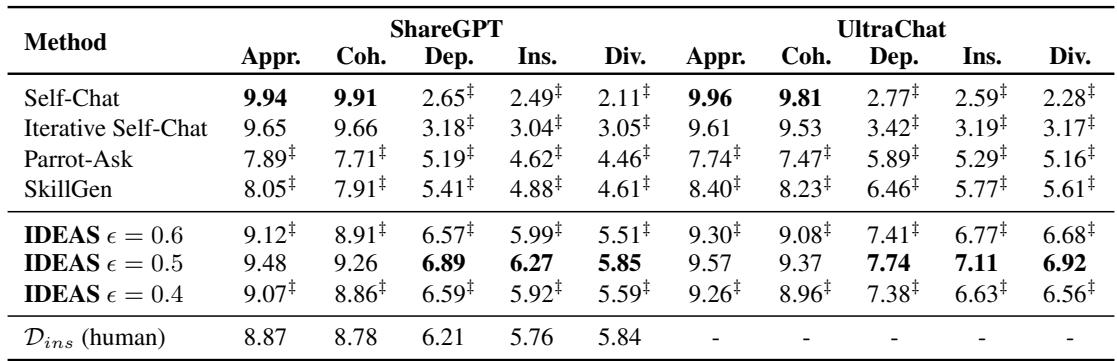
As seen in Table 1, IDEAS significantly outperforms baselines, particularly in Depth and Diversity.
- Parrot-Ask (implicit learning) scores lower, suggesting that without explicit strategies, models revert to generic questions.
- IDEAS (\(\epsilon = 0.5\)) strikes the best balance. Note that the “human” row (\(\mathcal{D}_{ins}\)) shows that IDEAS is approaching (and sometimes exceeding) the perceived quality of the original training data in terms of depth.
2. Downstream Model Performance
The ultimate test is training a chat model on the synthetic data generated by IDEAS. If the data is better, the resulting chat model should be smarter.
They trained LLaMA-2-13B on the generated dialogues and tested it on benchmarks like MT-Bench (Multi-Turn Benchmark) and AlpacaEval.
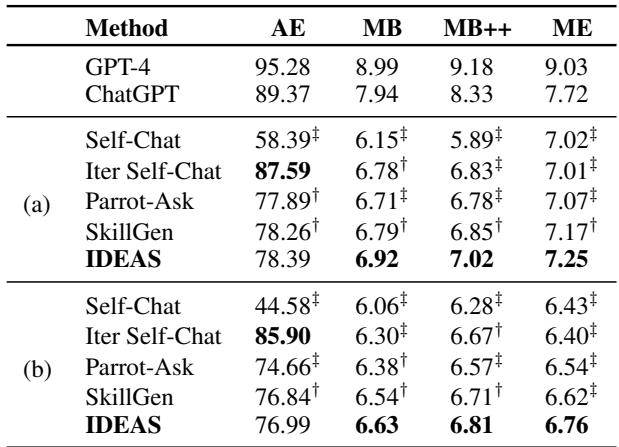
Table 3 shows a clear victory for IDEAS.
- On MT-Bench and MT-Bench++, IDEAS achieves the highest scores (6.92 and 7.02 respectively).
- It beats Iterative Self-Chat, which uses two GPT-4 agents. This is impressive because IDEAS uses a much smaller LLaMA-2 model as the User Simulator, proving that strategy matters more than raw model size for data generation.
3. The Power of Scaling
One of the most interesting findings is how the method scales. Usually, adding more synthetic data eventually hits a point of diminishing returns—the model stops learning because the data is too repetitive.
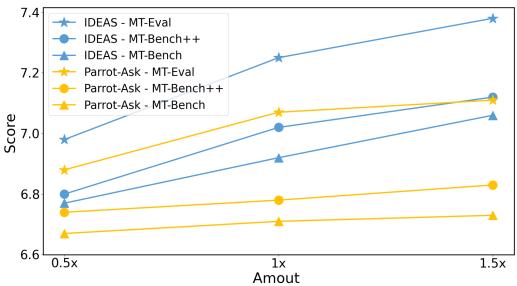
Figure 3 illustrates that while the baseline (Parrot-Ask) plateaus at “1x” amount of data, IDEAS continues to improve performance as you add more data (1.5x). This confirms that the diversity provided by the strategy reuse prevents the dataset from becoming repetitive.
4. Ablation Study: Does Every Part Matter?
The researchers removed components one by one to see what drove the performance.
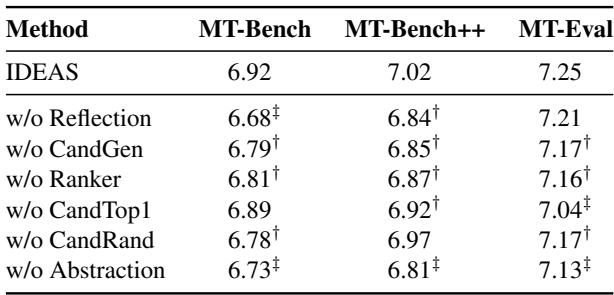
Table 4 reveals:
- w/o Reflection: Removing the quality control drops performance significantly. Bad questions lead to bad training.
- w/o Abstraction: Using raw strategies instead of high-level ones hurts performance. Strategies need to be general to be reusable.
- w/o Ranker: Randomly picking strategies is better than nothing, but picking relevant strategies (via the Ranker) is much better.
Conclusion and Implications
The IDEAS paper presents a compelling argument: To build better AI, we need to teach AI how to think about conversation flow, not just predict the next word.
By explicitly modeling the inductive process of learning strategies and the deductive process of applying them, IDEAS creates synthetic data that is rich, diverse, and deeply instructional.
Key Takeaways for Students:
- Implicit vs. Explicit: LLMs act better when underlying rules are made explicit (via strategies) rather than left implicit in the weights.
- Synthetic Data Engineering: The future of LLM training isn’t just “more data”; it’s “better engineered synthetic data.”
- Human-In-The-Loop Design: Even though the process is automated, the architecture is heavily inspired by human cognitive science, proving that understanding how humans think is still vital for advancing AI.
As we move forward, methods like IDEAS will likely become standard for generating the training fodder that powers the next generation of intelligent assistants.