](https://deep-paper.org/en/paper/2404.13947/images/cover.png)
Introduction
Imagine showing an AI a photo of a specific cat breed. A standard computer vision model might tell you, “This is a cat.” A more advanced model might say, “This is a Garfield cat.” But if you ask, “What is the favorite food of this cartoon character?” the model hits a wall. The answer—Lasagna—isn’t in the pixel data. It requires external world knowledge.
This is the challenge of Knowledge-based Visual Question Answering (VQA). Unlike traditional VQA, which asks about what is visible in the image (e.g., “What color is the car?”), Knowledge-based VQA requires the model to reason about the visual world using facts, history, and common sense not present in the image itself.
To solve this, researchers often use Retrieval-Augmented Generation (RAG). They take the image, search a database (like Wikipedia) for relevant text, and feed that text to the model. However, there is a catch: retrieval systems are noisy. They often return a pile of documents where only one or two sentences are actually relevant, while the rest are distractions.
In the paper “Self-Bootstrapped Visual-Language Model for Knowledge Selection and Question Answering,” researchers propose a clever solution. Instead of blindly trusting all retrieved knowledge, they build a two-part system: a Selector that filters for high-quality information, and an Answerer that predicts the result. Crucially, these two modules train each other in a loop, a process called self-bootstrapping.
In this post, we will break down how this framework works, why it outperforms massive models like GPT-3 on benchmarks, and how it achieves this by fine-tuning only 0.16% of its parameters.
The Problem: Noise in the Library
To understand the solution, we first need to understand the bottleneck in current approaches.
Most state-of-the-art methods use Dense Passage Retrieval (DPR). Here is the typical workflow:
- Convert an image into a text description (captioning).
- Use that text to search a massive knowledge base (like Google Search or Wikipedia).
- Retrieve the top-\(k\) documents (e.g., top 10 or 30).
- Feed all those documents into a Large Language Model (LLM) along with the image to generate an answer.
The problem lies in step 4. DPR retrieves documents based on general similarity, not specific utility for the question. If you ask about a specific building’s architect, DPR might return documents about the building’s height, location, or tourism hours.
When you feed an LLM a massive amount of irrelevant text (noise) alongside the one correct fact (signal), the model often gets confused or hallucinates. The researchers argue that retrieval is not enough; we need selection.
The Solution: Selector and Answerer
The researchers propose a framework built on the BLIP-2 architecture (a powerful Visual-Language Model). They split the task into two distinct modules:
- The Selector: A discriminative model that looks at the retrieved documents and decides, “Does this specific document actually help answer the question?”
- The Answerer: A generative model that takes the selected (filtered) documents and produces the final answer.
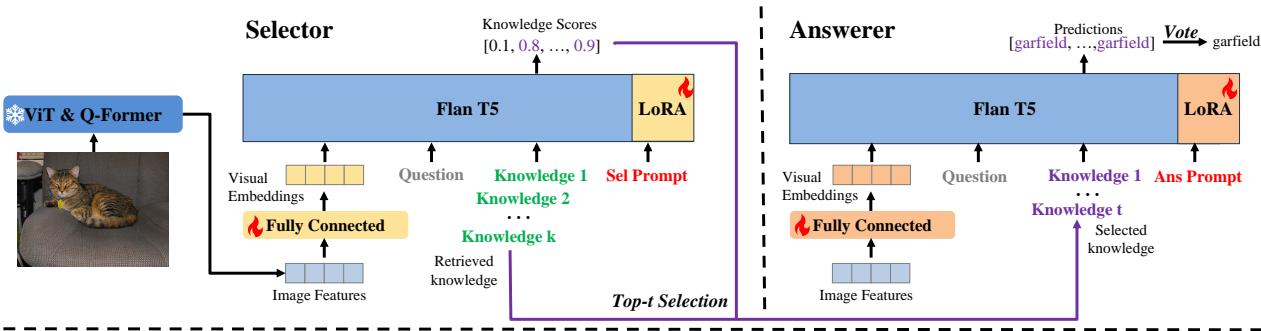
As shown in Figure 1 above, both modules share the same frozen visual feature extractor (ViT & Q-Former). The magic happens in how they are fine-tuned using LoRA (Low-Rank Adaptation), making the training highly efficient.
1. The Selector Module
The Selector’s job is to re-rank the noisy documents retrieved by DPR. It acts as a gatekeeper.
For every document retrieved, the Selector receives:
- The visual embeddings of the image.
- The question.
- The document itself.
- A specific prompt: “Does the retrieved knowledge document provide the key information to help answer the question?”
The model is trained to output a score (the probability of generating the word “yes”). Based on these scores, the system keeps only the top-\(t\) documents.
Mathematically, the selection process is defined as:

Here, \(\hat{\mathcal{P}}_i\) represents the refined, “clean” set of knowledge documents.
2. The Answerer Module
Once the knowledge is filtered, the Answerer takes over. It doesn’t look at the entire noisy pile; it only sees the high-quality documents chosen by the Selector.
The Answerer processes the image, question, and the selected knowledge to generate a prediction.

Interestingly, the researchers found that Voting works better than concatenation. Instead of pasting all selected documents into one long text prompt, the Answerer predicts an answer for each selected document individually. The final answer is determined by a majority vote among these predictions. This isolates the reasoning process, preventing one bad document from corrupting the context of the good ones.
The Core Innovation: Self-Bootstrap Learning
You might be asking a valid question: How do we train the Selector? We have datasets of questions and answers (like OK-VQA), but we don’t have labels for which Wikipedia paragraph contains the answer. We don’t have “ground truth” for the Selector.
This is where the Self-Bootstrapping (or cycle training) comes in. The researchers treat this as a “chicken and egg” problem and solve it by having the modules teach each other.
The training pipeline cycles between two stages:
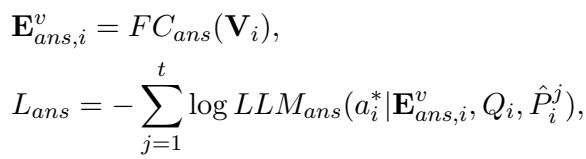
Stage 1: Training the Answerer
First, we use the current Selector to pick the best documents it can find. We then train the Answerer to predict the ground-truth answer using those documents.
Stage 2: Training the Selector (using Pseudo-Labels)
This is the clever part. Once the Answerer has been updated, we use it to generate labels for the Selector.
We take the Answerer and feed it every retrieved document. If the Answerer successfully predicts the correct answer using a specific document, we label that document as “Positive” (useful). If the Answerer fails, we label it “Negative” (not useful).
This generates Pseudo-Labels (\(y_{i,j}\)):
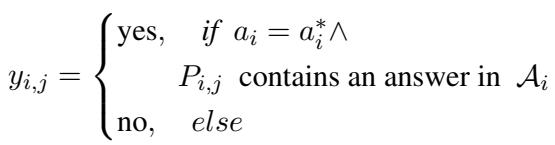
Now that we have these generated labels, we can train the Selector to predict them. The Selector learns to identify documents that are likely to help the Answerer succeed.
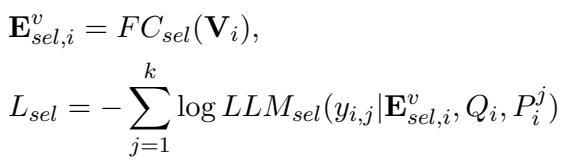
By repeating these two stages, the Selector gets better at finding good documents, which allows the Answerer to learn more robustly, which in turn leads to more accurate pseudo-labels for the Selector. It is a virtuous cycle.
Experiments and Results
The team tested this framework on OK-VQA, a challenging benchmark for open-domain visual question answering. They utilized Google Search as the knowledge source.
Comparison with State-of-the-Art
The results were impressive. As shown in Table 1 below, the proposed method achieves an accuracy of 62.83%, outperforming massive models like Flamingo (80B parameters) and methods using GPT-3 (175B parameters), despite using a much smaller backbone (BLIP-2 T5-XL, 3B parameters) and only fine-tuning 0.16% of the parameters.
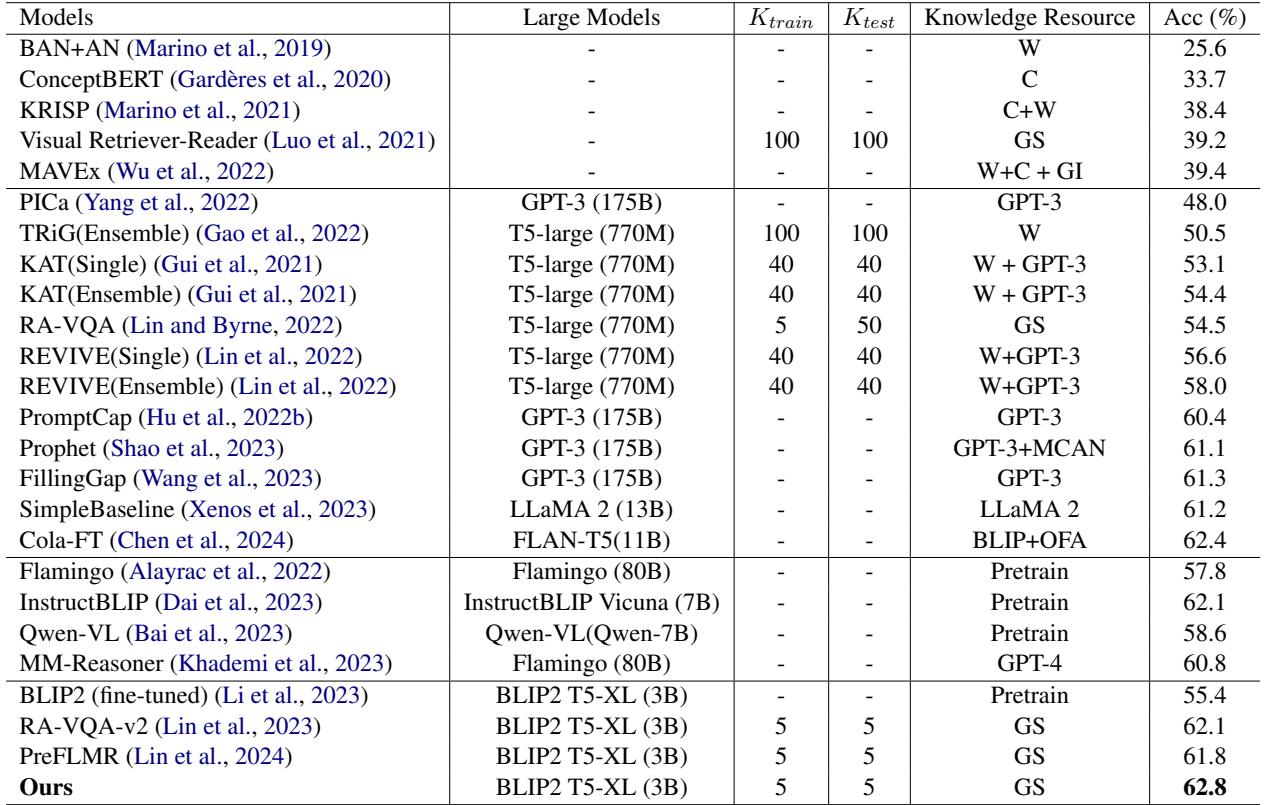
It is worth noting that the baseline BLIP-2 model (without external knowledge) only scores 55.4%. Adding the self-bootstrapped knowledge selection provides a massive jump in performance.
Does Selection Actually Matter?
One might argue that modern LLMs are smart enough to ignore noise, so perhaps the Selector isn’t necessary. The ablation study in Table 2 proves otherwise.
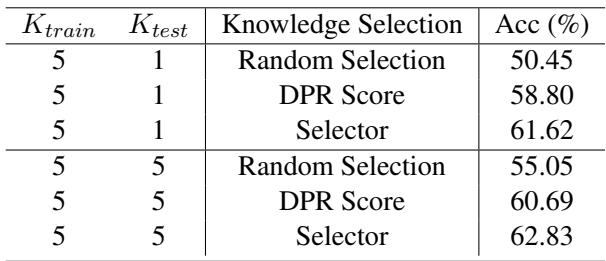
- Random Selection: 55.05%
- DPR Score (Standard RAG): 60.69%
- Selector (Ours): 62.83%
Using the raw scores from the retrieval engine (DPR) is better than random, but the specialized Selector provides a significant 2%+ boost. This confirms that generic retrieval scores (which measure text similarity) are not perfectly aligned with “helpfulness for answering.”
Voting vs. Concatenating
The researchers also investigated how the Answerer should consume the knowledge. Should we combine all knowledge into one long paragraph (Concatenating) or ask the model to answer based on each document separately and take a vote (Voting)?
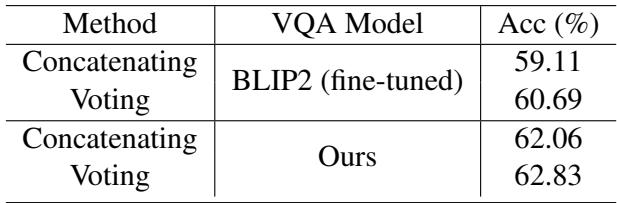
Table 3 shows that Voting yields the best results. Concatenating introduces too much noise into the context window, whereas voting allows the model to reason clearly on specific pieces of evidence.
The Power of Cycle Training
Finally, to validate the “Self-Bootstrapping” concept, they compared independent training (training modules separately without the loop) against cycle training.
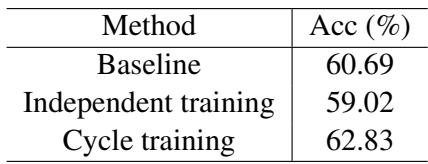
Table 4 reveals that independent training actually performs worse than the baseline. Without the feedback loop, the Selector doesn’t learn what the Answerer actually needs. The cycle training is essential for the system’s success.
Qualitative Analysis
It is helpful to see the model in action to understand the impact of the Selector.
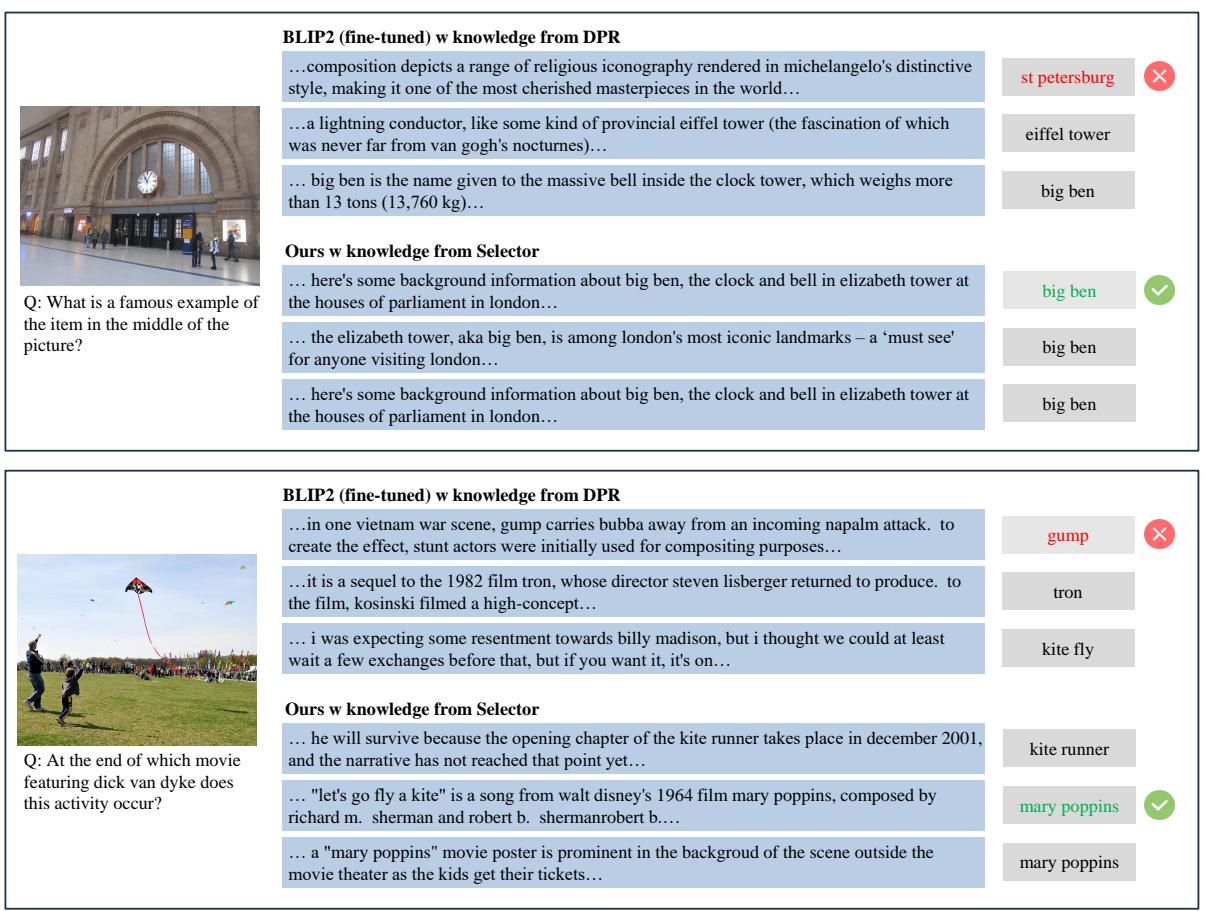
In Figure 2, look at the top example. The image shows the clock tower at the Palace of Westminster.
- The Baseline (DPR): Retrieves documents mentioning “St. Petersburg” and the “Eiffel Tower” (perhaps due to visual similarity in the retrieval embedding space). The model incorrectly answers “st petersburg”.
- The Selector: Filters out those distractions and selects documents explicitly mentioning “Big Ben” and “Elizabeth Tower.” The Answerer then correctly identifies “big ben.”
This clearly illustrates that retrieving the right document is not enough; the model must select it and ignore the distractors to reason correctly.
Conclusion
The “Self-Bootstrapped Visual-Language Model” paper teaches us a valuable lesson about AI architecture: More data isn’t always better; better data is better.
By acknowledging that retrieval systems are imperfect and noisy, the researchers built a mechanism to filter knowledge dynamically. Their Selector-Answerer framework, powered by the ingenious self-bootstrapping training loop, allows the model to refine its own training data without human intervention.
Key Takeaways:
- Selection > Retrieval: Just grabbing documents from Google isn’t enough. You need a dedicated brain (Selector) to verify if those documents are useful.
- Synergy via Bootstrapping: A cycle where the answerer teaches the selector (via pseudo-labels) and the selector helps the answerer (via clean data) creates a powerful feedback loop.
- Efficiency: You don’t need a 175-billion parameter model to achieve state-of-the-art results. Smart architecture and parameter-efficient fine-tuning (LoRA) can outperform raw size.
This approach paves the way for more reliable multimodal AI systems that can look at the world and not just recognize objects, but understand the rich context and knowledge behind them.