](https://deep-paper.org/en/paper/2404.16418/images/cover.png)
In the rapidly evolving landscape of Large Language Models (LLMs), we have seen a massive shift towards Instruction Tuning. Models like FLAN-T5 and T0 have demonstrated that training a model on a massive mixture of tasks—formatted as natural language instructions—unlocks incredible “zero-shot” capabilities. The prevailing wisdom has often been “the more tasks, the better.” The logic follows that a generalist model trained on thousands of tasks will be better equipped to handle a new, unseen task.
But is more always better?
Recent research suggests that when you want a model to perform well on a specific target task, training on irrelevant tasks can actually hurt performance—a phenomenon known as negative transfer. If you want a model to excel at medical summarization, training it on arithmetic or code generation might introduce noise that degrades its summarization abilities.
This leads to a new paradigm: Instruction Tuning as a Specialist. The goal is to select only the most relevant “source” tasks to train on, optimizing performance for a specific “target” task.
However, finding those relevant tasks is computationally expensive. Traditional methods require running thousands of experiments or needing data samples from the target task, which defeats the purpose of true zero-shot learning.
In this post, we are deep-diving into a fascinating paper titled “Optimized Instruction Tuning of Specific Tasks,” which proposes a novel, efficient solution called INSTA (Instruction-based Task Selector). This method selects the best training tasks by looking only at the instructions, ignoring the data samples entirely.
The Problem: The High Cost of Finding “Friends”
Imagine you have a new task you want your LLM to solve, let’s call it Task T (e.g., “Determine if this sentence is sarcastic”). You have a massive library of existing tasks (summarization, translation, logic puzzles, etc.) that you can use for training.
You want to find the tasks in your library that are “friends” with Task T—tasks that, if learned, will transfer knowledge effectively.
Previously, researchers used two main approaches to find these friends:
- Pairwise Transfer: Train a model on Task A, test it on Task B. If it does well, they are related. Do this for every possible pair of tasks.
- The Downside: This is astronomically expensive. If you have 100 tasks, you need to run thousands of training loops.
- Data Sample Similarity: Take a few example inputs/outputs from Task T and compare them to examples from your library using an embedding model.
- The Downside: This requires you to have labeled data for Task T. If Task T is truly “unseen” or you don’t have data yet, you can’t use this method.
The researchers behind INSTA posed a simple question: Can we identify relevant tasks by looking ONLY at the instruction text?
If Task A’s instruction is “Translate this English text to French” and Task B’s instruction is “Convert the following sentences from English into French,” a human knows they are similar without needing to see the actual sentences. The goal of INSTA is to give models this same intuition.
The Solution: INSTA (Instruction-based Task Selector)
The core hypothesis of the paper is that the instruction—the natural language description of what needs to be done—contains sufficient semantic information to define the task’s characteristics.
The INSTA method involves a three-step pipeline:
- Embedding: Convert task instructions into vector representations.
- Scoring: Calculate the similarity between the target task instruction and the library of training task instructions.
- Selection: Pick the top-\(k\) most similar tasks for training.
Let’s break down the mathematics and architecture that make this work.
1. Measuring Instruction Similarity
To compare tasks, the authors treat instructions as sentences. They utilize a pre-trained Sentence Transformer (specifically Sentence-BERT), a model designed to map sentences to a vector space where semantically similar sentences are close together.
Let \(I_i^{\bar{T}}\) be the instruction for your new target task \(\bar{T}\). Let \(I_j^{T}\) be an instruction from a potential training task \(T\).
The similarity score is calculated using Cosine Similarity between their embeddings \(E(\cdot)\):

This equation simply asks: “How close are these two instructions in the vector space?” If the angle between the vectors is small (result close to 1), the tasks are deemed highly relevant.
2. Aligning the Selector (The “Secret Sauce”)
Using an off-the-shelf Sentence Transformer is a good start, but generic models might focus on the wrong keywords. For example, a generic model might think “Write a story about a dog” and “Write a story about a cat” are almost identical (both are stories), whereas for instruction tuning, the difference in the specific entity might not matter as much as the structural difference between “Write a story” (generation) and “Is this story true?” (classification).
To fix this, the authors introduce a fine-tuning step called Alignment. They train the Sentence Transformer on the “meta-dataset” (the collection of all tasks) to understand the specific style and nuances of the instructions in that library (like P3 or NIV2).
They use a contrastive learning objective. They take pairs of instructions and train the model to minimize the distance if they belong to the same task type, and maximize it if they don’t.

In this equation:
- \(y=1\) if the instructions belong to the same task (positive pair).
- \(y=0\) if they are from different tasks (negative pair).
- The model minimizes the squared difference between the predicted score and the true label \(y\).
This alignment process is crucial. It creates a specialized embedding space where tasks that require similar reasoning capabilities are clustered together, regardless of whether they share the exact same keywords.
3. Multi-Task Selection
Once the embeddings are generated (and optionally aligned), selecting the training data becomes a simple ranking problem.
For an unseen target task \(\bar{T}\), the system calculates scores against all available training tasks. It then selects the top-\(k\) tasks with the highest scores.

The “k-argmax” operation selects the subset of tasks \(T\) that maximizes the similarity score. These tasks—and only these tasks—are then used to fine-tune the LLM.
Efficiency: Why This Changes the Game
Before we look at performance, it is vital to understand the efficiency gains here.
In the Pairwise Transfer method (the “brute force” way), if you have 35 tasks, you train a model 35 times and evaluate it 34 times for each model. This takes hundreds of GPU hours.
In the Sample-based method (like “Retrieval of Experts”), you need to encode hundreds of data samples (inputs and outputs) for every single task. This has a time complexity that scales with the number of samples (\(n\)) and the length of the data.
INSTA, by contrast, only looks at the instruction text (usually one sentence). The complexity drops significantly.
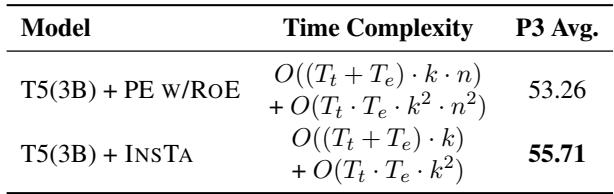
As shown in Table 8, the instruction-based approach eliminates the dependency on \(n\) (number of samples) in the encoding phase. In practice, the authors note that the Pairwise Transfer method took approximately 35 \(\times\) 32 hours. The INSTA alignment training took 5 minutes. This is a massive improvement in resource efficiency.
Experimental Setup
The researchers tested their method on two major instruction tuning benchmarks:
- P3 (Public Pool of Prompts): A dataset used to train the T0 model.
- NIV2 (Super-NaturalInstructions V2): A massive dataset with over 1600 tasks.
They also evaluated on Big-Bench and Big-Bench Hard (BBH) to see if the selected tasks generalized well to difficult, complex reasoning problems.
The statistics of the datasets are summarized below:
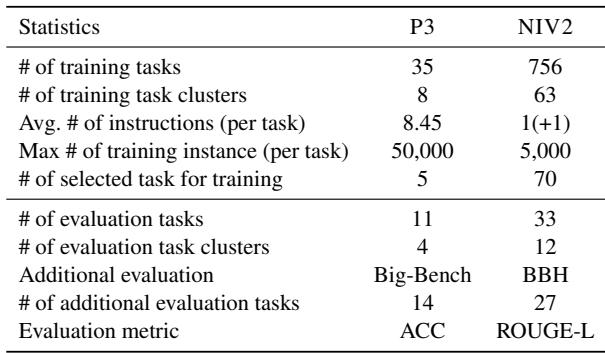
A key detail here is the number of tasks selected for training. For P3, they selected the Top-5 tasks. For NIV2, they selected the Top-70 tasks. This is a tiny fraction of the total available data, yet the hypothesis is that this “specialist” data is more valuable than the whole.
Results: Quality over Quantity
1. P3 Benchmark Results
Let’s look at the performance on the P3 dataset. The authors compared their method (T5 + INSTA) against several baselines:
- T0-3B: Trained on all tasks.
- T5 + Random: Trained on 5 random tasks.
- T5 + Pairwise Transfer: The “brute force” upper bound (theoretically the best possible selection).
- PE w/ RoE: A sample-based selection method (using data examples).
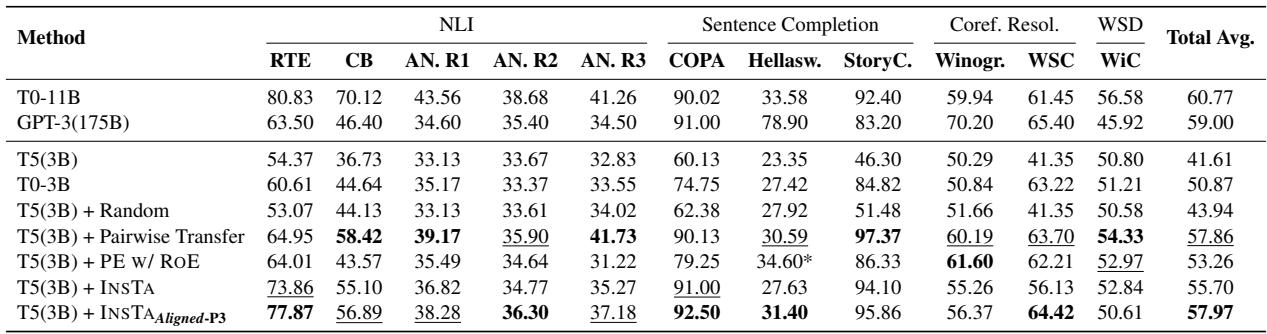
Key Takeaways from Table 2:
- Beating Random: INSTA (55.70%) significantly outperforms Random selection (43.94%). This proves the metric is finding meaningful correlations.
- Beating the Generalist: In many cases, the specialist models (trained on just 5 tasks!) outperform or rival T0-3B (trained on all 35 tasks).
- Beating Sample-Based: Surprisingly, INSTA (55.70%) outperforms the sample-based method PE w/ RoE (53.26%). This suggests that data instances might add noise. Sometimes, specific examples in a dataset can distract the selector, whereas the instruction offers a pure, high-level summary of the goal.
- Rivaling the Oracle: The aligned INSTA model (57.97%) actually performs on par with the Pairwise Transfer method (57.86%), which is considered the “gold standard” but takes weeks to compute.
2. NIV2 Benchmark Results
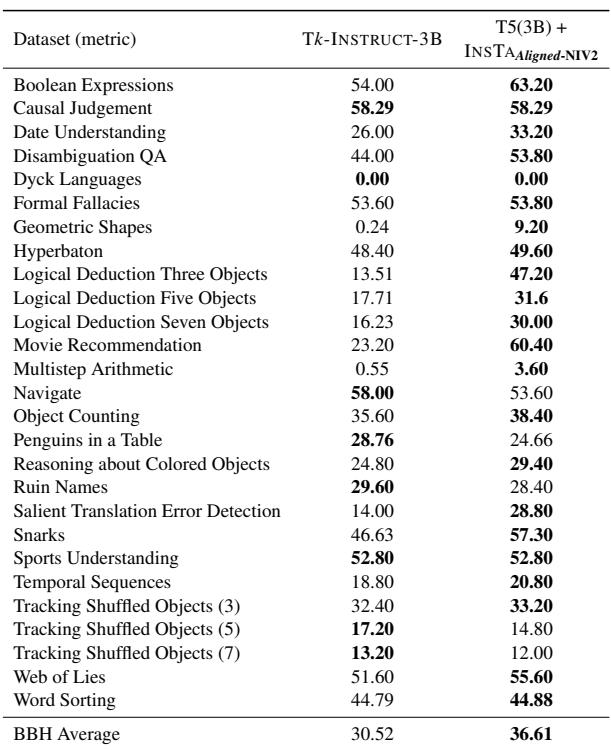
The results on the larger NIV2 dataset are visually striking. The figure below compares the baseline Tk-INSTRUCT (trained on 756 tasks) against T5 + INSTA (trained on only 70 tasks selected by INSTA).
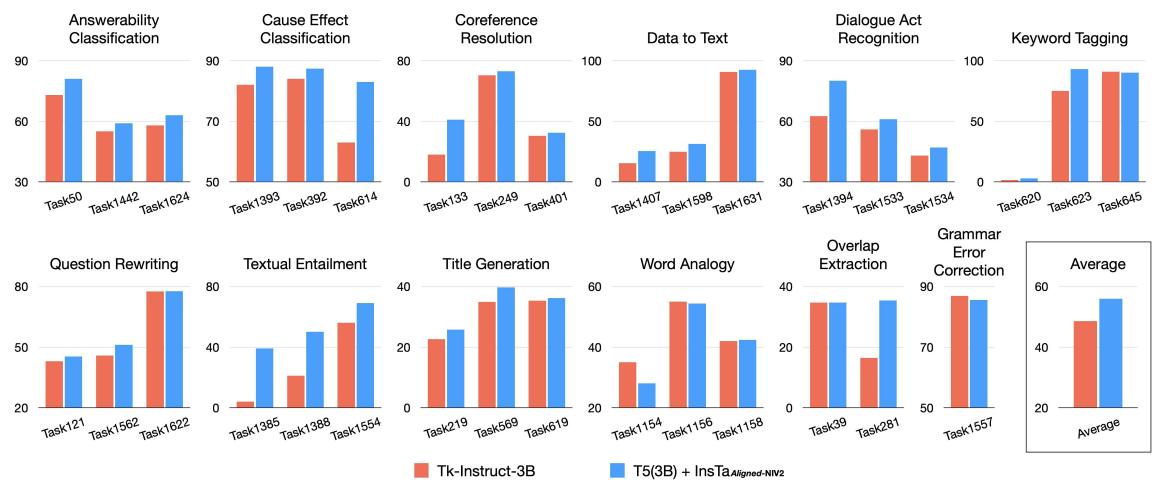
In Figure 1, the blue bars (INSTA) frequently surpass the red bars (Tk-INSTRUCT).
- Look at the “Average” cluster on the bottom right. The INSTA model achieves a higher average score despite using less than 10% of the training data.
- This strongly supports the Negative Transfer hypothesis. Training on the other 686 irrelevant tasks wasn’t just a waste of time—it was actively confusing the model for these specific target tasks.
3. Instruction vs. Data Samples
The paper dedicates a specific analysis to the “Instruction vs. Sample” debate. Is it better to judge a task by its description or its data?
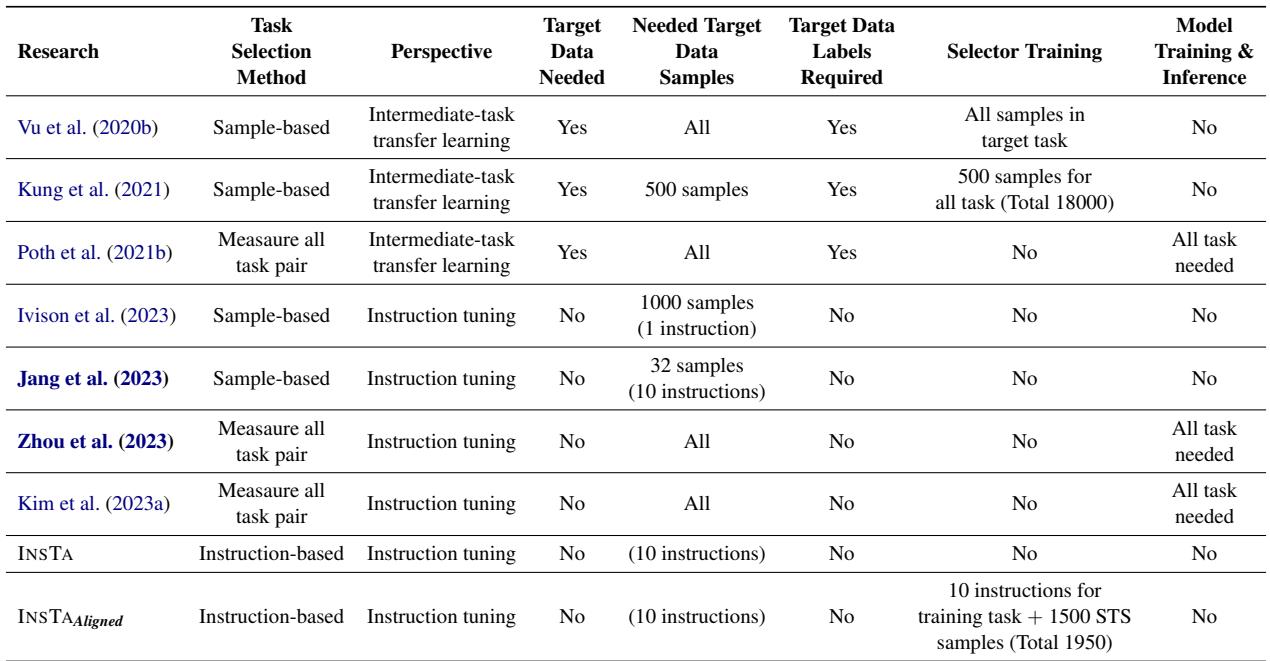
Table 7 highlights the practical differences. Sample-based methods require target data labels or at least raw samples. INSTA requires nothing but the prompt.
Furthermore, Table 5 (below) shows the performance comparison directly.
 (Note: Based on context, the text refers to Table 5 which compares DSTA—Data Sample Task Selector—and INSTA. While the image deck provides a file named 008.jpg, I will rely on the provided image deck file
 images/008.jpg or images/014.jpg if they correspond to this. However, looking at the deck provided in the prompt, let’s look at the P3 results table again or the summary provided in the text. Actually, looking at the file list, images/010.jpg is Table 6, images/012.jpg is Table 7. Let’s use the text analysis for this comparison if the specific table image is missing or ambiguous, but Table 2 (Image 005) already showed PE w/ RoE vs INSTA).
The authors found that data samples sometimes contain “spurious correlations”—patterns that exist in the data but don’t define the task. Instructions, being human-written summaries, are more robust features for retrieval.
The “Sweet Spot”: How Many Tasks?
One of the most interesting analyses in the paper is the “Scaling” of relevant tasks. If we select tasks based on similarity, at what point do we start letting in “bad” tasks?
The authors plotted the model’s performance as they increased \(k\) (the number of selected tasks).
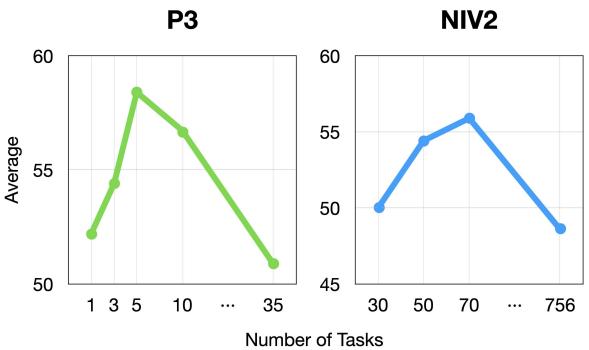
Figure 2 Analysis:
- Left Graph (P3): Performance climbs rapidly as you add the top 1, 3, and 5 tasks. But notice the drop after 5 tasks. If you train on the top 10 or all 35, performance decreases. The “tail” of the distribution contains tasks that are dissimilar enough to cause negative transfer.
- Right Graph (NIV2): A similar trend is observed. Performance peaks around 70 tasks and drops significantly when training on all 756 tasks.
This graph is the “smoking gun” for the specialist approach. It proves that selective training is not just faster; it yields a smarter model.
Practical Implications: Alignment and Instruction Refinement
The authors noted that the quality of the instruction matters. In the P3 dataset, some original instructions contained placeholders that acted as shortcuts or noise.
They performed an experiment filtering and refining these instructions.
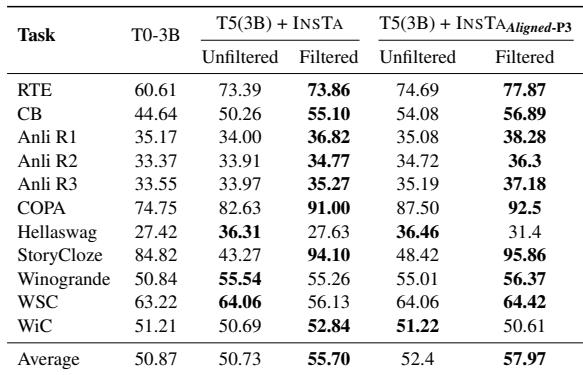
Table 6 shows that refining the instructions (Filtered) and using the Aligned selector leads to the highest performance (57.97%). This highlights a crucial lesson for prompt engineers and ML practitioners: The clarity of your task definition directly impacts your ability to find relevant training data.
Conclusion
The “Optimized Instruction Tuning of Specific Tasks” paper presents a compelling argument for Instruction-based Task Selection (INSTA).
By shifting the focus from data samples to task instructions, the researchers achieved three major wins:
- Efficiency: Task selection takes minutes, not days.
- True Zero-Shot: No need for data samples from the target task.
- Performance: By avoiding negative transfer, specialist models trained on small subsets of data outperformed generalist models trained on massive datasets.
This work suggests that as the number of available datasets continues to explode, the future of LLM training might not be “train on everything,” but rather “train on what matters.” It turns the instruction—usually just a prompt for the model—into a powerful metadata tool for organizing the entire learning process.
For students and practitioners, INSTA offers a practical toolkit: if you have a specific problem to solve, don’t just fine-tune on a random dump of data. Write a clear instruction for your problem, use an embedding model to scan the open-source ecosystem, and curate a high-quality, relevant curriculum for your model.