](https://deep-paper.org/en/paper/2404.18443/images/cover.png)
Introduction
In the rapidly evolving world of Artificial Intelligence, Large Language Models (LLMs) like GPT-4 and Llama have become household names. We generally think of them as generative engines—tools that write poetry, code, or emails. However, in specialized fields like medicine, the ability to generate text is only half the battle. The other half—and perhaps the more critical half for accuracy—is retrieval.
Imagine a doctor needing to find a specific case study regarding a rare side effect of a new drug, or a researcher sifting through millions of papers to find a specific protein interaction. They don’t just need an LLM to hallucinate an answer; they need a system to dig through a massive haystack of medical literature and retrieve the exact needle of truth. This is the foundation of Retrieval-Augmented Generation (RAG).
However, general-purpose retrievers often struggle with the dense, jargon-heavy world of biomedicine. On the other hand, specialized biomedical models are often too small or trained on private data that isn’t accessible to the public.
Enter BMRetriever.
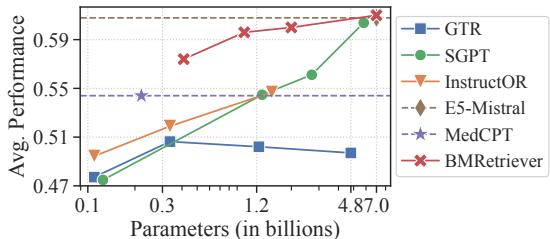
In a recent paper, researchers from Emory University, Georgia Tech, and UCLA introduced BMRetriever, a new family of dense retrievers designed specifically for the biomedical domain. What makes this work standout is its efficiency. As shown in the performance graph below, the smallest version of their model (410M parameters) outperforms general-purpose models that are over 10 times larger.
In this post, we will tear down the architecture of BMRetriever to understand how the authors successfully tuned LLMs to become state-of-the-art biomedical search engines using open-source data and clever synthetic instruction tuning.
Background: The Challenge of Biomedical Retrieval
Before we dive into the solution, we need to understand the problem. Text retrieval usually relies on Dense Retrieval.
In dense retrieval, a model converts a query (e.g., “symptoms of cardiac arrest”) and a document (e.g., a medical paper abstract) into numerical vectors called embeddings. If the model is good, the vector for the query and the vector for the relevant document will be very close to each other in mathematical space.
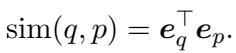
The similarity score between a query (\(q\)) and a passage (\(p\)) is typically calculated using the dot product of their embeddings (\(e_q\) and \(e_p\)):
The Gap in Current Models
There are two main categories of existing models, and neither is perfect for this task:
- BERT-based models: These are specialized for medicine (like BioBERT) but are limited by their small size and older architecture.
- General LLM-based retrievers: These are massive and powerful (like GTR or SGPT) but lack specific medical domain knowledge. They suffer from “distribution shift”—they are great at retrieving Wikipedia articles but stumble when faced with clinical trial reports.
The goal of BMRetriever was to combine the best of both worlds: the power of modern LLMs and the specificity of biomedical training.
The Core Method: A Two-Stage Framework
The authors developed BMRetriever using a family of decoder-only Transformer models (like Pythia, Gemma, and BioMistral) as backbones. They scaled these models from 410 million parameters up to 7 billion parameters.

To transform these generative models into effective retrievers, they employed a two-stage training framework.
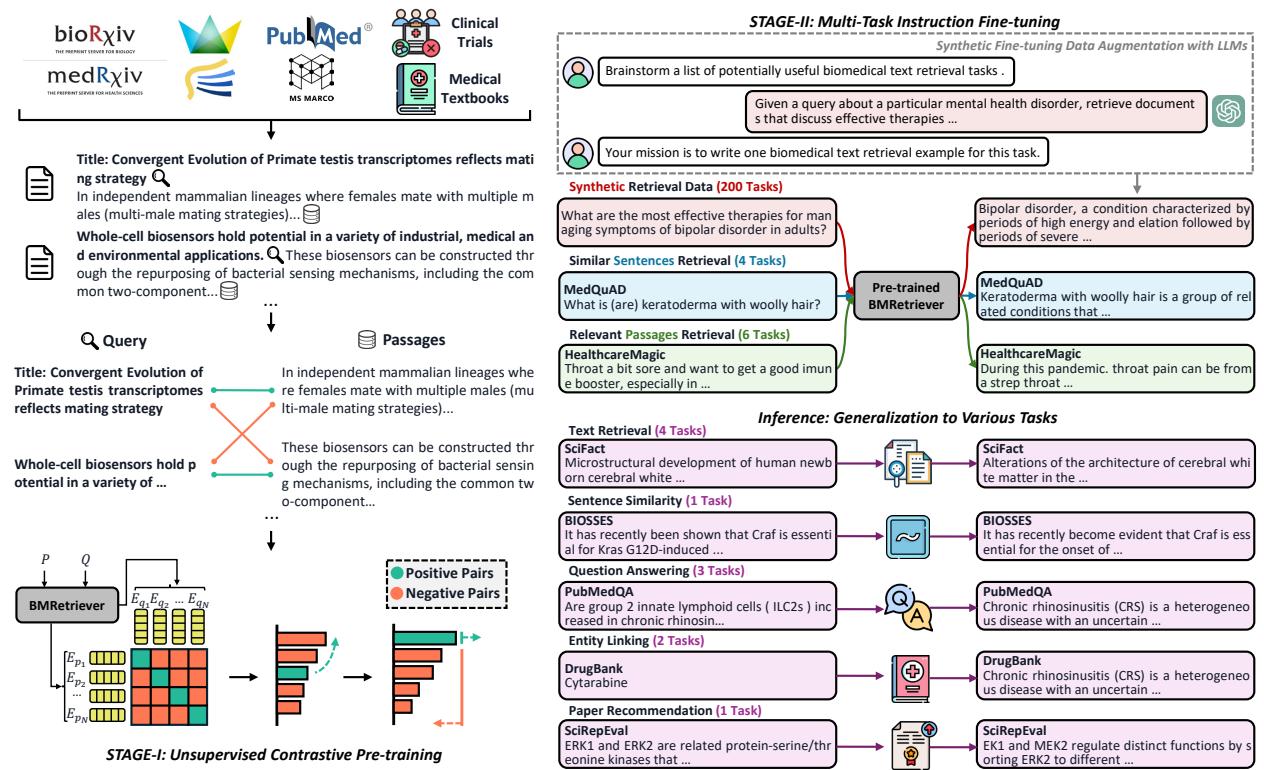
Let’s break down these two stages in detail.
Stage I: Unsupervised Contrastive Pre-training
The first step is teaching the model the “language” of biomedicine. The researchers collected a massive dataset of unlabeled biomedical text, including:
- Biomedical publications (PubMed, bioRxiv)
- Medical textbooks
- Clinical trials
- General web corpus
Since this data is unlabeled (it doesn’t have human-marked “correct answers”), the team used Contrastive Learning. They created pairs of data from the raw text. For example, they might take a paper title as the “query” and the abstract as the “passage.”
The model is trained to recognize that a title and its abstract belong together (positive pair), while other random abstracts in the same batch are unrelated (negative pairs).
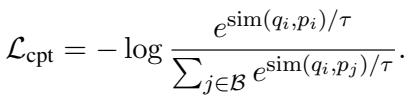
The training objective uses the InfoNCE loss function. This mathematical formula forces the model to maximize the similarity score of the positive pair while minimizing the scores of the in-batch negatives.
By processing millions of these pairs, the model learns the semantic relationships between medical terms without needing a human to manually label anything.
Stage II: Instruction Fine-tuning
Pre-training gives the model domain knowledge, but it doesn’t teach the model how to search based on user intent. A user might ask a question, look for a definition, or try to verify a fact. This requires Instruction Fine-tuning.
The researchers gathered public datasets for tasks like:
- Medical Question Answering (QA)
- Fact Verification
- Entity Linking (e.g., matching a drug name to its description)
However, public biomedical datasets are relatively small and don’t cover every possible retrieval scenario. To solve this, the authors used a clever technique: Synthetic Data Augmentation.
Leveraging GPT-4 for Synthetic Data
They used advanced LLMs (GPT-3.5 and GPT-4) to generate new training data. This happened in two ways:
- Instance-level augmentation: Giving an LLM a medical passage and asking it to write a relevant query for it.
- Task-level augmentation: Asking GPT-4 to brainstorm entirely new types of retrieval tasks and then generate examples for them.
The prompts used for this generation were designed to create diverse and challenging scenarios, ensuring the model wouldn’t just learn simple keyword matching.

Hard Negative Mining
In this stage, simply comparing a query to a random document isn’t hard enough. The model needs to learn to distinguish the correct answer from a plausible but wrong answer.
To do this, they mined Hard Negatives. They used an existing retriever to find top results for a query and selected wrong answers that looked very similar to the query. The Fine-tuning loss function was updated to specifically penalize the model if it ranked these hard negatives too high.
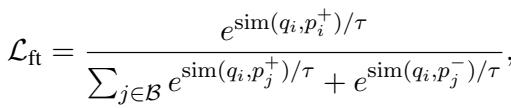
This rigorous training regime ensures that BMRetriever doesn’t just “guess” based on shared words but actually understands the medical nuance required to separate a correct diagnosis from a similar but incorrect one.
Experiments & Results
The team evaluated BMRetriever on 5 tasks across 11 biomedical datasets, covering everything from standard information retrieval to sentence similarity and paper recommendations.
Performance vs. Baselines
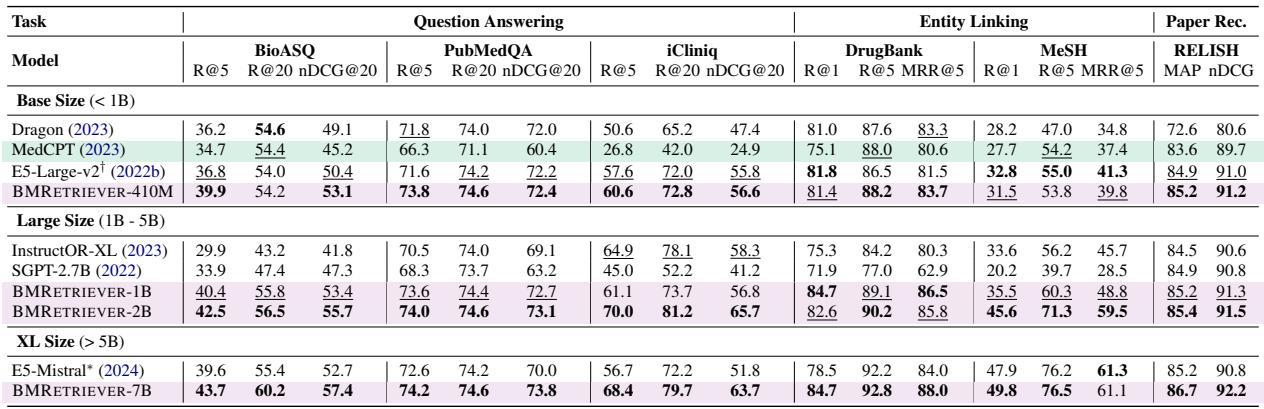
The results were compelling. As seen in the table below, BMRetriever models consistently outperformed or matched baselines that were significantly larger.
- Small but Mighty: The 410M parameter version of BMRetriever outperformed the 4.8B parameter GTR model and the 2.7B SGPT model.
- Scale Efficiency: The 1B variant achieved 98% of the performance of the massive 7B E5-Mistral model while using only 14% of the parameters.
Why does it work better?
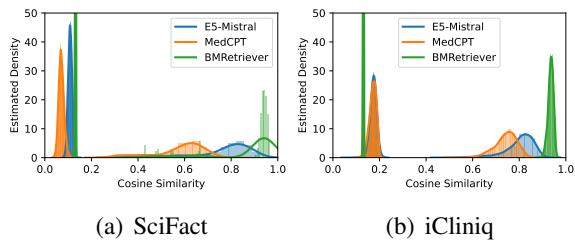
To understand why the model works so well, we can look at the “separation” capabilities of the model. A good retriever should assign very high similarity scores to positive pairs (correct matches) and very low scores to negative pairs.
The density plots below show this separation. The green curve (BMRetriever) shows a sharper distinction between how it handles negatives (left graph) and positives (right graph) compared to other models like MedCPT.
The Power of Synthetic Data
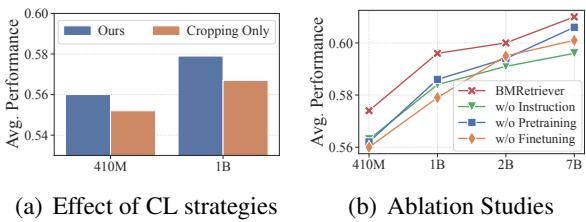
One of the most interesting findings in the paper is the impact of the synthetic data. The researchers performed an ablation study (removing parts of the training data) to see what mattered most.
The results showed that synthetic data contributed the most significant performance gain. This suggests that in specialized domains where labeled data is scarce, using LLMs to generate training data is a highly effective strategy.
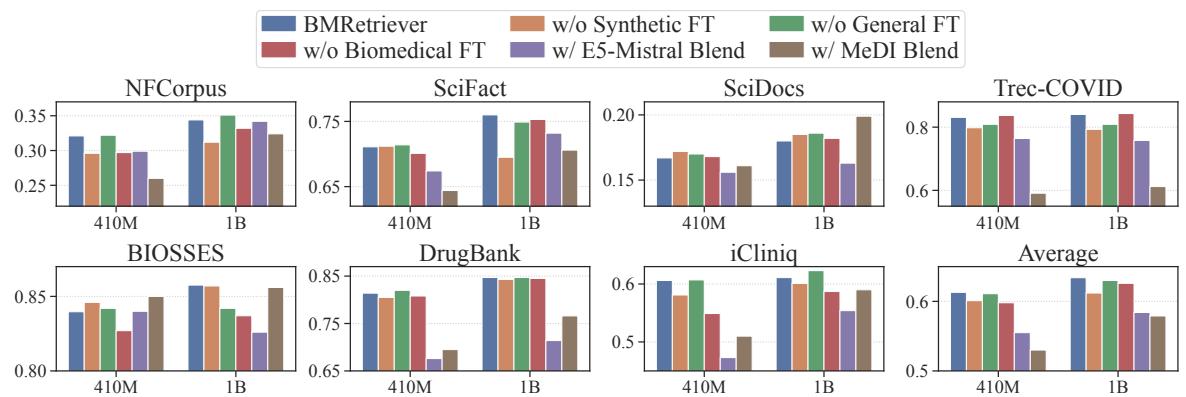
The ablation studies also confirmed that every part of the pipeline—pre-training, fine-tuning, and instructions—was necessary. Removing the pre-training stage (blue line in Figure 4b below) hurt the performance of smaller models significantly, though larger models (7B) were more resilient, likely because they already had some medical knowledge from their original training.
Data Efficiency
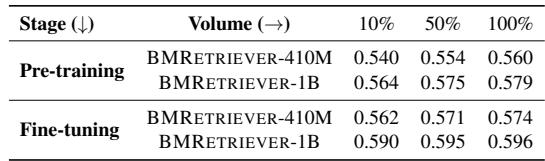
Finally, the researchers highlighted how data-efficient their method is. Even when using only 10% of the pre-training and fine-tuning data, BMRetriever-1B outperformed many baselines that used the full datasets.
Conclusion and Implications
The BMRetriever paper demonstrates a crucial shift in how we approach specialized AI applications. It proves that we don’t necessarily need models with hundreds of billions of parameters to achieve state-of-the-art results in complex fields like medicine.
By carefully combining unsupervised pre-training on open corpora with instruction fine-tuning on high-quality synthetic data, the authors created a model that is both highly accurate and computationally efficient.
Key Takeaways:
- Parameter Efficiency: Domain-specific tuning allows smaller models (410M) to beat generalist giants (4.8B+).
- Synthetic Data is Key: When human-labeled data is scarce, LLM-generated data can bridge the gap effectively.
- Open Science: The authors used public data and released their models, making this a reproducible blueprint for other domains (like law or engineering).
For students and researchers, BMRetriever serves as a case study in “smart scaling”—optimizing the data and the training curriculum is often more valuable than simply increasing the model size. As we move forward, these specialized, efficient retrievers will be the backbone of reliable AI systems in healthcare.