](https://deep-paper.org/en/paper/2404.19441/images/cover.png)
In the age of real-time communication—think Zoom calls, Discord chats, and streaming services—the way we compress audio data is critical. We demand high fidelity, low latency, and minimal data usage. For years, the industry has relied on traditional Digital Signal Processing (DSP) codecs like Opus or MP3. However, recently, Neural Audio Codecs have taken center stage, using deep learning to compress audio far more efficiently than hand-engineered rules ever could.
Most current state-of-the-art neural codecs rely on Convolutional Neural Networks (CNNs). While effective, CNNs have limitations in capturing the long-range dependencies inherent in speech. Today, we are diving into a research paper that challenges this status quo: ESC (Efficient Speech Codec). This work proposes a shift away from CNNs toward Transformers and introduces a novel quantization scheme that changes how we think about compressing audio features.
The Problem with Current Neural Codecs
To understand why ESC is significant, we first need to look at the current landscape. Leading neural codecs, such as Google’s SoundStream or Meta’s EnCodec, generally follow an Autoencoder structure:
- Encoder: Compresses the audio waveform into a dense latent representation.
- Vector Quantizer (VQ): Discretizes this representation (rounds the numbers to the nearest “code” in a codebook) so it can be transmitted as bits.
- Decoder: Reconstructs the audio from these codes.
These systems predominantly use convolutional layers. While CNNs are excellent at detecting local patterns (like the sharp attack of a drum), they struggle to capture “global” redundancy—patterns that span longer durations of time. To compensate for this, existing models often require:
- Adversarial Discriminators: Large, separate neural networks (GANs) trained to judge if the audio sounds “real.” This adds massive complexity to training.
- High Parameter Counts: Increasing the model size to brute-force better quality.
The researchers behind ESC argue that we can do better by changing the fundamental architecture to one that is inherently better at modeling speech: the Transformer.
The Foundation: Vector Quantization (VQ)
Before we dissect the ESC architecture, let’s briefly review the core mechanism of neural compression: Vector Quantization.
In a continuous latent space, a feature vector could be any set of numbers. To transmit this, we need to turn it into a discrete index. We do this using a codebook (\(\mathcal{C}\)), which is a list of learned vectors (codewords). For any input vector \(z_e\), we find the closest codeword \(c_k\) in the codebook and use that instead.
Mathematically, the quantized vector \(z_q\) is selected by minimizing the Euclidean distance:

This process is non-differentiable (you can’t calculate a gradient through an argmin function), so researchers use a “Straight-Through Estimator” to pass gradients during training. They also apply a specific loss function to ensure the encoder outputs stay close to the codebook vectors, and that the codebook vectors move toward the encoder outputs:

The first term updates the codebook, while the second term (weighted by \(\beta\)) ensures the encoder “commits” to the chosen embedding.
The ESC Architecture: A Transformer-Based Approach
The Efficient Speech Codec (ESC) replaces the standard convolutional encoder/decoder with a Swin Transformer backbone.
Why Transformers?
Transformers utilize mechanisms called Self-Attention, which allow the model to weigh the importance of different parts of the input signal relative to each other, regardless of how far apart they are in time. This makes them naturally superior at capturing the long-term dependencies in speech signals. Specifically, ESC uses Swin Transformers (Shifted Window Transformers), which calculate attention within local windows that shift, allowing for both local detail capture and global context awareness with high efficiency.
Input Representation: Complex STFT
Unlike many codecs that operate on the raw waveform (a long list of amplitude numbers), ESC operates on the Complex Short-Time Fourier Transform (STFT).
The input audio is transformed into a spectrogram \(\mathcal{X}\), containing real and imaginary parts. This frequency-domain representation is often more intuitive for speech analysis than raw time-domain waveforms.

The system breaks this spectrogram into small “patches,” essentially treating the audio spectrogram like an image.
The Full Pipeline
Below is the complete architecture of ESC. Notice the symmetry: the top half is the Encoder, and the bottom half is the Decoder.
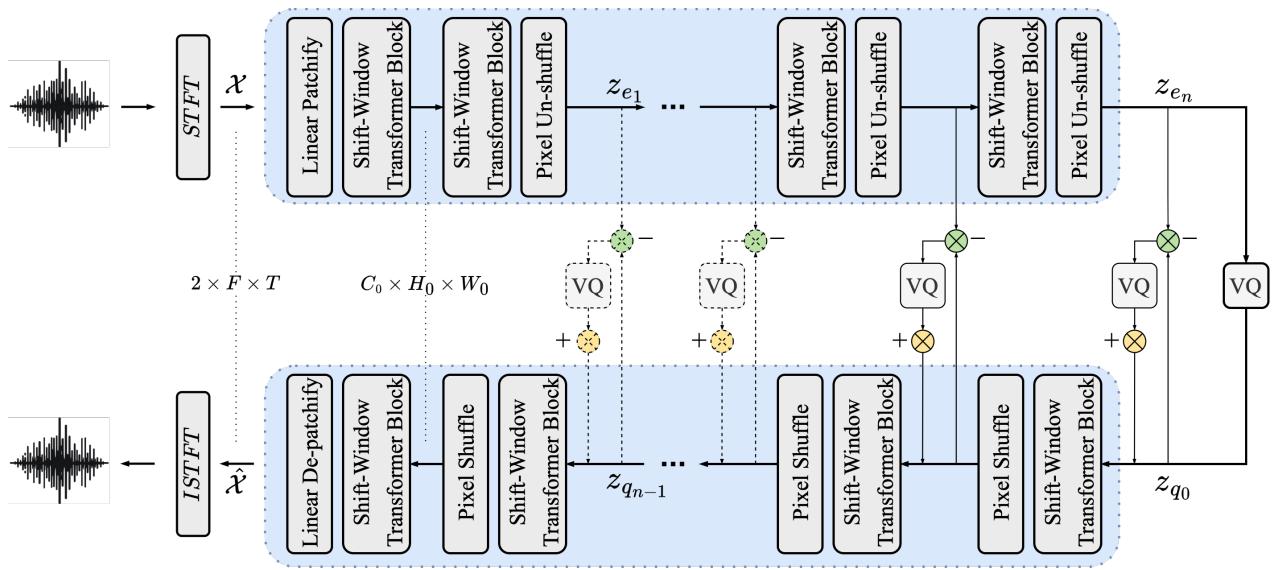
The architecture functions in a U-Net-like shape:
- Downsampling (Encoder): The transformer blocks process the audio patches, progressively reducing the frequency resolution (halving it at each stage) while increasing the feature depth.
- Bottleneck: At the most compressed point, the features are quantized.
- Upsampling (Decoder): The decoder recovers the resolution.
A key innovation here is how the dimensions are handled. Instead of standard pooling, ESC uses Pixel Unshuffle/Shuffle operations to trade frequency resolution for channel depth without losing information.
Downsampling Logic:

Upsampling Logic:

The “Special Sauce”: Cross-Scale Residual Vector Quantization (CS-RVQ)
The most critical innovation in ESC is not just using transformers, but how it handles quantization.
Standard codecs use Residual Vector Quantization (RVQ). In RVQ, you quantize the vector, calculate the error (residual), quantize the error, calculate the new error, and so on. This usually happens entirely at the bottleneck—the lowest resolution point.
ESC argues that quantizing only at the bottleneck ignores the fine-grained details present in earlier layers. Instead, they implement Cross-Scale RVQ (CS-RVQ).
How CS-RVQ Works
Refer back to Figure 1. You will see connections (arrows) flowing from the encoder to the decoder at different stages, not just the middle.
- Coarse Quantization: The system first quantizes the features at the lowest bottleneck resolution.
- Step-wise Decoding: The decoder starts reconstructing.
- Fine Quantization: As the decoder upsamples to a higher resolution, it looks at the corresponding layer in the encoder. It calculates the residual (difference) between the encoder’s features and the current decoder features.
- Refinement: This residual is quantized and added to the decoder stream.
This means the codec transmits information from coarse-to-fine. The bottleneck carries the “gist” of the audio, while the higher-resolution layers transmit the specific details needed to reconstruct high-frequencies perfectly.
Solving Codebook Collapse
A major headache in training VQ-based networks is Codebook Collapse. This happens when the model effectively “gives up” on most of the codes in its codebook, utilizing only a tiny fraction of the available capacity. This results in wasted bitrate and lower quality.
ESC tackles this with three specific techniques:
1. Product Vector Quantization (PVQ)
Instead of quantizing one giant vector against one giant codebook, ESC splits the vector into smaller sub-vectors. Each sub-vector is quantized independently. This effectively increases the combinatorial diversity of the codes.
2. Factorization and Normalization
To make the nearest-neighbor search more stable, ESC projects the vectors into a lower-dimensional space and normalizes them before quantization.
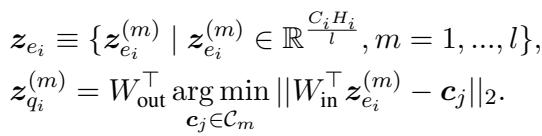
Here, \(W_{in}\) and \(W_{out}\) project the vector down and up, and the distance is calculated in a normalized space. This ensures that all codewords lie on a sphere, making them easier to utilize evenly.
3. The Pre-training Paradigm
This is a simple yet brilliant optimization trick. Training a Transformer and a Quantizer simultaneously is unstable because the Quantizer introduces sudden jumps in the signal (discretization error).
The authors propose a Pre-training Warm-start:
- Phase 1: Deactivate the VQ layers. Train the Encoder and Decoder as a standard continuous Autoencoder. This allows the Transformer layers to learn how to represent speech features without the noise of quantization.
- Phase 2: Turn on the VQ layers and train the whole system.
Because the encoder already outputs high-quality features, the codebook adapts quickly, preventing collapse.
Experiments and Results
The researchers compared ESC against DAC (Descript Audio Codec), widely considered the current state-of-the-art. They tested three versions of ESC:
- ESC-Base (Non-Adversarial): No GAN discriminator used.
- ESC-Base (Adversarial): Uses a discriminator (similar to DAC).
- ESC-Large: A deeper version of the model.
Reconstruction Quality
The results, shown in Figure 2, are telling.
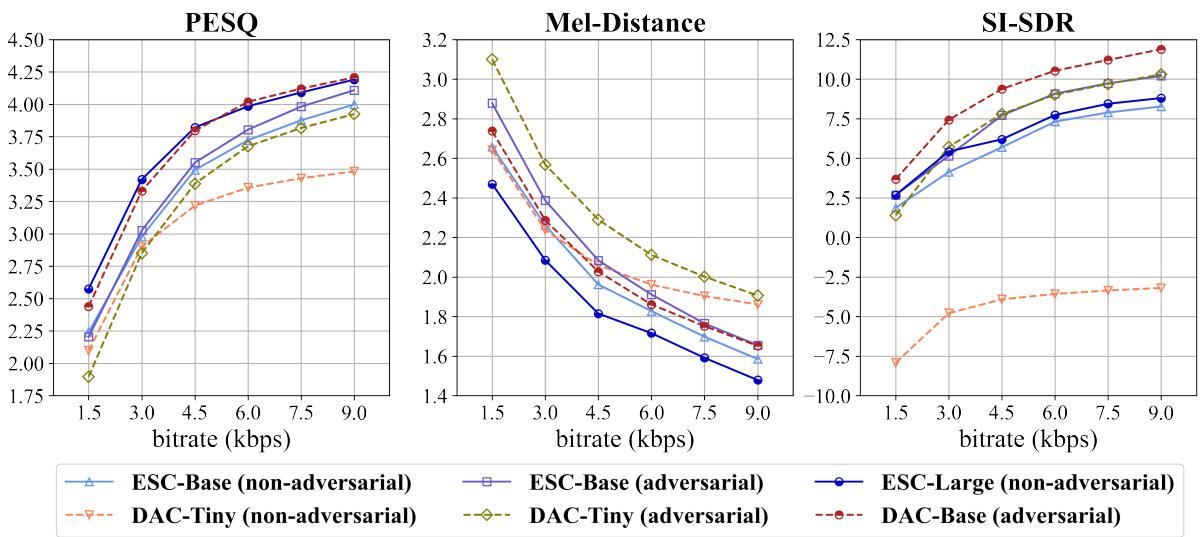
- PESQ (Perceptual Evaluation of Speech Quality): Higher is better. The solid purple line (ESC-Base Adversarial) outperforms the corresponding DAC models. Even the non-adversarial ESC (blue line) is highly competitive.
- Mel-Distance: Lower is better. This measures how spectrally accurate the reconstruction is. ESC consistently achieves lower distance than DAC-Tiny.
Key Takeaway: ESC-Base (Non-Adversarial) beats DAC-Tiny (Non-Adversarial) by a massive margin. DAC requires a discriminator to work well; ESC produces high-quality audio simply because its architecture (Transformers + CS-RVQ) is better at modeling the signal.
Ablation Studies: What Matters Most?
To prove that the specific components (Transformers and CS-RVQ) are the reason for the success, the authors ran ablation studies.
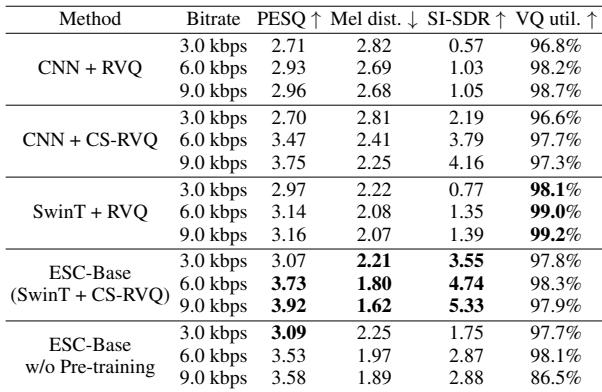
Looking at Table 2, we can draw two conclusions:
- Transformers > CNNs: Comparing “SwinT + RVQ” against “CNN + RVQ” shows that simply swapping the CNN for a Transformer improves PESQ and SI-SDR.
- CS-RVQ > RVQ: Comparing “CNN + CS-RVQ” against “CNN + RVQ” shows that the Cross-Scale quantization scheme significantly boosts performance, regardless of the backbone.
When you combine both (SwinT + CS-RVQ), you get the best performance (the ESC-Base rows).
Conclusion
The ESC paper presents a compelling argument for the future of audio compression. By moving from Convolutional networks to Transformers, the model captures the complex, long-range dependencies of speech more effectively. Furthermore, by utilizing Cross-Scale Residual Vector Quantization, it ensures that both coarse structures and fine details are preserved efficiently.
Perhaps the most exciting implication is the reduced reliance on adversarial training. While discriminators (GANs) can push quality higher, they are notoriously difficult to tune and train. ESC demonstrates that with a stronger fundamental architecture, we can achieve high-fidelity speech coding without necessarily relying on the “hallucination” capabilities of a GAN. This paves the way for more stable, efficient, and scalable speech foundation models in the future.