](https://deep-paper.org/en/paper/2405.03000/images/cover.png)
The integration of Large Language Models (LLMs) into the biomedical domain holds immense promise, from assisting in complex diagnoses to automating clinical note-taking. However, a significant barrier stands in the way of widespread adoption: the “resource-privacy-performance” trilemma.
On one hand, we have massive Black-Box LLMs (like GPT-4) that offer state-of-the-art reasoning but come with high costs and severe privacy risks when patient data is involved. On the other hand, we have White-Box LLMs (like LLaMA-2) that can be run locally and privately, but often struggle to match the reasoning capabilities of their larger counterparts, even after expensive fine-tuning.
How do we reconcile these limitations? How can medical institutions adapt powerful models to their specific needs without uploading sensitive data to a third-party cloud or spending a fortune on GPU clusters?
In this post, we will explore MedAdapter, a novel framework proposed by researchers from Georgia Tech and Emory University. MedAdapter offers a unified, efficient solution for adapting both white-box and black-box LLMs to medical reasoning tasks. By the end of this article, you will understand how training a small, BERT-sized adapter can significantly boost the performance of massive LLMs at a fraction of the cost.
The Problem: The Performance and Privacy Gap
To understand why MedAdapter is necessary, we must first look at the current landscape of biomedical NLP.
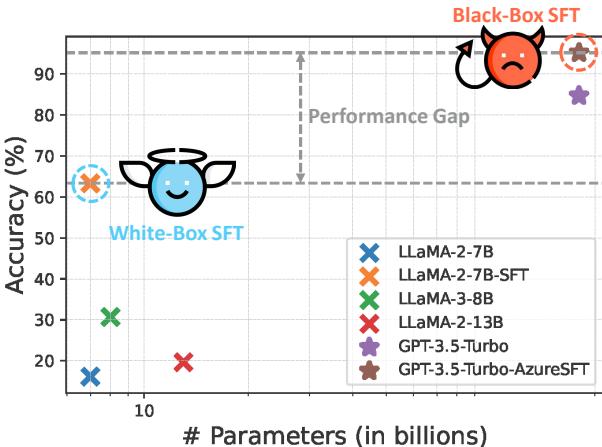
As shown in Figure 1, there is a distinct performance gap between open-source models and proprietary giants. The orange and green markers represent white-box models (like LLaMA-2 and LLaMA-3). Even when fine-tuned, they often lag behind the “Black-Box” models (represented by stars, like GPT-3.5-Turbo).
This creates a dilemma for medical researchers:
- Use Black-Box Models: You get high accuracy, but you cannot access the weights. Fine-tuning these via APIs (like OpenAI’s fine-tuning service) requires uploading training data. In healthcare, uploading patient data to a third-party server is often a non-starter due to HIPAA regulations and privacy concerns. Furthermore, it is incredibly expensive.
- Use White-Box Models: You keep data local and private, but the performance is lower. To improve it, you must fine-tune the model yourself, which requires substantial computational resources (high-end GPUs) that many academic and medical centers lack.
MedAdapter was born from the need to find a “third way”—a method to adapt these models efficiently, cheaply, and privately.
MedAdapter: A Unified Post-Hoc Adapter
The core insight of MedAdapter is that we do not need to retrain the massive “brain” of the LLM to adapt it to a new domain. Instead, we can treat the LLM as a generator of possibilities and train a small, specialized “critic” to select the best answer.
MedAdapter is a Test-Time Adaptation technique. It fine-tunes a lightweight adapter (specifically, a BERT-sized model with only ~110 million parameters) to rank candidate solutions generated by the backbone LLM.
The Architecture
The workflow of MedAdapter is elegant in its simplicity. It separates the generation of ideas from the evaluation of those ideas.
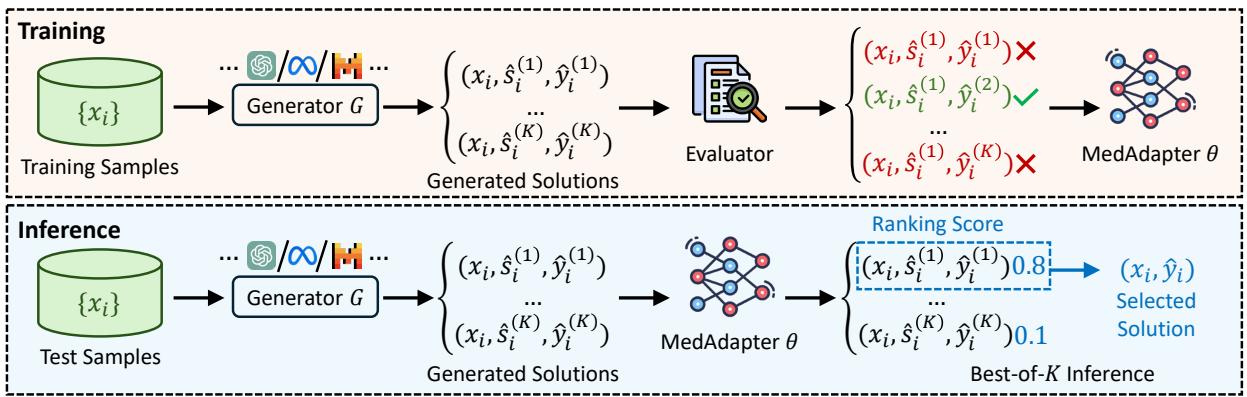
As illustrated in Figure 2, the process consists of two distinct phases:
- Training Phase (Top):
- We take a training dataset of medical questions.
- We ask the LLM (Generator \(G\)) to generate multiple candidate solutions for each question.
- We compare these solutions against the ground truth to label them as “correct” or “incorrect.”
- We train the MedAdapter (\(\theta\)) to predict these labels.
- Inference Phase (Bottom):
- We give the LLM a new, unseen medical question.
- The LLM generates \(K\) different potential reasoning paths and answers.
- The MedAdapter scores each candidate.
- We select the candidate with the highest score as the final answer.
This architecture allows the system to utilize the generative creativity of Large Language Models while enforcing domain-specific accuracy through the Adapter.
Deep Dive: The Core Method
Let’s break down the mathematical formulation of how MedAdapter works. This section is crucial for understanding how the system learns to differentiate between good and bad medical reasoning.
1. Candidate Solution Generation
First, we need data to train our adapter. We start with a source LLM, denoted as \(G\). For every question input \(x_i\) in our training set, we prompt \(G\) to generate \(k\) different solutions. These solutions usually include a “Chain-of-Thought” (reasoning steps) followed by a final answer.
For each generated solution \(\hat{y}_{i,j}\), we assign a correctness label \(z_i\). This is a binary label: 1 if the generated answer matches the ground truth \(y_i\), and 0 otherwise.

This process creates a new dataset specifically for the adapter, denoted as \(\mathcal{D}_{\mathrm{ada}}\). This dataset consists of pairs of (Input + Generated Solution) and their corresponding (Correct/Incorrect) labels.

Here, \(\mathbf{h}_{i,j}\) represents the concatenation of the original medical question and the generated candidate solution. This is what the adapter will read.
2. Training the Outcome-Supervised Adapter
The adapter is a standard encoder model (like BERT or Longformer). Its job is to look at the reasoning produced by the LLM and output a probability score representing how likely it is that the reasoning leads to the correct medical conclusion.
The authors found that treating this as a binary classification problem worked best. The adapter is trained to minimize the following loss function:

In this equation:
- \(z\) is the ground truth binary label (Is this candidate correct?).
- \(V_{\theta}(\mathbf{h})\) is the score (probability) output by the MedAdapter.
- The loss function penalizes the adapter if it gives a low score to a correct answer or a high score to an incorrect one.
This is distinct from other methods like Reinforcement Learning from Human Feedback (RLHF) which might use pairwise ranking loss. The researchers found that this direct classification objective was more stable and effective for this specific use case.
3. Best-of-K Inference
Once the adapter is trained, we can deploy it. During test time (inference), we are given a question \(x_i\) where we don’t know the answer.
We ask the LLM to generate \(K\) candidate solutions. Then, we feed all of them into MedAdapter. MedAdapter assigns a score \(r_{\theta}\) to each one. We simply pick the one with the maximum score:

This technique effectively filters out “hallucinations” or incorrect reasoning paths that the LLM might drift into, strictly selecting the reasoning that aligns with the medical domain knowledge the adapter learned during training.
Why is this efficient?
The beauty of this approach lies in the Parameter Efficiency.
If you were to fine-tune LLaMA-2-7B using standard Supervised Fine-Tuning (SFT), you would be updating billions of parameters. Even using LoRA (Low-Rank Adaptation), you are managing a large model in memory.
MedAdapter, however, uses a model with only 110 Million parameters (Longformer-Base). This is roughly 1.5% of the size of a 7B parameter model.
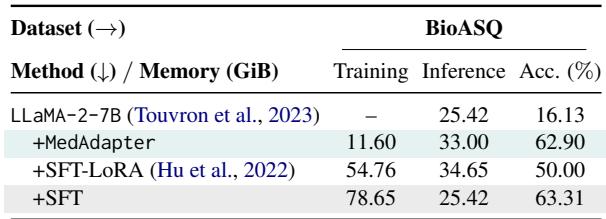
Table 4 highlights this efficiency. Using MedAdapter requires significantly less GPU memory for training (11.60 GiB) compared to full SFT (78.65 GiB) or even LoRA (54.76 GiB). This allows medical labs with modest hardware to perform high-quality domain adaptation.
Experimental Results
The researchers evaluated MedAdapter across four biomedical tasks and eight datasets, including MedQA (USMLE questions), PubMedQA, and BioASQ. The results were compelling for both white-box and black-box scenarios.
Performance on Biomedical QA
The main takeaway is that MedAdapter consistently improves performance.
- White-Box: It improved LLaMA-2-7B accuracy by an average of 18.24%.
- Black-Box: It improved GPT-3.5-Turbo accuracy by 10.96%.
Crucially, MedAdapter often matched or outperformed expensive API-based fine-tuning. For example, on the BioASQ dataset, GPT-3.5 with MedAdapter achieved 93.55% accuracy, comparable to the Azure SFT performance of 95.16%, but at a fraction of the cost and with better privacy.
Cost Effectiveness
One of the strongest arguments for MedAdapter is financial. Fine-tuning a model like GPT-3.5 via Microsoft Azure or OpenAI is billed by the token and can become incredibly expensive for large datasets.

Table 3 shows a stark contrast. For the MedQA dataset:
- Azure-SFT Cost: ~$172.85 for training.
- MedAdapter Cost: ~$42.57 for training.
This represents a cost reduction of roughly 75%. Since MedAdapter runs locally, you avoid the high premium of “hosting” fine-tuned models on cloud platforms.
Label Efficiency
Another common bottleneck in medical AI is the lack of labeled data. Annotating medical questions requires board-certified doctors, which is expensive.
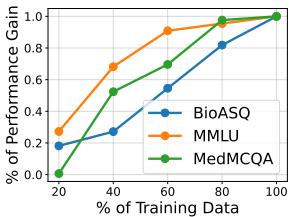
Figure 4 demonstrates that MedAdapter is remarkably label-efficient. It achieves significant performance gains (the “knee” of the curve) using only 40% to 60% of the available training data. This suggests that institutions don’t need massive datasets to build an effective adapter—a moderate, high-quality dataset is sufficient.
Scaling Analysis
An interesting finding in the paper is the “Scale-up Analysis.” One might assume that using a larger model for the Adapter (e.g., upgrading from 110M to 2.7B parameters) would yield better results.
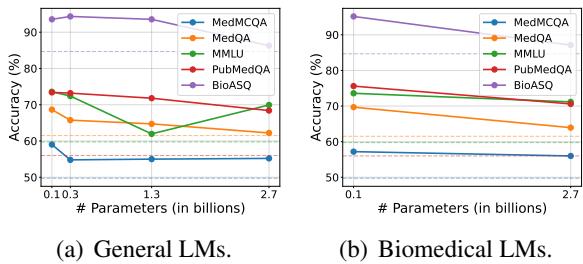
However, Figure 3 shows that performance plateaus relatively quickly. The lines are mostly flat, indicating that a small, 110M parameter model is sufficient for the task of ranking solutions. This is excellent news for deployment, as it confirms we don’t need to waste resources on a massive adapter.
Combining Approaches: A Complementary Solution
MedAdapter isn’t mutually exclusive with other adaptation methods. In fact, the researchers found that it works best as a complementary tool.
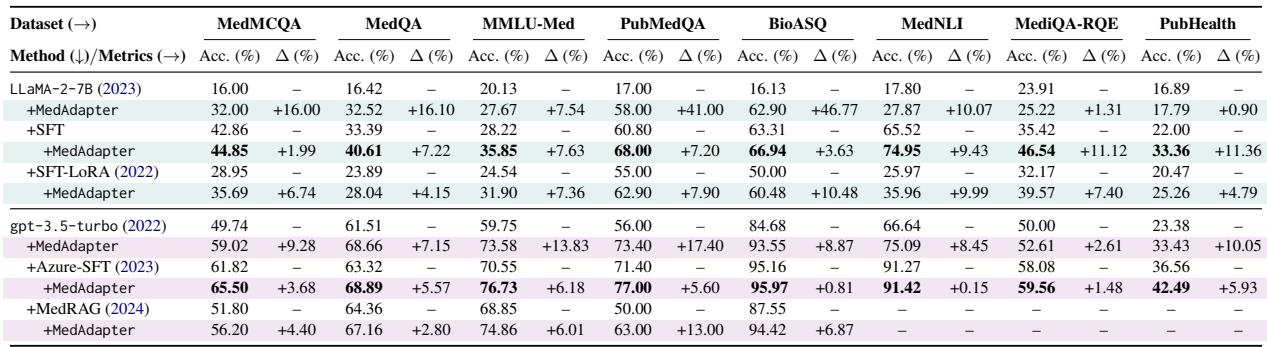
As shown in Table 2, applying MedAdapter on top of other methods yields the highest scores.
- SFT alone on LLaMA-2 gives 33.39% on MedQA.
- SFT + MedAdapter jumps to 40.61%.
This flexibility allows researchers to plug MedAdapter into existing pipelines (like RAG or LoRA) to squeeze out extra performance gains.
Conclusion and Implications
MedAdapter represents a pragmatic shift in how we approach domain adaptation for Large Language Models. Rather than trying to force the entire LLM to “learn” medicine by updating its billions of weights, MedAdapter accepts the LLM as a powerful inference engine and simply guides it toward the correct path using a lightweight supervisor.
Key Takeaways:
- Privacy: By training the adapter locally, you avoid sending training datasets to third-party APIs for fine-tuning.
- Cost: It drastically reduces training and inference costs compared to commercial fine-tuning services.
- Efficiency: It achieves competitive results using only ~1.5% of the memory required for full fine-tuning.
- Universality: It works for both open-source (White-Box) and proprietary (Black-Box) models.
For students and researchers entering the field, MedAdapter serves as a powerful example of system-level AI design. Sometimes, the solution isn’t a bigger model, but a smarter architecture that leverages the strengths of different components efficiently. As we move toward more specialized AI applications in healthcare, efficient and privacy-preserving tools like MedAdapter will be essential in bridging the gap between cutting-edge research and clinical reality.