](https://deep-paper.org/en/paper/2405.08719/images/cover.png)
In modern science and engineering, we have moved away from modeling phenomena with a few hand-written equations. Instead, we rely on complex, stochastic computer simulations. From predicting climate change to modeling the cardiovascular system, these simulators allow us to describe intricate processes that defy simple analytical solutions.
However, this reliance on simulation introduces a critical problem. We often use these simulators to solve the inverse problem: given a real-world observation (data), what were the physical parameters that generated it? This is the domain of Simulation-Based Inference (SBI).
SBI works beautifully when the simulator is a perfect reflection of reality. But in the real world, “all models are wrong, but some are useful.” Simulators are approximations. They simplify physics, ignore variables, or make incorrect assumptions. This discrepancy is known as model misspecification. When we use a misspecified simulator to infer parameters from real-world data, the results can be disastrously wrong—biased estimates and dangerously overconfident predictions.
In this post, we explore a new framework called Robust Posterior Estimation (RoPE). This method acknowledges that simulators are imperfect and uses a small set of real-world “calibration data” to bridge the gap between simulation and reality. By leveraging Optimal Transport (OT), RoPE learns the relationship between the simulated world and the real world, allowing us to trust our inferences even when the simulator is flawed.
The Problem: When Simulations Lie
To understand RoPE, we first need to define the standard SBI setup and where it breaks down.
Simulation-Based Inference (SBI)
In a standard SBI setting, we have a simulator \(S\) that takes in physical parameters \(\theta\) (like the stiffness of an artery or the rate of infection) and a source of randomness \(\varepsilon\) to produce a simulated observation \(\mathbf{x}_s\).
\[ \mathbf{x}_s = S(\theta, \varepsilon) \]Our goal is to estimate the posterior distribution \(p(\theta | \mathbf{x}_o)\). This distribution tells us the probable values of the parameters \(\theta\) given a specific real-world observation \(\mathbf{x}_o\). Because the simulator is complex, we cannot write down the likelihood function \(p(\mathbf{x}|\theta)\) directly. Instead, methods like Neural Posterior Estimation (NPE) train neural networks to approximate this distribution by generating millions of \((\theta, \mathbf{x}_s)\) pairs from the simulator.

The equation above shows the standard objective for NPE: maximizing the log-probability of the true parameters given the simulated data. If successful, we get a neural network that acts as a surrogate for the posterior.
The Misspecification Gap
Here lies the trap. NPE learns \(p(\theta | \mathbf{x}_s)\). It becomes an expert at interpreting simulated data. However, if the real-world data \(\mathbf{x}_o\) comes from a distribution that is slightly different from \(\mathbf{x}_s\) due to simplified physics or measurement noise, the neural network might fail.
We say a simulator is misspecified if the posterior derived from the simulator does not match the true posterior of the real-world data.

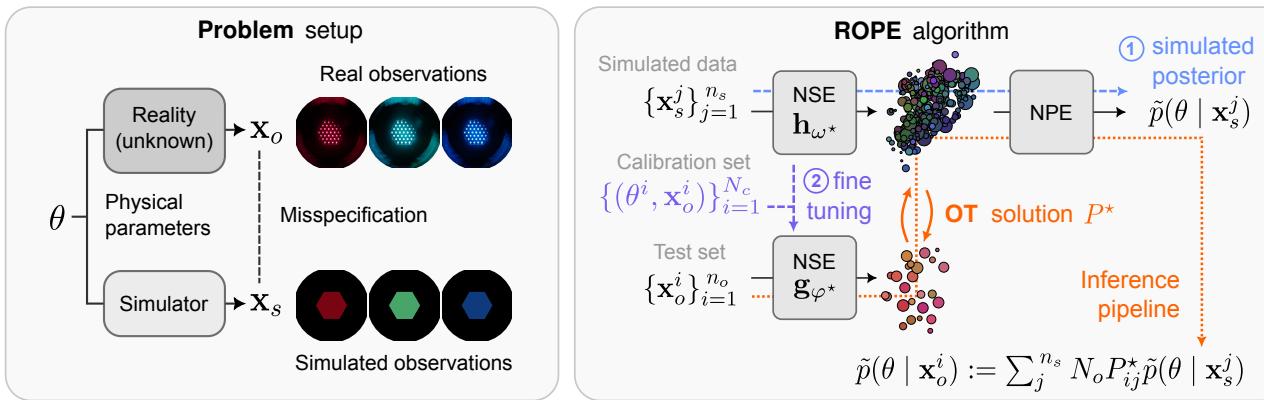
As shown in the left panel of Figure 4 below, there is a divergence between the “Reality” path and the “Simulator” path. If we blindly apply the inference trained on the bottom path to the data from the top path, our results will be invalid.
The Solution: Robust Posterior Estimation (RoPE)
The researchers propose RoPE to handle this specific scenario. The method is designed for cases where:
- We have a simulator (even a flawed one).
- We have a calibration set: a small dataset of real-world observations paired with their ground-truth parameters.
The core insight of RoPE is to treat misspecification as a geometry problem. We have two “clouds” of data: the simulated data points and the real-world data points. Even if they don’t overlap perfectly in the data space, they share the same underlying physics (the parameters \(\theta\)). RoPE uses Optimal Transport to build a bridge between these two clouds.
The Modeling Assumption
RoPE relies on a specific conditional independence assumption to make the math tractable:
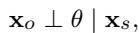
This implies that if we know the simulated observation \(\mathbf{x}_s\) that corresponds to a real observation \(\mathbf{x}_o\), the real observation itself provides no additional information about \(\theta\). In other words, the simulator—despite being imperfect—captures all the relevant physical relationships between parameters and observations. The “misspecification” is just a distortion of the observation, not a fundamental break in the link between parameter and data.
Under this assumption, the posterior for real-world data can be written as:

Here, \(p(\theta | \mathbf{x}_s)\) is the posterior we get from our simulator (using standard NPE), and \(\pi^\star(\mathbf{x}_s | \mathbf{x}_o)\) is the misspecification model. This term answers the question: Given a real-world observation, which simulated observations is it most related to?
Step 1: Learning a Shared Representation
Before we can link real and simulated data, we need to look at them through the same lens. Raw data (like images or time series) might be too complex or noisy to compare directly.
RoPE first trains a neural statistic estimator (NSE), denoted as \(h_\omega\), on the simulated data. This network compresses high-dimensional simulations into a compact vector (summary statistics).
However, because the simulator is misspecified, this network might look for features that exist in simulations but not in reality. To fix this, RoPE fine-tunes this network using the small calibration set. It adjusts the weights so that the representation of a real observation \(\mathbf{g}_\varphi(\mathbf{x}_o)\) is close to the expected representation of simulated observations generated by the same parameters.

This step ensures that the “language” used to describe real and simulated data is consistent.
Step 2: Optimal Transport (The Coupling)
This is the heart of the RoPE method. We have a set of real observations (from our test or calibration set) and a set of simulated observations. We want to define a “coupling” or a map between them.
RoPE formulates this as an Optimal Transport (OT) problem. Imagine the real data is a pile of earth and the simulated data is a set of holes. We want to move the earth into the holes with the least amount of effort. The “effort” or cost is defined by the distance between their representations (learned in Step 1).

Specifically, RoPE solves for a transport matrix \(P^\star\).
- Cost (\(C\)): The Euclidean distance between the neural representations of simulated and real data.
- Constraints: The method uses semi-balanced OT. This ensures that every real observation is matched to something, but allows the method to ignore simulated observations that don’t look like reality.
- Regularization (\(\gamma\)): An entropic regularization term is added. This encourages the transport plan to be “fuzzy” rather than a hard one-to-one mapping. This fuzziness is crucial—it prevents the model from being overconfident by spreading the probability mass over multiple similar simulations.

Step 3: The Robust Posterior
Once the transport matrix \(P^\star\) is computed, estimating the parameter \(\theta\) for a new real-world observation \(\mathbf{x}_o^i\) becomes a weighted average.
For a specific real observation, we look at which simulated observations it is coupled with (via \(P^\star\)). We take the posteriors of those simulations and average them, weighted by the transport probability.
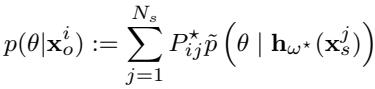
This equation effectively says: “The posterior for this real image is a mixture of the posteriors of the 50 simulated images that look most like it.”
Experimental Results
Does RoPE actually work? The authors tested the framework on several benchmarks, ranging from synthetic mathematical problems to real-world physics experiments.
The Benchmarks
Two standout benchmarks involve real physical systems:
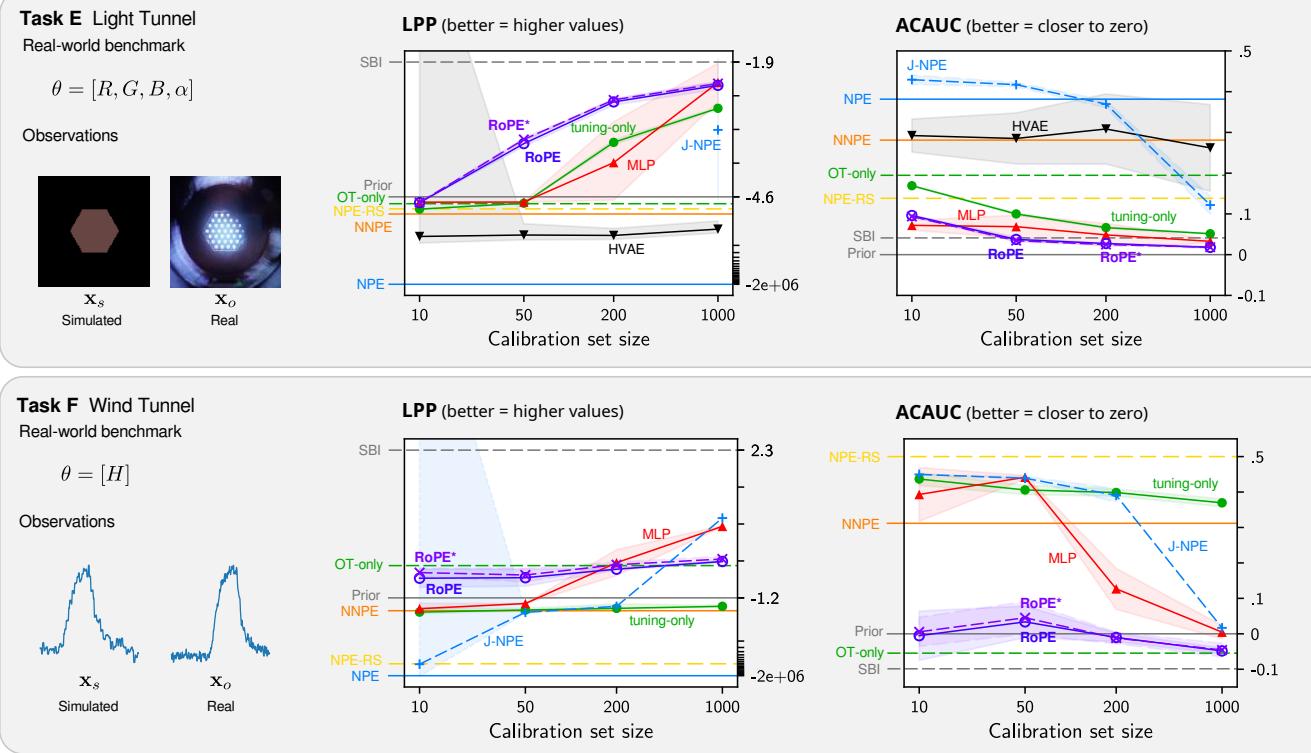
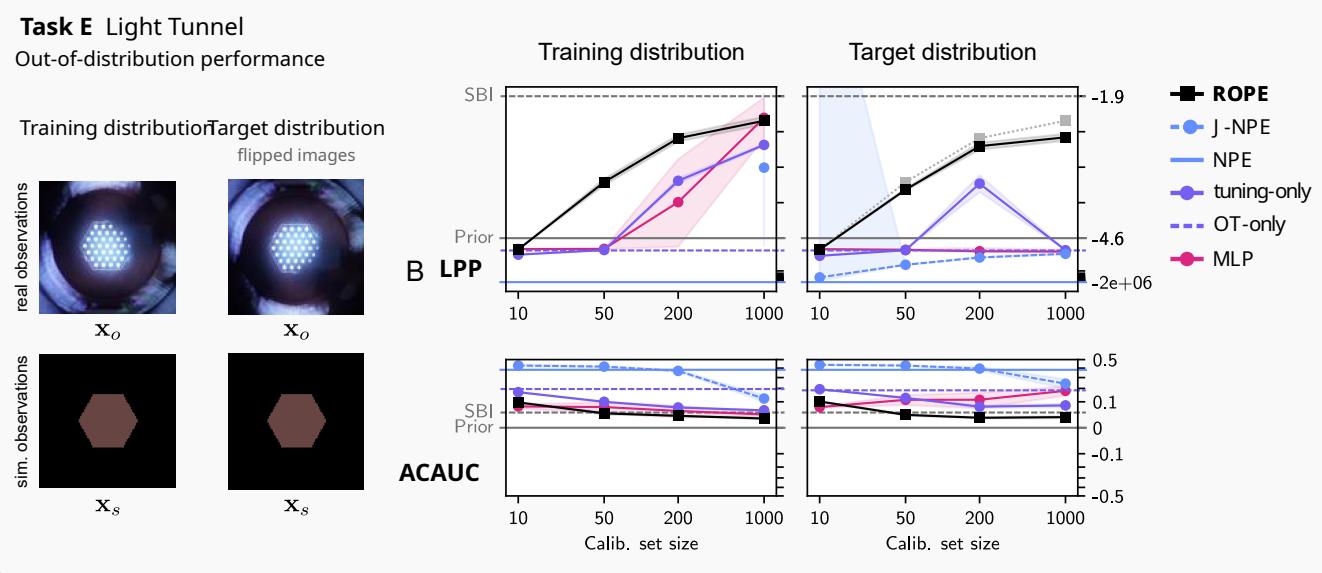
- Light Tunnel (Task E): Inferring the color settings of a light source and polarizer angles from an image. The simulator is a simplified rendering engine that produces hexagonal blobs, while the real data looks like actual photos of a light source (see Figure 1 below).
- Wind Tunnel (Task F): Inferring the position of a hatch in a wind tunnel based on pressure sensor readings.
Performance Metrics
The performance was measured using:
- LPP (Log-Posterior Probability): Higher is better. Measures how much probability the model assigns to the true parameter values.
- ACAUC: Closer to 0 is better. This measures calibration. If the model says “I am 90% sure the parameter is between 0 and 1,” it should be correct 90% of the time.
Key Findings
Figure 1 summarizes the performance across six tasks.
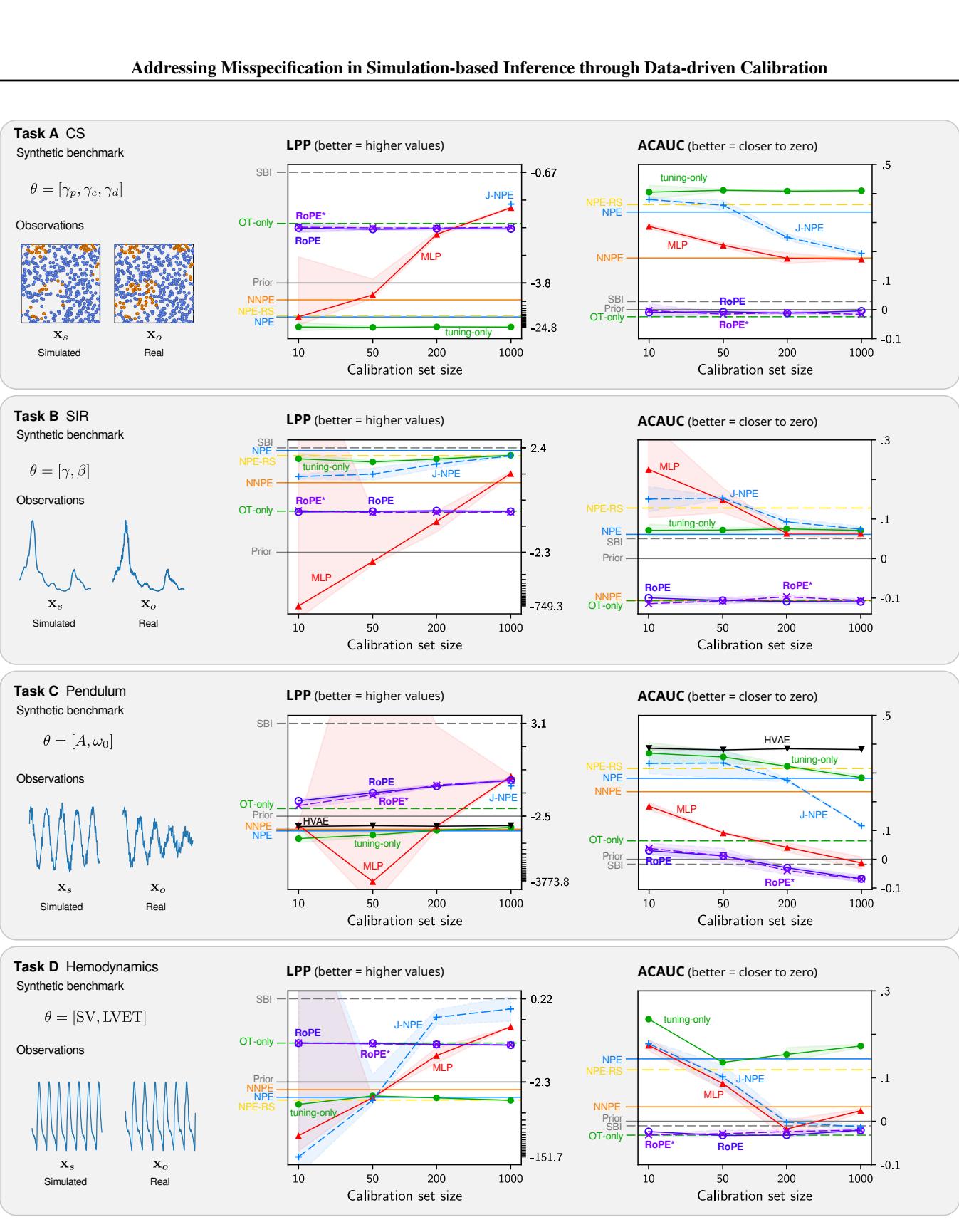
- RoPE (Black lines): Consistently achieves high LPP and low ACAUC (near zero) even with very small calibration sets (10-50 samples).
- Baselines:
- SBI (Sim-only): Often fails completely (horizontal lines), as it ignores the reality gap.
- J-NPE / MLP: These methods try to learn directly from the calibration set or mix data. They require much more real data to catch up to RoPE’s performance. At small sample sizes, they are unreliable.
The results are further highlighted in Task F (Wind Tunnel), where RoPE maintains robustness where other methods struggle.
Visualizing the Posteriors
Numbers are great, but what do the probability distributions actually look like?
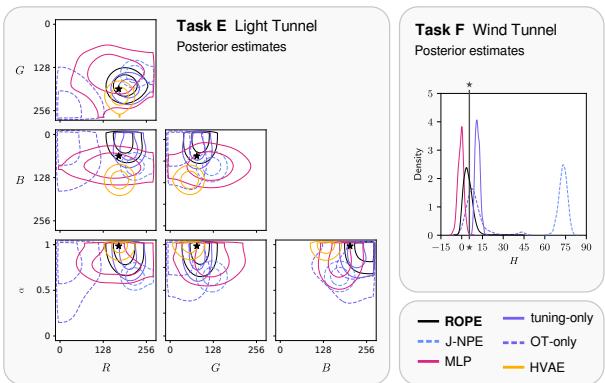
Figure 7 shows the “corner plots” for the Light Tunnel and Wind Tunnel tasks. These plots visualize the estimated credible intervals for the parameters.
- In the Light Tunnel (left), the RoPE (Black) contours tightly surround the true parameter values (stars).
- Other methods like OT-only (Purple) or MLP (Pink) often produce contours that are offset (biased) or too wide (underconfident).
Robustness to Prior Misspecification
A common issue in Bayesian inference is having an incorrect prior—assuming the parameters are uniformly distributed when they are actually concentrated in a specific range.
RoPE includes a mechanism to handle this via the “unbalanced” transport parameter \(\tau\). If we set \(\tau < 1\), we allow the algorithm to discard simulated data that doesn’t match the distribution of the real data.
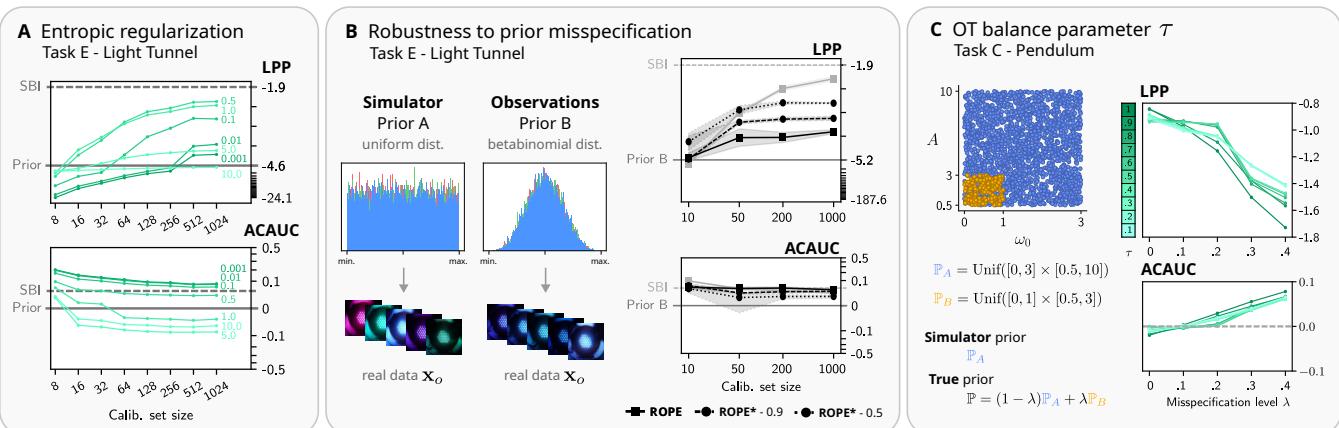
As shown in Figure 3(b), the standard RoPE (where \(\tau=1\), blue line) performs worse when the prior is wrong. However, RoPE* (where \(\tau < 1\), orange/green lines) recovers the performance, effectively ignoring the misleading parts of the prior distribution.
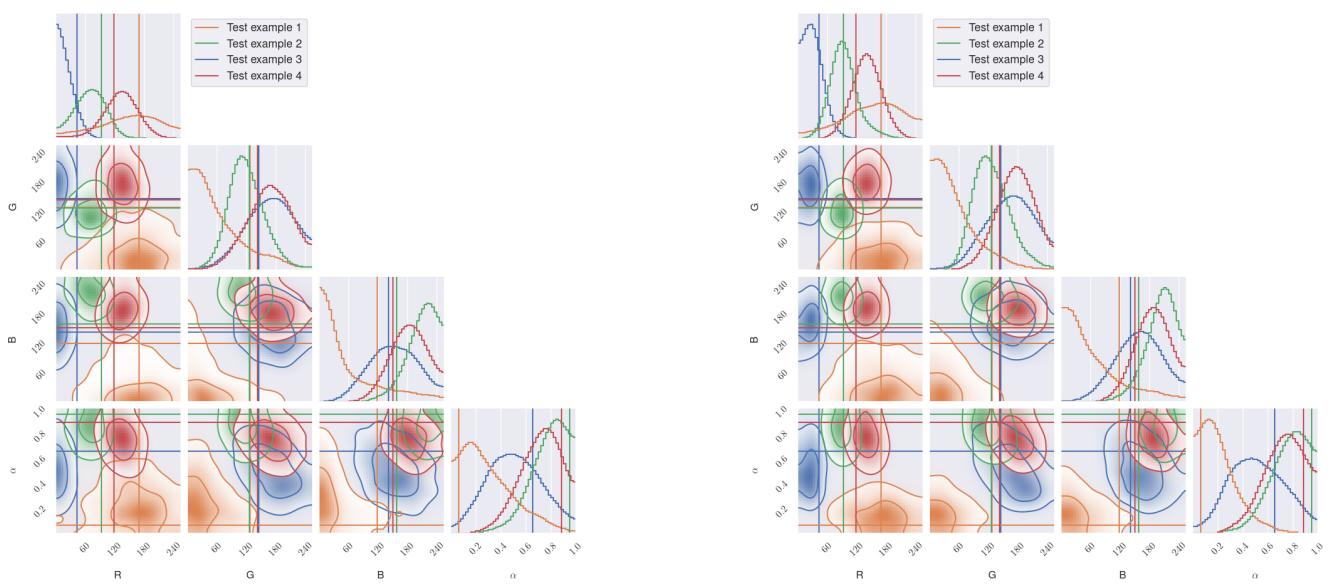
This is visually confirmed in Figure 5. When the prior is misspecified (right side), the standard formulation might skew, but the semi-balanced OT formulation keeps the posterior centered on the truth.
Out-of-Distribution Generalization
One of the most powerful features of RoPE is that it relies on the physics encoded in the simulator, rather than just fitting the calibration data.
In an experiment shown in Figure 6, the researchers trained the models on standard images and then tested them on flipped images.
- MLP and J-NPE: These methods learned “shortcuts” from the pixels in the training data. When the test images were flipped, their performance crashed.
- RoPE: Because the simulator’s physics (color mixing) are invariant to the image orientation, and RoPE relies on the simulator for the inference structure, its performance remained stable.
Conclusion
Simulation-Based Inference is a powerful tool, but the “reality gap” has long been a barrier to its safe deployment in critical fields. RoPE offers a principled way to cross this bridge.
By combining the structural knowledge of a simulator with the empirical grounding of a small real-world calibration set, RoPE achieves the best of both worlds. It uses Optimal Transport to align the simulated and real domains, correcting for misspecification without discarding the valuable physics encoded in the model.
The key takeaways are:
- Don’t trust misspecified simulators blindly: They yield overconfident and biased results.
- Data-driven calibration works: A handful of labeled real-world examples can correct deep structural errors in a simulator.
- Geometry matters: Optimal Transport provides a controllable, robust way to map simulations to reality, balancing precision with calibrated uncertainty.
As we continue to build more complex digital twins and simulators, methods like RoPE will be essential for ensuring that our digital predictions hold up in the physical world.