](https://deep-paper.org/en/paper/2405.10512/images/cover.png)
How Contrastive Learning is Revolutionizing Event Causality Identification
Causality is the bedrock of how humans understand the world. If we see a glass fall, we anticipate it might break. If we read that a heavy rainstorm occurred, we understand why the flight was delayed. For Artificial Intelligence, however, making these connections—specifically determining if one event explicitly caused another based on text—is a significant challenge. This task is known as Event Causality Identification (ECI).
In this post, we are going to dive deep into a research paper titled “In-context Contrastive Learning for Event Causality Identification”. The researchers propose a novel framework called ICCL (In-Context Contrastive Learning). This method cleverly combines the emerging power of “prompt learning” with the discriminative power of “contrastive learning” to achieve state-of-the-art results.
If you are a student of NLP or machine learning, this paper offers a masterclass in how to combine different paradigms to solve complex relationship extraction problems.
The Problem: Why is ECI Hard?
Event Causality Identification (ECI) aims to detect whether there is a causal relation between two event mentions in a document. For example, consider the sentence: “The plane was delayed because of the rain.” The two events are “delayed” and “rain,” and the relationship is clearly causal.
However, consider this: “Peter doesn’t care about the boar ravaging the crops.” While “ravaging” and “care” are related in the sentence, one didn’t cause the other in a direct physical sense. Distinguishing between these subtle semantic differences is difficult for models that rely solely on surface-level patterns.
The Limitations of Current Approaches
Before ICCL, researchers largely relied on two methods:
- Graph-based methods: These construct complex graphs representing events and their syntactic relationships. While effective, they are computationally heavy and rely on rigid structures.
- Prompt Learning: This newer paradigm reformulates the classification task as a “fill-in-the-blank” (cloze) task for a Pre-trained Language Model (PLM) like BERT or RoBERTa.
Prompt learning has shown great promise, particularly In-Context Learning. This involves giving the model a few examples (demonstrations) inside the prompt before asking it to solve the query.
However, standard in-context learning has a flaw: it blindly feeds examples to the model. It doesn’t explicitly teach the model why a positive example is similar to the query or why a negative example is different. It relies on the model implicitly “getting the vibe.”
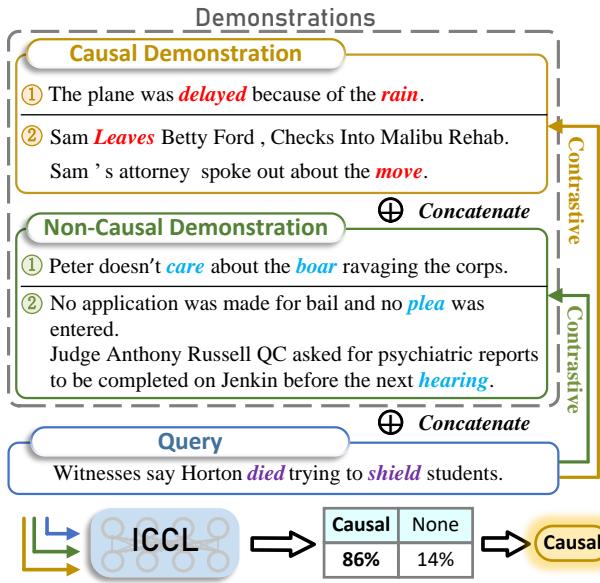
As shown in Figure 1, the motivation behind ICCL is to fix this. Instead of just listing examples, the researchers wanted to enhance the analogy between the query and the demonstrations. They wanted the model to explicitly understand: “This query is like these causal examples, and unlike those non-causal examples.”
The Solution: In-Context Contrastive Learning (ICCL)
The researchers propose ICCL to bridge the gap between prompt learning and representation learning. The core idea is to use Contrastive Learning on the specific event pairs within the prompts.
The framework consists of three main modules:
- Prompt Learning Module: Reformulates the input and retrieves demonstrations.
- In-context Contrastive Module: The “secret sauce” that aligns representations.
- Causality Prediction Module: The final classifier that predicts the label.
Let’s look at the high-level architecture:
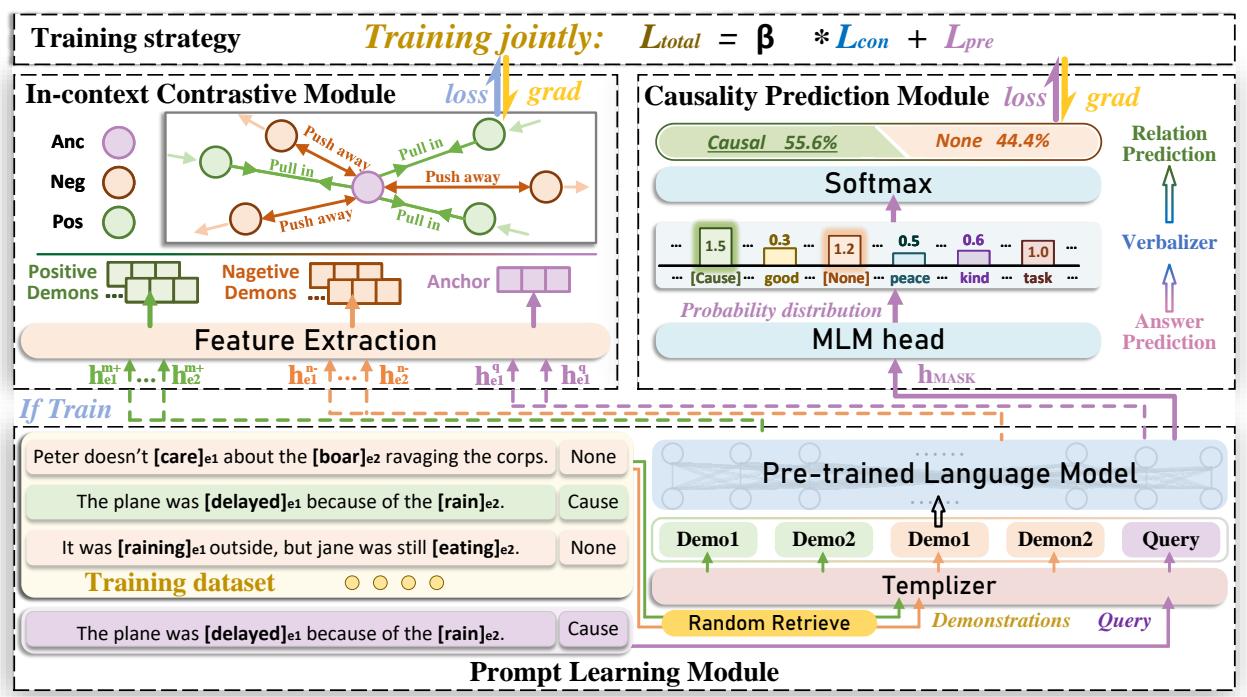
As you can see in Figure 2, the model takes a query and retrieves random demonstrations (some causal, some non-causal). These pass through a PLM. The output feeds into two branches: a contrastive loss (left) to shape the embeddings, and a prediction loss (right) to determine the answer.
1. The Prompt Learning Module
First, we need to translate the raw text into a format the model can process effectively. The input consists of an event pair (\(E_1, E_2\)) and their sentences.
The goal is to create a template \(T(x)\). The researchers design two specific templates: one for the query (the pair we want to classify) and one for the demonstrations (the examples we provide).
The templates look like this:
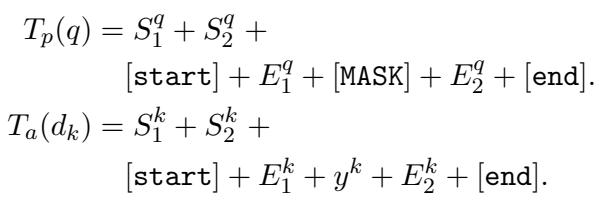
- \(T_p(q)\) (Prediction Template): This is for the query. It inserts a
[MASK]token between the two events. The model’s job will be to predict a word for that mask. - \(T_a(d_k)\) (Analogy Template): This is for the demonstrations. Instead of a mask, it inserts the actual label (represented by a virtual word corresponding to the label \(y^k\)).
These templates are then concatenated into one long sequence to form the final input to the PLM:

The input starts with [CLS], follows with positive demonstrations (\(d^+\)), then negative demonstrations (\(d^-\)), and finally the query (\(q\)). This structure provides the “In-Context” part of the learning.
2. The In-Context Contrastive Module
This is the most critical contribution of the paper. Standard prompt learning would just take the output of the PLM and try to guess the mask. ICCL adds an intermediate step to ensure the model really understands the event relationships.
The researchers focus on the event mention embeddings. They extract the hidden states (\(h\)) of the two events involved.
The Offset Trick:
Borrowing from classic word embedding theory (where King - Man + Woman = Queen), the researchers represent the relationship between two events as the difference between their vectors:
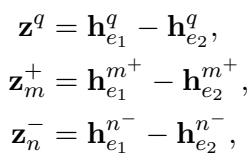
Here, \(z^q\) represents the relationship vector of the query. \(z_m^+\) are the vectors for the positive (causal) demonstrations, and \(z_n^-\) are for the negative (non-causal) demonstrations.
The Contrastive Loss: Now that we have these relationship vectors, we want the query’s vector (\(z^q\)) to be geometrically close to the positive demonstration vectors (\(z^+\)) and far away from the negative ones (\(z^-\)).
This is achieved using Supervised Contrastive Loss:
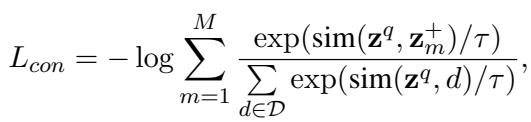
In this equation:
- We sum over all positive demonstrations.
- The numerator maximizes the similarity (dot product) between the query and positive examples.
- The denominator includes both positive and negative examples, effectively pushing the query away from the negatives.
- \(\tau\) is a temperature parameter that controls smoothness.
By minimizing this loss, the model learns a vector space where all “causal” pairs cluster together and all “non-causal” pairs cluster together.
3. The Causality Prediction Module
While the contrastive module shapes the “understanding” of the model, we still need a final answer: Is it causal or not?
For this, the model looks at the hidden state of the [MASK] token from the query template. It uses a Masked Language Model (MLM) classifier to predict the probability of a word filling that blank.

The researchers map the outputs to two virtual words in the vocabulary: <causal> and <none>. A softmax function converts these scores into probabilities:

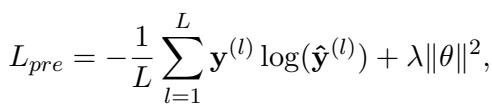
The prediction relies on a standard Cross-Entropy Loss (\(L_{pre}\)):
Training Strategy: Joint Learning
The beauty of ICCL is that it doesn’t train these modules separately. It trains them jointly. The total loss function combines the prediction loss and the contrastive loss:

Here, \(\beta\) is a hyperparameter that balances the two objectives. This forces the model to learn representations that are not only good for immediate prediction but also robustly clustered according to their causal nature.
Experiments and Key Results
To prove this method works, the researchers tested ICCL on two standard datasets: EventStoryLine (ESC) and Causal-TimeBank (CTB). They compared it against a wide range of competitors, including graph-based models (like RichGCN) and other prompt-based models (like DPJL).
1. Overall Performance
The results were impressive. As shown in Table 4 (below), ICCL achieves state-of-the-art F1 scores.
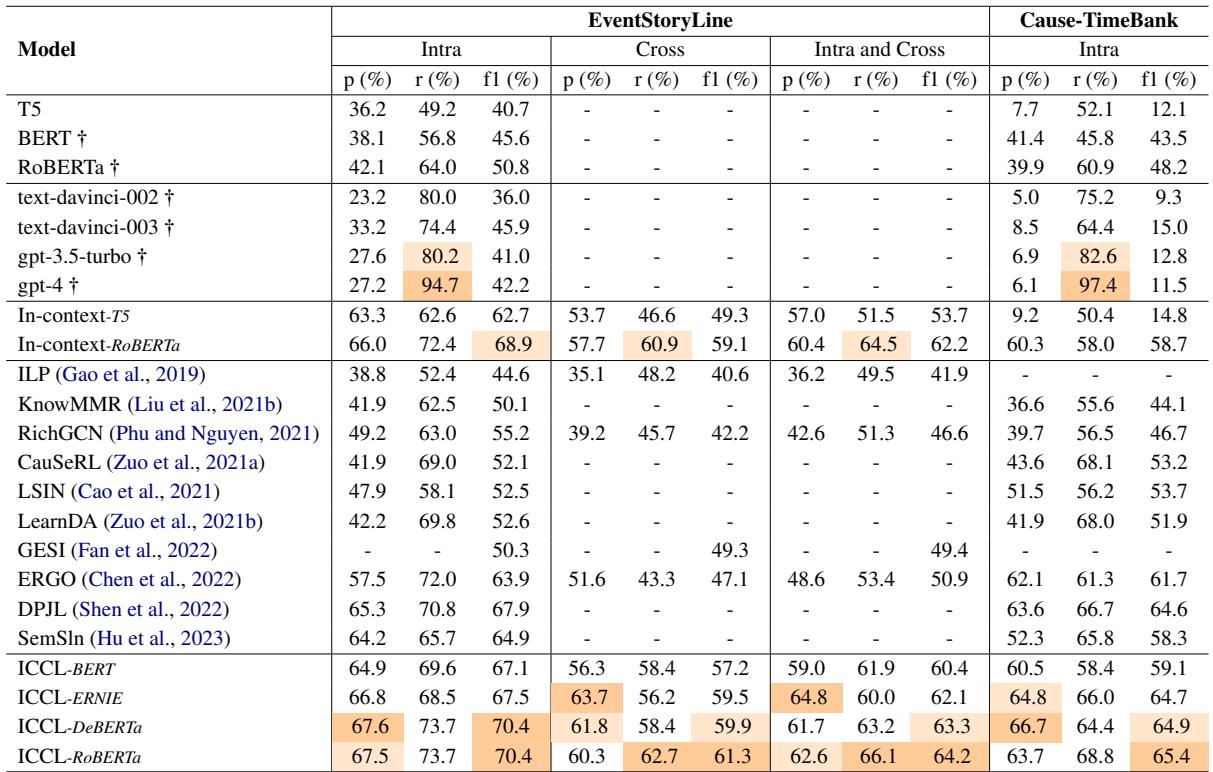
Take a look at the ICCL-RoBERTa row. On the EventStoryLine dataset, it achieved an F1 score of 70.4% for “Intra and Cross” sentence causality. This significantly outperforms standard prompt baselines and complex graph neural networks. It shows that explicitly guiding the model with contrastive demonstrations is more effective than just hoping the model understands the prompt.
2. Does the Contrastive Module Actually Help?
You might wonder: “Maybe just adding examples (In-Context Learning) was enough. Do we really need the contrastive loss?”
The researchers visualized the embeddings of the event pairs using t-SNE (a technique to visualize high-dimensional data in 2D).
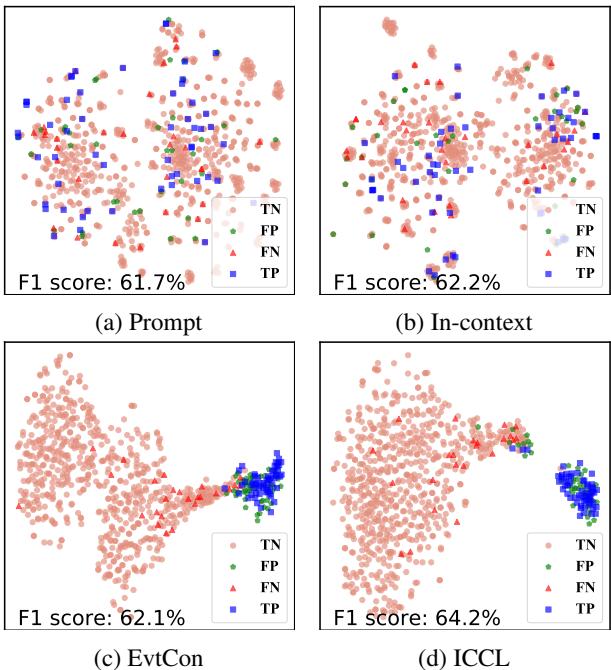
- Plot (a) Prompt and (b) In-context: The points (representing event pairs) are somewhat scattered. The separation between causal and non-causal is messy.
- Plot (d) ICCL: Notice the clear separation. The red triangles (False Positives) and pink dots (False Negatives) are reduced, and there is a distinct clustering of the classes. This visualizes exactly what the contrastive loss equation was trying to achieve: pulling similar classes together.
3. Sensitivity to Demonstrations
How many demonstrations should we use? Does it matter if they are causal or non-causal?
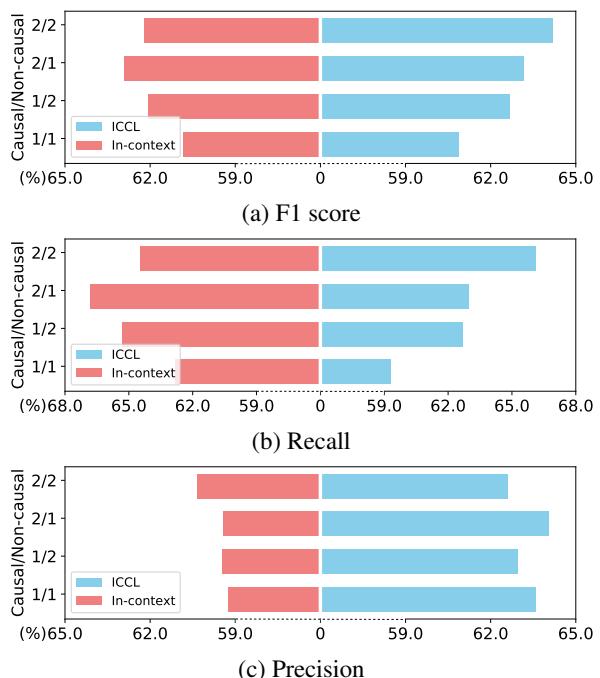
Figure 3 shows that as the number of demonstrations increases (from 1 positive/1 negative to 2 positive/2 negative), ICCL continues to improve, whereas the standard “In-context” model starts to struggle or plateau. This suggests that ICCL is better at handling longer contexts and extracting useful signal from the provided examples.
4. Few-Shot Learning
In the real world, we often don’t have thousands of labeled examples. Can ICCL learn from just a small fraction of the data?

Figure 4 compares ICCL against ERGO (a strong graph-based competitor). The orange line (ICCL) stays significantly higher than the green line (ERGO) as the amount of training data drops (moving left on the X-axis). Even with only 20% of the data, ICCL maintains an F1 score above 50%, while other models crash. This robustness makes ICCL highly valuable for low-resource scenarios.
5. Choice of Pre-Trained Model
Finally, the paper explores which underlying Language Model works best.
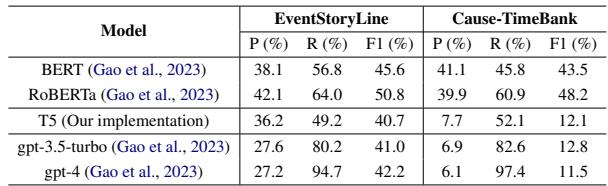
Interestingly, generative models like T5 and GPT-3.5 (zero-shot) performed significantly worse than discriminative models like BERT and RoBERTa for this specific task. This highlights that while Chatbots are popular, fine-tuned representation models (autoencoders) are still superior for specific structural classification tasks like causality identification.
Conclusion
The ICCL paper presents a compelling narrative: simple prompting isn’t enough. To make models truly understand complex relationships like causality, we need to guide them. By combining In-context Learning (giving examples) with Contrastive Learning (mathematically enforcing similarity to those examples), we get the best of both worlds.
Key Takeaways:
- Demonstrations matter: Providing examples in the prompt helps, but guiding how the model uses them helps more.
- Contrastive Loss is a powerful regularizer: It forces the model’s internal representation of “causality” to be distinct from “non-causality.”
- Event Offsets: Representing a relationship as the vector difference between two events (\(h_{e1} - h_{e2}\)) is a simple yet effective way to capture semantic interaction.
This research paves the way for more robust information extraction systems that can “read between the lines” and understand not just what happened, but why it happened.