](https://deep-paper.org/en/paper/2405.13009/images/cover.png)
Imagine you are studying for a difficult history exam. You take a practice quiz and get a question wrong about the French Revolution. You don’t just look up the correct answer for that specific question; you realize you have a fundamental misunderstanding of the timeline. You write a note to yourself: “Always check the dates of events before determining causality.”
This process—generalizing a specific failure into a rule for future success—is a hallmark of human learning. It is often referred to as accumulating semantic memory.
Large Language Models (LLMs), however, generally lack this capability in their default state. If an LLM agent fails a task, it might be able to correct itself in the moment if you prompt it (a process called self-reflection), but once that session ends, the lesson is lost. The model doesn’t “learn” to avoid that mistake in the next chat session without expensive fine-tuning.
In a recent paper from Microsoft, researchers introduce METAREFLECTION, a novel technique that allows Language Agents to build their own semantic memory. By analyzing past failures offline, the agent creates a set of general instructions that permanently improve its performance on future, unseen tasks.
The Problem: Online Correction vs. Offline Learning
To understand why METAREFLECTION is necessary, we first need to look at how we currently try to improve LLM agents.
The Limit of Self-Reflection
Current “state-of-the-art” agents often use a technique called Self-Reflection (or Reflexion). In this setup, if an agent gets a question wrong, the system gives it feedback (e.g., “That answer is incorrect”). The agent then “reflects” on its error and tries again. This works effectively as an online process—meaning it happens during the inference of a specific task.
The problem is inefficiency and lack of persistence. The agent has to make the mistake and correct it every single time it encounters a similar problem. It doesn’t carry the lesson forward to new tasks.
The Limit of Prompt Optimization
Another approach is Prompt Optimization (like OPRO or PROMPTAGENT). These algorithms search for the “perfect” system prompt by trying variations and seeing which one gets the highest score on a training set. While effective, these methods are usually designed for simple, single-step tasks (like classification). They struggle with complex “Language Agents” that take multiple steps, use tools, or perform reasoning chains (CoT or ReAct frameworks).
The Solution: METAREFLECTION
METAREFLECTION bridges this gap. It is an offline reinforcement learning technique. It runs simulations on training data to experience failures, learns from them, and then crystallizes those lessons into a “semantic memory”—a list of text-based instructions appended to the agent’s prompt.
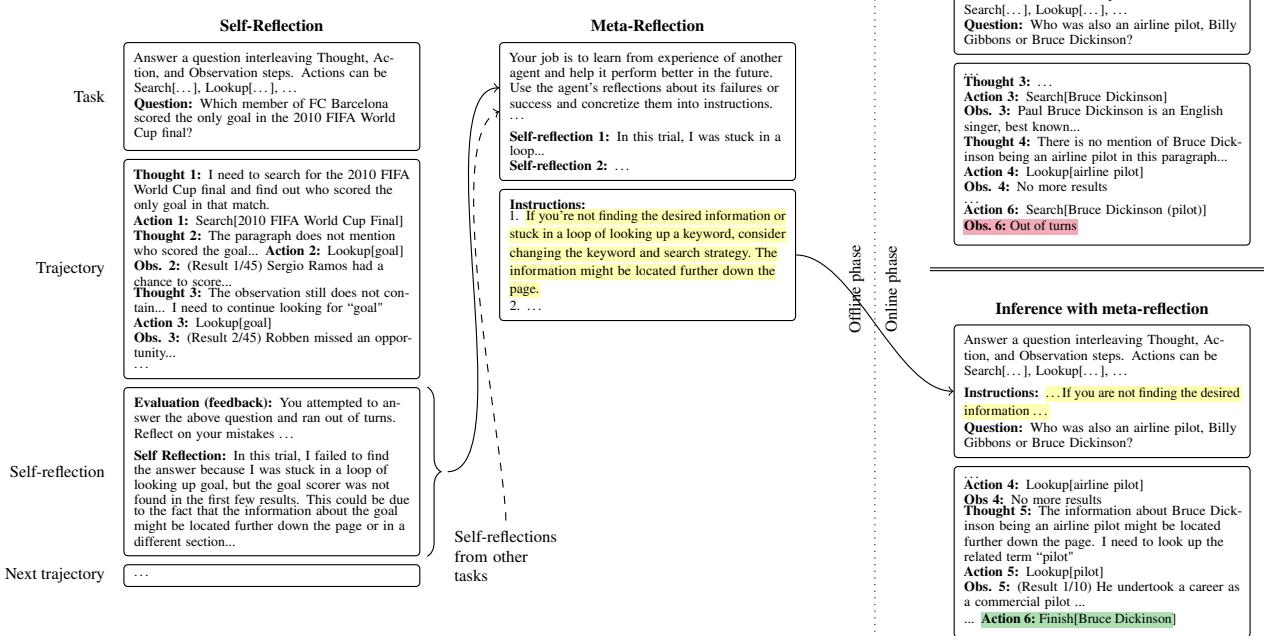
As shown in Figure 1 above, the process mimics human study habits:
- Offline Phase (Left): The agent attempts a task (e.g., finding a football player). It fails because it gets stuck in a search loop.
- Meta-Reflection: Instead of just fixing the football question, the system generates a general instruction: “If you’re not finding the desired information or stuck in a loop… consider changing the keyword.”
- Online Phase (Right): Later, when the agent tries a completely different task (finding a musician), it reads that instruction before it starts. It avoids the loop and solves the problem on the first try.
How The Algorithm Works
The core of METAREFLECTION is a loop that iteratively refines the agent’s instructions.
1. The Trial Loop
The system takes a batch of training examples. The agent attempts to solve them using its current prompt.
2. Self-Reflection
For every failed trajectory, the agent performs standard self-reflection to identify why it failed. It produces a specific correction for that specific instance.
3. The “Meta-Reflect” Step
This is the critical innovation. A separate LLM call takes the specific self-reflections and the current list of instructions as input. It is asked to generalize the specific failure into a high-level instruction.
For example:
- Specific Error: “I failed to find the birth date of George Washington because I searched for ‘President’ instead of his name.”
- Meta-Reflection: “When searching for biographical details, always use the entity’s specific name rather than their job title.”
4. Validation and Backtracking
LLMs can be unpredictable. Sometimes, a new instruction might confuse the agent or be too specific (overfitting). Therefore, after generating a new instruction, the algorithm validates it on a small sample of data. If the new instruction makes performance worse, the system backtracks, discarding the bad rule and trying again.
Experimental Setup
To prove that this isn’t just a theoretical improvement, the researchers tested METAREFLECTION across several diverse and difficult domains.
- Complex Reasoning: Using the “Big-Bench Hard” (BBH) dataset, specifically tasks involving causal judgment and temporal sequences.
- Question Answering: The HotpotQA dataset, which requires multi-hop reasoning (finding clues in one document to find the answer in another).
- Bio-Medical: The BIOSSES dataset for semantic similarity in medical text.
- Infrastructure-as-Code (IAC): A newly introduced dataset involving Terraform and Azure. This is a highly specific, technical domain where the agent must detect security vulnerabilities in code.
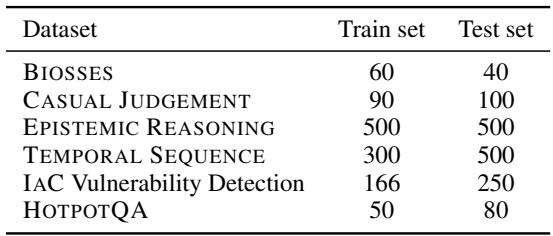
The variety of datasets (Table 1) ensures that the method works for both “common sense” reasoning and highly technical, domain-specific knowledge.
Key Results
The results show that METAREFLECTION consistently outperforms the base GPT-4 model and competes with state-of-the-art prompt optimization techniques, often doing so more efficiently.
Efficiency and Accuracy in Single-Step Tasks
In single-step tasks (where the agent just gives an answer without a chain of thought), METAREFLECTION showed significant gains.
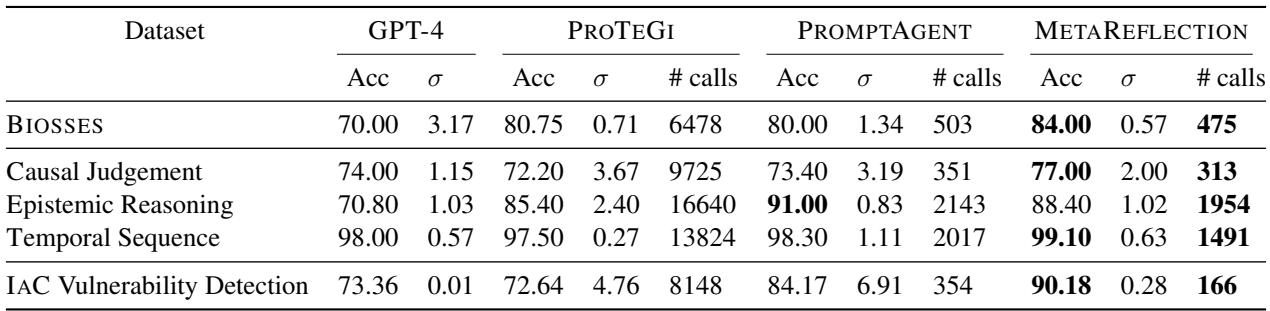
As seen in Table 2, METAREFLECTION achieves the highest accuracy in almost every category. Crucially, look at the # calls column. The baseline “PROTEGI” required nearly 10,000 to 16,000 LLM calls to optimize the prompt for causal judgment. METAREFLECTION achieved better accuracy with only 313 calls.
This efficiency comes from the “insight” driven nature of the method. Instead of blindly guessing prompt variations (like a genetic algorithm), METAREFLECTION analytically derives the optimal instruction from the error itself.
Mastering Technical Domains (IAC)
The researchers introduced a specialized dataset for detecting vulnerabilities in Infrastructure-as-Code (IAC). This is a difficult task for generic LLMs because it requires understanding strict security policies and applying them to code (Terraform).
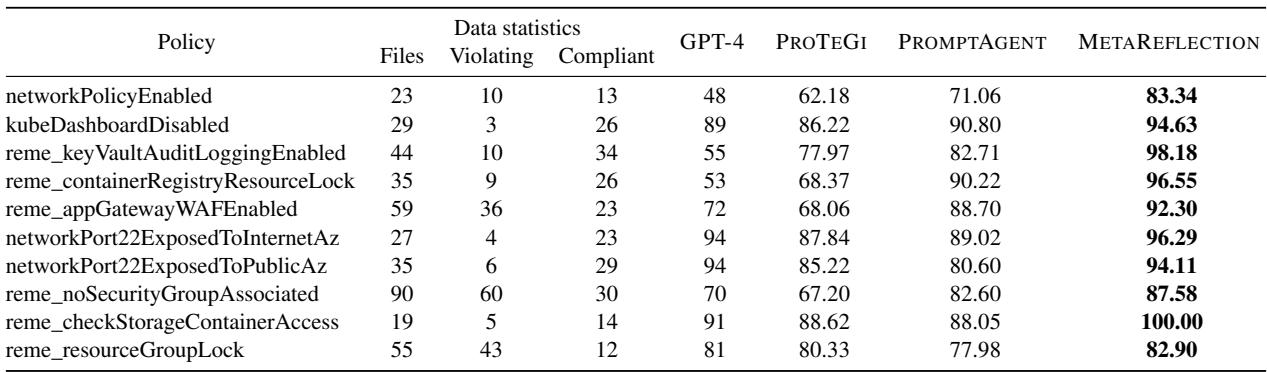
Table 3 highlights the power of semantic memory in technical domains. For policies like reme_checkStorageContainerAccess, METAREFLECTION reached 100% accuracy, significantly beating GPT-4 (91%) and other optimization methods.
Why such a big jump? The qualitative analysis shows that the agent learned specific technical nuances.
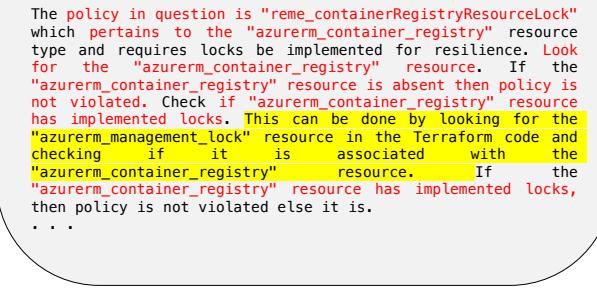
In Figure 2, we can see the difference in the prompts.
- PROTEGI generated a generic prompt asking the model to “verify” code.
- METAREFLECTION learned a detailed, rule-based instruction: “Absence of azurerm_container_registry indicates non-violation; presence requires checking for implemented locks…”
This is the “Semantic Memory” in action. The agent “learned” the logic of the security policy and codified it into an instruction.
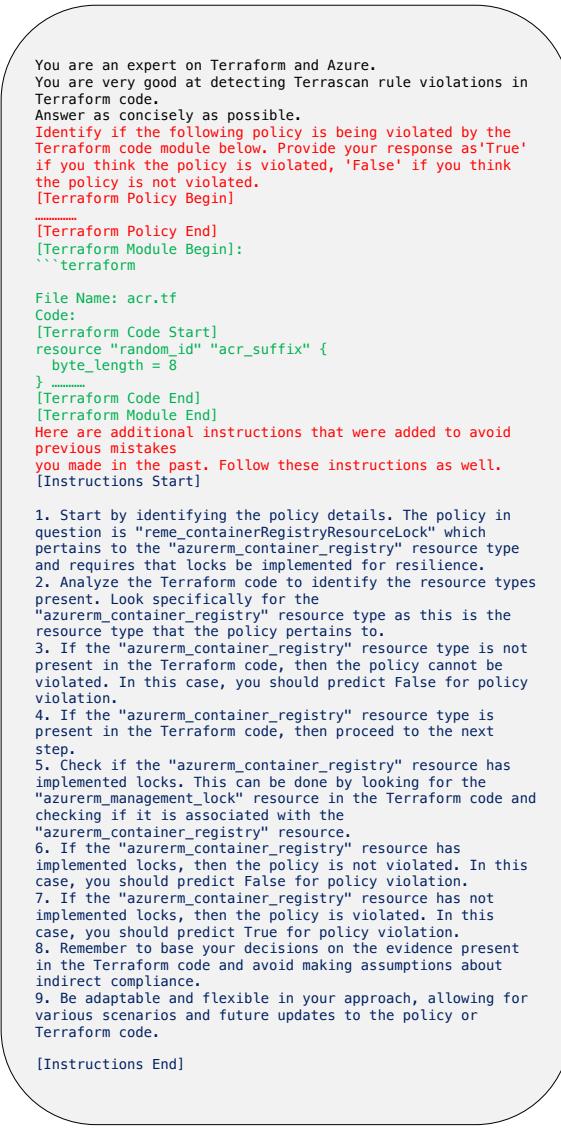
Figure 4 further illustrates how these learned instructions translate into a structured inference process, guiding the agent to check specific conditions (like the existence of azurerm_container_registry) before making a judgment.
Improvements in Multi-Step Agents (CoT and ReAct)
Most prompt optimization techniques fail when applied to multi-step agents because the “prompt” is just the starting gun; the agent’s performance depends on the trajectory of thoughts and actions it takes. METAREFLECTION shines here because it can give instructions on how to think.

Table 4 demonstrates performance on HotpotQA using a Chain-of-Thought (CoT) agent. METAREFLECTION boosts accuracy by over 10% compared to the GPT-4 baseline in the Ground Truth (GT) setting.
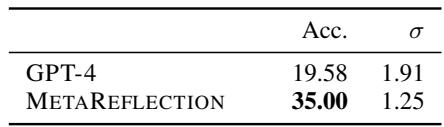
Table 5 shows results for a ReAct agent—an agent that can search Wikipedia. This is a notoriousy difficult setup to optimize. METAREFLECTION nearly doubles the accuracy of the GPT-4 baseline (19.58% to 35.00%).
Qualitative Analysis: What did the agent learn?
The instructions learned by the agent in these complex scenarios are fascinating. They aren’t just factual corrections; they are strategic heuristics.
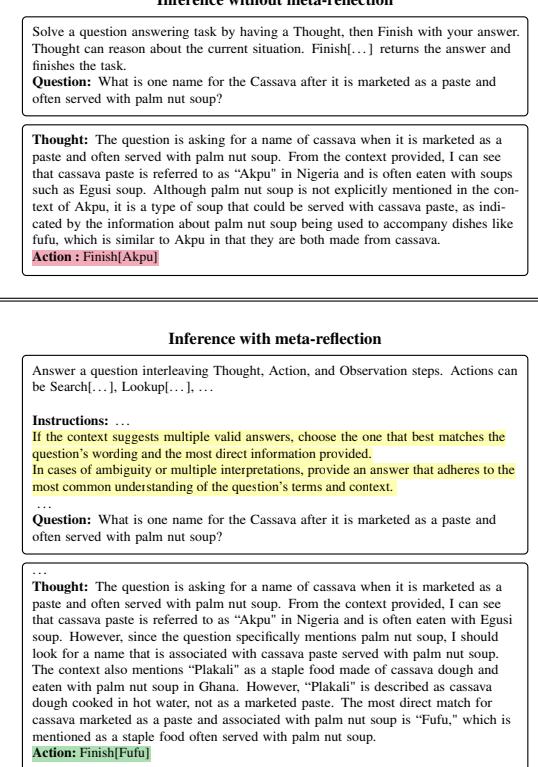
In Figure 10, the baseline agent (top) gets confused by similar concepts (“Akpu” vs “Fufu”) and hallucinates a connection. The METAREFLECTION agent (bottom) operates under a new learned instruction: “If the context suggests multiple valid answers, choose the one that best matches the question’s wording…” Guided by this rule, the agent correctly identifies that “Fufu” is the specific paste served with palm nut soup, filtering out the distractor.
Conclusion
METAREFLECTION represents a significant step forward in making Language Agents more autonomous and capable. By formalizing the process of “learning from mistakes” into an offline loop, researchers have created a way to give LLMs a form of long-term, semantic memory without the massive cost of model fine-tuning.
The key takeaways are:
- Generalization: Specific failures are turned into general instructions.
- Efficiency: It requires drastically fewer LLM calls than brute-force prompt optimization.
- Versatility: It works across simple classification, complex reasoning, and multi-step agentic workflows.
As LLMs continue to be integrated into complex software environments, techniques like METAREFLECTION will be essential for creating agents that don’t just perform tasks, but actually get better at them over time.