](https://deep-paper.org/en/paper/2405.14092/images/cover.png)
Introduction
We have all been there. You ask a Large Language Model (LLM) a complex question—perhaps a tricky math word problem or an obscure trivia query—and it confidently gives you an answer. It looks plausible. The reasoning seems sound. But then, upon closer inspection, you realize the answer is completely wrong.
This phenomenon, often called hallucination or reasoning failure, is one of the biggest hurdles in deploying AI agents for high-stakes tasks. The natural solution seems to be: “Why don’t we just ask the model to double-check its work?”
For a long time, the research consensus has been pessimistic. Previous studies indicated that LLMs struggle with intrinsic self-correction. When you simply ask a model, “Are you sure? Check for mistakes,” it tends to either blindly double down on its error or, worse, “correct” a right answer into a wrong one because it lacks an external source of truth.
But what if the problem isn’t the model’s ability to reason, but how we ask it to verify?
A fascinating new paper titled “Large Language Models Can Self-Correct with Key Condition Verification” flips the script on self-correction. The researchers introduce a framework called PROCO (Progressive Correction). Instead of vaguely asking the model to “find mistakes,” PROCO forces the model to perform a specific verification test: identifying a key condition in the question, masking it, and trying to reproduce it using its own answer.
In this deep dive, we will explore how PROCO works, the mathematics behind its verification process, and why it might be the missing link to making LLMs more reliable autonomous reasoners.
The Background: Why Self-Correction is Hard
To understand why PROCO is significant, we first need to understand the current state of LLM reasoning.
Chain-of-Thought and its fragility
The standard for getting good answers out of an LLM is Chain-of-Thought (CoT) prompting. This encourages the model to generate intermediate reasoning steps before arriving at a final answer. While CoT is powerful, it is fragile. A single error in the reasoning chain can snowball into an incorrect final answer.
The “Sycohalphancy” of Verification
Prior attempts at self-correction (like a method literally called Self-Correct) operate on a loop:
- Generate an answer.
- Ask the model: “Review your previous answer and find mistakes.”
- Refine the answer.
The problem? LLMs are often sycophantic or overconfident. Without external feedback (like a calculator, a search engine, or a human), the model cannot objectively judge its own output. It often fails to spot reasoning gaps because it uses the same flawed logic to verify as it did to generate.
The PROCO Hypothesis
The researchers behind PROCO propose a different approach based on Substitute Verification. The intuition is simple: solving a problem from scratch is hard, but verifying a solution is often easier.
Imagine a math problem: \(x + 5 = 12\). Solving it requires algebraic manipulation. Verifying it simply requires plugging the answer back in: “If the answer is 7, does \(7 + 5 = 12\)?”
PROCO automates this “plugging back in” process for LLMs, applying it not just to math, but to open-domain QA and commonsense reasoning.
The Core Method: How PROCO Works
PROCO stands for Progressive Correction. It is an iterative framework that helps LLMs identify and correct false responses without any external tools.
The process follows a “Verify-then-Correct” cycle. Let’s break down the architecture step-by-step.
Step 1: Initialization and Key Conditions
First, the model generates an initial answer using standard Chain-of-Thought prompting. Once an answer is on the table, the PROCO process begins by analyzing the original question to find a Key Condition.
A key condition is a specific constraint or piece of information in the question that is crucial for solving it. As shown in the image below, these conditions vary depending on the task.
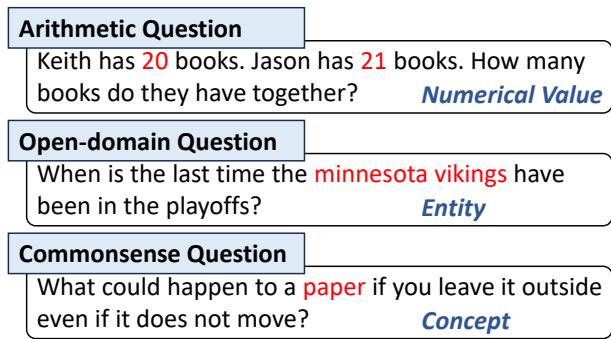
- Arithmetic: The key condition is a number (e.g., “Keith has 20 books”).
- Open-Domain QA: The key condition is an entity (e.g., “Minnesota Vikings”).
- Commonsense: The key condition is a concept.
Identifying the Key Condition
For arithmetic tasks, the system needs to find which number in the text is most relevant to the query. The researchers use a similarity metric to find the sentence \(s_j\) in the context that is most semantically similar to the query sentence \(q\).
They calculate this using Cosine Similarity:

Once the sentence is identified, regular expressions extract the numerical value. For non-math tasks (like literature or trivia), the model is simply prompted to “identify a set of entities… and select the one most relevant.”
Step 2: The Substitute Verification Trick
This is the most innovative part of the paper. Once the system has an Initial Answer (\(a_{t-1}\)) and a Key Condition (\(c_k\)), it creates a Verification Question.
It does this by:
- Masking the key condition in the original text (replacing it with “X”).
- Appending the Initial Answer as a known fact.
- Asking the model to solve for X.
Mathematically, if we denote the masking process as replacing the key condition in the sentence \(s_{J(k)}\), the masked question looks like this:

The system then constructs the full verification prompt (\(Q_t^{(v)}\)) by combining this masked question with the model’s previous answer (\(a_{t-1}\)) and a verification query (\(q^{(v)}\)):

A Concrete Example
Let’s look at how this works in practice.
- Original Question: “Who plays Skylar on Lab Rats: Elite Force?”
- LLM Initial Answer: “Paris Berelc.”
- Key Condition identified: “Skylar.”
The system now essentially says: “Okay, let’s pretend we don’t know the character’s name is Skylar. Let’s pretend the actor is Paris Berelc. Can we derive the character name?”
- Verification Question: “Who plays X on Lab Rats: Elite Force? Suppose the answer is Paris Berelc. What is the value of unknown variable X?”
The LLM solves this new question. If it replies “Skylar Storm,” the system compares this Verified Answer against the original Key Condition (“Skylar”).
Step 3: Verification Logic
How does the system decide if the verification passed?
For Math: It uses a straightforward match. If the calculated X equals the original number, the answer is verified.
For Text: Exact matching is dangerous because “Skylar” and “Skylar Storm” are different strings but refer to the same entity. To solve this, PROCO uses Proposition-based Verification. It asks the LLM a new prompt:
“Determine the correctness of the proposition: If the answer to question [Verification Q] is [Key Condition], then X could also be [Verified Answer].”
This allows the LLM to use its semantic understanding to judge equivalence.
Step 4: Iterative Correction
If the verification passes, the answer is accepted. But if it fails—if plugging the answer back in leads to a contradiction—the answer is marked as incorrect.
The incorrect answer is added to a set of “potentially incorrect answers” (\(\mathcal{P}_t\)). The model is then prompted to answer the original question again, but with a specific hint:
“The answer is likely not in {\(\mathcal{P}_t\)}.”
This prevents the model from looping and repeating the same mistake. The process iterates (usually up to 3 times) until a consistent answer is found.
Experiments and Results
The researchers tested PROCO on three diverse reasoning domains:
- Arithmetic Reasoning: GSM8K, AQuA, MATH.
- Open-Domain QA: Natural Questions (NQ), TriviaQA, WebQ, HotpotQA.
- Commonsense Reasoning: CSQA.
They compared PROCO against standard CoT, the “Self-Correct” baseline (Kim et al., 2023), and RAG-based methods.
Performance on General Reasoning
The results were compelling across the board. The table below shows the performance on QA and Commonsense tasks using GPT-3.5-Turbo and the open-source Mixtral-8x7B.
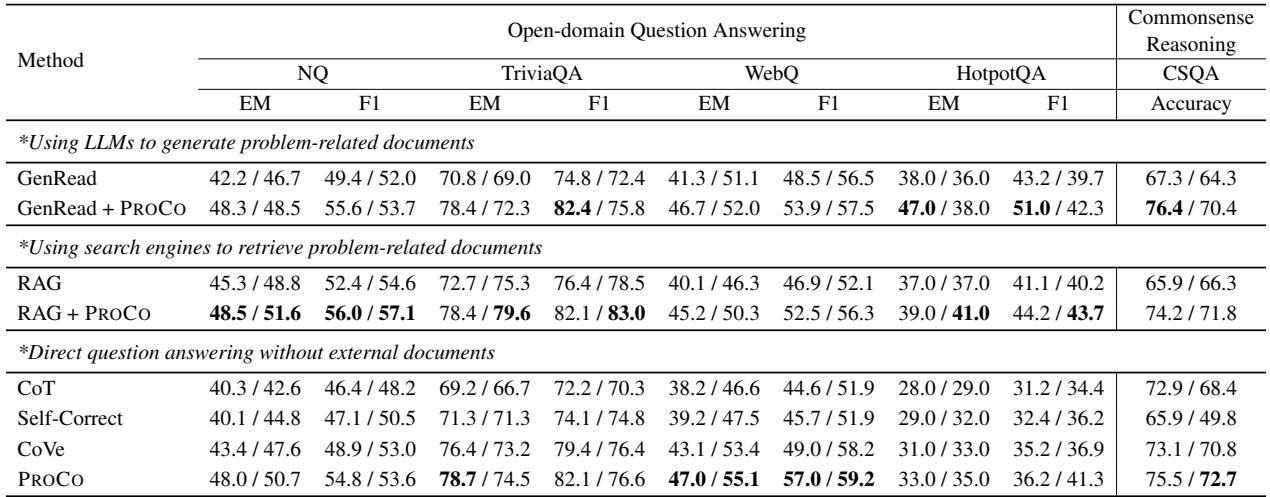
Notice the “PROCO” row at the bottom. On the Natural Questions (NQ) dataset, PROCO achieves an Exact Match (EM) score of 48.0, significantly higher than Standard CoT (40.3) and the traditional Self-Correct method (40.1). This demonstrates that the verification step is actually catching errors that standard prompting misses.
Performance on Math
Math is often the hardest area for LLMs to self-correct because calculation errors can be subtle. PROCO shines here because math problems are inherently verifiable (the logic must balance).
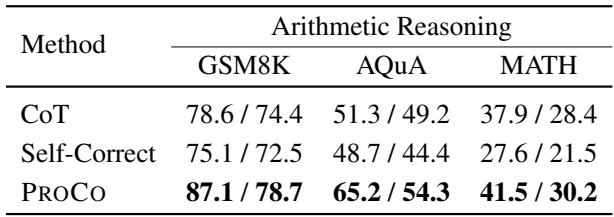
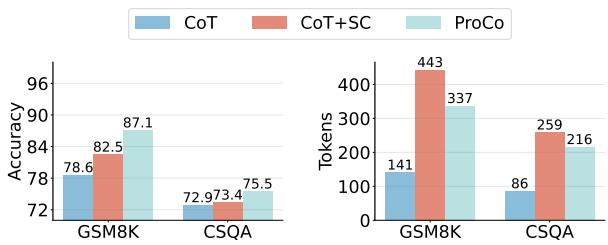
On the GSM8K dataset (grade school math), PROCO improved the accuracy of GPT-3.5-Turbo from 78.6% (CoT) to 87.1%. This is a massive jump for a prompting-only technique, closing the gap between smaller models and larger state-of-the-art models.
Does it work on GPT-4?
One common critique of prompting papers is that they only help weaker models. The researchers tested PROCO on the powerful GPT-4-Preview.
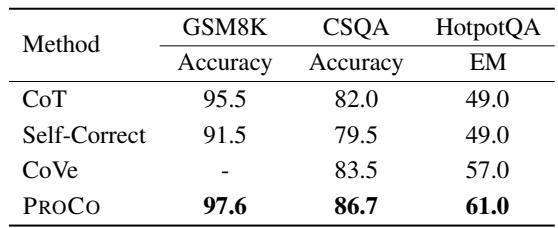
Even with GPT-4, PROCO pushed performance higher, achieving near-perfect scores on GSM8K (97.6%) and significantly boosting HotpotQA (from 49.0 to 61.0).
Why PROCO Succeeds Where Others Fail
The true test of a self-correction method isn’t just whether it gets more right answers—it’s whether it accurately identifies wrong ones without breaking the right ones.
The “Do No Harm” Principle
A major flaw in previous “Self-Correct” methods is that models often doubt themselves unnecessarily. If you ask an LLM “Are you sure?”, it might change a correct answer to an incorrect one due to anxiety or sensitivity to the prompt.
The chart below analyzes how often answers changed status (Correct \(\to\) Incorrect vs. Incorrect \(\to\) Correct).
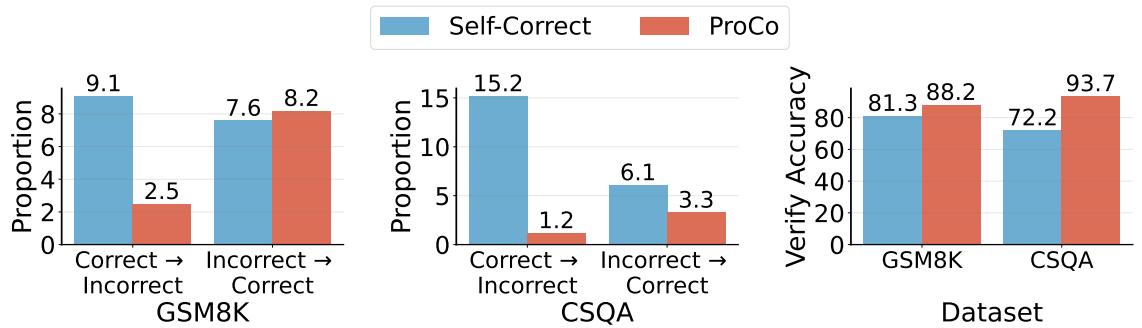
Look at the “Correct \(\to\) Incorrect” group on the left. The standard Self-Correct method (blue bar) ruined nearly 10% of correct GSM8K answers. PROCO (red bar) ruined only about 2.5%. Conversely, in the “Incorrect \(\to\) Correct” group, PROCO fixed more errors.
This proves that verification is a safer mechanism than critique. By requiring the answer to mathematically or logically fit the masked question, PROCO acts as a strict gatekeeper that only allows changes when there is a demonstrable contradiction.
Efficiency and Iteration
Does this process take forever? Surprisingly, no. The researchers found that most problems are resolved in very few iterations.
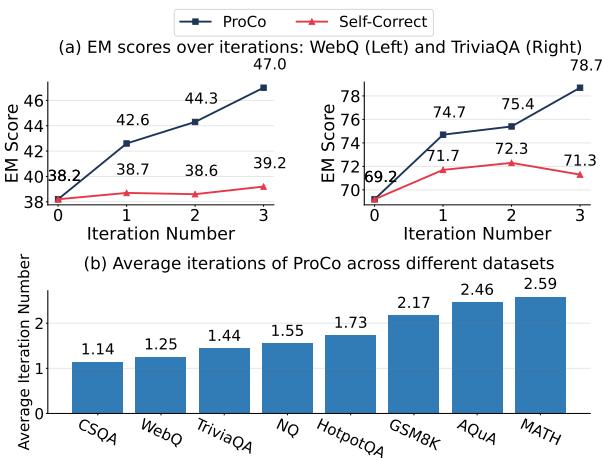
The average iteration count is low (often around 1.5 to 2 iterations). This means the model usually gets it right the first time, or fixes it immediately after the first verification check.
Case Study: “Patience is a Virtue”
To illustrate the difference qualitatively, the researchers provided a case study regarding the origin of the phrase “Patience is a virtue.”
In the example (Table 6), standard CoT hallucinates that the origin is unknown. The “Self-Correct” method confidently (but wrongly) attributes it to Piers Plowman. Only PROCO, specifically when combined with RAG (Retrieval Augmented Generation), correctly identifies the origin as the 5th-century poem Psychomachia.
The Figure 5 chart included in the image above also highlights an efficiency gain. While Self-Consistency (asking the model 5 times and voting) is a popular way to boost accuracy, it is expensive in terms of tokens. PROCO achieves higher accuracy than Self-Consistency while using significantly fewer tokens.
Conclusion & Implications
The PROCO framework represents a significant step forward in the autonomy of Large Language Models. By shifting the paradigm from “critique” to “verification,” the authors have unlocked a way for models to check their own work that mimics human problem-solving. When we are unsure of a calculation, we work backward to see if it fits. PROCO teaches LLMs to do the same.
The key takeaways from this research are:
- Intrinsic Self-Correction is Possible: We don’t necessarily need external calculators or search engines to fix reasoning errors; we just need to structure the prompt to force a “reverse engineering” check.
- Verification > Critique: Asking “Is this right?” is weak. Asking “If this is the answer, does it derive the premise?” is strong.
- Applicability: This method works across math, trivia, and commonsense reasoning, and improves both small open-source models and massive proprietary ones.
As we move toward agentic AI workflows where models operate independently for long periods, frameworks like PROCO will be essential. They provide the “sanity check” layer that prevents hallucinations from cascading into failures.