](https://deep-paper.org/en/paper/2405.15585/images/cover.png)
Introduction
We are living in the golden age of Large Language Models (LLMs). Tools like ChatGPT and GPT-4 have revolutionized how we interact with software, demonstrating an uncanny ability to reason, summarize, and generate creative text. However, if you have ever tried to use a general-purpose LLM to perform a very specific, rigid task—like booking a restaurant table through an API or navigating a car dashboard—you might have noticed a problem.
LLMs are often too chatty. They are trained on vast amounts of internet text, which makes them eager to please, often resulting in long-winded, overly comprehensive answers. In the world of Task-Oriented Dialog (TOD), this is a significant issue. A user driving a car doesn’t want a paragraph explaining five different restaurant options with flowery adjectives; they want a specific address and a confirmation.
Furthermore, traditional TOD systems are “data-hungry.” They require thousands of expert-annotated dialogs to learn how to behave. LLMs can learn from just a few examples (In-Context Learning), but they often struggle to mimic the precise style and brevity required by the system.
This brings us to a fascinating paper titled “Synergizing In-context Learning with Hints for End-to-end Task-oriented Dialog Systems”. The researchers introduce SyncTOD, a framework that combines the reasoning power of LLMs with the precision of small, auxiliary models.
Take a look at the example below to see the problem in action:
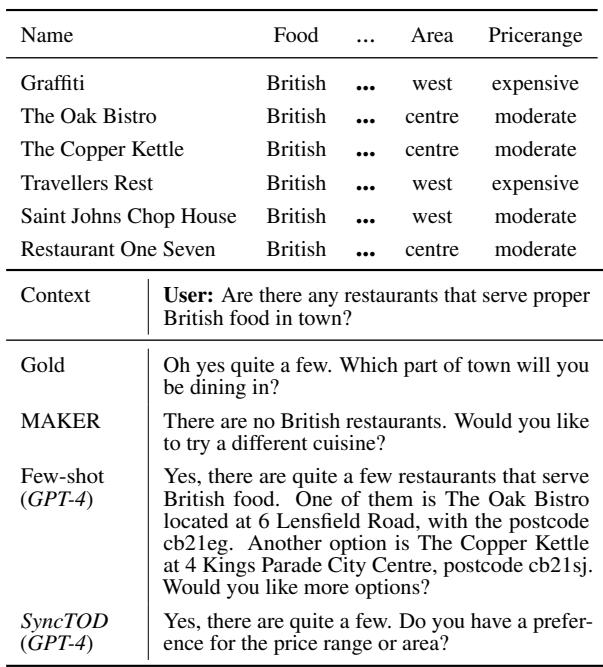
As shown in Table 1, the “Gold” standard response (what a human expert would say) is concise and asks a clarifying question. GPT-4, however, dumps a wall of text containing every British restaurant in the database. While informative, this is a failure in a task-oriented setting. SyncTOD fixes this by guiding the LLM to align with the correct style.
In this post, we will tear down the SyncTOD architecture, explain how it “steers” LLMs using hints, and analyze why it outperforms state-of-the-art models, especially when training data is scarce.
Background: The Challenge of Task-Oriented Dialogs
To understand why SyncTOD is necessary, we need to distinguish between two types of dialog systems:
- Modular Systems: These are the traditional workhorses. They are pipelines composed of separate models for Natural Language Understanding (NLU), Dialog State Tracking (DST), and Natural Language Generation (NLG). They are precise but expensive to build because they require detailed annotations for every step.
- End-to-End Systems: These models take the user input and directly generate a response. They are easier to train but usually require massive datasets to learn the correct “policy” (what to say and when).
The Promise and Peril of LLMs
LLMs offer a third path. Through In-Context Learning (ICL), you can feed an LLM a few examples of a task (prompts), and it adapts. This is often combined with Retrieval Augmented Generation (RAG), where the system finds similar past conversations and adds them to the prompt to help the LLM understand the context.
However, standard RAG has a flaw. It retrieves examples based on semantic similarity (similar words), but it doesn’t necessarily account for the state of the conversation. Just because two conversations are about “hotels” doesn’t mean the agent should respond in the same way. Furthermore, LLMs struggle to align with the specific length and entity requirements of the training data, often “hallucinating” extra details or being overly polite.
SyncTOD aims to solve this by explicitly teaching the LLM the “rules of the road” for each specific turn in the conversation.
The Core Method: Inside SyncTOD
SyncTOD stands for Synergizing In-context Learning with Hints. The core philosophy is simple: instead of hoping the LLM figures out the pattern from a few examples, we explicitly tell it what constraints to follow.
The architecture is composed of two main phases: Hint Prediction and Exemplar Selection, which feed into the final LLM generation.
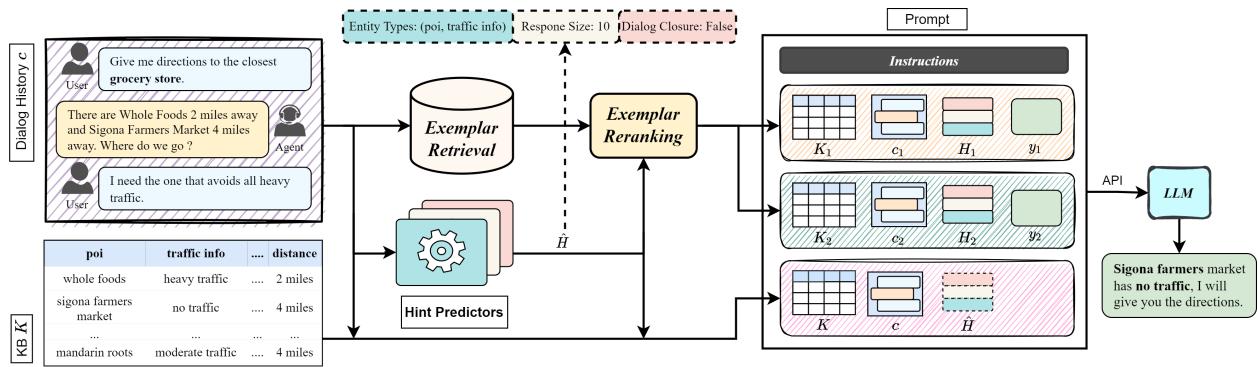
As illustrated in Figure 1, the process flows as follows:
- Input: The system receives the Dialog History (\(c\)) and the Knowledge Base (\(K\)).
- Hint Predictors: Auxiliary models predict constraints (hints) for the next response.
- Retrieval & Re-ranking: The system finds the best training examples that match these predicted hints.
- Prompt Generation: The examples and the hints are converted into instructions for the LLM.
- Output: The LLM generates the final response.
Let’s break down these components in detail.
1. Hint Predictors: The Guide Rails
The researchers identified that LLMs fail primarily because they don’t know what to focus on. To fix this, SyncTOD uses small, trainable models (based on T5 or DeBERTa) to predict three specific types of hints (\(H\)) before the LLM is even called:
- Entity Types (ET): This is the most critical hint. It predicts which specific pieces of information from the database should be in the response. For example, if a user asks for a hotel address, the ET predictor calculates that the response must contain
{hotel name, address}. This prevents the LLM from rambling about the hotel’s star rating or phone number if the user didn’t ask for it. - Response Size (RS): This predictor estimates the number of words the response should have. This effectively curbs the “verbosity” of models like GPT-4, forcing them to be concise.
- Dialog Closure (DC): A binary classifier that predicts whether the conversation should end after this turn. This stops the LLM from asking open-ended questions like “Is there anything else I can help you with?” when the user has already said goodbye.
These predictors are trained on the available dataset. Even with limited data, these small models are surprisingly effective at learning these simple structural patterns.
2. Exemplar Selector: Retrieve and Re-rank
Standard RAG systems retrieve examples based on text similarity. SyncTOD goes a step further. It argues that a good example isn’t just one that looks like the current conversation, but one that behaves like the desired output.
Retrieval: First, SyncTOD uses a standard dense retriever (based on BGE embeddings) to fetch the top-\(k\) most semantically similar dialogs from the training set.
Re-ranking: This is where the magic happens. The system takes those top-\(k\) candidates and re-ranks them based on the hints predicted in the previous step. It looks for examples in the training set where the ground truth response matches the predicted Entity Types and Dialog Closure status.
The similarity score is calculated using the following equation:

Here is what this equation tells us:
- \(\hat{H}\) represents the predicted hints for our current user query.
- \(H_i\) represents the actual properties of a retrieved example.
- \(\mathbb{1}[\hat{d}c = dc_i]\) checks if the Dialog Closure status matches (1 if yes, 0 if no).
- \(\mathcal{J}(\hat{et}, et_i)\) is the Jaccard Similarity between the Entity Types. It measures the overlap between the entities we expect to generate and the entities present in the example.
By maximizing this score, SyncTOD selects examples that are structurally identical to what we want the LLM to produce.
3. Prompt Construction
Once the best exemplars are selected and the hints are predicted, SyncTOD constructs a prompt. It doesn’t just paste the examples; it translates the hints into explicit natural language rules.
For example, if the Entity Type predictor says the response should contain a “Restaurant Name” and “Address,” the prompt will explicitly state:
Rule: The response must only include entities of type: [restaurant name, address].
If the Response Size predictor says 10 words, the prompt adds:
Rule: The response must be 10 words or shorter.
This transforms the LLM from a creative writer into a compliant agent that follows strict logic while maintaining fluent language generation.
Experiments and Results
The researchers evaluated SyncTOD on three major datasets: MultiWOZ 2.1, SMD (Stanford Multi-domain), and BiTOD. They compared it against state-of-the-art supervised models (like MAKER) and standard LLM baselines (ChatGPT and GPT-4 using vanilla RAG).
1. Full Data Performance
Even when the full training dataset is available (a scenario where supervised models usually dominate), SyncTOD performed exceptionally well.
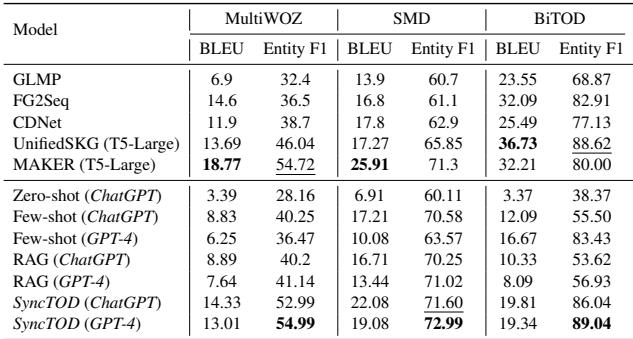
In Table 2, we can see the results across two metrics:
- BLEU: Measures word-for-word overlap with the reference text.
- Entity F1: Measures if the correct database information (entities) was provided.
Key Takeaway: SyncTOD (using GPT-4) achieves the highest Entity F1 scores across all datasets (54.99 on MultiWOZ vs. MAKER’s 54.72). This confirms that the “hints” successfully guide the LLM to retrieve and state the correct facts from the database. While BLEU scores are slightly lower than supervised models, this is often because LLMs phrase things differently than the specific gold reference, even if the answer is correct.
2. Low-Data Performance (The “Cold Start” Problem)
The most impressive results come from scenarios where training data is scarce. This is a common problem in the real world—startups often want to build a bot but don’t have 10,000 logs of past conversations.
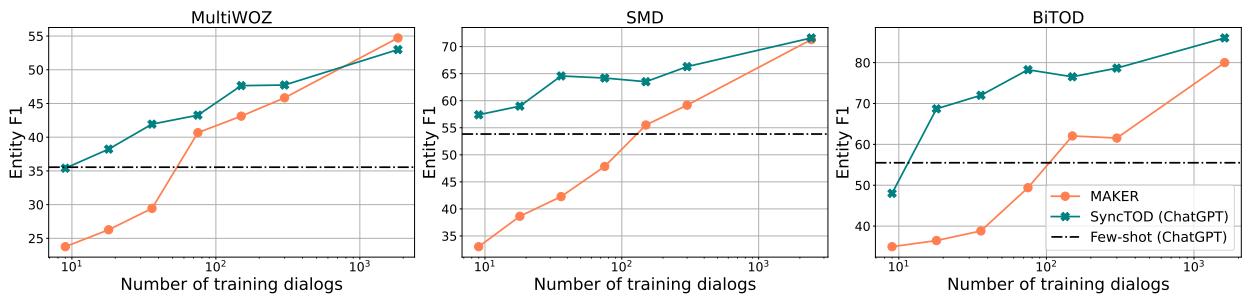
Figure 2 shows the Entity F1 score as the number of training dialogs increases (log scale):
- Orange Line: MAKER (Supervised Model).
- Teal Line: SyncTOD.
On the MultiWOZ and BiTOD datasets, SyncTOD dominates the supervised model when data is low (\(10^1\) to \(10^2\) examples). In the SMD dataset, SyncTOD reaches a high performance level almost immediately, while the supervised model struggles significantly until it sees hundreds of examples. This proves SyncTOD is an excellent solution for few-shot scenarios.
3. Alignment and Human Evaluation
Did the model actually stop being verbose?
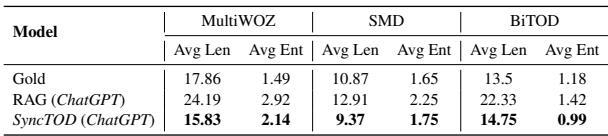
Table 4 compares the average length (Avg Len) and average entities (Avg Ent) of the responses.
- Gold: The human baseline.
- RAG: Standard Retrieval Augmented Generation.
- SyncTOD: The proposed method.
Notice how RAG (ChatGPT) tends to generate much longer responses (24.19 words vs Gold’s 17.86 on MultiWOZ). SyncTOD brings this down to 15.83 words, much closer to the human standard. It also reduces the number of entities, indicating it has stopped “hallucinating” or over-sharing unrequested information.
To confirm the quality, the authors conducted a human evaluation.
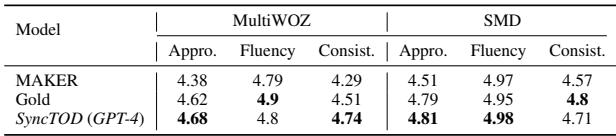
As shown in Table 3, human annotators rated SyncTOD higher than MAKER in Appropriateness and Consistency. This suggests that despite the lower BLEU scores mentioned earlier, the actual user experience with SyncTOD is superior—the responses are fluent, accurate, and contextually appropriate.
Case Study: SyncTOD in Action
Let’s look at a concrete example from the BiTOD dataset to see how SyncTOD handles complex constraints compared to other models.
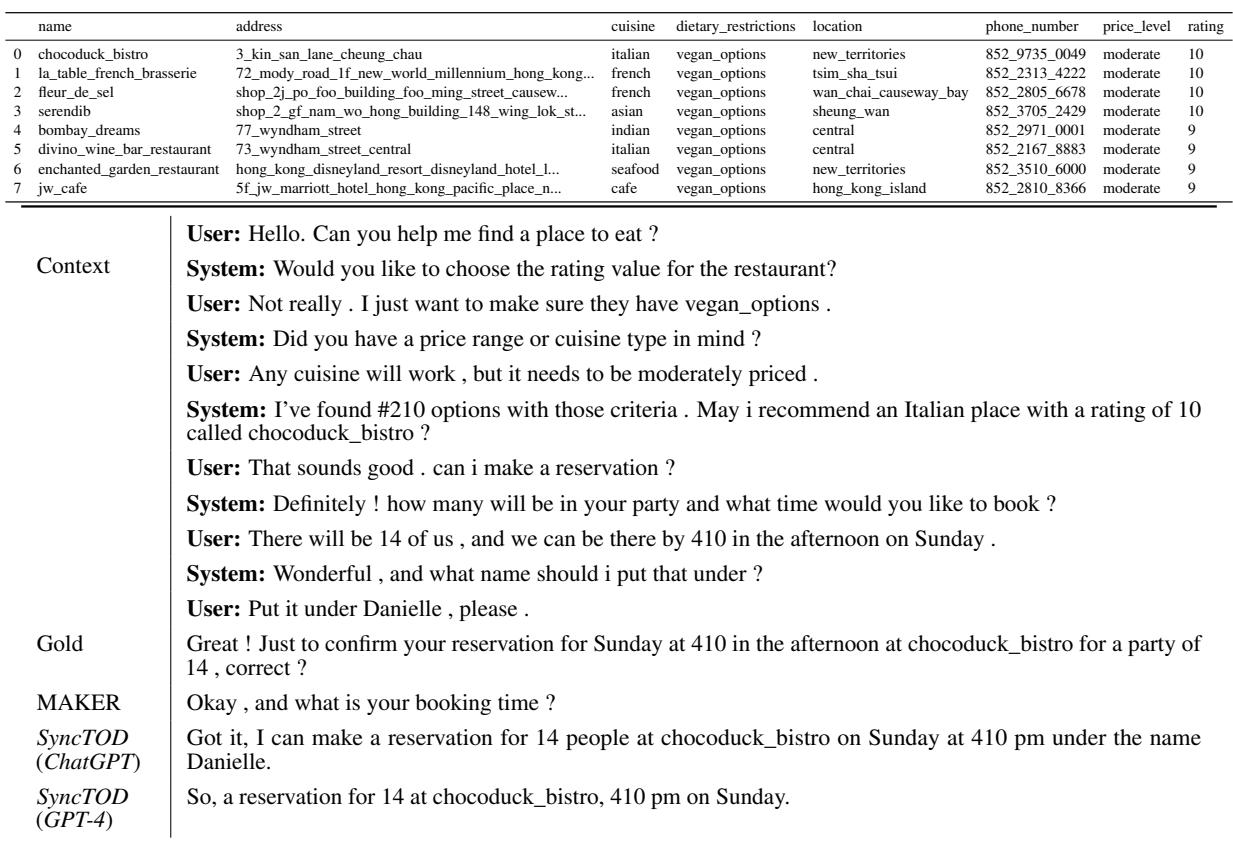
In Table 14, the user wants to make a reservation for 14 people at a specific time.
- MAKER: Fails completely. It asks “what is your booking time?” even though the user explicitly said “4:10 in the afternoon.” This is a classic failure of supervised models that haven’t learned to attend to long contexts perfectly.
- SyncTOD (ChatGPT & GPT-4): Correctly captures all constraints: 14 people, Chocoduck Bistro, Sunday, 4:10 PM, and the name “Danielle.”
Because SyncTOD creates specific rules based on the dialogue history, the LLM is explicitly instructed to verify these entities before generating the response.
Conclusion and Implications
The paper “Synergizing In-context Learning with Hints for End-to-end Task-oriented Dialog Systems” offers a compelling blueprint for the future of conversational AI. It bridges the gap between the “black box” creativity of Large Language Models and the structured, rule-based requirements of business applications.
By employing small, efficient auxiliary models to generate hints, SyncTOD achieves three major wins:
- Precision: It forces the LLM to stick to the facts (entities) in the Knowledge Base.
- Conciseness: It curbs the natural verbosity of LLMs, aligning response length with human norms.
- Efficiency: It achieves state-of-the-art results with a fraction of the training data required by traditional supervised models.
For students and researchers entering the field, this paper highlights an important trend: Hybrid AI Systems. We are moving away from asking one giant model to do everything, and toward systems where specialized modules guide general-purpose reasoning engines. SyncTOD demonstrates that sometimes, the best way to get a genius to work effectively is simply to give them a good set of hints.