](https://deep-paper.org/en/paper/2405.15991/images/cover.png)
Fixing the Flaw in Neural Processes: A Deep Dive into Rényi Divergence
In the world of probabilistic deep learning, Neural Processes (NPs) occupy a fascinating middle ground. They attempt to combine the flexibility of deep neural networks with the data-efficiency and uncertainty estimation of Gaussian Processes (GPs). If you have ever worked with meta-learning or few-shot learning, you know the dream: a model that can look at a handful of context points and immediately predict a distribution over functions for new target points.
However, standard NPs have a subtle but significant structural flaw. To make training feasible, they force the model that estimates the prior (what we know from context) and the model that estimates the posterior (what we know from context + targets) to share parameters. This creates a “chicken-and-egg” problem that researchers call parameterization coupling.
This coupling leads to prior misspecification. Effectively, the model learns a biased prior, and because the standard training objective (the Evidence Lower Bound or ELBO) strictly penalizes deviation from the prior, the model becomes over-confident or “oversmoothed.”
In this post, we are dissecting the paper “Rényi Neural Processes”, which proposes a mathematically elegant solution. By swapping the standard Kullback-Leibler (KL) divergence for the Rényi divergence, the researchers created a method that is robust to these “bad priors,” significantly improving performance without changing the underlying neural architecture.
1. The Background: How Neural Processes Work (and Fail)
Before we get to the fix, we need to understand the break.
Neural Processes represent stochastic processes. Given a Context Set \((X_C, Y_C)\) (observed data) and a Target Set \((X_T, Y_T)\) (points we want to predict), the goal is to predict the target labels while estimating uncertainty.
The standard NP framework uses a latent variable model. It assumes there is a global latent variable \(\mathbf{z}\) that captures the “function identity.” The process looks like this:
- Encoder: Compresses the context data \((X_C, Y_C)\) into a distribution for \(\mathbf{z}\).
- Sampling: We sample \(\mathbf{z}\) from this distribution.
- Decoder: We use \(\mathbf{z}\) and the target inputs \(X_T\) to predict \(Y_T\).
The Training Objective: Variational Inference
Because the true posterior distribution of \(\mathbf{z}\) is intractable, we use Variational Inference (VI). We try to maximize the ELBO. The standard loss function for VI-based NPs looks like this:

Here is the breakdown of that equation:
- The Log-Likelihood term: \(\log p_{\theta}(Y_T | X_T, \mathbf{z})\). This rewards the model for predicting the targets accurately.
- The KL Divergence term: \(D_{\mathrm{KL}}(q_{\phi} || p_{\varphi})\). This is the regularizer. It forces the approximate posterior \(q\) (which sees both context and targets) to be close to the conditional prior \(p\) (which sees only context).
The Problem: Parameter Coupling
In a perfect Bayesian world, the prior \(p(\mathbf{z})\) is fixed and known. In Neural Processes, the prior is learned. It is parameterized by a neural network.
The paper points out a critical issue: The prior model \(p_{\varphi}\) and the posterior model \(q_{\phi}\) share parameters. They are usually the same neural network encoder applied to different sets of data (context vs. context+target).
Because of this coupling, the prior model can never perfectly match the true distribution of the data. It is misspecified. Yet, the KL divergence term in the loss function rigorously forces the posterior to stay close to this flawed prior.
The result? The model acts like a student copying off a bad teacher. If the prior is wrong (e.g., too uncertain or biased), the posterior is forced to be wrong too. This typically manifests as oversmoothing—the model predicts variances that are too large and mean functions that wash out fine details.
2. The Solution: Rényi Neural Processes (RNP)
The researchers propose a fundamental shift in the objective function. Instead of trying to fix the architecture (which is computationally efficient), they fix the way the distance between the posterior and the prior is measured.
They replace the standard KL Divergence with the Rényi Divergence (RD).
What is Rényi Divergence?
The Rényi divergence is a family of divergences parameterized by a value \(\alpha \in (0, \infty)\) (where \(\alpha \neq 1\)). It is defined as:
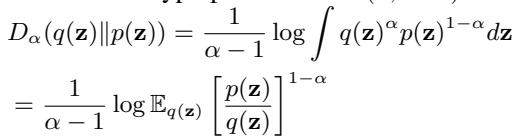
This might look just like another scary integral, but look at the second line: the expectation involves the ratio \(\frac{p(\mathbf{z})}{q(\mathbf{z})}\) raised to the power of \(1-\alpha\).
- When \(\alpha \to 1\): The Rényi divergence converges to the standard KL Divergence.
- When \(\alpha \neq 1\): It changes how much we penalize mismatches between the distributions.
The RNP Objective
By substituting the KL term in the original NP objective with the Rényi divergence, the authors derive a new objective function, \(\mathcal{L}_{RNP}\). Using Monte Carlo sampling with \(K\) samples to approximate the expectation, the loss function becomes:
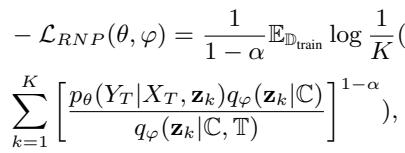
This equation is the heart of the paper. Notice the term inside the log: it’s a weighted sum of likelihood ratios. The power \((1-\alpha)\) acts as a “damper.”
Why Does This Help?
The magic happens in the gradients. When we compute the gradient of this new loss function with respect to the encoder parameters \(\varphi\), it takes the form of a weighted gradient descent:

Here, \(w_k\) represents the importance weight of a specific sample \(k\).
In standard VI (where \(\alpha \to 1\)), the model tries to cover the entire support of the prior. If the prior is wide and misspecified (incorrectly predicts high variance), the posterior tries to cover that width, leading to vague predictions.
In RNP (where \(\alpha < 1\)), the weights \(w_k^{1-\alpha}\) fundamentally change the dynamic. The gradient is scaled such that samples with high likelihood (good fit to data) get higher weights, while the influence of the misspecified prior is dampened.
Visualizing the Impact:
The image below perfectly illustrates the difference. In plot (a), we see the posterior distributions in latent space. The green ellipse is the standard NP posterior—it is wide and loose. The red ellipse is the RNP posterior—it is tighter and more focused.
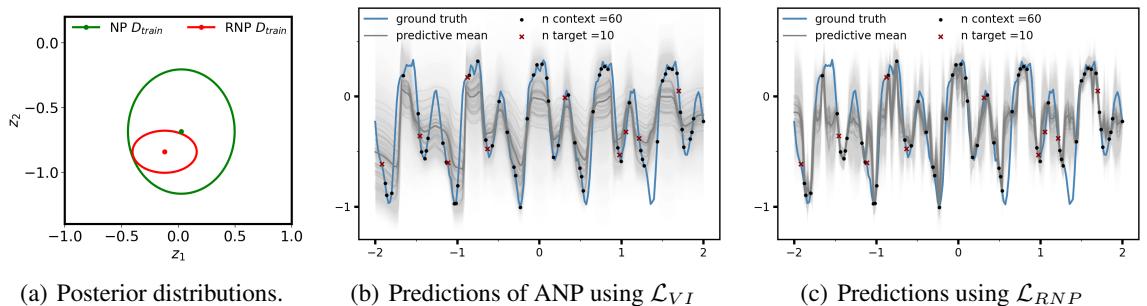
Because the posterior is tighter (plot a), the predictions in data space (plot c) are much sharper and fit the ground truth (blue line) better than the standard NP (plot b), which is “oversmoothed” and uncertain.
3. Unifying the Family
One of the most theoretically satisfying contributions of this paper is that RNP doesn’t just invent a new method; it unifies existing ones.
Depending on how you set \(\alpha\), RNP recovers standard methods:
- \(\alpha \to 1\): You get standard Variational Inference (VI) (Vanilla NPs).
- \(\alpha = 0\): You recover Maximum Likelihood (ML) estimation.
This relationship creates a rigorous bound:

This spectrum is crucial. Pure ML (\(\alpha=0\)) often ignores the prior too much, leading to overfitting. Pure VI (\(\alpha=1\)) trusts the prior too much, leading to underfitting (oversmoothing). By picking an \(\alpha \in (0, 1)\), RNP finds a “sweet spot” where the model respects the prior information but is robust to its flaws.
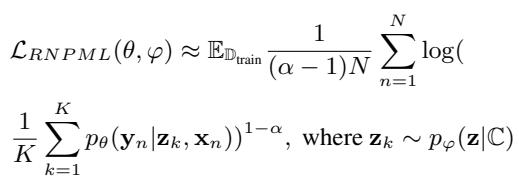
The method is also flexible enough to be applied to ML-based Neural Processes (like Transformer Neural Processes), which don’t explicitly use a latent variable \(z\) in the same way, by minimizing the divergence between the empirical distribution and the model distribution:
4. Experimental Results
The theory sounds great, but does it work? The authors tested RNP across several benchmarks, including 1D regression and image inpainting.
1D Regression Benchmarks
The most telling visual results come from the Periodic dataset. Periodic functions are notoriously difficult for standard NPs because the averaging effect of the KL divergence tends to wash out the peaks and valleys of the sine waves.
In Figure 7 (below), look at the difference between the VI columns (left) and the RNP columns (right).
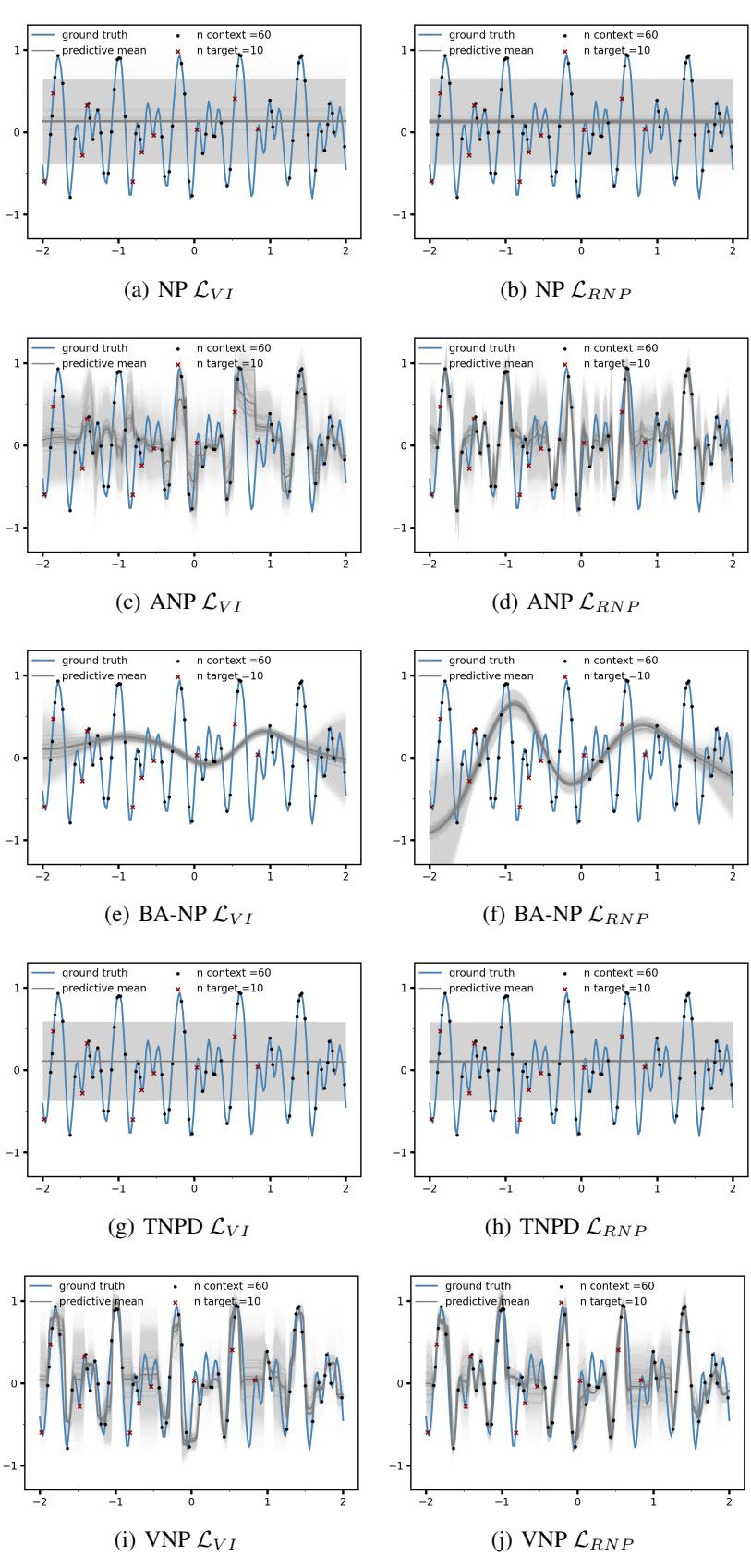
- Left (VI): The models (especially NP and ANP) struggle to capture the amplitude. The predictions look “damped.”
- Right (RNP): The predictions track the ground truth (blue line) much more aggressively. The uncertainty bands are tighter where data exists.
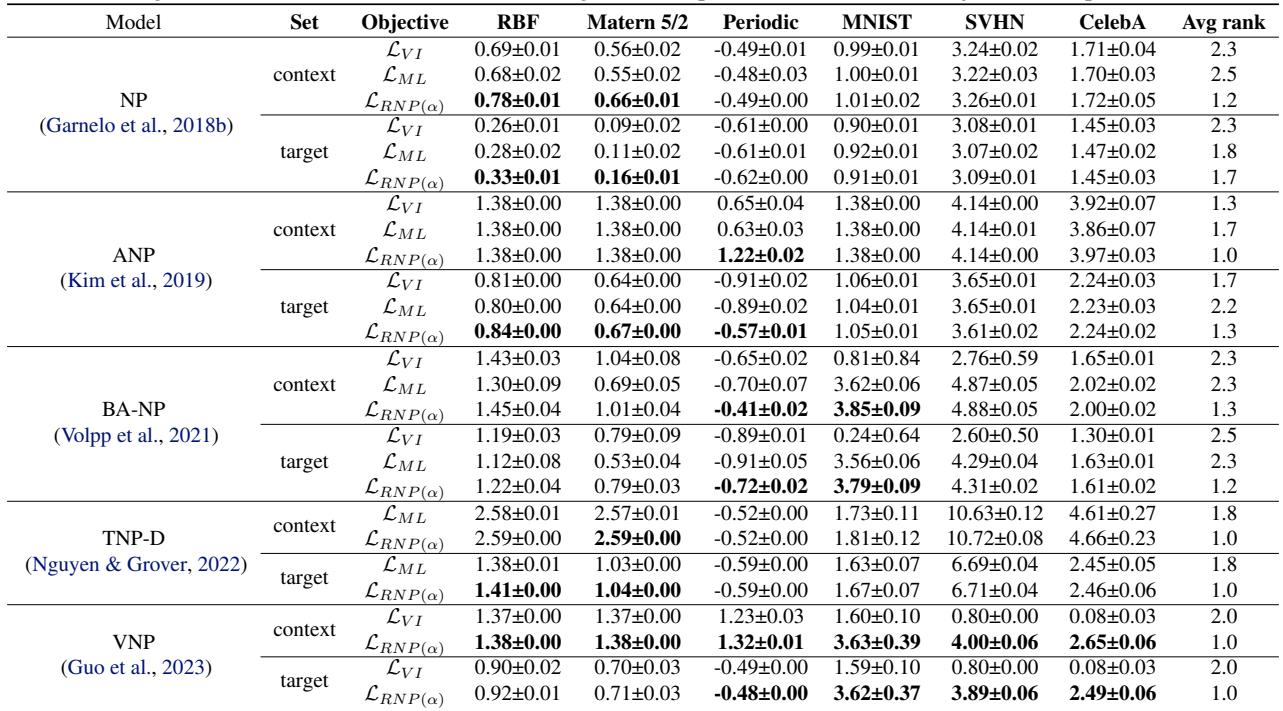
The quantitative results back this up. In Table 1, RNP consistently outperforms standard objectives (\(\mathcal{L}_{VI}\) and \(\mathcal{L}_{ML}\)) across almost all models (NP, Attentive NP, Transformer NP) and datasets.
Robustness to Misspecification (Sim-to-Real)
The authors devised a clever experiment to explicitly test “prior misspecification.”
- Train a model on simulated data (Lotka-Volterra predator-prey equations).
- Test the model on real-world data (Canadian Lynx-Hare dataset).
Because the training distribution (simulated) is different from the test distribution (real), the prior learned during training is misspecified by definition.

As shown in Table 2 below, RNP significantly outperforms the Maximum Likelihood (ML) objective in this transfer task. The RNP model is better able to adapt to the real-world data despite having a prior biased toward the simulation.

The Importance of Alpha (\(\alpha\))
So, what is the best \(\alpha\)? It turns out there isn’t one single magic number—it depends on the dataset and the model architecture. The authors used cross-validation to find the optimal \(\alpha\).
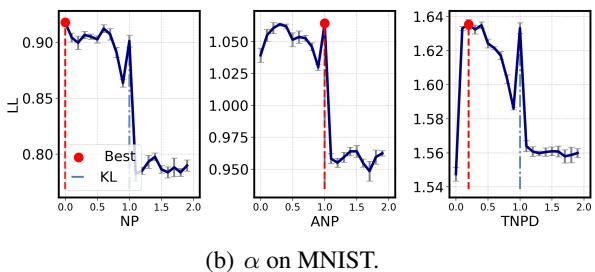
The charts show that the likelihood (y-axis) peaks at different \(\alpha\) values for different setups. However, the authors propose a practical heuristic: start with \(\alpha\) close to 1 (strong prior regularization) and anneal it toward 0 (more expressivity) during training. This allows the model to learn a rough structure first and then refine the details without being held back by the prior.
5. Conclusion & Implications
The “Rényi Neural Processes” paper highlights a specific but pervasive issue in deep probabilistic learning: when we learn our priors, we cannot blindly trust them.
By identifying parameter coupling as the source of prior misspecification, the authors reveal why standard Neural Processes often produce blurry, oversmoothed predictions. Their solution—replacing the KL divergence with the Rényi divergence—is powerful because:
- It requires no architectural changes. You can take an existing NP, ANP, or TNP model and simply swap the loss function.
- It provides a “control knob” (\(\alpha\)). This allows practitioners to balance between trusting the prior and fitting the data.
- It works. The empirical results show consistent gains in log-likelihood and visual fidelity.
For students and researchers working with Neural Processes, this suggests that the standard ELBO objective might not always be the best default. If your model is underfitting or producing oddly large uncertainty estimates, the prior might be the culprit—and the Rényi divergence might be the cure.
This work fits into a broader trend in machine learning of “Robust Variational Inference,” moving beyond the standard KL divergence to find objectives that are more tolerant of model imperfections. As we continue to apply these models to complex, real-world data where our priors are almost certainly “wrong,” these robust methods will become increasingly essential.