](https://deep-paper.org/en/paper/2405.17220/images/cover.png)
The rise of Multimodal Large Language Models (MLLMs)—AI that can see images and talk about them—has been nothing short of revolutionary. Models like GPT-4V and LLaVA have demonstrated an uncanny ability to understand the visual world. However, they share a persistent, critical flaw: hallucination.
You have likely seen it happen. You show a model a picture of a kitchen, and it confidently describes a blender that isn’t there. Or you upload a chart, and it invents numbers that don’t exist. These “confident lies” make deploying these models in high-stakes environments risky.
To fix this, the industry standard has been Reinforcement Learning from Human Feedback (RLHF). Humans painstakingly label data, telling the model what is true and what is false. But this is slow and expensive. The alternative, Reinforcement Learning from AI Feedback (RLAIF), usually involves using a massive, proprietary model (like GPT-4V) to “teach” smaller models. But what if you don’t have access to GPT-4V, or what if you want to build a model better than the teacher?
In this post, we are deep-diving into RLAIF-V, a groundbreaking framework from researchers at Tsinghua University and other institutions. They propose a method where open-source models can align themselves using “peer feedback” rather than relying on a superior teacher. The result? An open-source model that actually outperforms GPT-4V in trustworthiness.
Let’s explore how they achieved this.
The Core Problem: The Teacher Bottleneck
In the current landscape of AI alignment, we usually see a “Teacher-Student” dynamic. A proprietary, closed-source giant (the Teacher, e.g., GPT-4V) generates feedback data, which is then used to train an open-source model (the Student).
While this works to an extent, it has two major limitations:
- The Ceiling Effect: The student can rarely surpass the teacher. If the teacher hallucinates (which GPT-4V does), the student learns to hallucinate too.
- Opacity: We don’t know how the proprietary models generate their feedback, leaving the open-source community in the dark about how to replicate that quality.
RLAIF-V flips this script. As illustrated below, it moves from a hierarchy to a peer-to-peer approach.
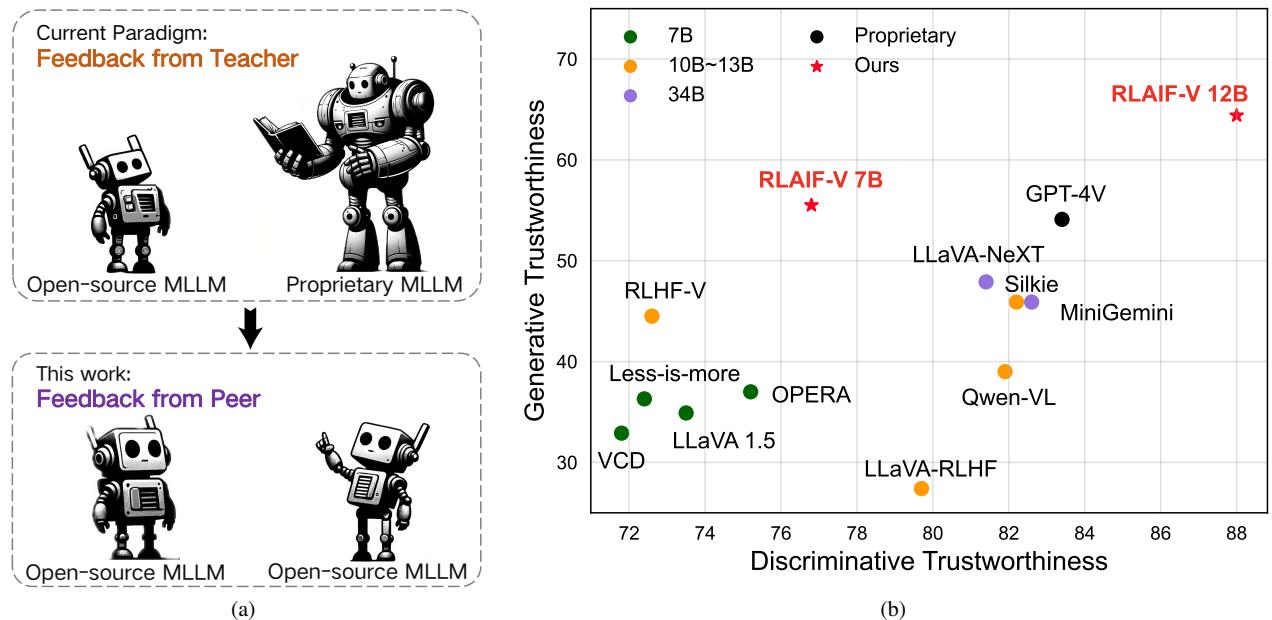
In Figure 1(a), you can see the shift. Instead of a large robot teaching a small one, RLAIF-V allows open-source models to generate feedback for each other (or even for themselves). Figure 1(b) teases the result: The RLAIF-V 12B model (top right) achieves higher trustworthiness scores than the very models usually used as teachers.
The RLAIF-V Framework
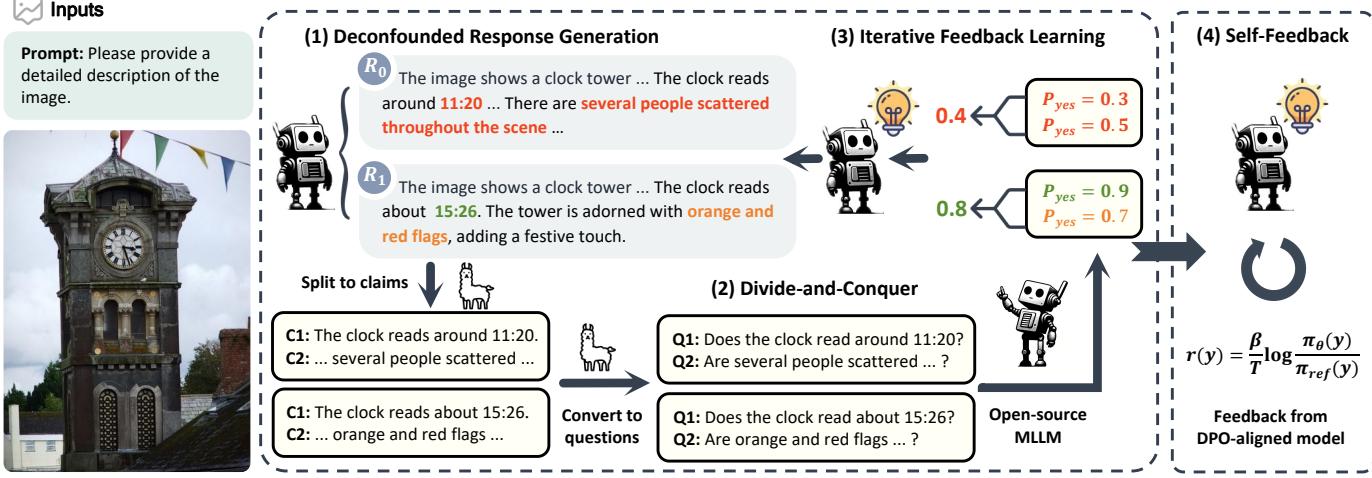
The researchers didn’t just ask the model to “check its work.” That rarely works well because models are often blind to their own hallucinations in a holistic sense. Instead, they developed a sophisticated pipeline centered on three key stages: Deconfounded Response Generation, Divide-and-Conquer Feedback, and Iterative Learning.
Let’s break down the architecture shown in the figure below.
1. Deconfounded Response Generation
To teach a model what constitutes a “good” response, you typically need pairs of answers: a winner (trustworthy) and a loser (hallucinated).
However, if you just take two random responses, they might differ in many ways other than truthfulness. One might be polite and long but wrong; the other might be rude and short but true. If the model learns to prefer the second one, is it learning to be truthful, or is it learning to be rude? This is called a confounding factor.
The authors solve this by using Deconfounded Sampling. They take the exact same input (image + prompt) and use the same model to generate multiple responses, changing only the random seed. Because the same model generates both, the writing style, length, and tone are nearly identical. The only significant difference left is the content accuracy. This makes it much easier for the AI to learn exactly what makes a response trustworthy.
2. Divide-and-Conquer Feedback
This is the “secret sauce” of RLAIF-V.
Asking an open-source model, “Is this paragraph true?” usually results in poor feedback. The task is too complex; the model gets overwhelmed by the length and nuance of the text.
The authors propose a Divide-and-Conquer strategy, visualized in the center of Figure 2 above:
- Divide (Claim Extraction): They take a generated response (e.g., “The clock reads 11:20”) and split it into atomic claims.
- Conquer (Verification): They convert each claim into a simple Yes/No question (e.g., “Does the clock read around 11:20?”).
- Score: They ask the open-source model to answer these simple questions based on the image.
By simplifying the task from “Evaluate this paragraph” to “Answer this specific Yes/No question,” the accuracy of the open-source model skyrockets.
The final score for a response is calculated based on the number of “rejections” (claims the model flagged as false). If Response A has 0 rejections and Response B has 2 rejections, Response A is the winner. This creates high-quality preference pairs without human intervention.
3. Iterative Feedback Learning
The researchers use Direct Preference Optimization (DPO) to align the model. However, doing this once isn’t enough. The model’s behavior changes as it learns.
They employ an iterative approach. They generate data, align the model, and then use that newly aligned model to generate new data for the next round. This ensures the feedback always matches the current capabilities of the model, creating a positive feedback loop that steadily reduces hallucinations.
Inference-Time Scaling: The Self-Feedback Loop
The training phase is impressive, but RLAIF-V introduces another innovation that happens after training, during inference (when you actually use the model).
Once a model is trained via DPO, it “secretly” acts as a reward model. It can assign a probability score to its own answers. The authors utilize this for a technique called Best-of-N (BoN) sampling.
They generate \(N\) different responses for a user’s prompt and pick the best one. But how do they score them? They use the DPO implicit reward formulation:

Here, \(\pi_{\theta}\) is the tuned model and \(\pi_{ref}\) is the original reference model. The reward \(r(y)\) essentially measures how much more likely the tuned model is to generate the response compared to the original model.
The Length Bias Problem: There is a catch. Previous research showed that this reward calculation is biased toward shorter answers. A short, incomplete answer might get a higher score than a long, detailed one simply due to the math of probability summation.
The Fix: The authors apply a simple Length-Normalization strategy. They average the token-level scores (dividing by the length \(T\)). This simple division removes the penalty for writing longer, more detailed descriptions, allowing the model to select the best response based on content, not brevity.
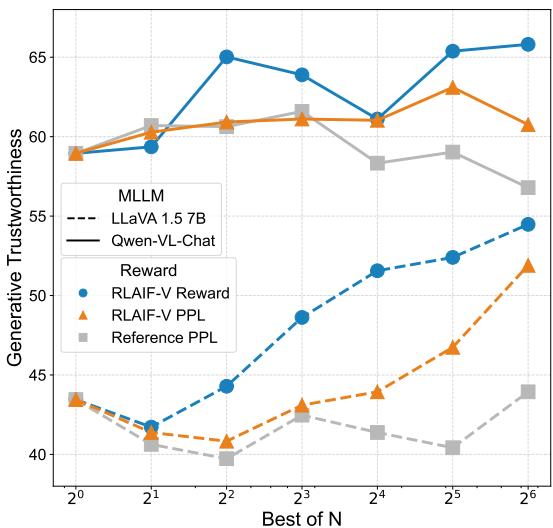
As shown in Figure 5, applying this self-feedback reward (the blue line) significantly boosts trustworthiness as you increase the number of samples (\(N\)), outperforming other methods like simple perplexity (PPL).
Experimental Results: Beating the Teacher
The researchers tested RLAIF-V on several major benchmarks, including Object HalBench (hallucination detection) and MHumanEval. They also compared it against closed-source giants like GPT-4V.
Quantitative Analysis
The results, presented in Table 1 below, are striking.
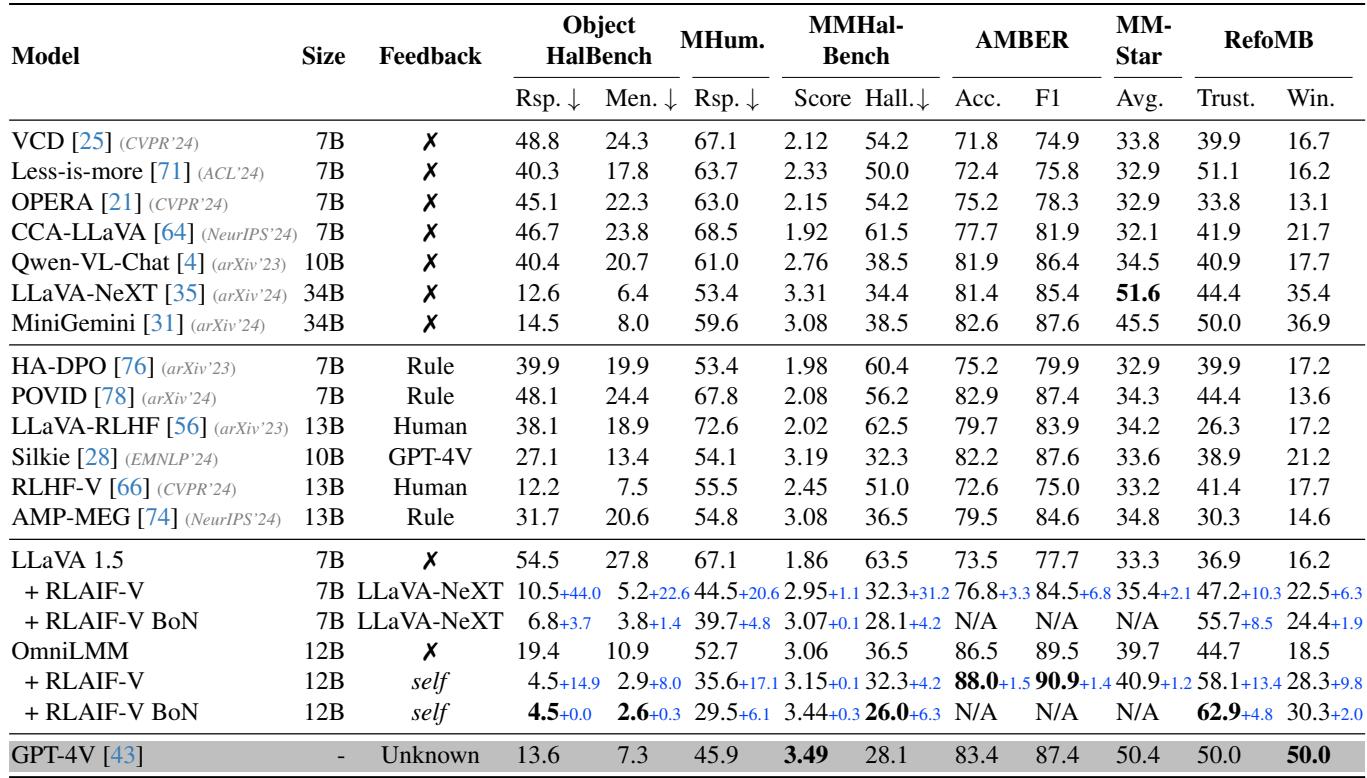
Key takeaways from the data:
- Massive Reduction in Hallucinations: RLAIF-V 7B reduces object hallucinations by 80.7% compared to the baseline LLaVA 1.5.
- Outperforming GPT-4V: Look at the bottom rows. RLAIF-V 12B achieves lower hallucination rates (a score of 35.6 on MHumanEval hallucination vs. GPT-4V’s 45.9).
- Self-Alignment Works: The “OmniLMM + RLAIF-V” row represents a model aligned using itself as the labeler. It still beats GPT-4V on trustworthiness metrics. This proves you don’t need a smarter teacher to improve a model; you just need a smarter process.
Generalization
One might worry that the feedback is specific to one model. However, the researchers found that data collected using RLAIF-V is highly transferrable.
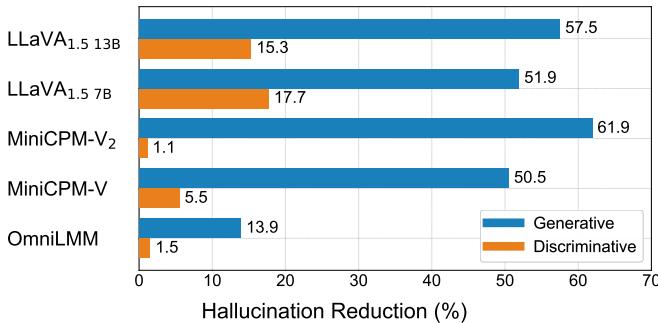
Figure 4 demonstrates that data generated by the RLAIF-V 12B model can be used to train completely different models (like MiniCPM-V or LLaVA), resulting in significant hallucination reductions (the blue bars) across the board.
Qualitative Comparison
Numbers are great, but what does this look like in practice? Let’s look at a comparison between RLAIF-V and GPT-4V.

In Figure 12 (bottom example), the prompt asks about people in a truck.
- GPT-4V (Red box): Hallucinates that the people are wearing “white clothing.”
- RLAIF-V (Green box): Correctly identifies they are wearing red hats but does not invent the clothing color.
This highlights the core achievement of RLAIF-V: it is more conservative and precise, avoiding the tendency to “fill in the blanks” with probable but incorrect details.
RefoMB: A Better Yardstick
During their research, the authors realized that existing benchmarks for MLLMs were flawed. Many relied on GPT-4 text-only evaluation which missed visual nuances, or GPT-4V visual evaluation which itself suffers from hallucinations.
To fix this, they created RefoMB (Reliable Free-format Multimodal Benchmark).
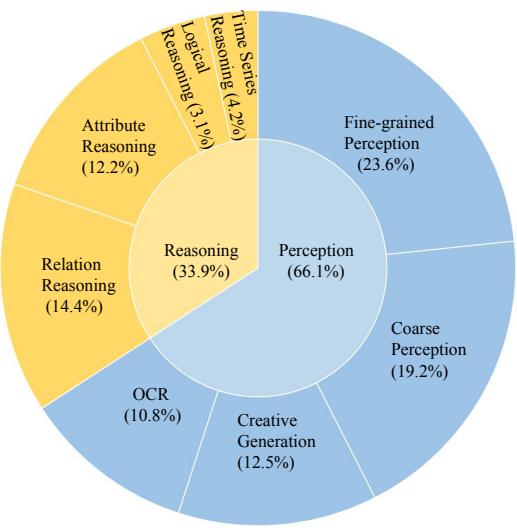
RefoMB covers diverse capabilities, from fine-grained perception to logical reasoning. The authors used a rigorous process involving human-verified “comprehensive image descriptions” to ensure the ground truth was actually true. This allows for a fair fight when comparing model trustworthiness.
Conclusion and Implications
The RLAIF-V paper presents a significant shift in how we think about AI alignment. It challenges the assumption that we need human labor or massive proprietary models to make AI trustworthy.
By breaking the problem down—deconfounding the inputs, dividing the feedback tasks, and iterating on the results—open-source models can effectively “pull themselves up by their bootstraps.”
The Key Takeaways:
- Peer Feedback Works: Open-source models can generate human-level feedback if the task is structured correctly (Divide-and-Conquer).
- Super Trustworthiness: It is possible to build models that are statistically more trustworthy than GPT-4V using purely open-source methods.
- Inference Matters: You can squeeze more performance out of a model after training by using its own probability distribution as a trustworthiness filter (Self-Feedback).
For students and researchers, RLAIF-V offers a blueprint for high-quality alignment accessible to anyone with consumer-grade hardware, democratizing the path to safer, more reliable AI.