](https://deep-paper.org/en/paper/2405.18348/images/cover.png)
In the rapidly evolving world of Machine Translation (MT), we have reached a pivotal moment. A few years ago, the goal of translation systems was simply to produce understandable text. Today, systems like Google Translate, DeepL, and GPT-4 produce translations that are often indistinguishable from human output. We are no longer dealing with “word salad”; we are dealing with nuance, style, and high-fidelity accuracy.
But this success brings a new, insidious problem. The tools we use to grade these systems—automatic metrics like BLEU, COMET, and BLEURT—were designed and validated in an era where the difference between a “good” and a “bad” translation was obvious.
What happens when most translations are good? Can our current metrics actually tell the difference between a “great” translation and a “perfect” one?
A recent research paper titled “Can Automatic Metrics Assess High-Quality Translations?” tackles this exact question. The researchers systematically stress-tested state-of-the-art metrics against high-quality human translations. Their findings are a wake-up call for the NLP community: our measuring sticks might be broken exactly where we need them most.
In this deep dive, we will explore how modern metrics fail to distinguish between high-quality alternatives, why they struggle to identify error-free text, and what this implies for the future of MT evaluation.
The High-Quality Shift
To understand the problem, we first need to look at the data. In the past, datasets were a mixed bag of quality. Today, however, translation models are highly performant.
The researchers analyzed data from recent WMT (Workshop on Machine Translation) competitions. They used the MQM (Multidimensional Quality Metrics) framework as the gold standard. Unlike simple 1-10 scores, MQM involves trained linguists marking specific error spans (like “mistranslation” or “grammar”) and assigning penalties:
- 0: No errors (Perfect).
- -1: Minor errors.
- -5: Major errors.
The paper defines High-Quality (HQ) translations as those with an MQM score greater than -5. This means the translation has no major errors that would confuse a reader.
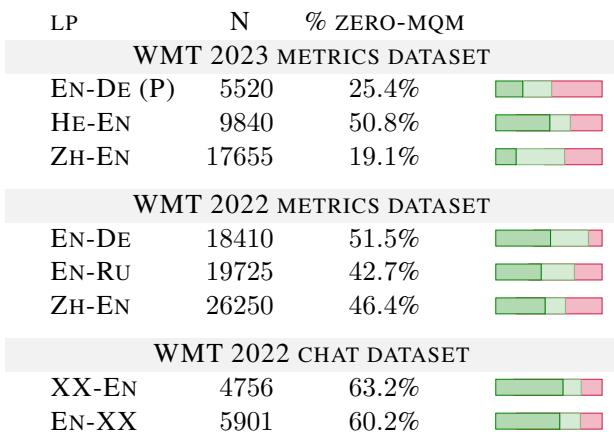
As shown in Table 1, the landscape of translation data is overwhelmingly “green.” Across different language pairs (like English-to-German or Chinese-to-English), the percentage of translations with zero errors (dark green) or only minor errors (light green) is massive. For English-to-German in WMT 2022, over 51% of translations were error-free.
This creates a statistical challenge. If you train a metric to spot disasters, but it only sees excellence, how do you know if it’s actually working? The researchers argue that current evaluation protocols mask the inability of metrics to handle this high-quality regime.
The Methodology: Stress-Testing the Metrics
The core contribution of this paper is a rigorous stress test of automatic metrics. The authors propose that we stop looking at “global correlation” and start looking at “local ranking.”
The Problem with Global Correlation
Traditionally, metric performance is calculated using Pearson or Spearman correlation over an entire dataset. This looks at thousands of sentence pairs (System A translating Sentence 1, System B translating Sentence 2, etc.) and asks: Does the metric generally agree with humans?
The problem is that this method mixes “easy” comparisons with “hard” ones. It’s easy for a metric to know that a fluent sentence is better than a broken one. It is much harder to look at one source sentence and three different, valid translations, and decide which is best.
The Experimental Setup
To test this, the authors designed specific ranking configurations, illustrated in Figure 1.
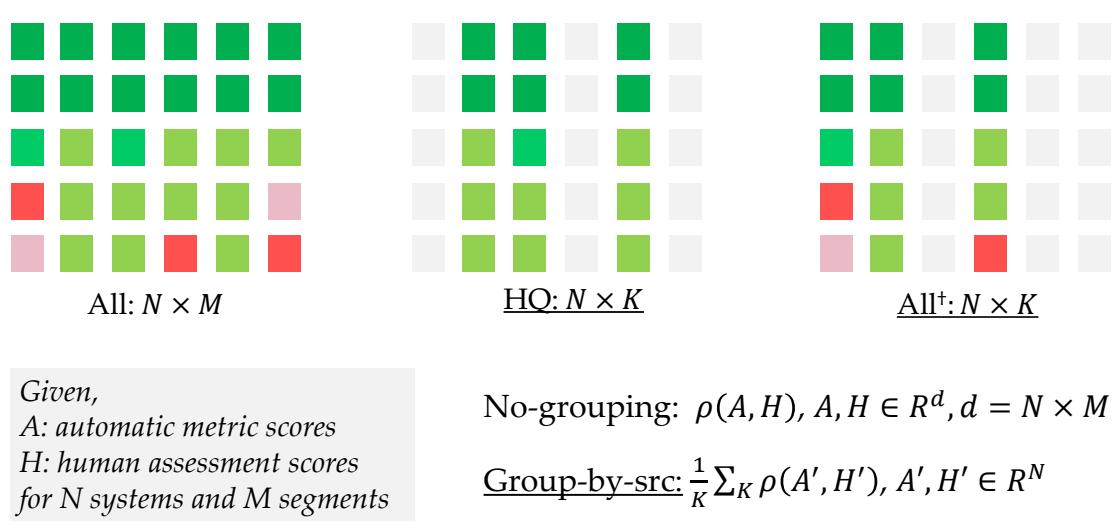
Let’s break down the grids in Figure 1:
- Left Grid (All: N × M): This is the standard approach (No-Grouping). You take all \(N\) systems and all \(M\) sentences and calculate one big correlation score. This effectively measures if a metric can separate good translations from bad ones generally.
- Middle Grid (HQ: N × K): This is the critical test. The researchers filtered the data to keep only the High-Quality (HQ) translations. They then grouped them by the source sentence (Group-by-Src). The task here is: Given one source sentence and several high-quality translations, can the metric rank them in the same order as humans?
- Right Grid (All⁺: N × K): This is a control setup, using the standard grouping but including all quality levels.
If a metric is truly robust, it should perform well in the middle grid (HQ). It should be able to detect the nuanced differences between a translation with one minor punctuation error and a translation with zero errors.
Result 1: The Ranking Failure
So, how did the metrics fare? The results were sobering.
The researchers tested several classes of metrics:
- Lexical metrics: BLEU, chrF (based on word/character overlap).
- Embedding metrics: BERTScore.
- Learned metrics: COMET, BLEURT, MetricX (neural networks trained to predict quality).
- Quality Estimation (QE) metrics: CometKiwi, GEMBA-MQM (metrics that don’t look at a human reference translation, only the source and the output).
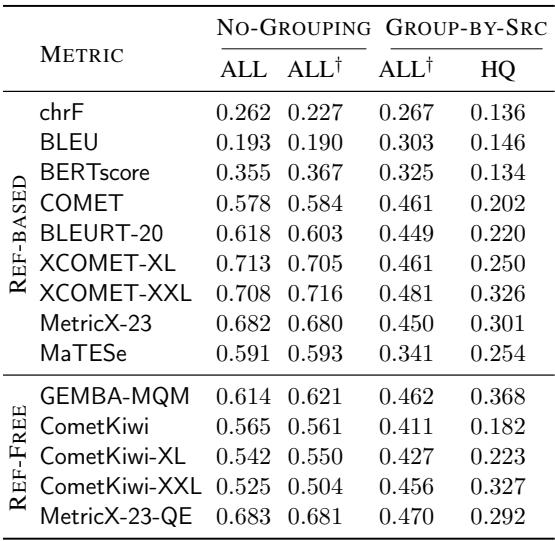
Table 2 presents the Spearman correlations for the English-to-German dataset.
Analyzing the Data
Look at the column labeled Group-by-src / HQ. This represents the “hard mode” of evaluating high-quality translations for the same source.
- Massive Performance Drop: Compare the No-Grouping / ALL column (standard evaluation) with the Group-by-src / HQ column.
- COMET drops from 0.578 to 0.202.
- BLEURT-20 drops from 0.618 to 0.220.
- xCOMET-XL drops from 0.713 to 0.250.
This indicates that while these metrics are great at telling a good translation from a bad one generally, they are nearly random when asked to rank two high-quality translations against each other.
QE Metrics are Competitive: Surprisingly, Quality Estimation metrics (which don’t use reference translations) performed on par with or better than reference-based metrics in the HQ setting. GEMBA-MQM (a prompt-based metric using GPT-4) achieved the highest correlation (0.368), though even this is quite low.
The “Tie” Problem: The authors suggest that one reason for low correlations is that metrics struggle to predict “ties.” In the HQ regime, many translations are equally good (e.g., MQM score of 0). Humans recognize this equality; metrics often force a ranking based on arbitrary features, introducing noise.
Result 2: Identifying “Perfection” (HQ-ZERO)
Ranking is hard, especially when translations are similar. So the researchers asked a simpler binary question: Can the metric identify a translation that has ZERO errors?
In the MQM framework, a perfect translation gets a score of 0. Most automatic metrics are normalized to output a score between 0 and 1 (or 0 and 100). Therefore, if a translation is perfect, the metric should output a score very close to its maximum (e.g., \(\geq 0.99\)).
The authors analyzed the distribution of metric scores specifically for these HQ-ZERO (perfect) translations.
The “Nervous” Metric Syndrome
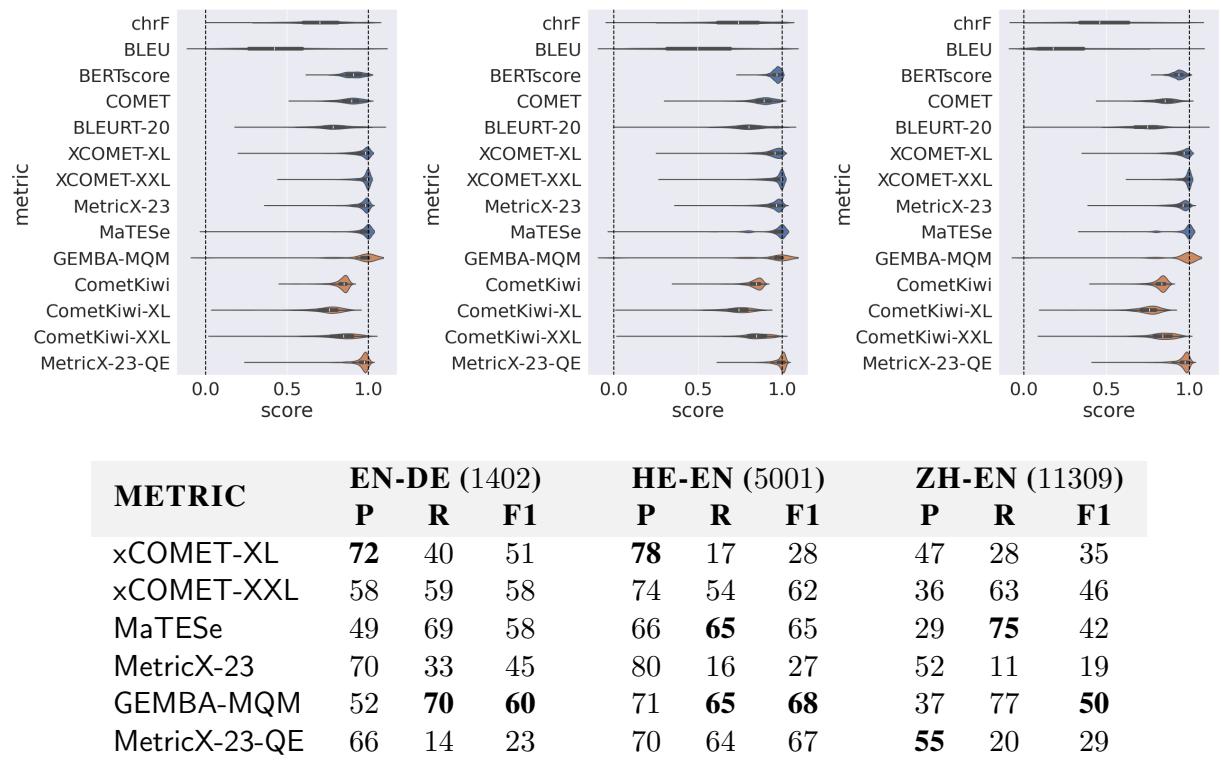
The top half of Figure 2 shows violin plots representing the score density for perfect translations. Ideally, these blobs should be smashed right up against the top of the graph (score 1.0).
- Lexical Metrics (chrF, BLEU): They almost never give a perfect score. This is expected; unless the translation is identical to the human reference, these metrics will penalize it, even if it’s a perfectly valid alternative translation.
- Learned Metrics (BLEURT, COMET): They also struggle to commit to a perfect score. Their distributions are spread out, often centering around 0.8 or 0.9. This means they are “underestimating” the quality of perfect translations.
- GEMBA-MQM: This metric (the red violin plot) shows a strong density at the very top. It is much more willing to label a translation as “error-free.”
Precision vs. Recall Trade-off
The table at the bottom of Figure 2 quantifies this using Precision (P), Recall (R), and F1 scores.
- xCOMET-XL has high Precision (0.759) but terrible Recall (0.026). It almost never calls a translation perfect, but when it does, it’s usually right.
- GEMBA-MQM achieves the best balance (Highest F1), with a very high Recall (0.835). It catches most of the perfect translations.
This reveals a flaw in how we train metrics. Most are trained to regress on human scores (predicting a 0-100 number). They learn to “hedge their bets” to minimize error, rarely outputting the extreme value of 1.0 even when the input is perfect.
Result 3: The Bias of LLMs
Given the results above, one might think, “We should just use GEMBA-MQM (GPT-4) for everything!” It ranks best in HQ settings and is willing to give perfect scores.
However, the researchers uncovered a critical bias.
They looked at Preference Bias. They calculated how often a metric assigns a “valid” (perfect) score to a translation that is actually perfect (HQ-ZERO) versus one that is not perfect (Non HQ-ZERO).
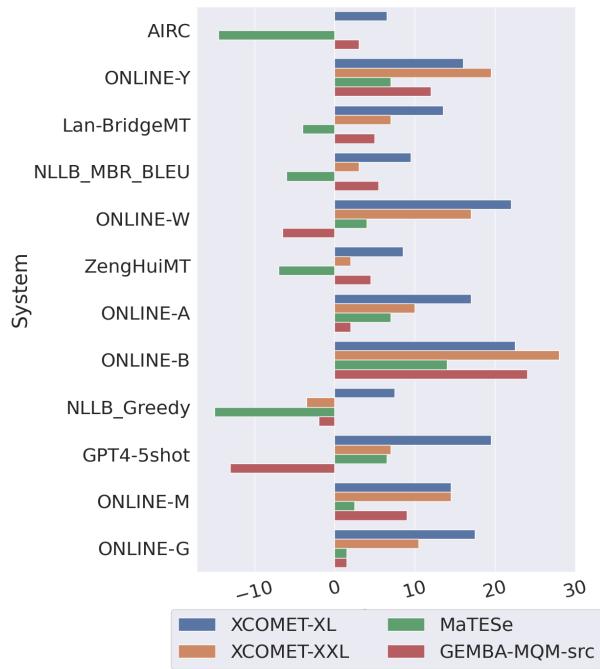
In Figure 3, we see the performance of metrics across different translation systems (like ONLINE-B, GPT-4-5shot, NLLB).
Look at the red bars representing GEMBA-MQM. Notice the behavior on GPT-4-5shot (the second row). GEMBA-MQM frequently assigns a perfect score to GPT-4 translations even when humans marked errors in them.
This suggests a self-preference bias. Because GEMBA-MQM is powered by GPT-4, it tends to prefer translations generated by GPT-4, overestimating their quality. It also penalizes other systems more harshly.
Conversely, the metric MaTESe (green bars) tends to overestimate quality across the board (high recall, low precision), assigning perfect scores to many translations that actually contain errors.
Implications for Students and Researchers
This paper highlights a significant “blind spot” in Natural Language Processing. As we push for “human parity” in AI, our evaluation methods are lagging behind.
Here are the key takeaways for anyone studying or working in this field:
- Don’t Trust Global Correlations: If you are reading a paper claiming a new metric is “state-of-the-art” based on global correlation, be skeptical. Ask how it performs on high-quality data specifically.
- The “Reference” is not Absolute: The failure of BLEU and chrF in the HQ regime confirms that relying on overlap with a single human reference is obsolete for high-quality translation. A perfect translation might use completely different words than the reference.
- Metric Calibration Matters: Current neural metrics are “under-confident.” They rarely predict perfect scores. If you are using these metrics to filter data (e.g., “keep only the best translations for training”), you might be throwing away perfectly good data because the metric is afraid to score it a 1.0.
- LLMs as Judges: Using LLMs (like GPT-4) as evaluators is promising but dangerous. They have distinct biases, favoring their own “voice” or style. This can create a feedback loop where we optimize models to sound like GPT-4, rather than to be correct.
Conclusion
The researchers conclude that while automatic metrics have served us well, they are currently insufficient for the “last mile” of translation quality. When the difference between two translations is a matter of nuance rather than grammar, current metrics are essentially guessing.
For the field to advance, we need a paradigm shift. We may need to move away from regression-based metrics (predicting a score) toward detection-based metrics (identifying specific errors), similar to the MQM framework itself. Until then, human evaluation remains the only true way to distinguish the great from the merely good.