](https://deep-paper.org/en/paper/2405.20974/images/cover.png)
Introduction
Imagine you are taking a difficult exam. You encounter a question where you recall two possible answers, but you can’t quite distinguish which one is correct. When you write down your answer, you might add a note: “I’m about 60% sure, but I might be confusing this with a similar concept from Chapter 4.”
That note is crucial. It separates a lucky guess from true knowledge.
Large Language Models (LLMs), however, are notoriously bad at this. They are often “confident liars.” They can hallucinate—fabricating information entirely—while sounding authoritative. Conversely, they might hedge their bets on facts they actually know perfectly well. For students and researchers utilizing AI, this lack of reliable “calibration” (the alignment between confidence and accuracy) is a major hurdle for trust.
In this post, we are diving deep into SaySelf, a research paper that proposes a novel training framework designed to fix this. SaySelf doesn’t just teach an LLM to give a confidence score (e.g., “I am 80% sure”); it teaches the model to produce self-reflective rationales. It forces the AI to introspect, identify specific knowledge gaps, and explain why it is uncertain in natural language.
The Problem: Why is Confidence So Hard?
Before understanding the solution, we must look at how we currently try to get confidence scores from LLMs and why those methods fall short.
There are generally two existing ways to estimate LLM confidence:
- Prompting-based approaches: You simply ask the model, “Are you sure?” or “Give me a score from 1 to 10.” Or, you ask the model to solve the problem multiple times (Self-Consistency) and see how often it repeats the same answer.
- The downside: Direct prompting is often inaccurate. Self-consistency is computationally expensive (you have to run the model 10+ times for one answer) and causes high latency.
- Training-based approaches: You fine-tune the model on datasets that include labels like “I am sure” or “I am unsure.”
- The downside: These are often binary (Sure/Unsure) and lack nuance. They don’t tell you why the model is hesitating.
The researchers behind SaySelf visualized this comparison clearly.
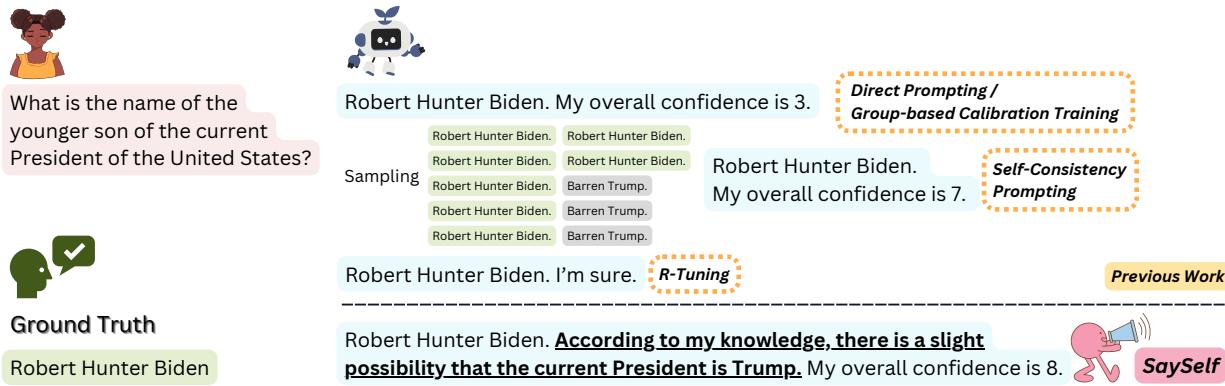
As shown in Figure 1, while previous methods (like R-Tuning or Direct Prompting) might give a binary “I’m sure” or a raw number, SaySelf provides a fine-grained score (8/10) and a specific reason: “According to my knowledge, there is a slight possibility that the current President is Trump.” This specific reasoning allows the user to understand that the model is hallucinating or relying on outdated data, rather than just guessing blindly.
The Solution: The SaySelf Framework
SaySelf is a two-stage training framework. It aims to teach the LLM to output a tuple of three things for every question:
- A Response: The actual answer.
- A Self-Reflective Rationale: An explanation of knowledge gaps.
- A Confidence Estimate: A score (e.g., probability or 1-10 scale).
The architecture is divided into Supervised Fine-Tuning (SFT) and Reinforcement Learning (RL).
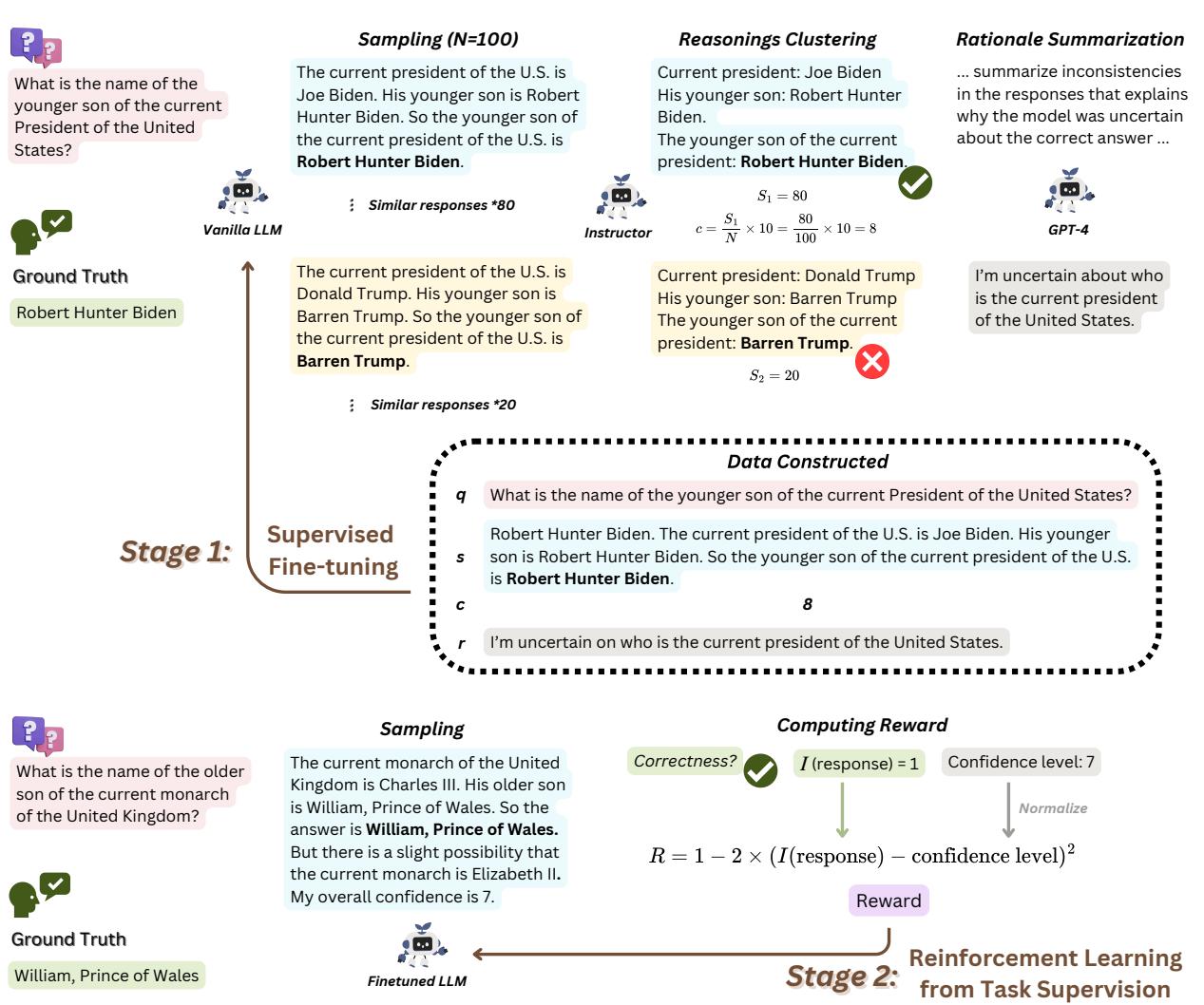
Let’s break down these two stages in detail.
Stage 1: Supervised Fine-Tuning (SFT)
The biggest challenge in training a model to “explain its uncertainty” is the lack of data. There are no massive datasets containing questions paired with “introspective AI thoughts.” The researchers had to build one using the model itself.
The Data Generation Pipeline
To create the training data, the researchers used a clever “Sampling and Clustering” approach:
- Sampling: For a specific question (from a dataset like HotpotQA), they ask the vanilla LLM to generate an answer and a reasoning chain 100 times.
- Clustering: Because LLMs are repetitive, many of these 100 answers will be identical or semantically similar. The system groups these responses into clusters.
- Analyzing Inconsistency: This is the core innovation. If the model generates one answer 70 times and a different answer 30 times, there is inconsistency. This inconsistency is a proxy for the model’s internal uncertainty.
- Rationale Generation: They feed these conflicting clusters into a more advanced model (like GPT-4) with a specific prompt: Analyze the inconsistency between these groups and summarize the uncertainty from a first-person perspective.
For example, if one cluster says a building was founded in 1903 and another says 1920, GPT-4 would generate a training label saying: “I am uncertain about the founding year because I have conflicting information about whether the building is in Letchworth or Welwyn Garden City.”
The Training Objective
Once the dataset is constructed, the vanilla LLM is fine-tuned to produce these outputs. The mathematical objective is to maximize the likelihood of generating the correct answer (\(s\)), the rationale (\(r\)), and the confidence score (\(c'\)) given the question (\(q\)).
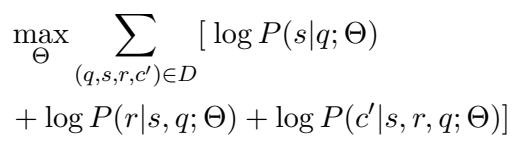
This equation ensures the model learns to generate the answer, explain its thinking, and assign a confidence score all in one smooth generation process.
Stage 2: Reinforcement Learning from Task Supervision
Supervised fine-tuning gets the model to speak the language of uncertainty, but it doesn’t necessarily make the confidence scores accurate. The model might learn to say “I am 90% sure” for everything just because that appeared frequently in the training data.
To fix this, the researchers employ Reinforcement Learning (specifically PPO). They need to penalize the model for being “confident but wrong” and reward it for being “confident and right.”
The Reward Function
The researchers designed a specific quadratic reward function to calibrate the confidence.

Let’s unpack this equation (\(R\)):
- \(\mathbb{I}(\mathrm{response})\) is the correctness indicator (1 if correct, 0 if incorrect).
- If the model is Correct (1) and High Confidence (1.0):
- \(R = 1 - 2 * (1 - 1)^2 = 1\). (Maximum Reward)
- If the model is Incorrect (0) and High Confidence (1.0):
- \(R = 1 - 2 * (0 - 1)^2 = 1 - 2 = -1\). (Maximum Penalty)
- If the model is Incorrect (0) and Low Confidence (0.0):
- \(R = 1 - 2 * (0 - 0)^2 = 1\). (Reward for knowing you don’t know!)
This function forces the model to lower its confidence when it is likely to be wrong, effectively “calibrating” it.
The Optimization
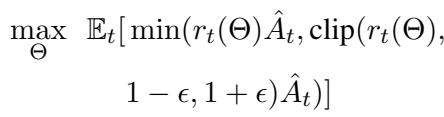
The model is then updated using Proximal Policy Optimization (PPO), a standard RL algorithm, to maximize these rewards.
Experiments and Results
Does SaySelf actually work? The researchers tested the framework on several datasets, including HotpotQA (in-distribution) and TruthfulQA (out-of-distribution), using Mistral-7B as the base model.
They measured success using two main metrics essential for uncertainty estimation:
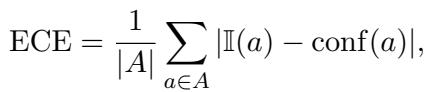
1. ECE (Expected Calibration Error): This measures the gap between the predicted confidence and the actual accuracy. If you say you are 70% confident 100 times, you should be right exactly 70 times. If you are right only 50 times, your calibration error is high. Lower is better.
2. AUROC (Area Under the Receiver Operating Characteristic): This measures how well the confidence score distinguishes between correct and incorrect answers. A perfect score (1.0) means correct answers always have higher confidence than incorrect ones. Higher is better.

Calibration Performance
The results show that SaySelf significantly outperforms existing baselines.
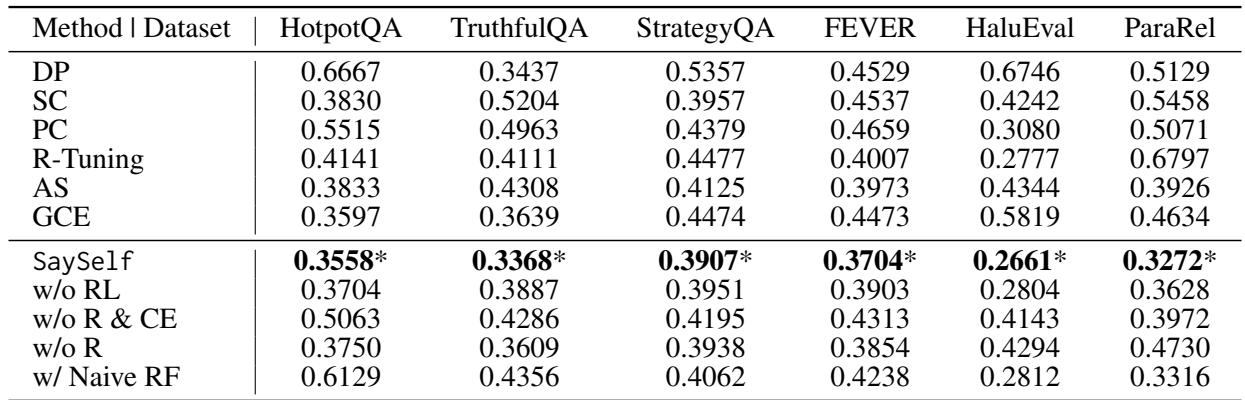
In Table 1, look at the HotpotQA column. The baseline “Direct Prompting” (DP) has a massive error of 0.6667. SaySelf drops this to 0.3558. This improvement is consistent across out-of-distribution datasets like TruthfulQA and StrategyQA as well. The asterisks indicate that these improvements are statistically significant.
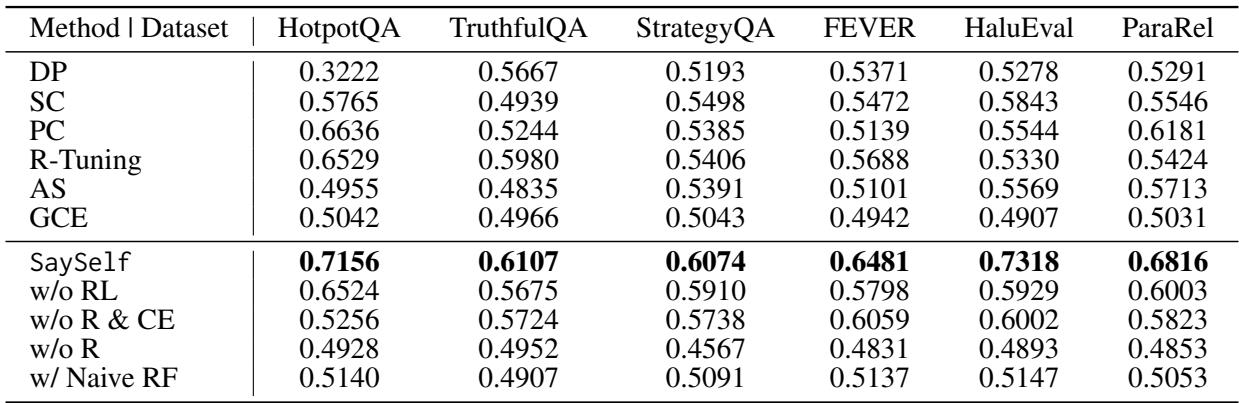
Similarly, when looking at AUROC (the ability to distinguish right from wrong), SaySelf achieves the highest scores.
Does Calibration Hurt Accuracy?
A common fear in uncertainty training is that the model becomes so cautious it stops answering correctly, or the additional training interferes with its general reasoning capabilities.
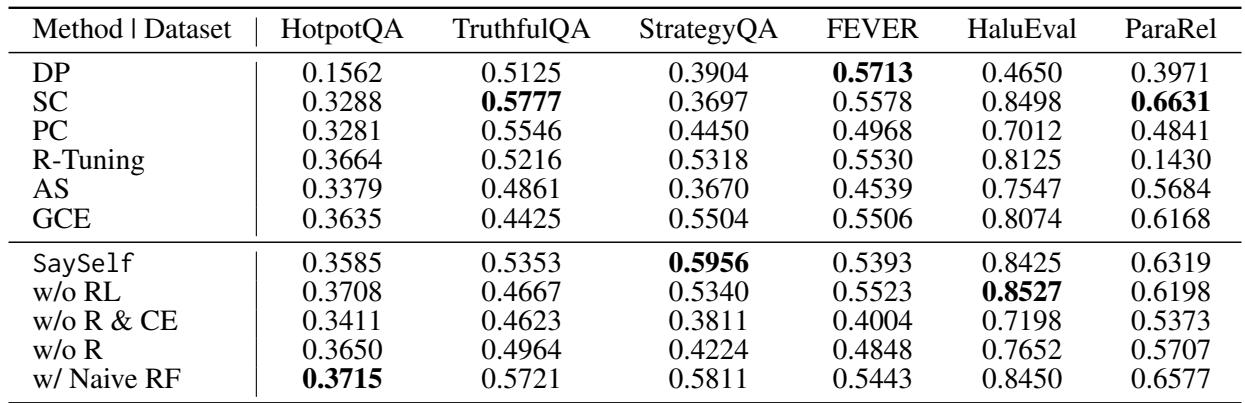
As Table 2 shows, SaySelf maintains accuracy comparable to the baselines. While “Self-Consistency” (SC) sometimes achieves higher accuracy, it requires sampling the model many times (slow inference). SaySelf achieves competitive accuracy with a single inference pass, making it much more practical for real-world applications.
The Quality of Rationales
Perhaps the most interesting part of SaySelf is the qualitative output. The model generates “Self-Reflective Rationales.” But are they faithful? Do they actually represent the model’s confusion?
The researchers used GPT-4 to evaluate the faithfulness of the generated rationales (scoring them 1-10).

SaySelf scores significantly higher (8.3 on HotpotQA) compared to baselines. This suggests the rationales are not just generic text; they accurately describe the knowledge gaps.
Let’s look at a specific example to see this in action.

In this example (Figure 3), the model is asked about the founding year of the town where “the Howard Centre” is located.
- Cluster 1 thinks it is in Welwyn Garden City (founded 1920).
- Cluster 2 thinks it is in Letchworth (founded 1903).
- SaySelf Rationale: The model explicitly states: “I am uncertain about whether the Howard Centre is in Letchworth or Welwyn Garden City… this ambiguity results in differing founding years.”
This is a massive leap forward from a model simply outputting “Confidence: 0.5”. It empowers the user to verify the specific ambiguity (Location of the Howard Centre) rather than checking the whole fact chain from scratch.
Conclusion
SaySelf represents a significant step toward “Honest AI.” By combining Supervised Fine-Tuning on self-generated inconsistencies with Reinforcement Learning tailored for calibration, the framework teaches LLMs to:
- Estimate their confidence more accurately (Calibration).
- Maintain their reasoning capabilities (Accuracy).
- Explain why they are confused in human-readable terms (Explainability).
For students and developers, this paper highlights that reliability in AI isn’t just about getting the right answer; it’s about knowing when you might have the wrong one. As LLMs become more integrated into decision-making workflows, mechanisms like SaySelf that allow models to “know what they don’t know” will be essential for building trust.
Instead of a black box that confidently asserts falsehoods, SaySelf moves us toward a “glass box” that can say, “I’m not sure, and here is exactly why.”