](https://deep-paper.org/en/paper/2406.00770/images/cover.png)
If you have been following the explosion of Large Language Models (LLMs), you know that the secret sauce isn’t just the sheer number of parameters—it’s the data. specifically, instruction tuning. This is the process that turns a raw text predictor into a helpful assistant capable of following complex commands.
To get good performance, you need high-quality, complex instruction datasets. But here lies the bottleneck: creating these datasets by hand is unscalable and expensive. Recently, the “Evol-Instruct” method (popularized by models like WizardLM) proposed a solution: use an LLM to rewrite simple instructions into complex ones.
However, even Evol-Instruct has a flaw. It relies on human-designed heuristics and rules to make questions harder. If you want to evolve a math dataset, you need different rules than for a creative writing dataset. It requires expertise and manual trial-and-error.
In this post, we are diving deep into Auto Evol-Instruct, a new framework from Microsoft Research that removes the human from the loop. Instead of manually writing rules to make data harder, the authors propose a system where LLMs automatically discover and optimize the best strategies to evolve instructions.
The Background: Why Evolution Matters
Before we look at the automation, we need to understand the premise of Instruction Evolution.
Most open-source instruction datasets (like ShareGPT or Alpaca) have a quality ceiling. They are often simple questions with simple answers. To train a “smart” model (like GPT-4 or Claude), you need training data that forces the model to reason, plan, and handle constraints.
The original Evol-Instruct method tackled this by taking a simple prompt, such as “Write a Python script to sort a list,” and applying a specific heuristic, such as “Add a time complexity constraint.” The result might be: “Write a Python script to sort a list in O(n log n) time.”
The goal is to maximize the performance of a model trained on this evolved data. Mathematically, if \(X\) is our original dataset and \(e\) is our evolving method (the rules for making it harder), we want to find the method \(e\) that results in the best model performance \(Q\):

The problem is that finding that perfect method \(e^*\) has historically been a manual job. Auto Evol-Instruct automates this search.
The Auto Evol-Instruct Framework
The core innovation of this paper is treating the design of the evolution prompt as an optimization problem. The framework doesn’t just rewrite data; it learns how to rewrite data better over time.
The architecture consists of two distinct LLM roles:
- The Evol LLM: The worker. It takes an instruction and tries to make it more complex based on current rules.
- The Optimizer LLM: The manager. It analyzes the worker’s output, spots failures, and updates the rules to prevent those failures in the future.
Let’s look at the overall architecture:
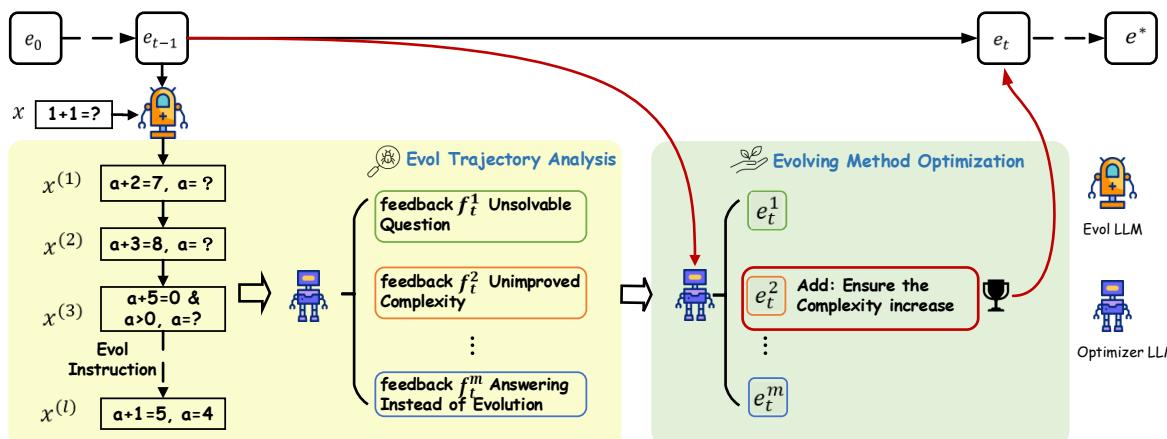
As shown in Figure 1, the process is a loop. We start with an initial evolving method (\(e_0\)). The Evol LLM tries to use this method to evolve instructions (\(x^{(1)}\) to \(x^{(l)}\)). The Optimizer LLM then steps in to analyze the “trajectory”—the path from simple to complex—and generates feedback (\(f_t\)). Based on this feedback, it updates the method to \(e_t\).
Let’s break this down into its three crucial phases.
Phase 1: Initial Evolving Method Design
Standard Evol-Instruct uses rigid templates. Auto Evol-Instruct starts with a “Universal Initial Evolving Method.”
Instead of telling the model exactly how to make a prompt harder (e.g., “add a constraint”), the initial prompt asks the model to:
- Read the instruction.
- Brainstorm a list of possible methods to make it more complex.
- Create a plan.
- Execute the plan.
This shifts the burden of creativity from the human engineer to the LLM. However, a generic prompt isn’t enough. It will often fail or produce “fake” complexity. That is why we need the optimization loop.
Phase 2: Evol Trajectory Analysis
This is arguably the most interesting part of the paper. How does an LLM know if an instruction evolution “failed”?
The researchers realized that when an LLM fails to make a question harder, it usually exhibits specific behaviors. For example, instead of rewriting the question, the model might just answer the question. Or, it might say “Understood, here is more info.”
The Optimizer LLM analyzes the inputs and outputs to detect these specific Evolution Failures.

As seen in Table 5 above, failures are categorized into types like:
- Stagnant Complexity: The model answers the prompt rather than complicating it.
- Insufficient Qualification: The model asks for clarification instead of rewriting.
- Loss of Key Information: The new prompt forgets the core task of the old one.
The Optimizer LLM uses a specific prompt to scrutinize these trajectories. It acts as a debugger, identifying exactly why the evolution didn’t work.
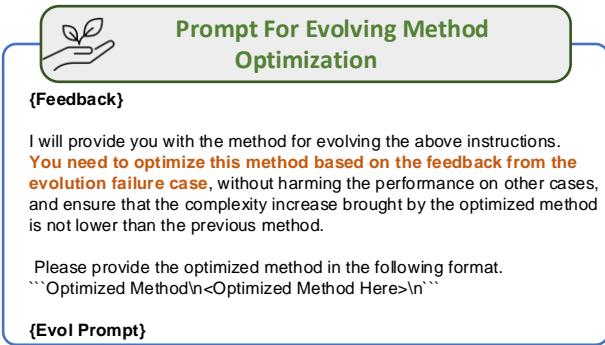
Figure 7 (top) shows the prompt used to find bugs in the evolution. Figure 8 (bottom) shows the prompt used to fix the method based on those bugs.
Phase 3: Evolving Method Optimization
Once the Optimizer identifies a problem (e.g., “The Evol LLM is answering the question instead of rewriting it”), it generates a new prompt (\(e_t\)) that explicitly forbids that behavior or encourages a better one.
For example, if the feedback is “Unimproved Complexity,” the Optimizer might add a constraint to the prompt: “Ensure the complexity increase is significant and involves multiple logical steps.”
Multiple Optimizations for Stability LLMs can be unstable. A single optimization step might make the prompt worse. To solve this, the authors borrow from the concept of “Self-Consistency.”
At each step, they generate \(m\) different potential optimized prompts (\(e_t^1\) to \(e_t^m\)). They test all of them on a small development set and calculate the Evolution Failure Rate:
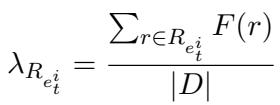
They select the prompt with the lowest failure rate to be the official method for the next round. This ensures the system creates a robust, high-quality instruction evolver.
Experiments and Results
Does this automated system actually beat human-designed heuristics? The authors tested the framework across three distinct domains: Instruction Following (Chat), Mathematical Reasoning, and Code Generation.
Implementation Details
They used GPT-4 as the Optimizer and generally used GPT-4 or GPT-3.5 as the Evol LLM. They then used these evolved datasets to fine-tune open-source models like Mistral-7B and Mixtral-8x7B.
Main Performance
The results show a clear victory for automation.

Looking at the table above, Auto Evol-Instruct consistently outperforms both the raw seed data and the standard, human-designed Evol-Instruct.
- Math (GSM8K): This is the most dramatic result. On the Mixtral-8x7B model, Auto Evol-Instruct achieves 82.49%, compared to 79.15% for standard Evol-Instruct and 70.60% for the seed data.
- Chat (MT-Bench): The method pushes the score to 8.00, surpassing the standard evolution method.
We can visualize this gap more clearly in the bar charts below:
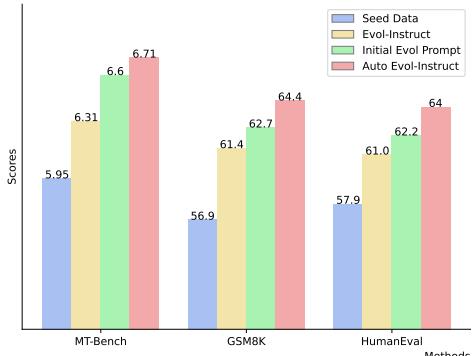
In Figure 3, the pink bars (Auto Evol-Instruct) are consistently the highest. What is particularly impressive is that this superior performance comes without needing a human to sit down and figure out “how to make a math problem harder.” The system figured it out itself.
The Importance of Iteration
One might ask: “How many times do we need to optimize the prompt?”
The authors analyzed the relationship between the number of optimization steps and the final model score.
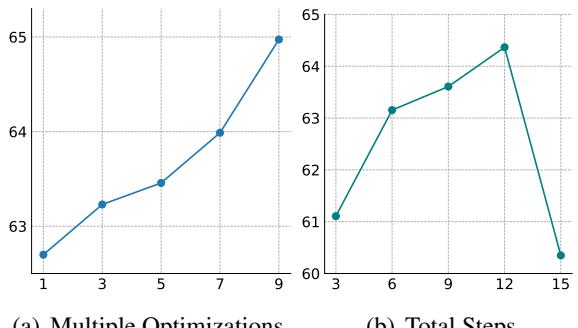
Figure 5(b) (Right) reveals an interesting “inverted U” shape. Performance increases as the prompt gets better optimized, peaking around step 12. After that, it degrades. This suggests that over-optimization is a risk—the prompt eventually becomes too cluttered or restrictive, accumulating “superfluous information” that confuses the Evol LLM.
Why This Matters
The significance of Auto Evol-Instruct extends beyond just higher benchmark scores. It represents a shift in how we approach Data-Centric AI.
- Domain Adaptability: If you need to create a dataset for a niche field (e.g., medical diagnosis or legal analysis), you don’t need to invent new heuristics for how to complicate medical questions. You just feed the seed data into this framework, and the Optimizer LLM adapts the evolution strategy to that specific domain.
- Cost Efficiency: While it involves multiple LLM calls, the authors show that the cost overhead is negligible compared to the performance gains.
- Breaking the Ceiling: We are running out of high-quality human text on the internet. Approaches like this, which synthetically elevate the complexity of existing data, are likely the future of training the next generation of models (like GPT-5 or Llama 4).
Conclusion
“Automatic Instruction Evolving for Large Language Models” offers a compelling look at the future of dataset engineering. By treating prompt design as an optimization problem solvable by LLMs, we can generate training data that is more complex, diverse, and effective than what we can curate manually.
The key takeaway for students and practitioners is simple: Don’t just fine-tune your model; fine-tune your data generation process. As models become more capable, their ability to teach themselves (and each other) will become the primary driver of progress.