](https://deep-paper.org/en/paper/2406.00999/images/cover.png)
Introduction
In the modern era of Deep Learning, data is the new oil. However, it is also a liability. With increasing concerns over user privacy and regulations like GDPR, the traditional approach of centralizing massive datasets on a single server is becoming risky and, in some cases, illegal. This has given rise to Distributed Learning frameworks, most notably Federated Learning (FL).
The promise of Federated Learning is elegant: keep the data on the user’s device (the “edge”). Instead of sending photos or text messages to a server, the device computes the necessary updates—called gradients—and sends only those updates to the central server. The server aggregates these updates to improve the global model. Theoretically, the raw data never leaves the user’s hands.
But is this process actually safe?
Recent years have seen the rise of Gradient Inversion Attacks. Researchers have demonstrated that a “curious-but-honest” server (or a malicious actor intercepting network traffic) can take these shared gradients and reverse-engineer them to reconstruct the original private training data, such as exact sentences or images.
Until now, the consensus was that for these attacks to be successful, the attacker needed access to the full model’s gradients—updates for every single parameter in the network. Consequently, defenses were proposed that involved “freezing” parts of the model or only training specific layers (layer-wise training) to minimize the attack surface.
A new paper, “Seeing the Forest through the Trees: Data Leakage from Partial Transformer Gradients,” shatters this assumption. The researchers demonstrate that you do not need the whole forest to see the trees. In fact, access to a tiny fraction of the model’s gradients—as little as 0.54% of the parameters—is sufficient to reconstruct private text data with alarming accuracy.

Background: Distributed Learning and The Threat Landscape
To understand the gravity of this research, we must first establish how distributed training and gradient attacks function.
The Mechanics of Federated Learning
In a typical Transformer-based language model training setup (like BERT), the model consists of an Embedding layer, a stack of Transformer Encoder layers, and a prediction head.
- Forward Pass: The client passes private text data (e.g., “John’s phone number is 123-456”) through the model.
- Backward Pass: The model calculates the loss (error) and computes gradients. These gradients represent the direction and magnitude by which the model weights (\(\Delta W\)) need to change to better predict the data next time.
- Transmission: The client sends \(\Delta W\) to the server.
Gradient Inversion Attacks
An attacker intercepts \(\Delta W\). Their goal is to find the input text \(x\) that produced this specific \(\Delta W\). They do this via optimization:
- The attacker creates a “dummy” input (random noise or gibberish text).
- They feed this dummy input into their copy of the model to compute “dummy gradients.”
- They compare the dummy gradients to the real, intercepted gradients.
- They adjust the dummy input to make the gradients look more like the real ones.
- Repeat until the dummy input effectively morphs into the original private text.
The “Partial” Assumption
Previous successful attacks, such as DLG (Deep Leakage from Gradients) or LAMP (Language Model Priors), utilized the full gradient vector. The community assumed that if an attacker only saw the gradients for one specific layer (e.g., Layer 5 of a 12-layer BERT model), they wouldn’t have enough information to propagate the reconstruction back to the input.
This paper proves that assumption wrong. The authors show that every single module within a Transformer—from the Feed-Forward Networks (FFN) to individual Attention matrices (Query, Key, Value)—is vulnerable.
Core Method: Attacking Partial Gradients
The core contribution of this paper is a rigorous methodology for performing Gradient Inversion Attacks using only subsets of the model’s gradients.
The Mathematical Framework
The researchers formulate the attack as an optimization problem. The goal is to minimize the distance between the gradients generated by the attacker’s reconstructed data and the true gradients received from the client.
The objective function \(\mathcal{L}\) is defined as:

Here:
- \(N\) is the subset of Transformer layers available to the attacker.
- \(M\) is the subset of specific modules (e.g., Query, Key, Value, FFN) within those layers.
- \(\Delta W'\) is the dummy gradient (from the attacker).
- \(\Delta W\) is the true gradient (from the victim).
- \(\mathcal{D}\) is the distance metric.
The Distance Metric
To align the gradients, the choice of distance metric is crucial. The authors follow state-of-the-art approaches by using Cosine Distance. Unlike Euclidean distance (L2), Cosine distance focuses on the direction of the gradient vectors rather than their magnitude. This is often more stable for reconstruction tasks involving high-dimensional text data.
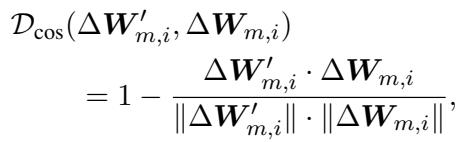
This metric calculates the cosine of the angle between the two gradient vectors. If the vectors point in the exact same direction, the distance is 0.
Granularity of the Attack
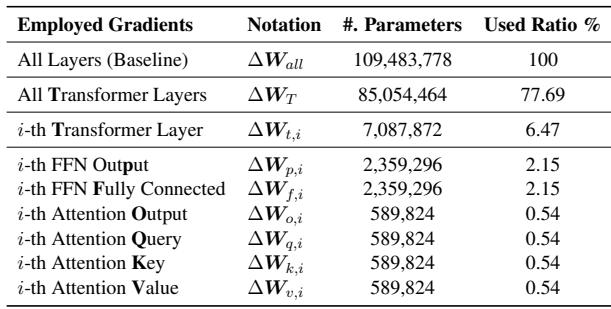
The researchers explored varying levels of “gradient visibility.” They started with the full model and systematically stripped away information to see when the attack would fail.
They categorized the gradients into specific modules found in BERT-like architectures. The table below highlights just how small the attack surface can be. While the full model has over 109 million parameters, a single Attention Query module has only roughly 590,000 parameters—roughly 0.54% of the total model size.
Specialized Objectives
The flexibility of their method allows them to target extremely specific components.
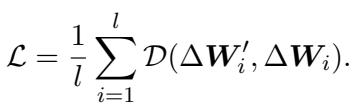
If an attacker has access to the whole model (the baseline scenario used in prior work), the loss function averages the distance across all layers:
However, if the attacker only intercepts the gradients for the Attention Query matrix of the \(i\)-th layer, the objective function simplifies to:

The optimization process then iteratively updates the dummy input tokens to minimize this specific loss. If the optimization converges, the dummy tokens should match the original private text.
Experiments and Results
The authors evaluated their method using BERT (Base, Large, and Tiny variants) on standard text classification datasets: CoLA (linguistic acceptability), SST-2 (sentiment analysis), and Rotten Tomatoes (movie reviews). They used ROUGE scores (a common metric for text similarity) to measure how closely the reconstructed text matched the original private text.
1. Are Single Layers Vulnerable?
The first major finding is that you do not need the whole model. The graph below shows the reconstruction quality (ROUGE-L score) when attacking individual Transformer layers (\(i=1\) to \(12\)).
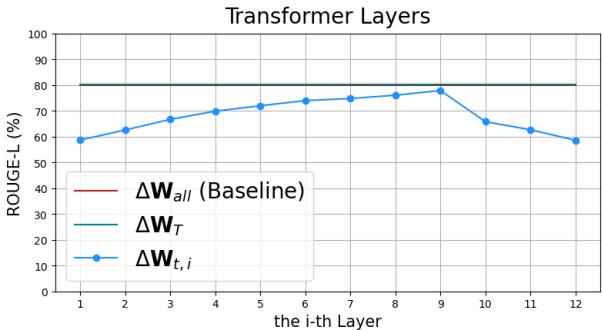
- Red Line (Baseline): The attack performance using 100% of the gradients.
- Blue Dotted Line (Single Layer): The attack performance using only that specific layer.
Analysis: Remarkably, the reconstruction performance using just a single layer (especially layers 6 through 9) is almost identical to using the full model. This suggests that the “middle” layers of a Transformer contain a “sweet spot” of information—rich enough in semantic detail to reconstruct the input, but coupled strongly enough to the input to guide the inversion process.
2. Can We Go Deeper? Attacking Attention Modules
The authors then zoomed in further, attempting to reconstruct data using only the gradients from specific matrices within the Multi-Head Attention mechanism: Query (\(W_q\)), Key (\(W_k\)), Value (\(W_v\)), and Output (\(W_o\)).
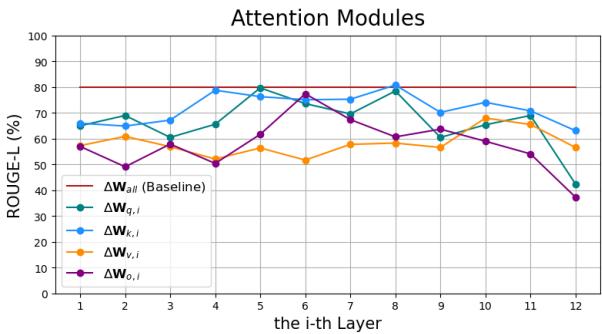
Analysis:
- Even individual linear components (0.54% of parameters) leak significant data.
- Query and Key matrices (Green and Orange lines) are generally more vulnerable than Value or Output matrices.
- Again, the middle layers (around layers 4-8) show the highest vulnerability, with some single modules achieving near-baseline performance.
3. What About Feed-Forward Networks (FFN)?
Transformer layers consist of an Attention block followed by a Feed-Forward Network. The researchers also tested the vulnerability of the FFN components.

Analysis: The FFN gradients also allow for successful reconstruction, particularly in the early-to-middle layers. However, the leakage tends to drop off more sharply in the deeper layers (10-12) compared to the attention mechanism.
4. Robustness Across Datasets
Is this specific to one type of text? The authors validated their findings across different datasets. The figure below shows the results on the CoLA dataset.
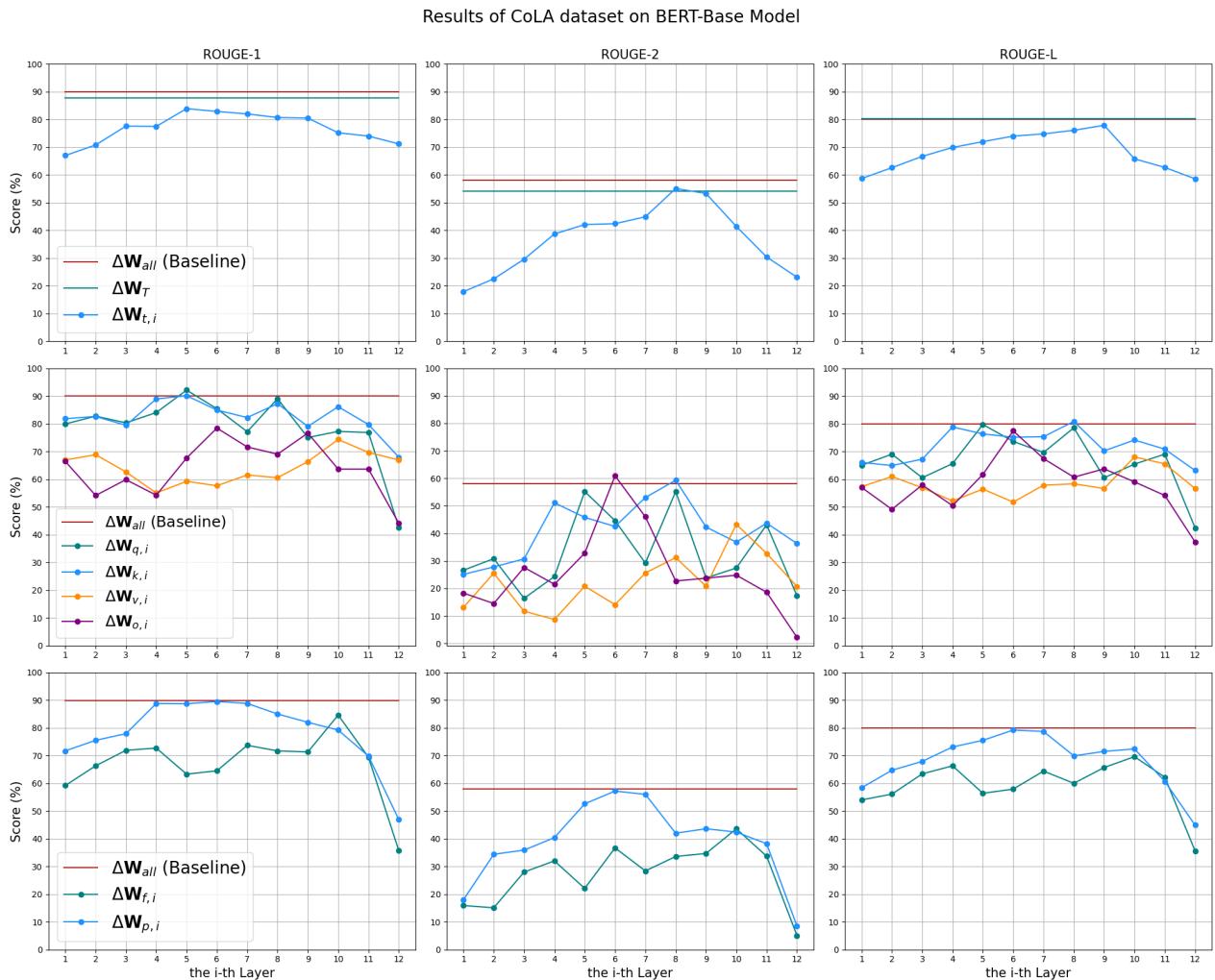
The trends remain consistent: partial gradients (green, blue, orange lines) frequently rival the baseline (red line), proving that this is a fundamental vulnerability of the Transformer architecture, not a dataset-specific quirk.
5. Does Differential Privacy Help?
The standard defense against gradient leakage is Differential Privacy (DP)—adding noise to the gradients before sharing them (e.g., via DP-SGD).
The authors applied DP with varying noise levels (\(\sigma\)) and privacy budgets (\(\epsilon\)).
- The Result: DP does reduce the success of the attack.
- The Catch: To make the attack fail significantly, the amount of noise required is so high that the model’s utility (accuracy) plummets.
- Quantifiable Failure: At a noise level where the attack starts to degrade (\(\sigma = 0.5\)), the model’s MCC (Matthews Correlation Coefficient) dropped to 0. This means the model became completely useless for its intended classification task.
This highlights a critical open problem: we currently lack a defense mechanism that effectively stops partial gradient attacks without destroying the model’s ability to learn.
Conclusion & Implications
The research paper “Seeing the Forest through the Trees” serves as a stark wake-up call for the privacy-preserving machine learning community.
Key Takeaways:
- No Safe Component: Every module in a Transformer—down to a single linear layer representing <1% of the model—is capable of leaking private training data.
- Middle Layers are Critical: The intermediate layers of deep networks appear to be the most vulnerable, acting as a bridge that retains enough input fidelity to allow reconstruction.
- Current Defenses are Insufficient: Strategies like “parameter freezing” (only updating specific layers) are not valid security measures against gradient inversion. Furthermore, Differential Privacy currently presents an unacceptable trade-off between security and utility.
Why This Matters: In real-world scenarios, engineers often use techniques like Split Learning or Layer-wise Training to save bandwidth or computational costs on edge devices. The assumption has been that sending updates for only a fragment of the model inherently protects the raw data. This research invalidates that assumption.
Future work in this field must look beyond simple noise addition. We may need to explore advanced cryptographic methods (like Homomorphic Encryption) or entirely new training paradigms to ensure that seeing a “leaf” (a partial gradient) doesn’t allow an attacker to reconstruct the whole “tree” (your private data).