](https://deep-paper.org/en/paper/2406.03916/images/cover.png)
When you scroll through your social media feed, you likely pause for a meme. It’s a quick laugh—a funny caption overlaying a recognizable image, shared instantly with friends. But memes have evolved into something far more potent than simple internet humor. They have become vehicles for cultural expression, political campaigns, and, increasingly, propaganda.
While the English-speaking world has seen significant research into detecting harmful content in memes, other languages have been left behind. This “resource gap” makes the digital world a dangerous place for non-English speakers, where disinformation can spread unchecked by AI filters.
In this post, we are diving deep into a groundbreaking paper: “ArMeme: Propagandistic Content in Arabic Memes.” The researchers behind this work have tackled the complex challenge of identifying propaganda in Arabic multimodal content (text + image). We will explore how they built the first dataset of its kind, the “ArMeme” dataset, and how they trained AI models to distinguish between a harmless joke and a manipulative political message.
The Problem: Why Memes Matter
Memes are multimodal, meaning they combine two different types of information: visual (the image) and textual (the caption). To understand a meme, you cannot just look at the picture or just read the text. You must understand the relationship between them.
For example, a picture of a smiling celebrity might be positive. A caption about a political failure is negative. Put them together, and you have irony. This complexity makes memes incredibly difficult for Artificial Intelligence to analyze.
When bad actors use memes to spread propaganda—content designed to manipulate opinions using psychological techniques—it becomes a massive moderation problem. The authors of this paper identified a critical gap: while tools exist for English, there were zero available datasets or resources for detecting propaganda in Arabic memes.
Building the ArMeme Dataset
To train an AI, you first need data. The researchers didn’t just scrape the web randomly; they built a sophisticated pipeline to ensure high-quality data. They collected approximately 6,000 Arabic memes from Facebook, Instagram, Pinterest, and Twitter (now X).
The Collection Pipeline
Data collection in the wild is messy. The internet is full of duplicates, low-quality screenshots, and irrelevant images. The researchers devised a multi-step process to clean this data up.
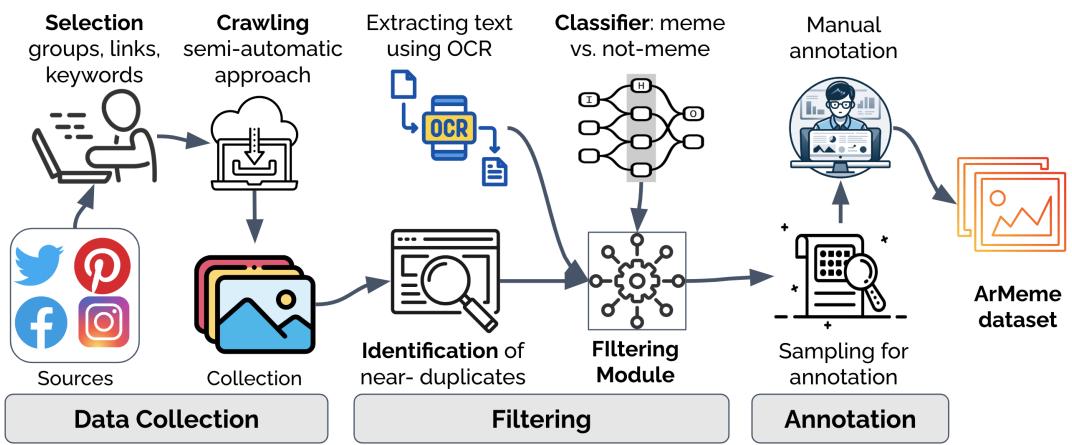
As shown in Figure 2, the workflow is comprehensive:
- Collection: They started by manually selecting public groups and using keywords related to politics and public figures.
- Filtering Duplicates: Memes go viral, meaning the same image appears thousands of times. The researchers used a ResNet18 deep learning model to extract visual features from images. They then calculated the similarity between these features to identify and remove near-duplicates.
- OCR (Optical Character Recognition): They used EasyOCR to read the Arabic text directly from the images. If an image had no text, it wasn’t a meme, so it was discarded.
- Meme Classifier: Just because an image has text doesn’t mean it’s a meme. It could be a book cover or a screenshot of a tweet. They trained a lightweight binary classifier (Meme vs. Non-Meme) to filter out non-meme content.
The Human Touch: Annotation
Once the data was collected, it needed to be labeled. This is where human intelligence is currently irreplaceable. The researchers employed native Arabic speakers to categorize the images.
They defined four specific categories for the dataset:
- Not-Meme: Images that slipped through the automated filters (e.g., screenshots of text, ads).
- Other: Memes that were offensive, unintelligible, contained nudity, or were not in Arabic.
- Not Propaganda: Standard memes intended for humor without manipulative intent.
- Propaganda: Memes using rhetorical techniques to influence the audience’s opinion or actions toward a specific goal.
To ensure consistency, the annotators followed a strict decision-making process.
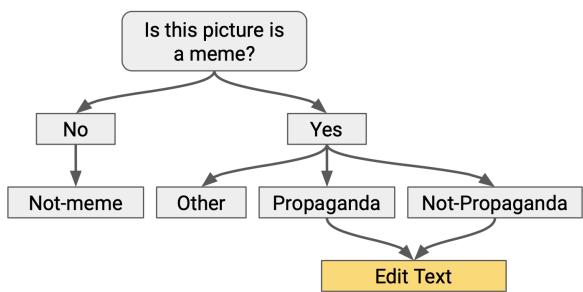
Figure 4 illustrates this workflow. The annotators first ask, “Is this a meme?” If yes, they categorize it. If the meme is propaganda or not-propaganda, they proceed to a “Text Editing” phase to correct any errors made by the automatic OCR software. This ensures the text data associated with the image is perfect for training AI models later.
A Look at the Data
Understanding the difference between these categories is crucial. Let’s look at some examples provided in the dataset to see exactly what the AI is up against.
The “Not-Meme” Category
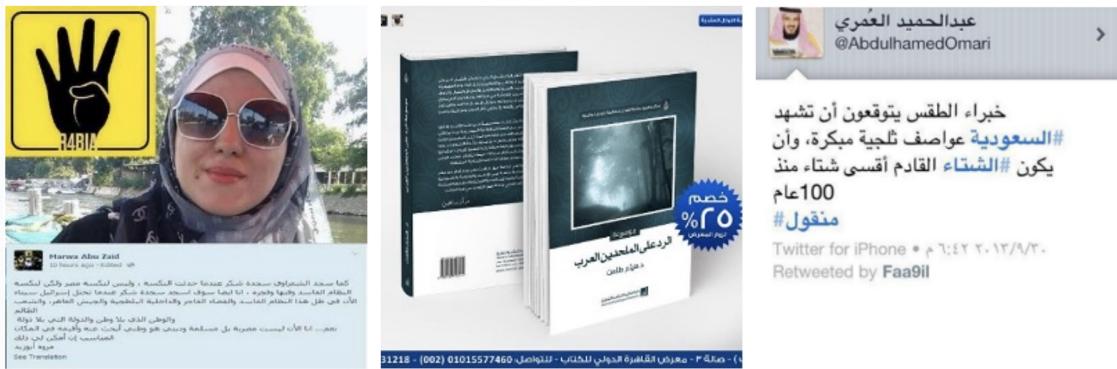 Figure 5 shows examples that might confuse a basic algorithm but are clearly not memes to a human. On the left, a Facebook post; in the center, a book advertisement; on the right, a screenshot of a tweet. These lack the visual-textual interplay that defines a meme.
The “Other” Category
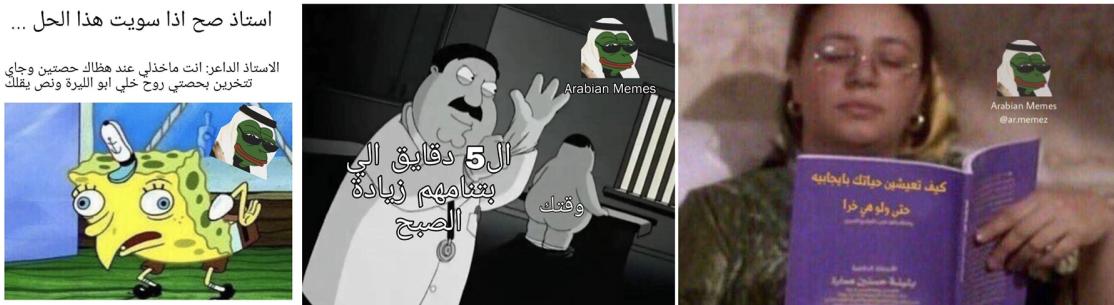 Figure 6 (labeled above as Figure 14) displays the “Other” category. These might be memes, but they fall outside the scope of the study due to being in a different language (like English mixed with Arabic), being unintelligible, or containing content that doesn’t fit the strict propaganda vs. non-propaganda binary.
The “Not Propaganda” Category
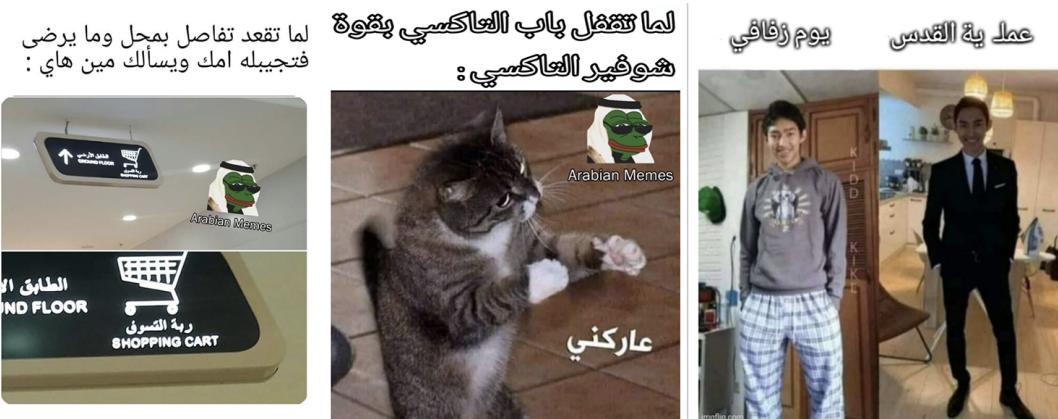 Figure 7 shows the “Not Propaganda” class. These are the “good” memes. They might be sarcastic or funny, but they aren’t trying to manipulate your political worldview. For example, the meme on the left jokes about shopping and domestic life. It’s relatable humor, not political warfare.
The “Propaganda” Category
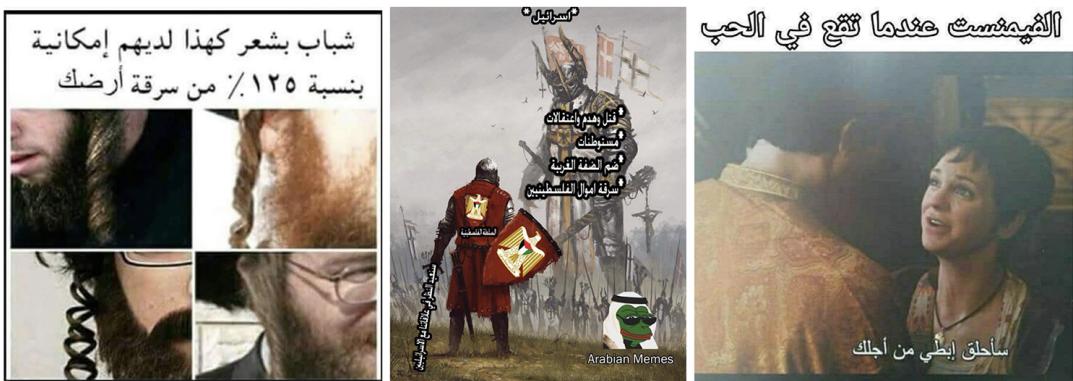 Figure 8 reveals the target: Propaganda. These memes are distinct. Look at the left panel: it uses a stereotype about appearance (“Young men with a beard like this…”) to incite fear or prejudice ("…have a 125% chance of stealing your land"). This attempts to bypass rational thought and appeal directly to bias—a textbook propaganda technique.
Dataset Statistics
The final dataset, named ArMeme, consists of 5,725 annotated samples. It is worth noting the imbalance in the data, which is a common challenge in real-world AI applications.
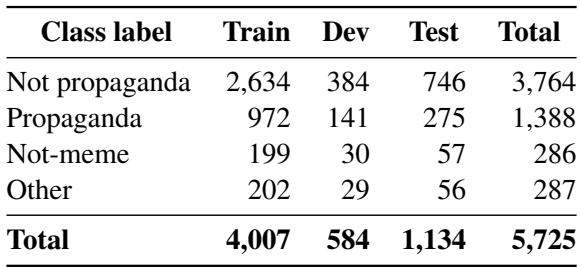
As Table 2 shows, the “Not propaganda” category makes up the majority (2,634 in the training set), while “Propaganda” is less than half of that (972). This imbalance makes training difficult because models tend to be biased toward the majority class.
The Experiments: Teaching Machines to Read Memes
With the dataset built, the researchers moved to the experimental phase. The goal was to build a computer program that could look at a meme and correctly classify it as “Propaganda” or “Not Propaganda.”
They tested three main approaches:
- Unimodal Text: Analyzing only the text caption.
- Unimodal Image: Analyzing only the visual image.
- Multimodal: Analyzing both together.
They also compared two different types of AI architectures:
- Fine-tuned Models: Taking a pre-existing “brain” (like BERT for text or ResNet for images) and training it specifically on the ArMeme dataset.
- Large Language Models (LLMs) in Zero-Shot settings: Asking massive models like GPT-4 or Gemini to classify the meme without any specific training on this dataset.
Text-Based Models
For text, they used models specifically designed for Arabic, such as AraBERT and Qarib. These models understand the nuances of the Arabic language and dialects better than generic multilingual models. They found that Qarib, a model pre-trained on Arabic tweets, performed the best. This makes sense, as the language used in memes is often informal, similar to Twitter dialects.
Image-Based Models
For images, they tested several famous architectures including VGG16, ResNet50, and EfficientNet. These models look for patterns in pixels—shapes, colors, and objects. The researchers found that ResNet50 achieved the best performance among the fine-tuned image models.
Multimodal and LLMs
The most exciting part of the research was combining text and image. They concatenated features from the best text model and the best image model to see if the combination improved accuracy.
They also tested the giants of the AI world: GPT-4 (Vision) and Gemini. These models were given a “prompt”—a set of instructions explaining the task—and asked to classify the memes.
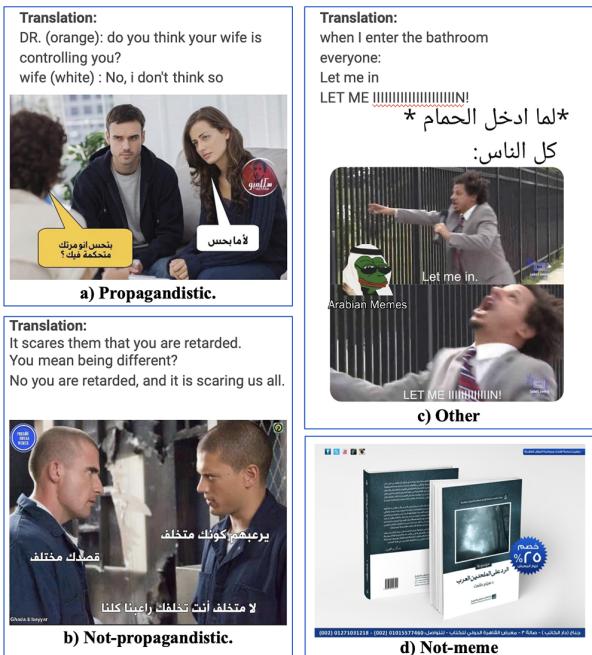
Looking at complex images like Figure 1, the model has to decipher the irony in a therapy session meme (panel a) versus a military meme (panel b).
The Results
The results highlighted a fascinating trend in AI development: bigger isn’t always better, but specialization is.
- Fine-Tuning Wins: The smaller models that were fine-tuned specifically on the ArMeme dataset generally outperformed the massive LLMs (like GPT-4) in the zero-shot setting. The fine-tuned Qarib model (text only) achieved a weighted F1-score of 0.690, which was the highest among unimodal models.
- Text is Powerful: Surprisingly, text-only models often performed as well as, or better than, image-only models. This suggests that in propaganda memes, the “message” is heavily carried by the caption.
- Multimodal Challenges: Combining text and image (Multimodal) provided good results (Weighted F1 of 0.659 for ConvNeXt + AraBERT), but it didn’t drastically outperform the best text-only models. This indicates that effectively fusing these two modalities remains a difficult engineering challenge.
- LLM Performance: While GPT-4 is incredibly smart, it struggled to beat the specialized models without specific training. However, the newer GPT-4o showed very promising results in auxiliary experiments, suggesting that the gap is closing fast.
Conclusion and Future Impact
The ArMeme paper represents a significant step forward in digital safety for the Arabic-speaking world. By creating the first dedicated dataset for Arabic meme propaganda, the authors have opened the door for more robust content moderation tools.
Key Takeaways:
- Resource Creation: The release of ~6,000 annotated memes allows other researchers to build upon this work.
- Language Specificity: Models pre-trained on Arabic dialects (like Qarib) significantly outperform generic models, proving the need for language-specific AI development.
- The Propaganda Challenge: Detecting propaganda is subtle and subjective. Even for humans, agreement isn’t perfect. For AI, understanding the cultural context, irony, and dialect of a meme is the next great frontier.
As we move forward, the techniques developed here will likely expand to detect not just propaganda, but also hate speech, cyberbullying, and offensive content in memes across many languages. In the fight against disinformation, ArMeme provides a crucial shield for the Arabic digital ecosystem.