](https://deep-paper.org/en/paper/2406.04251/images/cover.png)
The arrival of 3D Gaussian Splatting (3DGS) marked a paradigm shift in neural rendering. Unlike Neural Radiance Fields (NeRFs), which rely on expensive ray marching through implicit volumes, 3DGS utilizes explicit point clouds—specifically, 3D Gaussians—to render scenes in real-time with photorealistic quality.
However, despite its speed and visual fidelity, 3DGS has a “messy room” problem. The quality of the final render is heavily dependent on how the Gaussian points are distributed. If the initialization (usually via Structure from Motion) is poor, or if the optimization process fails to place points where they are needed, the model suffers from artifacts. You might see “floaters” (random blobs floating in space), blurred details in complex geometry, or erroneous depth estimations.
In this post, we are diving deep into a new paper, “Improving Gaussian Splatting with Localized Points Management”, which proposes a surgical solution to this problem. Instead of relying on global heuristics to add or remove points, the researchers introduce Localized Point Management (LPM)—a method that uses stereo geometry to pinpoint exactly where the model is failing and fixes it on the spot.
The Problem with Standard Density Control
To understand why LPM is necessary, we first need to understand how standard 3DGS manages its points.
In vanilla 3DGS, the scene starts as a sparse point cloud. During training, the model needs to decide where to add more detail (densification) and where to remove useless points (pruning). This process is called Adaptive Density Control (ADC).
ADC typically works by looking at the average gradient of the points. If a Gaussian point has a high gradient magnitude across multiple views, it means the model is struggling to represent that area. The system then decides to either split that big Gaussian into two smaller ones or clone it.
Why ADC Fails
While ADC works generally well, it has significant blind spots:
- Averaging Hides Errors: Because it thresholds the average gradient, a point that is terrible in one specific view but fine in others might be ignored.
- It Misses “Ill-Conditioned” Points: Sometimes, the optimization creates large, high-opacity Gaussians that block the view of the actual geometry behind them. These are essentially “walls” of artifacts. ADC often fails to identify and remove these, leading to incorrect depth maps.
- Passive vs. Active: ADC is somewhat passive; it waits for gradients to accumulate. It doesn’t actively look for regions in 3D space that correspond to errors in the 2D image.
The image below illustrates this failure perfectly. In the top row (Standard 3DGS), notice the red box in the depth map. The model has created “ill-conditioned” Gaussians—dense blobs that don’t exist in reality—which occlude the true geometry of the truck.
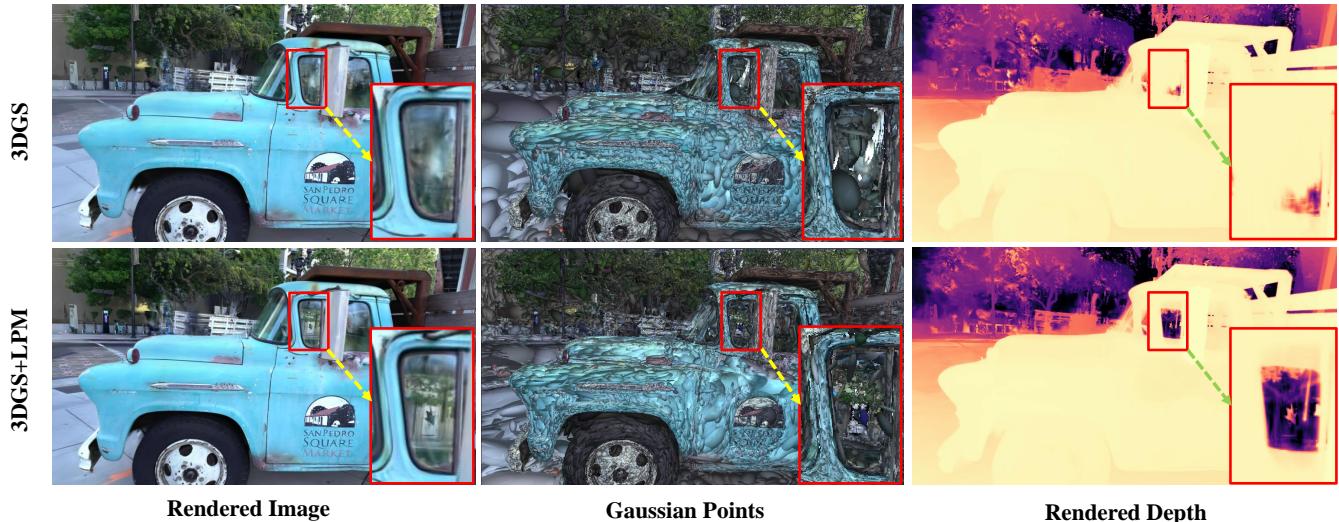
The bottom row shows the result of the new LPM method. The depth map is clean, the “floaters” are gone, and the texture of the truck is sharper. How did they achieve this? By stopping the reliance on global averages and starting to look at localized rendering errors.
Background: The Mathematics of 3DGS
Before dissecting the LPM method, let’s briefly recap the mathematical foundation it builds upon. A 3D scene is represented as a collection of 3D Gaussians. Each Gaussian \(G(x)\) is defined by a mean position \(\mu\) and a covariance matrix \(\Sigma\):

To render an image, these 3D Gaussians are projected into 2D (splatting). The color of a specific pixel \(p\) is calculated by blending the overlapping ordered Gaussians using \(\alpha\)-blending (similar to standard transparency in computer graphics):
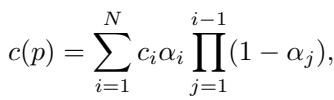
Here, \(c_i\) is the color and \(\alpha_i\) is the opacity. The optimization process tweaks these parameters to minimize the difference between the rendered image and the ground truth. The goal of LPM is to intervene in the creation and deletion of these \(G_i\) points more intelligently than before.
The Core Method: Localized Point Management (LPM)
The researchers’ core insight is intuitive: If we see a rendering error in a 2D image, we should be able to trace it back to the specific 3D zone causing it.
Standard approaches look at gradients on the points. LPM looks at errors in the images and projects them back into 3D space. This process involves a pipeline of three major steps: Error Map Generation, Cross-View Region Mapping, and Point Manipulation.
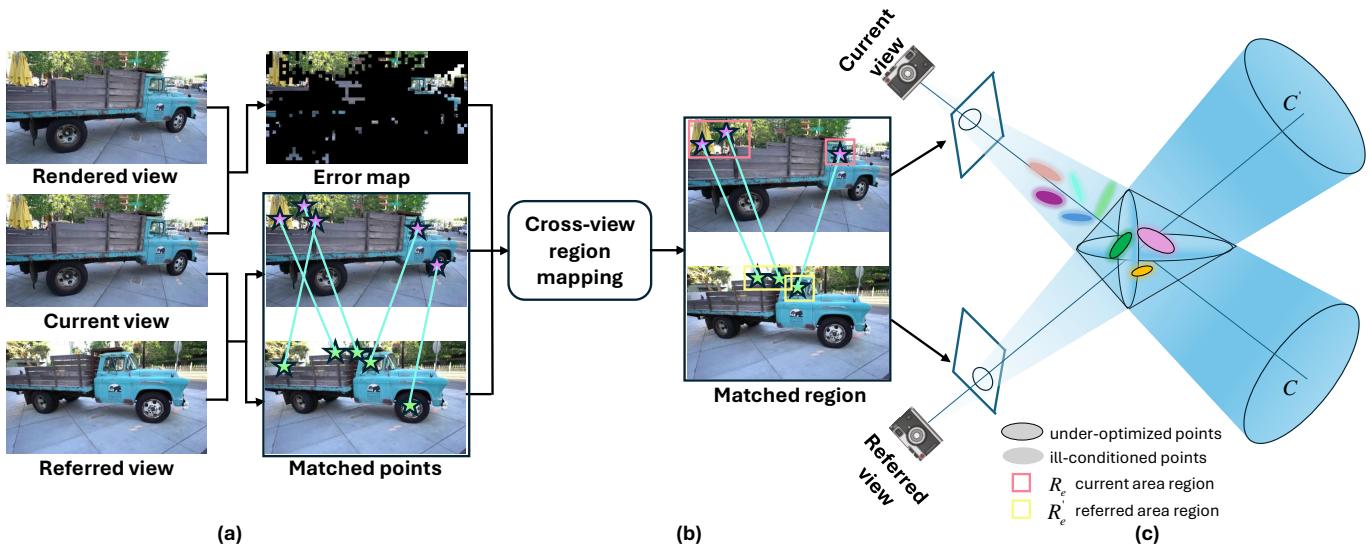
Let’s walk through the architecture as shown in the diagram below.
Step 1: Generating the Error Map
The process begins by rendering the current view and comparing it to the ground truth image. This generates an Error Map (Figure 2a), highlighting exactly which pixels are incorrect.
In standard training, this error is just used to calculate a loss scalar. In LPM, this map serves as a “treasure map” indicating where the 3D geometry is likely flawed.
Step 2: Cross-View Region Mapping
Knowing that a pixel at \((x, y)\) in rendering \(A\) is wrong doesn’t tell us how deep the error is in 3D space. To solve this depth ambiguity, the authors employ Multiview Geometry.
They select a neighboring view (referred to as the “Referred View”) and use a feature matching algorithm called LightGlue. LightGlue identifies corresponding points between the “Current View” and the “Referred View.”
If there is a high-error region in the Current View (\(R_e\)), the system finds the corresponding region (\(R'_e\)) in the Referred View (Figure 2b). We now have two 2D patches looking at the same 3D object from different angles.
Step 3: Identifying the Error Source Zone
This is the most geometric part of the method. The system casts a cone-shaped ray from the camera center of the Current View through the error region \(R_e\). Simultaneously, it casts a cone from the Referred View through \(R'_e\).
The Intersection is Key. Where these two cones intersect in 3D space constitutes the Error Source Zone (\(R_{zone}\)). This intersection (Figure 2c) represents the physical volume in the scene that is responsible for the bad rendering.
Step 4: Points Manipulation
Once the system has identified the specific 3D zone responsible for the error, it performs surgical operations on the points within that zone. This is distinct from the global ADC usually employed.
The manipulation involves two main strategies:
1. Point Densification (Fixing Under-Population)
If the zone contains points but the error is high, or if the zone is empty (sparse), it implies the geometry is under-represented.
- Action: The system applies densification locally with a lower threshold than the global setting.
- Result: It adds new points or splits existing ones specifically in this high-error pocket, allowing fine details (like tree leaves or rusty metal textures) to emerge.
2. Opacity Reset (Fixing Ill-Conditioned Points)
This is a critical innovation. If the Error Source Zone contains points with high opacity, yet the error remains high, it suggests these points might be “false positives”—occluders that shouldn’t be there (like the red blob in Figure 1).
- Action: The system resets the opacity of these points.
- Why? By resetting opacity, the points become transparent. In subsequent training steps, the optimizer gets a “second chance” to determine if these points should actually exist. If they are valid, their opacity will grow back. If they were artifacts, they will likely be pruned.
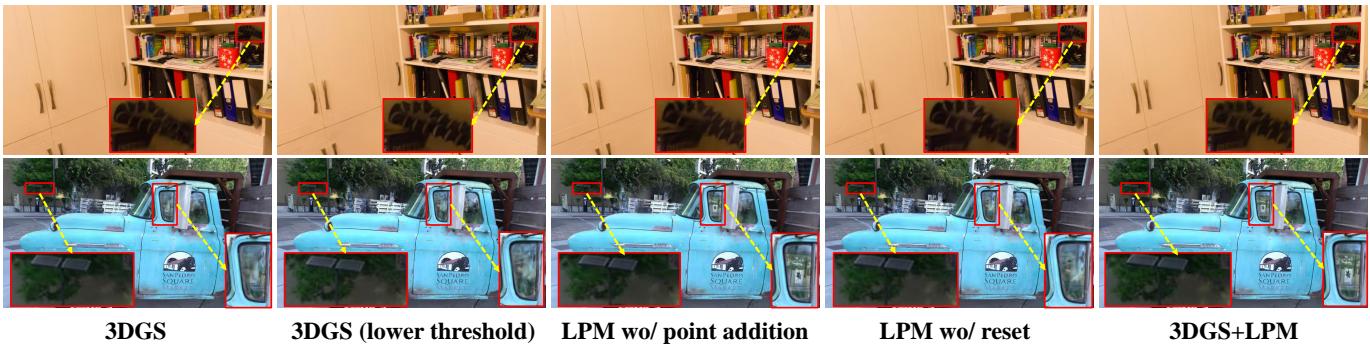
To visualize the impact of these specific operations, look at the ablation study below. Notice how “Point Addition” fills in the missing geometry of the toy, while “Point Reset” removes the artifacts on the window, clearing up the view.
Experiments and Results
The authors integrated LPM as a plugin into existing models, specifically 3DGS (for static scenes) and SpaceTimeGS (for dynamic 4D scenes). They tested on challenging datasets including Mip-NeRF 360, Tanks & Temples, and the Neural 3D Video dataset.
Static Scene Performance
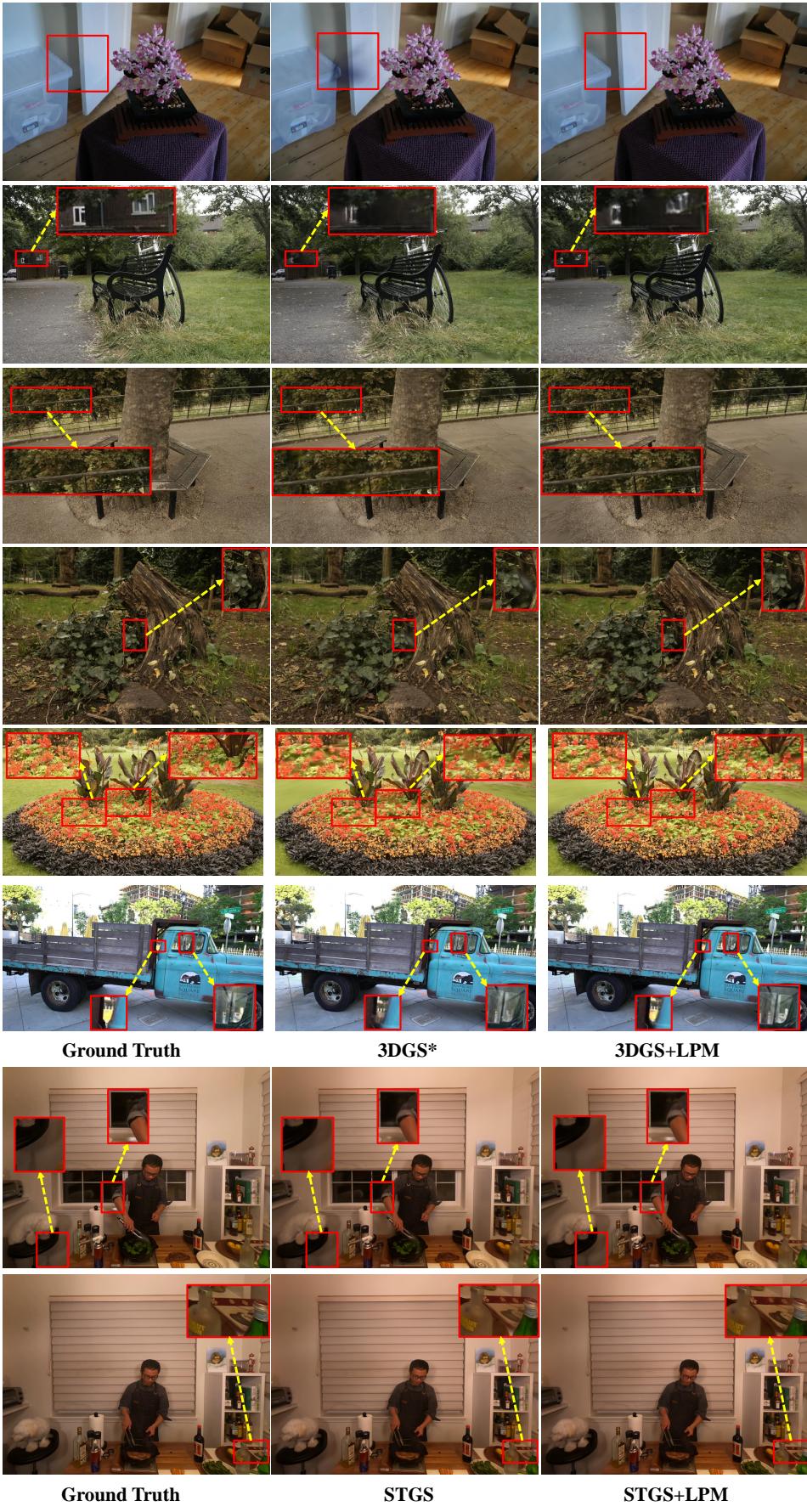
The results on static scenes show a consistent improvement in visual fidelity. By targeting error-prone areas, LPM allows the model to capture high-frequency details that vanilla 3DGS smooths over.
In the figure below, compare the 3DGS* column with 3DGS+LPM.
- Row (a): Look at the bonsai tree. 3DGS leaves floaters and blurs the leaves. LPM produces a crisp, clean reconstruction.
- Row (c): The depth map improvement is undeniable. LPM separates the branches from the background much more effectively.
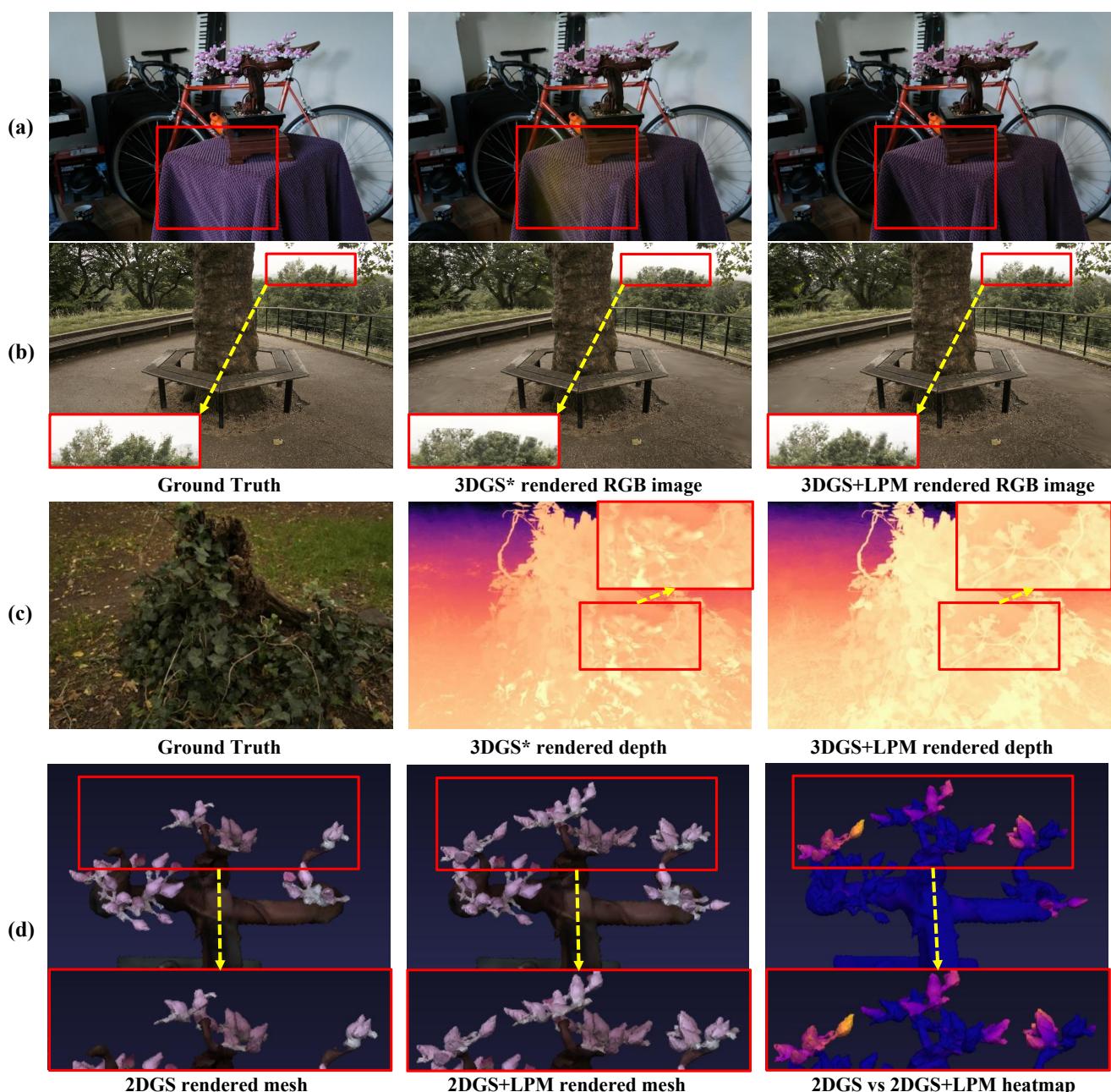
Quantitatively, the method also shines. The team performed ablation studies to prove that each component of LPM contributes to the success.
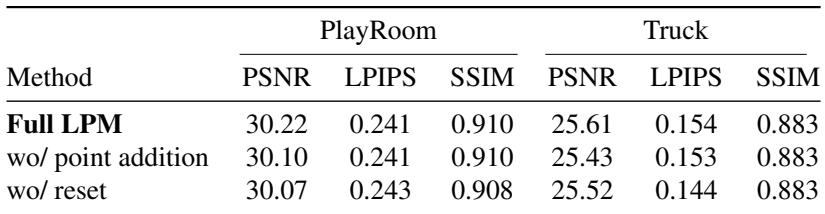
Table 3 (above) demonstrates that removing either “point addition” or “reset” drops the PSNR (Peak Signal-to-Noise Ratio) and SSIM (Structural Similarity), confirming that both adding detail and removing bad occluders are necessary for optimal performance.
Dynamic 4D Performance
Perhaps even more impressive is the application of LPM to 4D dynamic scenes (video). Dynamic scenes are notoriously difficult because “floaters” often appear when the model tries to explain motion it doesn’t understand.
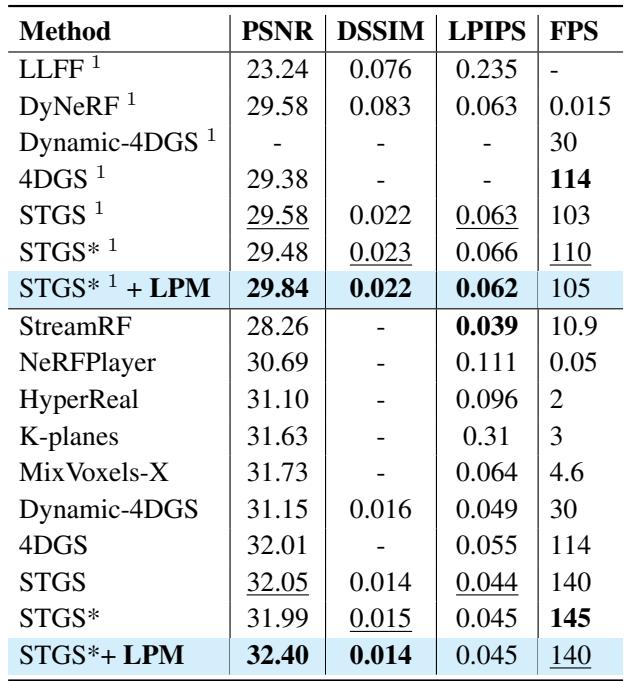
The authors applied LPM to SpaceTimeGS (STGS). The quantitative results in Table 2 below show that STGS with LPM achieves state-of-the-art FPS and rendering quality.
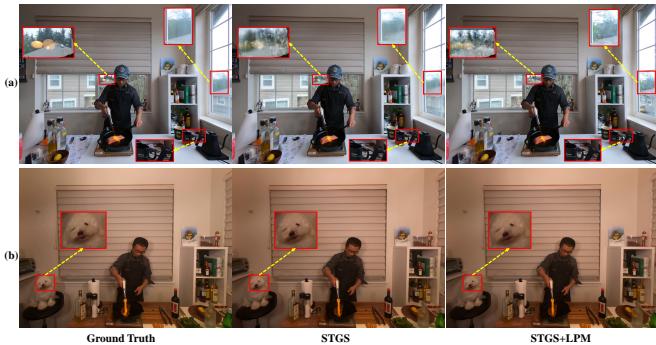
Visually, this translates to better handling of thin structures and rapid motion. In the figure below, observe the dog’s tongue (Row b). In the standard STGS, the tongue is blurred or missing. With LPM, the fine geometry is preserved even during motion.
Robustness
One final set of visual comparisons helps illustrate the robustness of the method across various scenarios, including outdoor environments and complex indoor clutter. In every case, the red boxes highlight areas where LPM successfully reconstructed geometry that the baseline method missed or corrupted.
Conclusion and Implications
The paper “Improving Gaussian Splatting with Localized Points Management” teaches us a valuable lesson in machine learning optimization: Context matters.
Standard 3D Gaussian Splatting relies on global statistics (averaged gradients) to manage the scene structure. While efficient, this approach is blind to local geometric inconsistencies. By introducing LPM, the researchers have effectively given the model a pair of stereo glasses. It can now look at its own errors, triangulate them in 3D space, and perform targeted surgery to fix them.
The key takeaways are:
- Geometric Constraints: Using multiview geometry (cone intersection) allows for precise localization of errors that simple gradient tracking misses.
- Opacity Reset: Aggressively resetting the opacity of points in high-error zones is a simple yet powerful way to escape local minima and remove visual artifacts.
- Versatility: LPM is not a new architecture but a training strategy. This means it can be plugged into various Gaussian Splatting frameworks (static or dynamic) to boost performance without altering the core rendering pipeline.
For students and researchers in the field, this paper highlights the potential of combining “old school” computer vision techniques (like feature matching and epipolar geometry) with modern neural rendering to solve the lingering artifacts of deep learning models.