](https://deep-paper.org/en/paper/2406.06973/images/cover.png)
Introduction
In the world of Artificial Intelligence, Contrastive Language-Image Pre-training (CLIP) was a watershed moment. By learning to associate images with their textual descriptions on a massive scale, CLIP enabled models to understand visual concepts with zero-shot capabilities that were previously unimaginable. If you show a standard computer vision model a picture of a specific breed of dog it wasn’t trained on, it fails. Show it to CLIP, and it understands.
However, the dominance of CLIP has relied heavily on the Transformer architecture. While Transformers are powerful, they come with a significant cost: quadratic computational complexity (\(O(N^2)\)). As the resolution of images increases or the length of text sequences grows, the memory and processing power required skyrocket. Furthermore, the massive datasets scraped from the internet to train these models are notoriously noisy—filled with irrelevant alt-text, broken grammar, and semantic mismatches.
What if we could achieve the performance of a Transformer but with the efficiency of a Recurrent Neural Network (RNN)? And what if we could automatically clean and upgrade the noisy data before the model ever sees it?
Enter RWKV-CLIP.
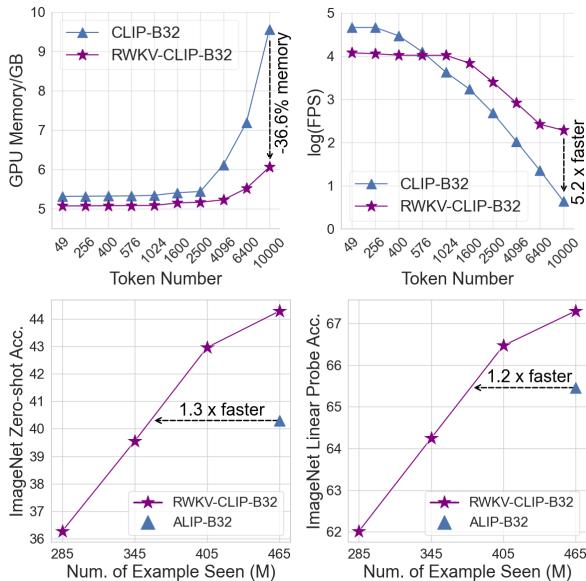
As shown in Figure 1 above, RWKV-CLIP is a new vision-language representation learner that challenges the status quo. It matches—and often exceeds—the accuracy of Transformer-based models while consuming significantly less GPU memory and offering faster inference speeds. In this article, we will dismantle the RWKV-CLIP paper, exploring how it leverages the “Receptance Weighted Key Value” (RWKV) architecture and a novel “Diverse Description Generation” framework to build a more robust and efficient multimodal model.
Background: The Bottlenecks of Modern Vision-Language Models
To understand why RWKV-CLIP is necessary, we first need to look at the limitations of the current landscape.
The Quadratic Curse of Transformers
Most state-of-the-art vision-language models use a Vision Transformer (ViT) for images and a text Transformer for captions. Transformers rely on the Self-Attention mechanism. For every token (part of an image or word in a sentence), the model calculates its relationship with every other token.
If you double the number of tokens (e.g., higher image resolution), the computational cost doesn’t just double—it quadruples. This is known as quadratic complexity. It creates a ceiling on how efficiently we can process high-resolution visual data or very long documents.
The Noisy Web Data Problem
CLIP models are hungry; they require billions of image-text pairs. These are usually scraped from the internet. The problem is that the “text” associated with web images is often garbage. It might be a filename (IMG_0045.jpg), SEO keywords, or completely unrelated to the visual content.
Previous attempts to fix this, like ALIP (Adaptive Language-Image Pre-training), used synthetic captions generated by smaller AI models to smooth out the noise. However, these synthetic captions often lack detail or are too simplistic, failing to capture the nuance of the image.
The RWKV Solution
RWKV (Receptance Weighted Key Value) is a novel architecture designed to bridge the gap between RNNs and Transformers.
- Like a Transformer: It can be trained in parallel. This is crucial because traditional RNNs (like LSTMs) must be trained sequentially (step 1, then step 2…), which is incredibly slow on modern hardware.
- Like an RNN: During inference (usage), it processes data linearly (\(O(N)\)). It maintains a “state” that evolves as it reads data, rather than keeping a massive history of every previous token interaction.
RWKV-CLIP applies this efficiency to the dual-encoder structure of CLIP.
The Core Method
The researchers propose a two-pronged approach: improving the data quality first, and then deploying the efficient RWKV architecture.
1. Diverse Description Generation Framework
Garbage in, garbage out. To ensure the model learns robust representations, the authors designed a pipeline to generate high-quality, diverse descriptions for training images. They don’t just rely on the raw web text or a single synthetic caption. Instead, they synthesize multiple sources of information.
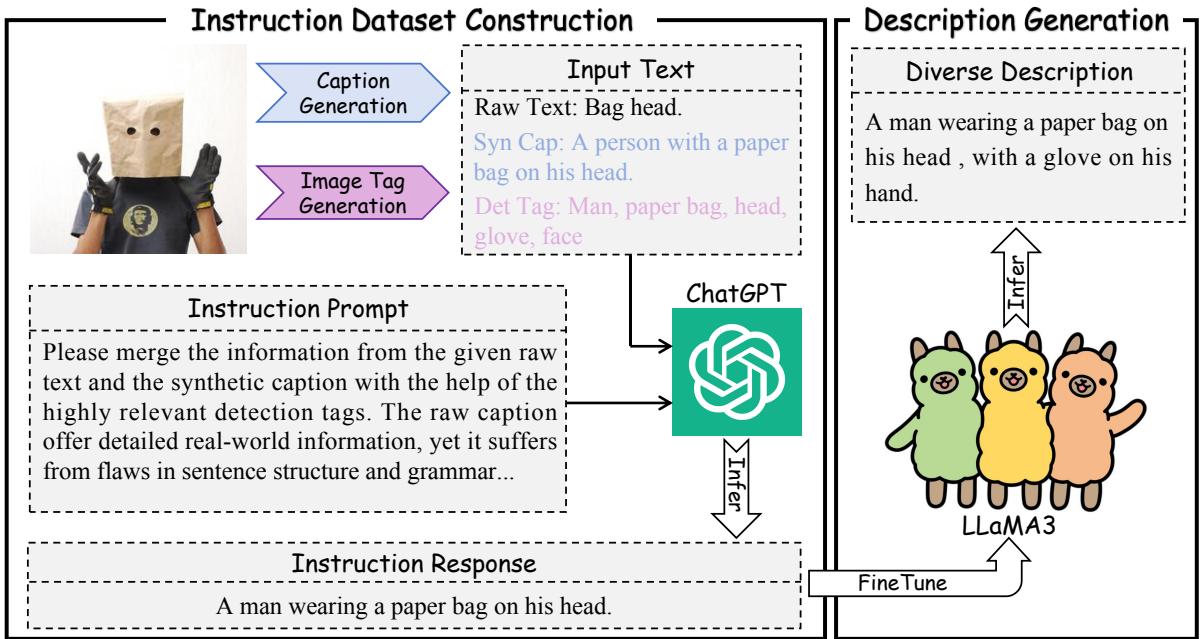
As illustrated in Figure 2, the process works as follows:
- Input: The raw image.
- Caption Generation: An OFA (One-For-All) model generates a basic synthetic caption. This ensures the text is at least visually relevant.
- Tag Generation: An open-set tagging model (RAM++) detects specific objects and concepts in the image (e.g., “Man,” “Paper bag,” “Gloves”). This captures fine-grained details that a caption might miss.
- Instruction Tuning (The Brain): An LLM (Large Language Model) acts as the synthesizer. Specifically, the authors fine-tuned LLaMA-3 to take the noisy raw text, the synthetic caption, and the detection tags, and merge them into a single, comprehensive, and grammatically correct description.
This results in three types of text available for training:
- Raw Text (\(T_r\))
- Synthetic Caption (\(T_s\))
- Generated Diverse Description (\(T_g\))
During training, the model uses a sampling strategy to randomly select one of these text sources. This augments the data, preventing the model from overfitting to a specific text style and exposing it to richer vocabulary.

2. The RWKV-CLIP Architecture
Now, let’s look at the engine under the hood. RWKV-CLIP replaces the Transformer blocks in both the image and text encoders with RWKV blocks.
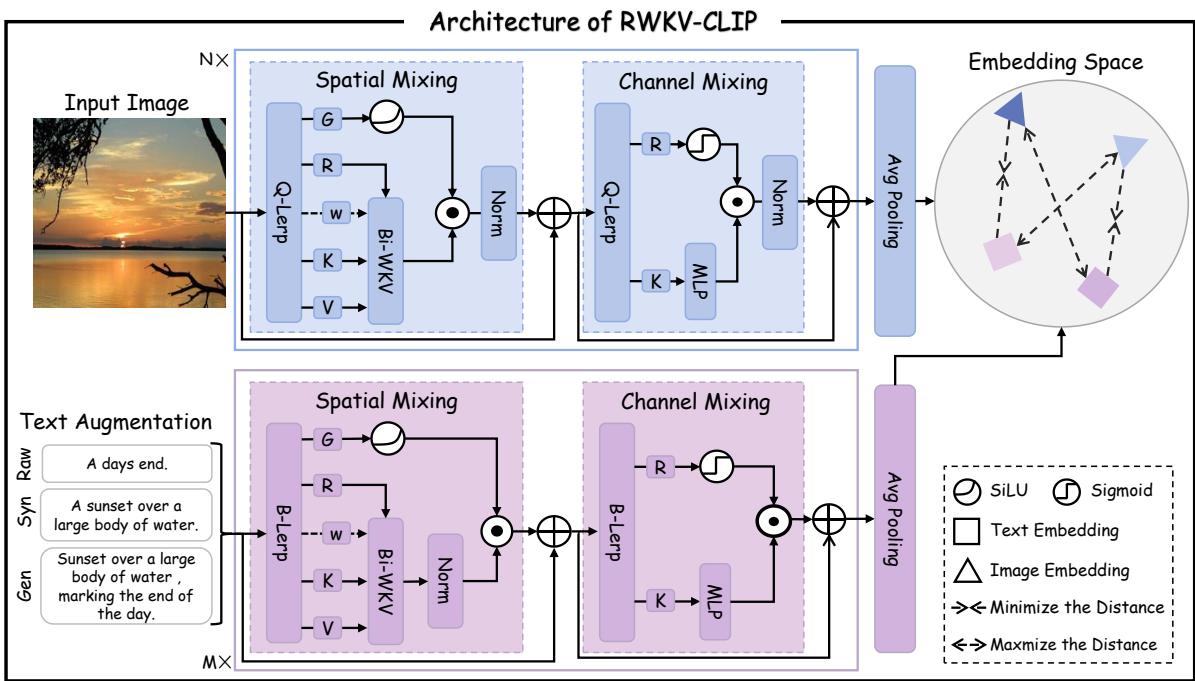
As shown in Figure 3, the architecture mirrors standard CLIP—dual towers for image and text—but the internal mechanics are different. The input image is patched (divided into squares), and the text is tokenized. They then pass through layers consisting of Spatial Mixing and Channel Mixing.
Spatial Mixing: The Attention Replacement
In a Transformer, “Attention” mixes information across different positions (spatial mixing). RWKV achieves this mixing with linear complexity using a mechanism called Bi-WKV.
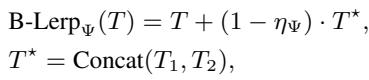
Before the mixing happens, the model uses a “Shift” operation, referred to here as Lerp (Linear Interpolation). This allows the model to “peek” at neighboring tokens without a heavy computational cost.
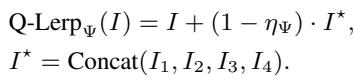
The general equation for Lerp is:

For Images (Q-Lerp): Images are 2D, so the model needs to look in all directions. The authors use Quad-directional Lerp. It shifts the image features up, down, left, and right, concatenating them to capture local textures and edges.
For Text (B-Lerp): Text is a sequence, so the model uses Bi-directional Lerp. It shifts features forward and backward, allowing the current word to be influenced by the words immediately preceding and succeeding it.
The Bi-WKV Mechanism
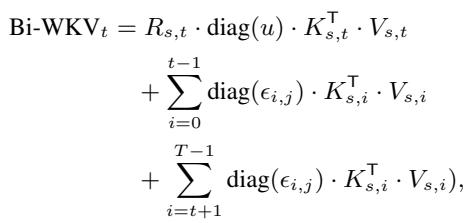
After the shifting (Lerp) creates the keys (\(K\)), values (\(V\)), and receptances (\(R\)), the core Bi-WKV calculation occurs. This is the mathematical equivalent of attention, but calculated recurrently.
To avoid relying on static weights, the model uses a dynamic temporal decay factor (\(w\)). This allows the model to decide, on the fly, how much historical information to remember or forget based on the current input.
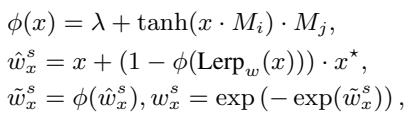
Using this decay, the global attention is computed via the Bi-WKV function. It looks scary, but it essentially aggregates information from all previous tokens (and future tokens, thanks to the bi-directional design) using a linear scan rather than an \(N^2\) matrix multiplication.
The output is then gated by a sigmoid function (\(\sigma\)) acting on the Receptance (\(G\)), ensuring the model controls how much information flows to the next layer.

Channel Mixing
After the tokens have shared information spatially, each token is processed independently to evolve its features (similar to the Feed-Forward Network in Transformers). This is called Channel Mixing. It also uses Lerp, but strictly for mixing feature dimensions (\(R\) and \(K\)).

The output uses a Squared ReLU activation (\(\rho\)), which has been found to be effective in RWKV architectures.

The Objective Function
Finally, the image and text representations are brought into a shared embedding space. The model is trained using the standard symmetric cross-entropy loss (contrastive loss). The goal is simple: maximize the similarity between the correct image-text pairs (the diagonal of the matrix) and minimize the similarity with all incorrect pairs.

Experiments and Results
The researchers pre-trained RWKV-CLIP on the YFCC15M dataset (15 million image-text pairs) and validated it on even larger scales using subsets of the LAION400M dataset (10M and 30M).
1. Linear Probing
One of the best ways to test a pre-trained model is “linear probing.” You freeze the heavy pre-trained model and train a tiny classifier on top of it for specific tasks. If the pre-trained model learned good features, the tiny classifier should perform well.
RWKV-CLIP demonstrated significant improvements over baselines like standard CLIP, DeCLIP, and ALIP.
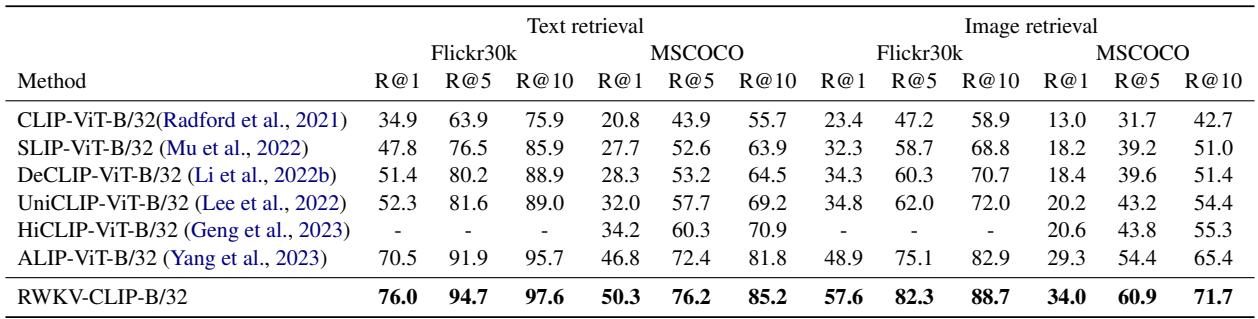
As seen in Table 1, RWKV-CLIP outperforms the ALIP baseline on almost every dataset, with an average improvement of nearly 2%. This confirms that the features learned by the RWKV backbone are more discriminative and robust.
For a more granular look, the authors expanded this test to 26 different datasets.
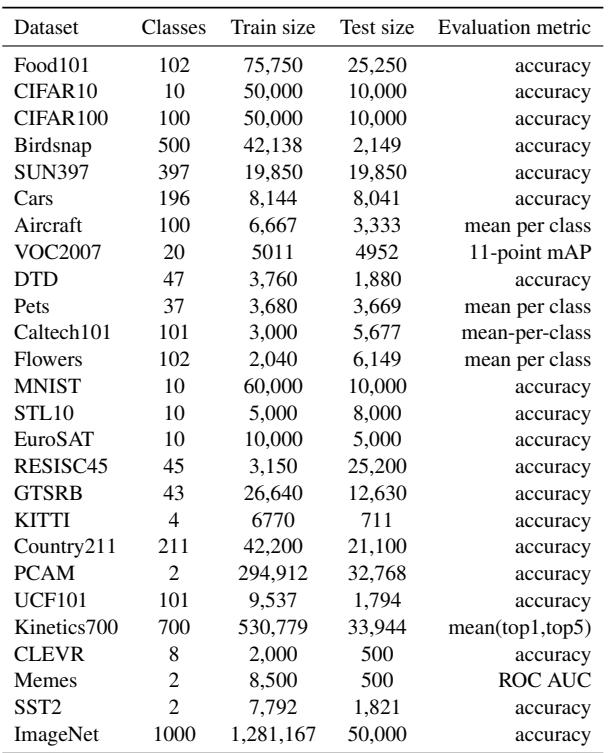
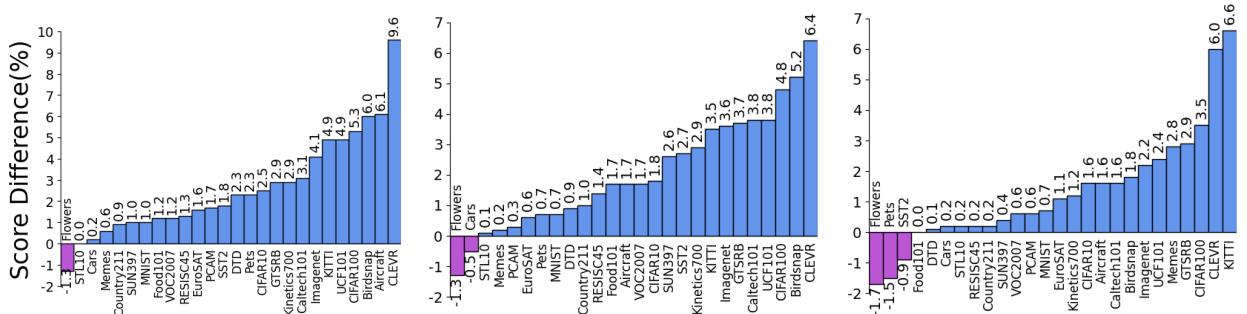
Figure 5 visualizes the gain. Whether pre-trained on 10 million or 30 million samples, RWKV-CLIP (the purple bars) consistently shows positive score differences compared to ALIP.
2. Zero-Shot Capabilities
Zero-shot classification is the ability to recognize categories the model has never explicitly seen labeled during training.
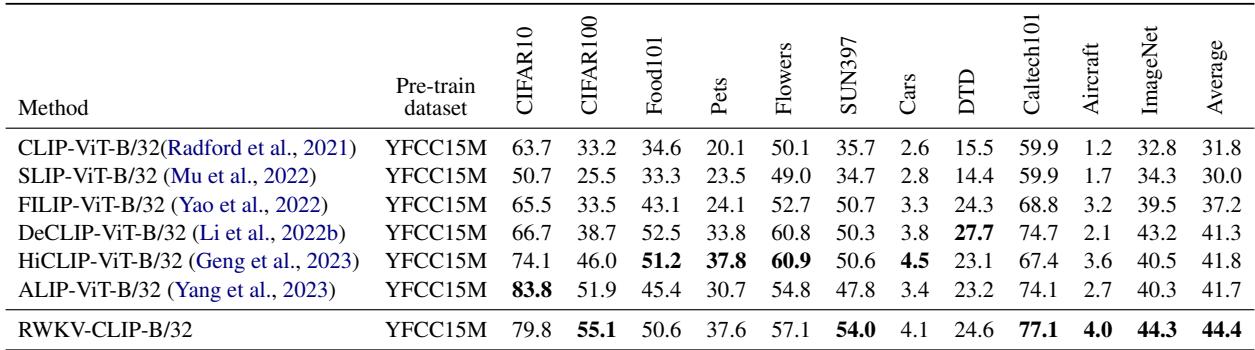
Table 3 highlights a remarkable 12.6% average improvement over the original CLIP and a 2.7% improvement over the strong ALIP baseline. On “Food101” (a food classification dataset), accuracy jumped from 45.4% (ALIP) to 50.6% (RWKV-CLIP).
3. Dealing with Hallucinations
A major risk when using LLMs to generate training data (captions) is “hallucination”—the AI making up details that aren’t in the image. The authors compared their framework against “CapsFusion,” another method for caption generation.
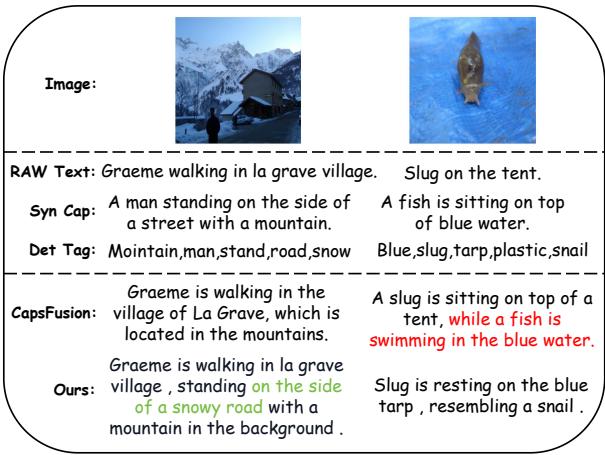
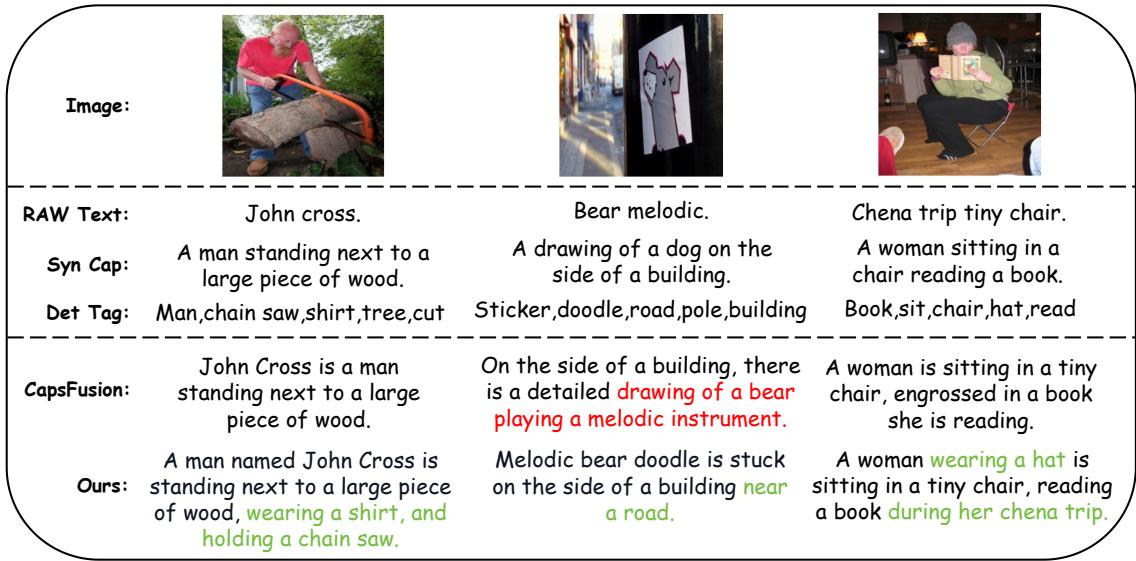
In Figure 4 and Figure 10, notice the red text. CapsFusion often hallucinates details (e.g., imagining a person is “playing a melodic instrument” when it’s just a drawing of a dog). The RWKV-CLIP data pipeline (labeled “Ours”) uses the detection tags to ground the LLM, resulting in accurate descriptions (green text) without the made-up fluff.
4. Modality Alignment
The ultimate goal of CLIP-like models is to map images and texts to the exact same point in geometric space if they have the same meaning.
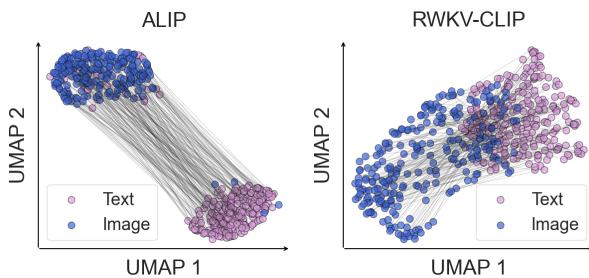
Figure 7 shows a UMAP visualization, which projects the high-dimensional features onto a 2D plane.
- ALIP (Left): The purple (text) and blue (image) dots are somewhat separated. This indicates a “modality gap”—the model struggles to bridge the two types of data perfectly.
- RWKV-CLIP (Right): The dots are much more mixed. This tighter coupling indicates superior cross-modal alignment.
5. Efficiency and Ablation
Finally, does the math hold up regarding efficiency?
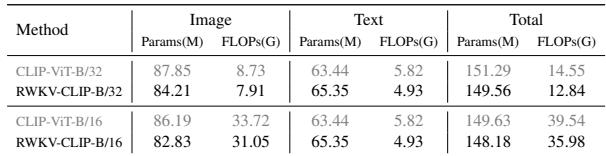
Table 8 confirms that RWKV-CLIP uses fewer Floating Point Operations (FLOPs) than the standard ViT-based CLIP while having a comparable parameter count.
The authors also tested mixing architectures (e.g., using a Vision Transformer for images but RWKV for text).
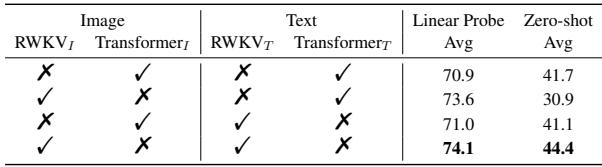
Table 7 reveals an interesting finding: pure RWKV (RWKV for both image and text) works best. Mixing Transformers and RWKV resulted in a performance drop, suggesting that the feature spaces of the two architectures might not align as naturally as a homogeneous architecture.
Conclusion
RWKV-CLIP represents a significant step forward in the democratization of large-scale AI. By moving away from the computationally expensive Transformer architecture toward the linear-complexity RWKV, the researchers have created a model that is:
- Faster and lighter: Capable of handling higher token counts with significantly less memory (as seen in the introduction).
- Smarter about data: Utilizing a sophisticated pipeline to clean noisy web data using LLMs and object detection.
- More accurate: Achieving state-of-the-art results on linear probing and zero-shot tasks.
This work proves that we are not locked into the Transformer paradigm. Efficient, RNN-based architectures can compete at the highest levels of vision-language understanding, potentially opening the door for running powerful multimodal models on consumer hardware in the near future.
The analysis in this blog post is based on the research paper “RWKV-CLIP: A Robust Vision-Language Representation Learner” by Tiancheng Gu et al.