](https://deep-paper.org/en/paper/2406.09330/images/cover.png)
Imagine you are a data scientist at a massive e-commerce aggregator. You have a database of products from Amazon and another from Google Shopping. Your task is to merge them.
On one side, you have a record: iPhone 13, 128GB, Midnight.
On the other side: Apple iPhone 13 - Black - 128 GB Storage.
To a human, these are obviously the same product. But to a machine, they are just strings of characters. This is the problem of Entity Matching (EM)—identifying when different records refer to the same real-world entity.
Traditionally, we solve this with supervised learning. We show a model thousands of pairs of computers, label them as “match” or “no match,” and the model learns to identify computers. But what happens when you suddenly ask that same model to match shoes? Or beers?
Usually, it fails. The model has memorized the features of computers (RAM, CPU, screen size) but has no “understanding” of what makes two shoes equivalent.
This is the Generalization Problem. In a fascinating research paper titled “Learning from Natural Language Explanations for Generalizable Entity Matching,” researchers propose a novel solution: instead of just teaching a model the answer (Yes/No), we should use Large Language Models (LLMs) to teach smaller models the reasoning behind the answer.
In this deep dive, we will explore how extracting “Chain-of-Thought” explanations from massive LLMs can create small, efficient models that generalize surprisingly well to new, unseen domains.
The Problem: Generalization and Cost
Entity matching is fundamental to data cleaning, healthcare, and finance. The standard approach involves training a binary classifier (often based on BERT or RoBERTa) on a specific dataset.
If you train a model on the “WDC-Computers” dataset, it becomes an expert at matching computers. However, as illustrated below, this expertise is fragile.
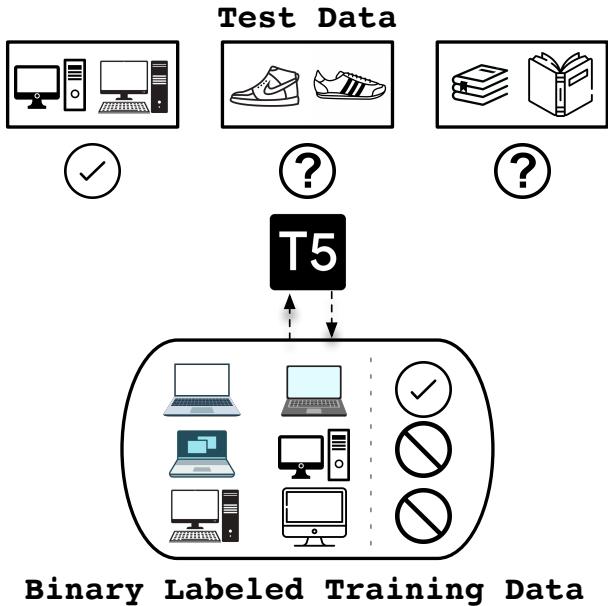
As shown in Figure 1, a model trained on computers (checking specs like “desktop” or “laptop”) is baffled when presented with sneakers. It doesn’t know which attributes matter for shoes. To fix this, you would typically need to collect and label a new dataset for shoes, then another for watches, and so on. This is incredibly expensive and time-consuming.
Why not just use GPT-4?
You might ask: “Why train a small model at all? LLMs like GPT-4 or Mistral already have general knowledge. Why not just ask them?”
The answer is scale and cost. In a database with just 1,000 items, you might have up to 1 million potential pairs to verify. Running a massive LLM (100B+ parameters) on millions of pairs is prohibitively expensive and slow.
The researchers highlight this dilemma in Table 1.
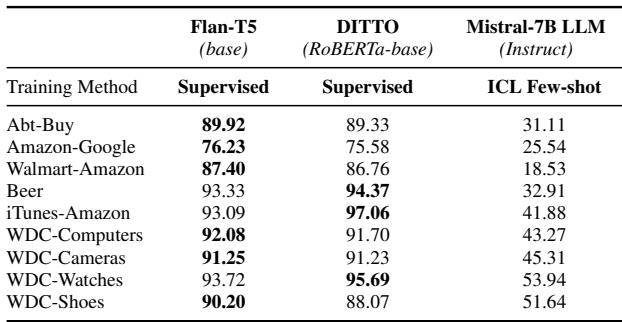
Here we see that fully supervised small models (like Flan-T5 and DITTO) achieve F-1 scores in the 90s for in-domain tasks (e.g., training on Beer, testing on Beer). The massive Mistral-7B, used in a few-shot setting (where it isn’t fully trained on the data), performs significantly worse (F-1 scores in the 30s and 40s) while being much more expensive to run.
So, we have a trade-off:
- Small Models: Fast and accurate in-domain, but terrible at generalizing to new domains.
- Large Models: Generally knowledgeable, but too expensive and slow for production-scale matching.
The researchers propose a method to get the best of both worlds.
The Solution: Entity Matching via Conditional Generation
The core innovation of this paper is to reframe Entity Matching. Instead of a binary classification task (outputting 0 or 1), they treat it as a conditional text generation task.
The Mathematical Framework
The model receives a pair of entity descriptions (\(x_i\)) and a context (\(C_i\)). It must generate a string sequence (\(y_i\)).
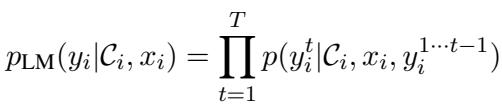
This equation represents the standard objective for a language model: predicting the next token (\(y_i^t\)) given the input and all previous tokens.
The Pipeline: Teacher and Student
The researchers use a technique known as Knowledge Distillation, but with a twist. They don’t just distill the probability of the answer; they distill the reasoning.
The process, visualized in Figure 2, has three distinct steps:
- The Teacher (Massive LLM): They take a dataset of entity pairs (e.g., Shoes) and feed it to a large model like Mistral or GPT. They use “Chain-of-Thought” prompting to ask the LLM to decide if they match and explain why.
- Explanation-Augmented Data: The output of the LLM isn’t just “Match.” It is “Match, because both entities refer to Nike Air Jordans from 2007.” This creates a new, richer training dataset.
- The Student (Small LM): They train a much smaller, efficient model (Flan-T5 Base) on this augmented data. The small model learns to generate both the label and the explanation.
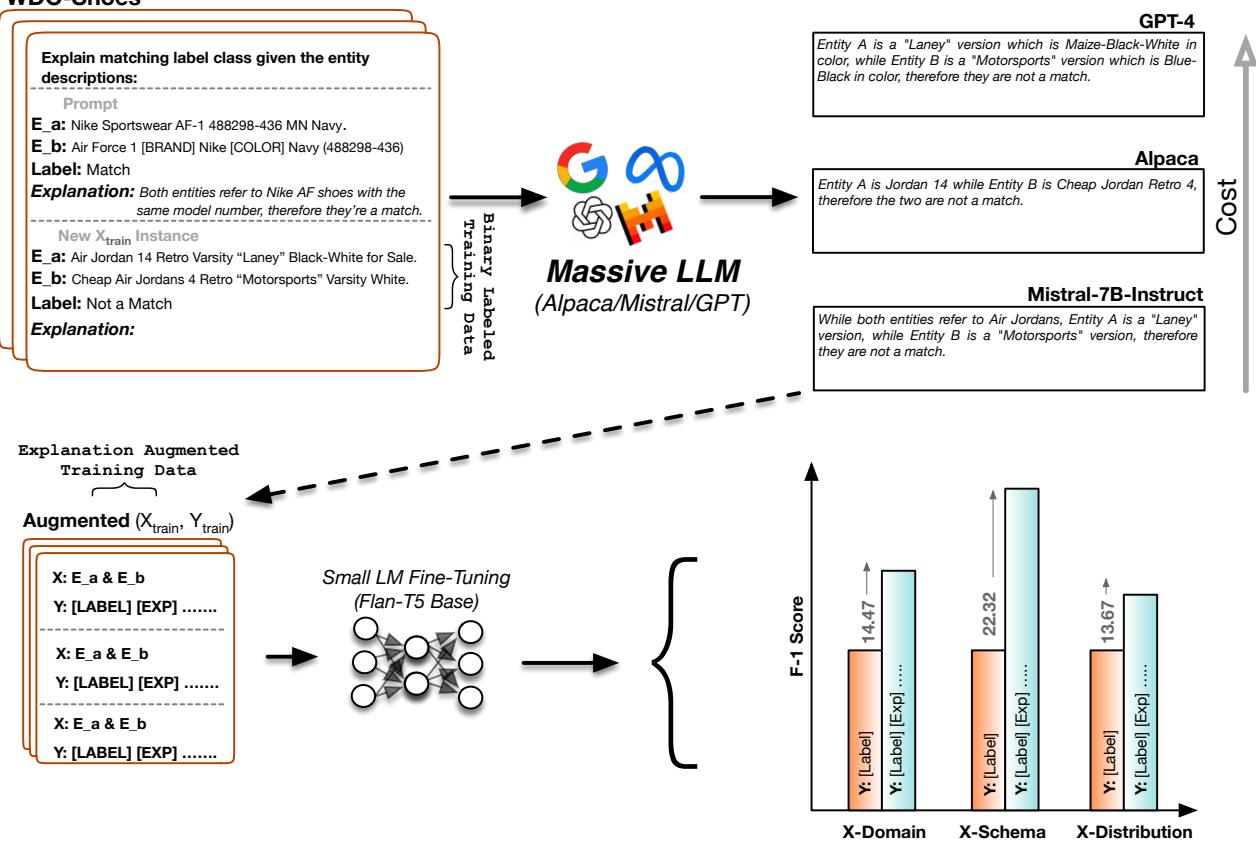
Notice the cost axis in Figure 2. The massive LLM is expensive (high up on the Y-axis), but it is only used once to generate training data. The resulting “Explanation Augmented Training Data” is then used to fine-tune the small Flan-T5 model, which is cheap to run in production.
By forcing the small model to generate the explanation, the researchers hypothesize that the model learns the logic of matching (e.g., “colors must match,” “model numbers must match”) rather than just memorizing specific keywords.
Does It Work? The Experiments
To test if this method actually improves generalization, the researchers set up three difficult “Out-of-Domain” (OOD) scenarios:
- Cross-Domain: Train on Computers, test on Shoes. (Different products entirely).
- Cross-Schema: Train on data with columns like “Artist/Song,” test on data with “Product/Price.” (Different structure).
- Cross-Distribution: Train on Walmart data, test on Abt-Buy data. (Same domain, but different data sources and writing styles).
The Results
The improvements were substantial. Table 2 compares the performance of the baseline Flan-T5 model (BL - Binary Label) against the model trained with Alpaca or Mistral explanations (EA).
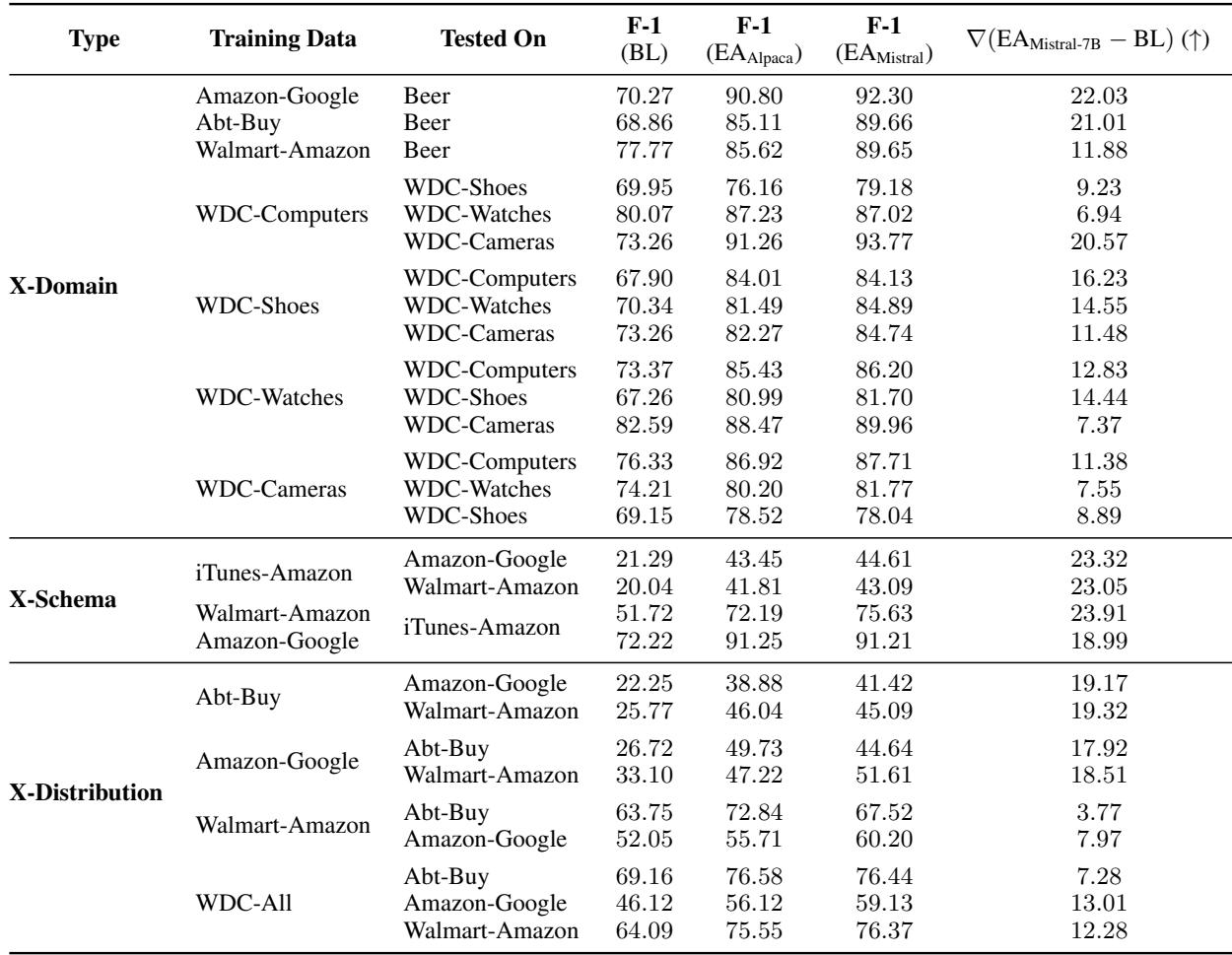
Look at the Cross-Schema section. When training on iTunes-Amazon and testing on Walmart-Amazon, the baseline model (BL) achieves a dismal F-1 score of 20.04. It effectively fails. However, the model trained with Mistral explanations (EA-Mistral) jumps to 43.09.
In the Cross-Domain setting (WDC-Computers \(\rightarrow\) WDC-Cameras), the improvement is huge: from 73.26 to 93.77. This suggests that by learning to explain why computers match, the model learned general principles (like comparing model numbers) that transferred perfectly to cameras.
Comparison with Non-Generative Models
Is this improvement just because Flan-T5 is a generative model? To check, they compared their method against DITTO, a state-of-the-art non-generative matching model (based on RoBERTa).
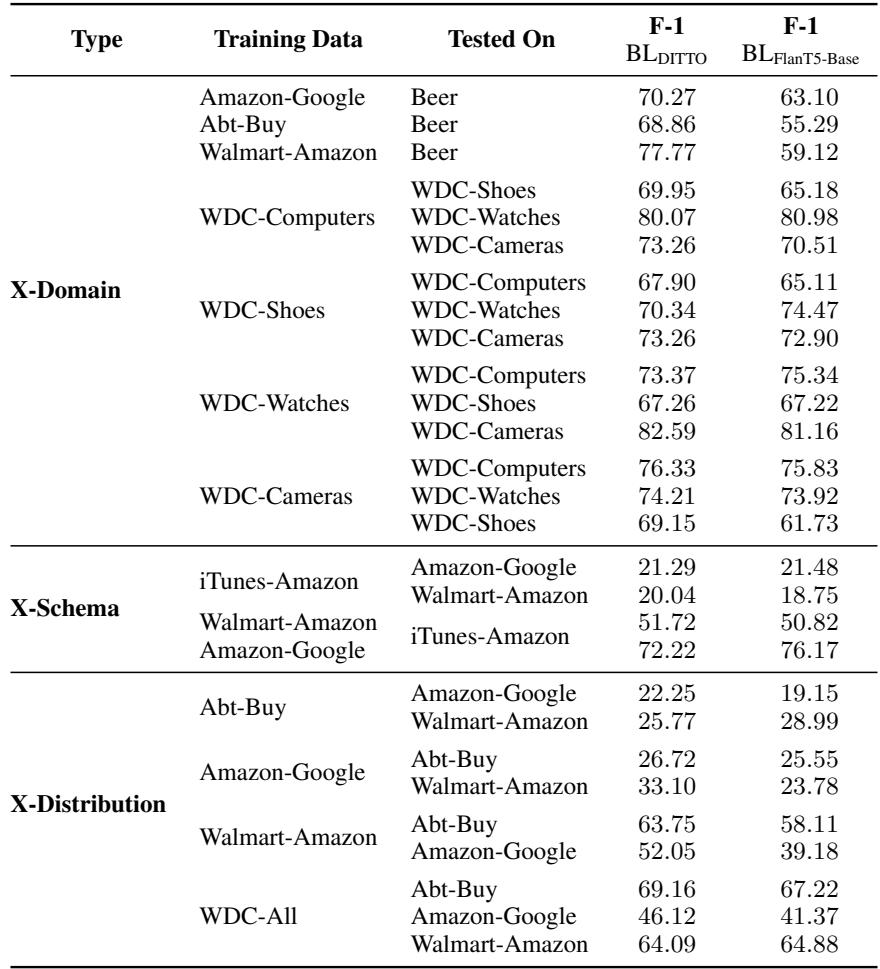
Table 4 shows that standard models like DITTO suffer the same generalization drops as the baseline Flan-T5. For example, in the Amazon-Google \(\rightarrow\) Beer test, DITTO drops to 70.27. The Explanation-Augmented model (from Table 2) hit 92.30. This proves that the explanation strategy is the key differentiator, not just the model architecture.
Why Does This Work? (Ablation Studies)
This is perhaps the most educational part of the paper. We know the performance improved, but why? Is the model actually learning reasoning, or is it just benefitting from seeing more text tokens?
The researchers performed Ablation Studies where they intentionally broke parts of the training data to see what happened. They tried:
- A (Junk Substitution): Replacing the smart explanation with random, meaningless words of the same length.
- B (Random Token-Drop): Randomly deleting half the words in the explanation.
- C (TF-IDF): keeping only the “important” keywords, losing the grammar/structure.
- D (Generic Explanations): Using a fixed sentence for every match (e.g., “These items match based on their description”) rather than a specific one.
- E (Random Corruption): Replacing tokens with
<unk>.
The results are visualized in Figure 3:
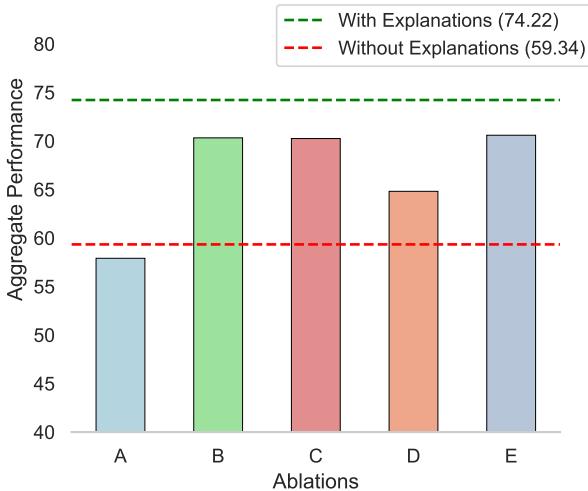
The dashed green line represents the model trained with full, high-quality explanations (74.22 average). The dashed red line is the baseline with no explanations (59.34).
- Ablation A (Junk Text) performs worse than having no explanation at all. This shows that simply adding more tokens doesn’t help; the tokens must have meaning.
- Ablation D (Generic) provides some benefit over the baseline but falls short of the full method. This indicates that instance-specific reasoning is crucial. The model needs to see why this specific pair matches.
- Ablation B (Shortened) shows that even reducing the length of the explanation hurts performance. The full chain of thought is necessary.
Detailed numbers for these ablations can be found in Table 3.
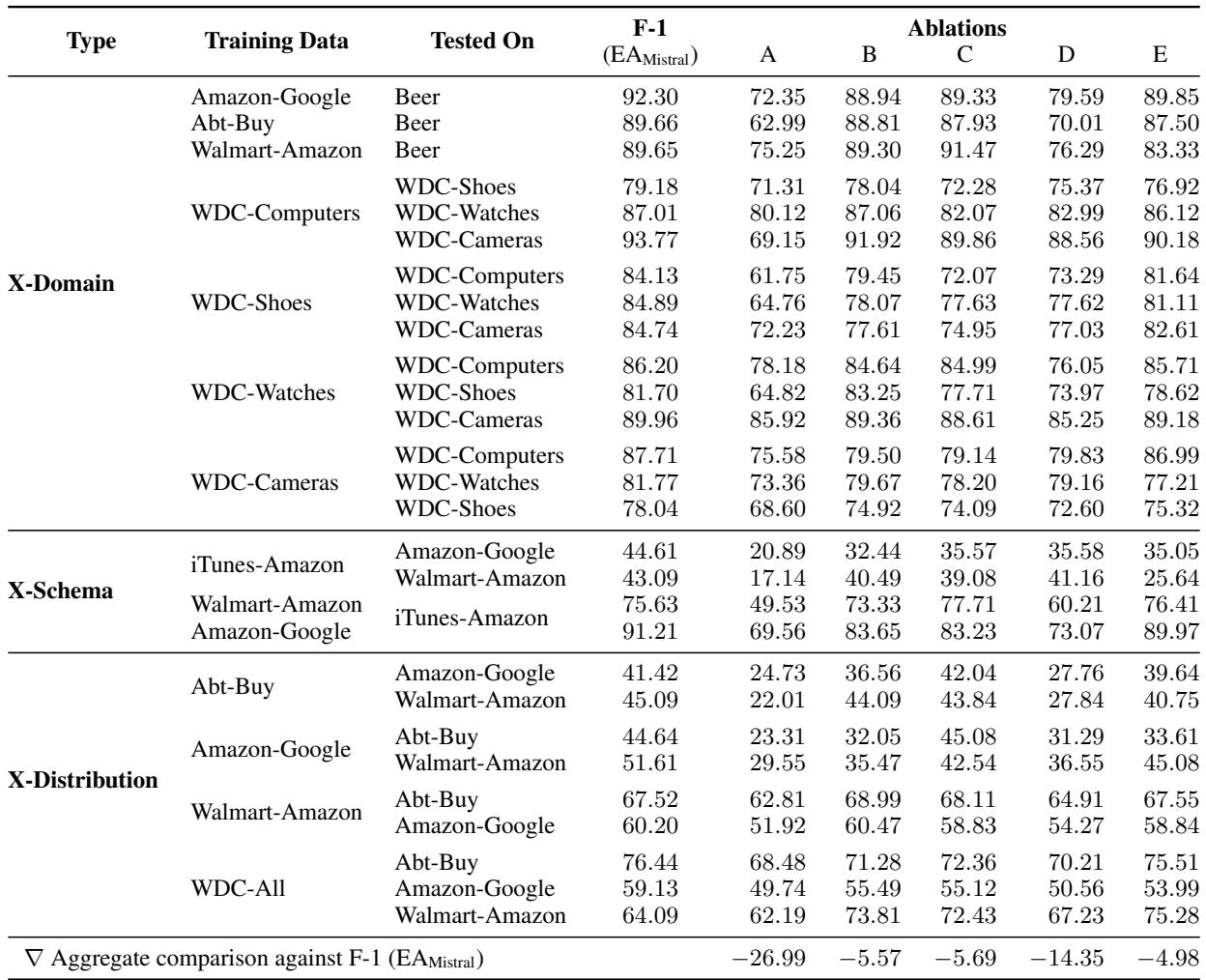
The takeaway here is clear: Quality matters. The small model is genuinely utilizing the semantic content of the explanation to guide its decision-making.
Real-World Robustness
To further prove the model was learning “reasoning” and not just keyword matching, the researchers performed a manual robustness test (\(H_1\)).
They took pairs of items that were matches (e.g., two 128GB Flash Drives) and manually edited one attribute to make them non-matches (changing one to 32GB).
- Models trained without explanations only noticed this change 23% of the time. They likely saw “Kingston,” “Flash Drive,” and “USB” and assumed “Match” despite the capacity difference.
- Models trained with explanations successfully flipped their prediction 54% of the time.
By training on explanations (which likely explicitly mentioned “capacity matches” or “capacity differs”), the model became more sensitive to the critical details that distinguish products.
Conclusion and Key Takeaways
This research paper offers a compelling blueprint for the future of Small Language Models (SLMs). We often assume that to get “reasoning” capabilities, we need massive models that cost a fortune to run.
This work demonstrates that we can distill reasoning from a teacher (LLM) to a student (SLM). By framing Entity Matching as a generation task and requiring the model to explain its work, we achieve:
- Better Generalization: The model learns concepts (comparing attributes) rather than memorizing datasets, allowing it to work on new domains (Shoes, Cameras) without retraining.
- Efficiency: We get LLM-like robustness in a model small enough to run cheaply at scale.
- Interpretability: Although not the primary focus, the model generates an explanation for its decision, which can be useful for human review.
For students and practitioners, the lesson is clear: Data augmentation isn’t just about flipping images or replacing synonyms. In the era of LLMs, data augmentation means generating knowledge and reasoning to teach our models how to think.