](https://deep-paper.org/en/paper/2406.09394/images/cover.png)
Imagine you are playing a video game or designing a virtual environment. You snap a photo of a street corner, and you want that photo to instantly expand into a fully navigable, infinite 3D world. You want to walk down that street, turn the corner, and see new buildings, parks, and skies generated in real-time, exactly as you imagine them.
For years, this has been the “holy grail” of computer vision and graphics. While we have seen massive leaps in generative AI (like Midjourney for 2D images) and 3D reconstruction (like NeRFs and Gaussian Splatting), combining them into a fast, interactive experience has remained elusive. Current methods are typically “offline”—meaning you provide an image, wait 30 minutes to an hour for a server to process it, and get back a static 3D scene.
Enter WonderWorld, a groundbreaking framework presented by researchers from Stanford University and MIT. WonderWorld is the first system that allows users to interactively generate diverse, connected 3D scenes from a single image with low latency.
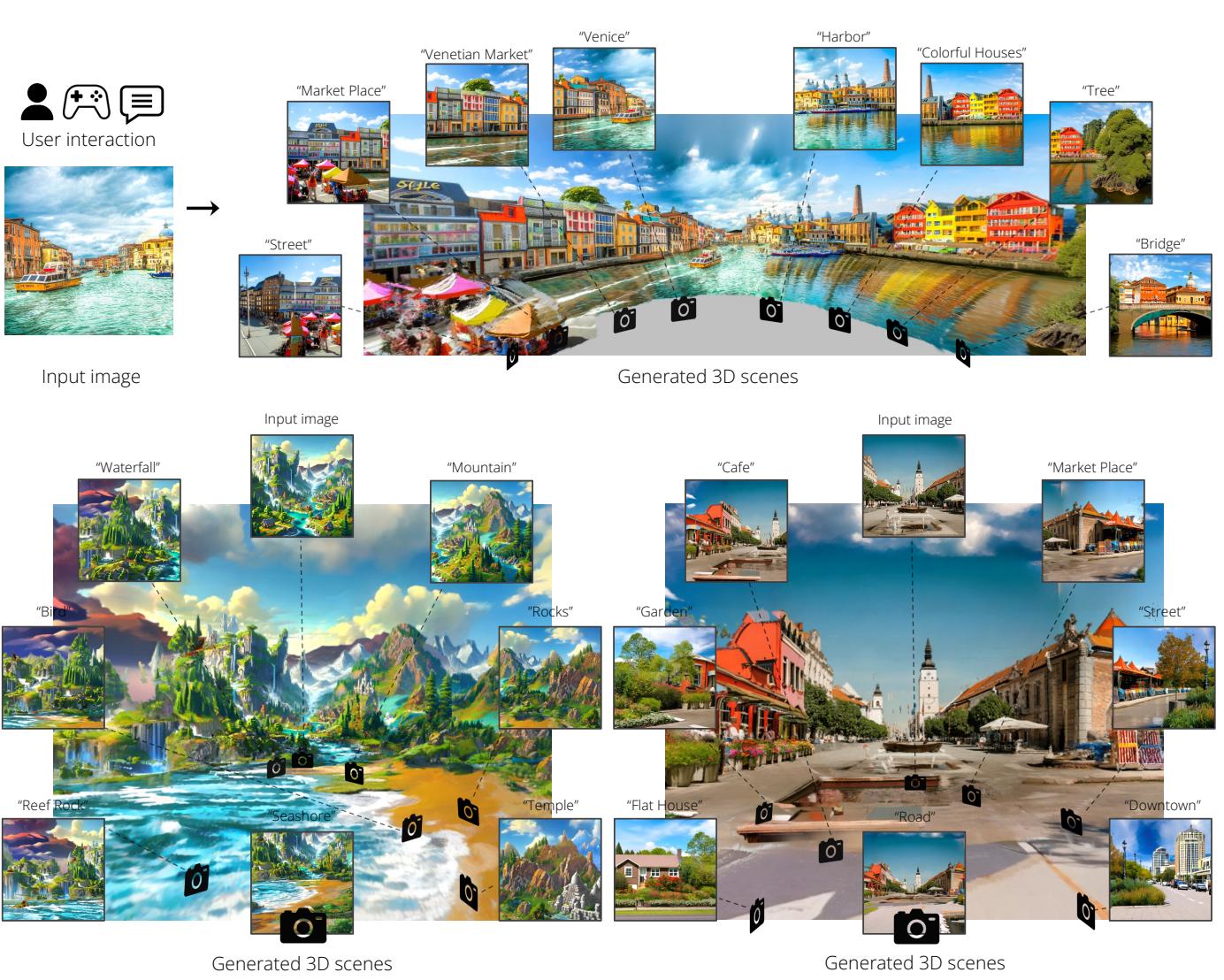
In this article, we will dissect the WonderWorld paper. We will explore how the authors achieved generation speeds of under 10 seconds per scene, the novel geometric representations they invented to make this possible, and how they solved the “seam” problem where generated worlds often fall apart at the edges.
The Bottleneck of 3D Generation
To understand why WonderWorld is significant, we first need to understand why 3D scene generation is traditionally slow.
Most existing state-of-the-art methods operate on a two-step process:
- Multi-view Generation: Starting with a single image, the system uses a diffusion model to “hallucinate” what the scene looks like from other angles, generating dozens of dense views and depth maps.
- Optimization: The system then tries to fit a 3D representation (like a NeRF, Mesh, or 3D Gaussian Splatting) to these generated images.
The second step is the killer. Optimizing a 3D scene from scratch usually requires thousands of iterations to get the geometry and color right. This is why existing tools like WonderJourney or LucidDreamer take 10 to 20 minutes to generate just one section of a scene. That is far too slow for an artist who wants to iterate, or a gamer exploring a procedural world.
WonderWorld tackles this by asking: What if we didn’t have to optimize from scratch? What if we could initialize the geometry so perfectly that we only need a few seconds of fine-tuning?
The WonderWorld Framework
The WonderWorld system operates as a continuous loop. It takes a starting image, generates a 3D representation, renders it, allows the user to move the camera or prompt for new content, generates a new image based on that movement, and repeats the process.
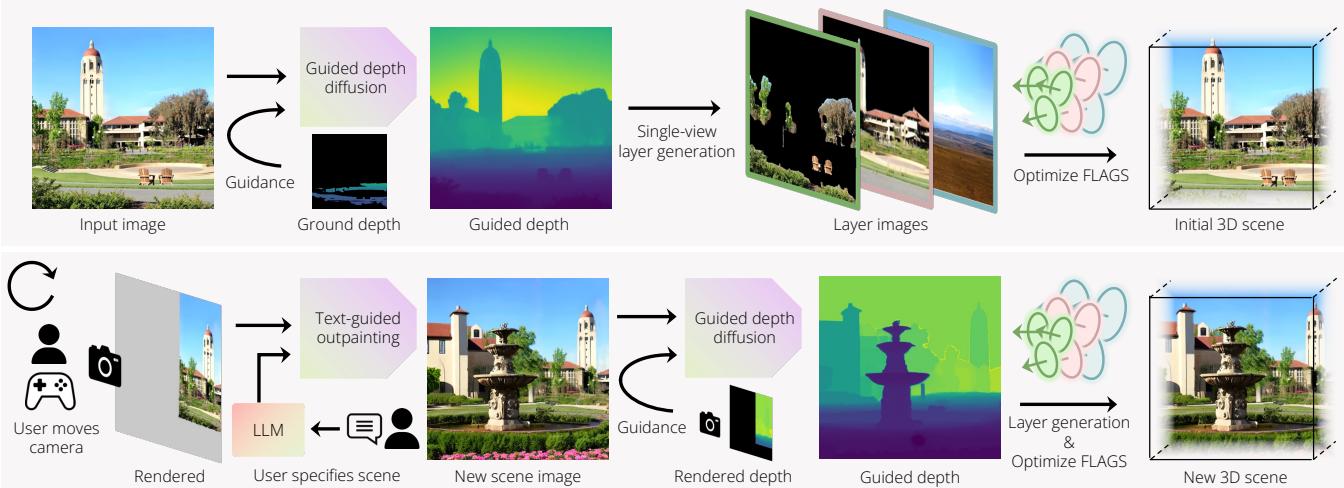
As shown in the architecture diagram above, the system relies on two critical innovations to achieve speed and consistency:
- FLAGS (Fast LAyered Gaussian Surfels): A new scene representation that is faster to optimize than standard Gaussian Splatting.
- Guided Depth Diffusion: A method to ensure that when a new chunk of the world is generated, it geometrically aligns with the previous chunk.
Let’s break these down in detail.
Core Innovation 1: Fast LAyered Gaussian Surfels (FLAGS)
Standard 3D Gaussian Splatting (3DGS) represents a scene as a cloud of 3D Gaussians (blobs), each with position, rotation, scale, opacity, and color. While faster than NeRFs, optimizing them still takes time.
The authors introduce FLAGS, which modifies the standard Gaussian approach in two specific ways to suit scene generation: Surfel parameterization and a Layered structure.
The Surfel Definition
Instead of volumetric blobs, WonderWorld uses “Surfels” (Surface Elements). In this context, a surfel is treated as a very flat Gaussian. It has a position \(p\), orientation quaternion \(q\), scales \(s\) (for x and y axes), opacity \(o\), and color \(c\).
The Gaussian kernel is defined as:

The covariance matrix \(\Sigma\) determines the shape of the Gaussian. In FLAGS, the authors explicitly flatten the Gaussian along its local z-axis (the surface normal) by introducing a tiny value \(\epsilon\):

By setting \(\epsilon\) to be very small, the Gaussian effectively becomes a 2D disc oriented in 3D space. This simplification helps in representing surfaces of scenes (like ground, walls, sky) more efficiently than volumetric clouds.
The Layered Strategy
A major issue in 3D generation is occlusion—what lies behind the building in the foreground? If you treat the whole scene as one blob of Gaussians, the optimization struggles to separate near objects from the background.
FLAGS divides the scene into three distinct layers:
- Foreground (\(\mathcal{L}_{fg}\)): Objects, buildings, trees.
- Background (\(\mathcal{L}_{bg}\)): Distant terrain, mountains.
- Sky (\(\mathcal{L}_{sky}\)): The celestial dome.

By generating and optimizing these layers separately, the system can handle occlusions much better. If you walk past a tree (foreground), the hill behind it (background) is already generated and waiting there, rather than being a hole in empty space.
Core Innovation 2: Geometry-Based Initialization
This is the “secret sauce” for the 10-second generation speed. In traditional methods, the 3D geometry starts as random points and slowly moves to the correct shape via gradient descent (optimization).
WonderWorld skips this by performing Geometry-Based Initialization. Because we have excellent monocular depth estimation models today, we can guess where the 3D points should be before we even start optimizing.
Pixel-Aligned Generation
For every pixel in the generated image, the system estimates a depth \(d\). It creates a surfel exactly at that 3D coordinate.

Here, \(K\) is the camera matrix and \(R, T\) represent the camera pose. This immediately places the surfels in roughly the right spot.
Initializing Orientation
Surfels need to face the camera or align with the surface. The authors calculate the surface normal \(n\) from the depth map and use it to set the orientation matrix \(Q\) of the surfel.

The Scale Problem (Preventing Holes)
How big should each surfel be? If they are too small, the rendered image will have holes (aliasing) when you zoom in. If they are too big, they overlap too much, blurring the texture and slowing down rendering.
The authors use the Nyquist sampling theorem to calculate the perfect size. The goal is to ensure the surfels cover the surface seamlessly.
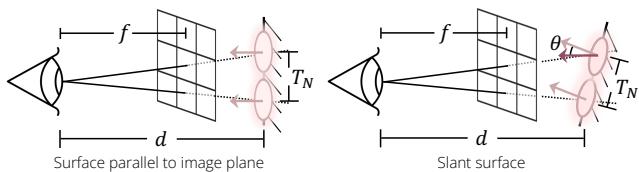
As illustrated in Figure 3, a surface that is tilted away from the camera (right side of the figure) needs larger surfels to cover the same screen space as a surface facing the camera head-on. The derived initialization for the x and y scales is:

By mathematically calculating the exact position, rotation, and scale of every surfel before optimization begins, WonderWorld reduces the optimization process to a quick “fine-tuning” step. The system optimizes the layers back-to-front (Sky -> Background -> Foreground) in just 100 iterations, which takes seconds.
Core Innovation 3: Guided Depth Diffusion
Generating a single scene is great, but WonderWorld aims to build a connected world. When a user moves the camera to the edge of the current scene, the system needs to “outpaint”—generate new content that extends the view.
A common failure mode here is Geometric Distortion. The depth estimator for the new image might not agree with the depth of the existing 3D scene. This creates visible seams, cliffs, or disconnected floors where the two scenes meet.
To fix this, the authors introduce Guided Depth Diffusion.
Instead of just asking a diffusion model to “predict depth,” they guide the denoising process. They tell the model: “Predict whatever depth you want for the new parts, but for the parts that overlap with the old scene, the depth must match what we already have.”
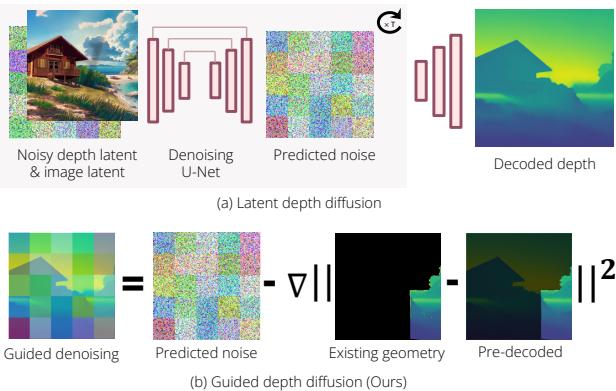
This is achieved by injecting a gradient guidance term into the diffusion process (specifically, into the latent noise prediction).

In Equation 11, the term \(g_t\) calculates the difference between the depth currently being generated (\(D_{t-1}\)) and the known guide depth (\(D_{guide}\)) in the overlapping regions (\(M_{guide}\)). This gradient forces the diffusion model to align the new terrain seamlessly with the old.
Experimental Results
The researchers compared WonderWorld against three leading baselines: WonderJourney, LucidDreamer, and Text2Room.
1. Speed
The speed difference is staggering. While baselines take over 10 minutes (700+ seconds) to generate a single scene, WonderWorld completes the task in 9.5 seconds.

Detailed analysis shows that the majority of WonderWorld’s time is actually spent on the diffusion inference (generating the image and depth map). The actual 3D optimization of the FLAGS takes less than 2 seconds, proving the efficacy of the geometry-based initialization.
2. Visual Quality and Consistency
Speed is useless if the result looks bad. However, WonderWorld also outperforms baselines in visual quality metrics.
The team evaluated “Novel View Synthesis”—moving the camera to a new angle and checking if the scene holds up.
- CLIP Score (CS): Measures how well the image matches the text prompt.
- CLIP Consistency (CC): Measures how consistent the visuals remain across different views.
- Human Preference: In a user study, participants overwhelmingly preferred WonderWorld’s results (over 98% preference rate).
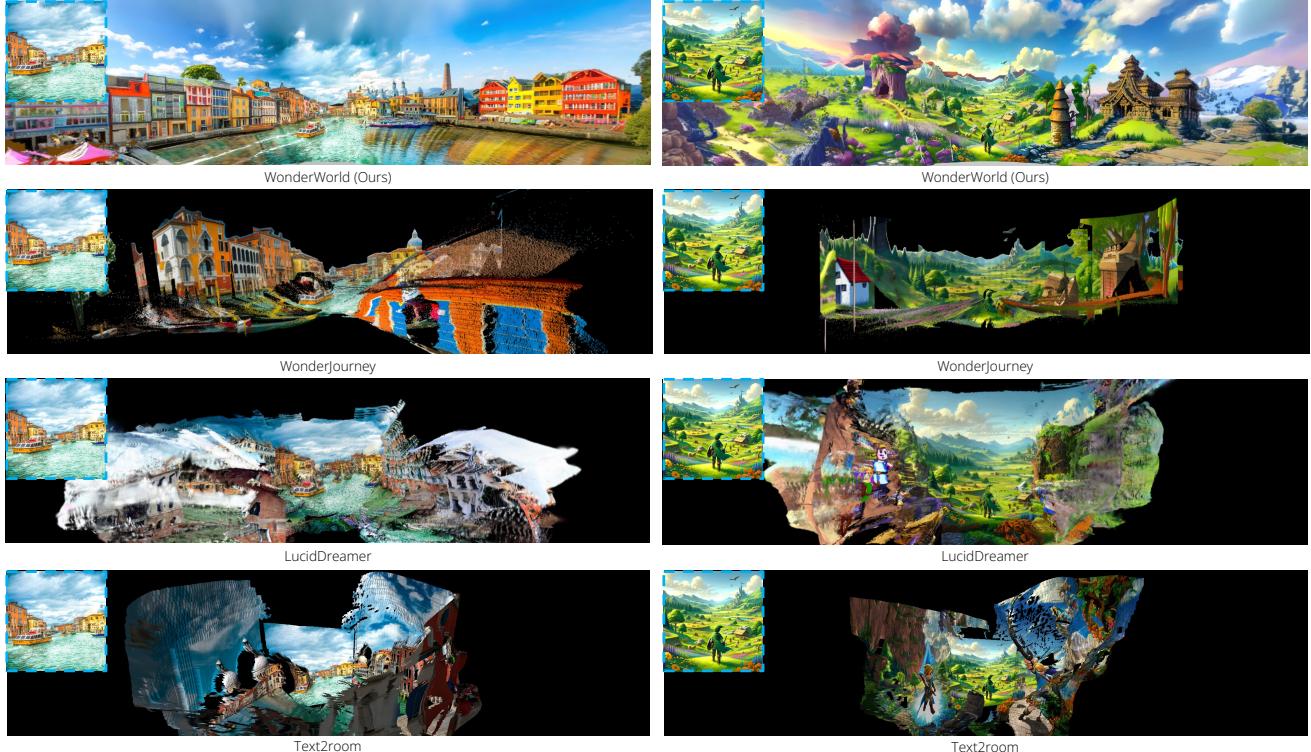
As seen in Figure 5, baseline methods struggle to create a coherent panoramic view, often resulting in “broken” geometry or repetitive textures when extending the scene. WonderWorld generates a consistent, connected environment.
3. Diversity
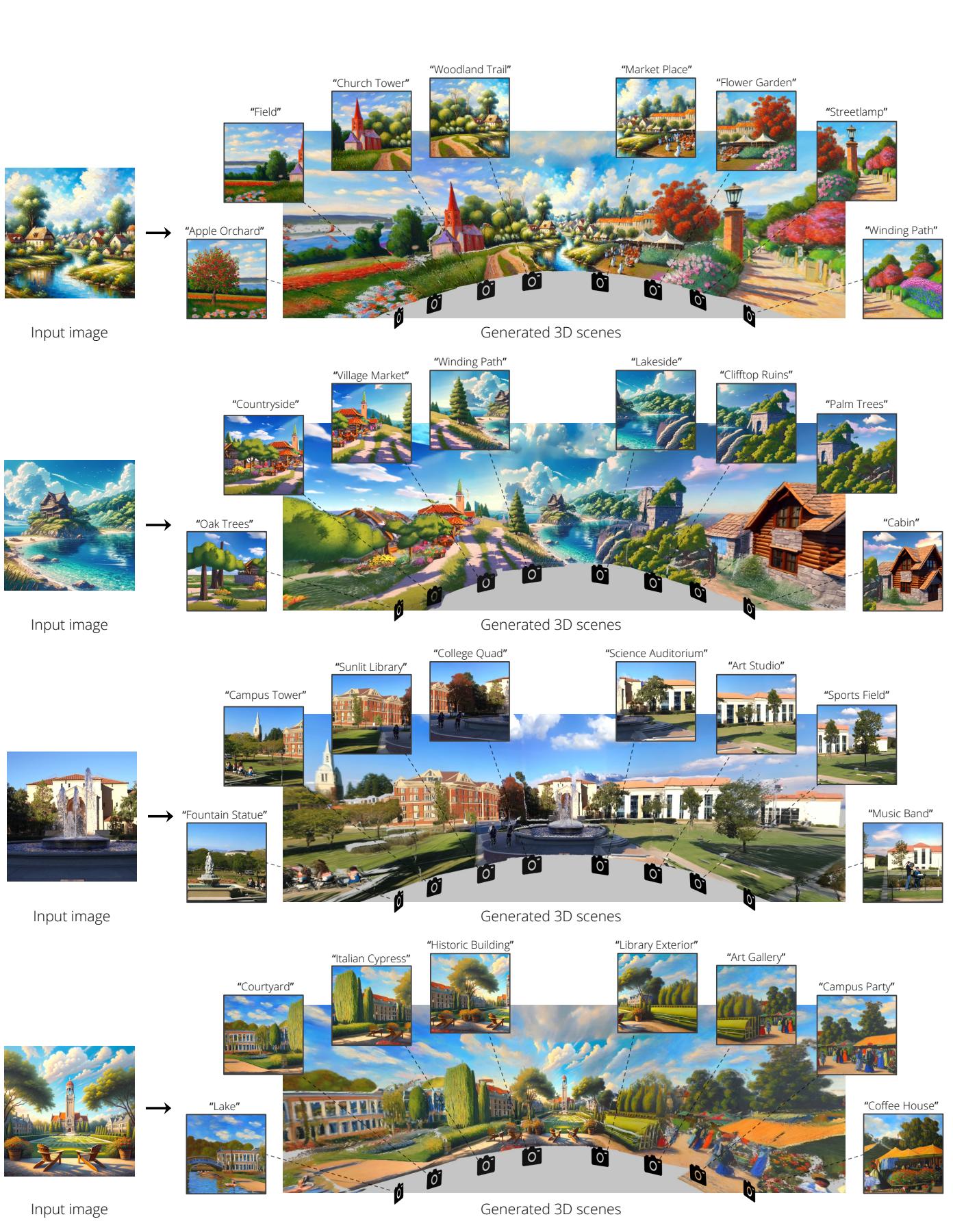
Because the system is driven by Large Language Models (LLMs) to generate prompts for new areas, the world can be incredibly diverse. Starting from a single image of a campus, the system can generate courtyards, libraries, and gardens.
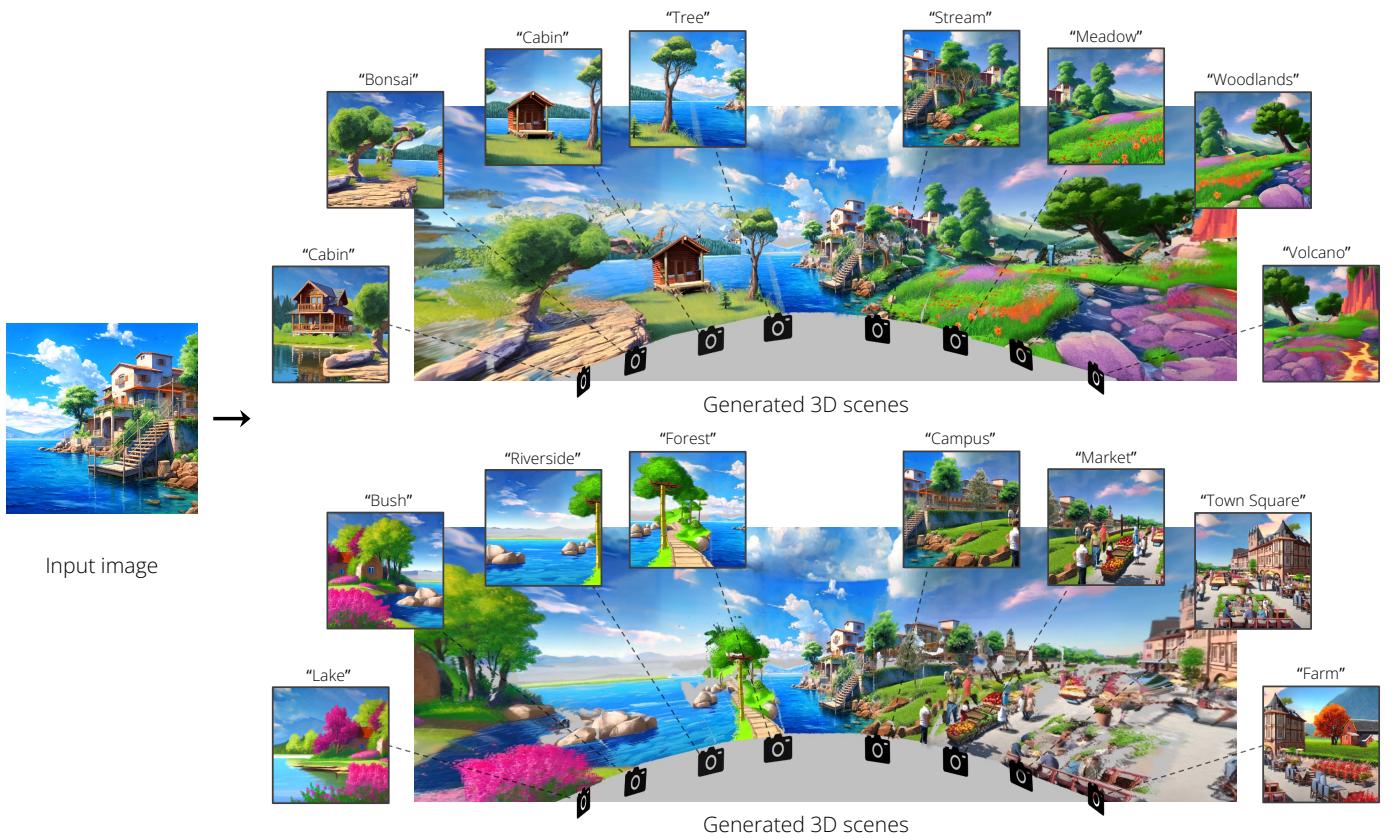
It also supports style transfer. You can tell the system to generate the next chunk of the world in “Lego style” or “Minecraft style,” and the FLAGS representation adapts accordingly.
4. Ablation Studies
To prove that their specific contributions matter, the authors removed them one by one:
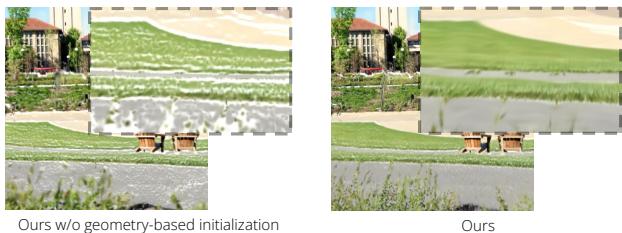
- Without Geometry Initialization: The scene relies on standard Gaussian initialization. The result is blurry and full of artifacts because the optimization didn’t have enough time to converge.
- Without Guidance: Significant seams appear between scenes. The ground plane might jump up or down arbitrarily.

Conclusion and Implications
WonderWorld represents a paradigm shift in 3D content creation. By combining the generative power of 2D diffusion models with a highly efficient, initialized 3D representation (FLAGS), it bridges the gap between static image generation and interactive 3D exploration.
Key Takeaways:
- Interactivity is Key: Reducing generation time from minutes to seconds changes the utility of the tool from “offline rendering” to “interactive design.”
- Physics-Aware Initialization: Instead of learning everything from scratch, using geometric principles (depth, normals, sampling theory) to initialize the model provides a massive speedup.
- Coherence via Guidance: Conditioning generative models on existing geometry is essential for building large-scale, seamless worlds.
This technology opens the door for infinite video games, rapid VR prototyping, and “Holodeck”-style experiences where the world is built as fast as you can walk through it. While currently limited by the inference speed of diffusion models, as those models become faster, WonderWorld’s framework is ready to power the next generation of virtual experiences.