](https://deep-paper.org/en/paper/2406.09570/images/cover.png)
Introduction
Generative AI has undergone a massive transformation with the advent of diffusion models. These models, which power tools like Stable Diffusion and DALL-E, generate stunning images by gradually removing noise from a signal. However, they suffer from a well-known bottleneck: speed. Generating a single image often requires dozens or hundreds of sequential steps.
To solve this, researchers introduced Consistency Models (CMs). The promise of a consistency model is alluring: it aims to generate high-quality data in a single step (or very few steps) by learning to map any point on a noisy trajectory directly to its clean starting point.
However, training these models from scratch (“Consistency Training”) has proven difficult compared to distilling them from existing, slow diffusion models (“Consistency Distillation”). There is a theoretical and practical gap between the two.
In this post, we are diving deep into the paper “Improving Consistency Models with Generator-Augmented Flows.” We will explore why standard consistency training is mathematically flawed, how the authors identified a “discrepancy” that persists even in the continuous-time limit, and their novel solution: Generator-Augmented Flows (GC). This method uses the model’s own predictions to straighten the generation paths, drastically improving training speed and quality.
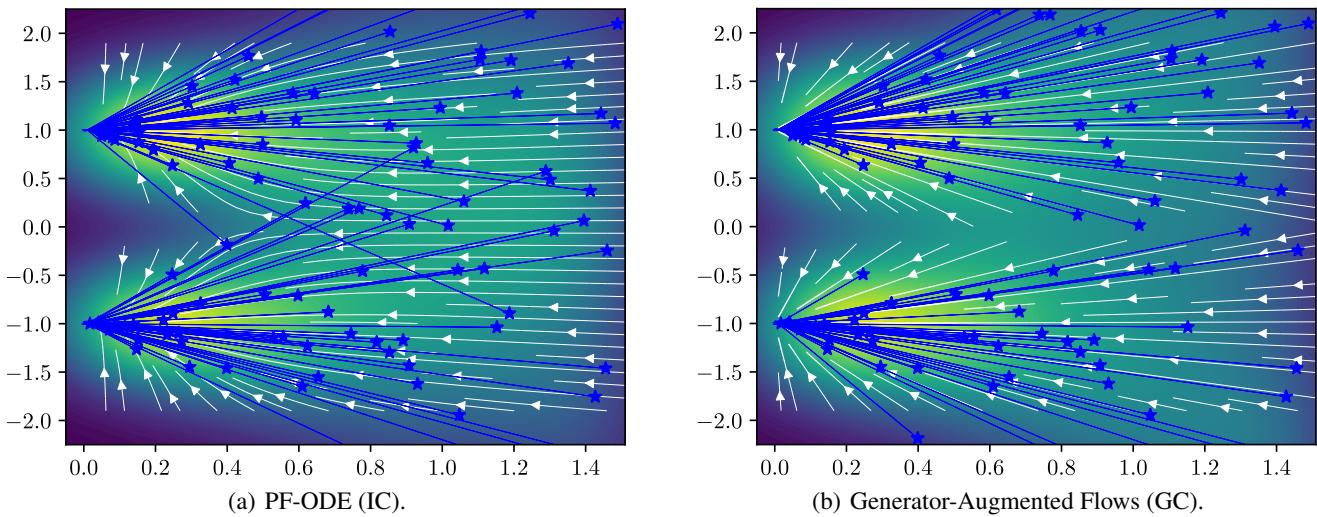
As shown in Figure 1 above, the standard approach (Independent Coupling, or IC) results in chaotic trajectories (left), whereas the proposed Generator-Augmented Flows (right) create straighter, more coherent paths aligned with the true velocity field.
Let’s unpack how this works.
Background: The Mechanics of Consistency
To understand the innovation, we first need to understand the baseline. Diffusion models can be described mathematically using a Probability Flow Ordinary Differential Equation (PF-ODE).
The PF-ODE
A diffusion process gradually adds noise to data \(\mathbf{x}_{\star}\) until it becomes pure noise \(\mathbf{z}\). This process describes a trajectory. We can reverse this trajectory to generate images. The movement along this trajectory is defined by a velocity field \(\mathbf{v}_t(\mathbf{x})\). The equation governing this movement is:
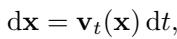
Here, \(\mathbf{v}_t(\mathbf{x})\) is the velocity field. In standard diffusion, this is derived from the score function (the gradient of the log-density).
Consistency Models
Solving the ODE step-by-step is slow. Consistency models try to learn a function \(f_{\theta}(\mathbf{x}_t, \sigma_t)\) that maps any point \(\mathbf{x}_t\) at time \(t\) back to the original data \(\mathbf{x}_0\).
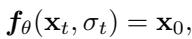
If the model is perfect, applying \(f_{\theta}\) to any point on the trajectory yields the same result: the clean image. This is the self-consistency property.
To ensure the model respects the boundary condition (i.e., at time 0, the output is the input itself), the architecture is usually parameterized using skip connections:

The Tale of Two Training Methods
There are two main ways to learn this function \(f_{\theta}\):
- Consistency Distillation (CD): You have a pre-trained teacher model (a standard diffusion model) that gives you the “true” velocity field \(\mathbf{v}_t\). You use this teacher to simulate a step and train your student \(f_{\theta}\) to match it.
- Consistency Training (CT): You don’t have a teacher. You want to train the model from scratch.
This article focuses on the challenges of Consistency Training.
In Distillation, we minimize the difference between the model’s prediction at the current step and the next step, where the next step is computed using the teacher’s velocity.

In this equation, \(\mathbf{x}_{t_i}^{\Phi}\) represents a “ground truth” step taken using the teacher’s exact velocity field:

However, in Consistency Training (CT), we don’t have access to the true velocity \(\mathbf{v}_{t_{i+1}}\). We replace it with a single-sample Monte Carlo estimate. We take a data point \(\mathbf{x}_{\star}\) and a noise vector \(\mathbf{z}\), mix them to get \(\mathbf{x}_{t_i}\) and \(\mathbf{x}_{t_{i+1}}\), and treat the difference between them as the direction.

Here lies the problem. We are substituting the true velocity field (an expectation) with a single noisy sample.
The Discrepancy: Why Training Lags Behind Distillation
Intuitively, one might think that replacing the true velocity with a noisy estimate just makes training noisier, but that it should average out over time. Previous research suggested that as the number of timesteps \(N \to \infty\) (the continuous-time limit), Consistency Training and Distillation would become equivalent.
The authors of this paper prove that this is false.
Theorem 1: The Gap Exists
The researchers provide a rigorous proof (Theorem 1) showing that even with infinite timesteps, the loss functions for training and distillation converge to different values.

There is a persistent gap, denoted as \(\mathcal{R}(\theta)\). This term is strictly positive and represents a fundamental bias introduced by using single samples instead of the true vector field.

Why does this gap exist? It comes down to the gradients. The “true” gradient used in distillation (\(\partial_{\mathrm{CD}}\)) relies on the expected velocity \(\mathbf{v}_t\). The gradient used in training (\(\partial_{\mathrm{CT}}\)) relies on the instantaneous sample velocity \(\dot{\mathbf{x}}_t\).


When we look at the specific case where the distance metric is squared Euclidean distance (\(\alpha=2\)), the residual term \(\mathcal{R}(\theta)\) takes a very clear form:

This equation is the “smoking gun.” The error depends on the squared difference between the sample velocity \(\dot{\mathbf{x}}_t\) and the true velocity \(\mathbf{v}_t(\mathbf{x}_t)\).
In plain English: Because standard training couples data and noise randomly (Independent Coupling), the path a single sample takes (\(\dot{\mathbf{x}}_t\)) is often very different from the average flow of the probability distribution (\(\mathbf{v}_t\)). This variance creates a permanent discrepancy in the loss landscape.
The gradients point to different optimums:

The Core Method: Generator-Augmented Flows
The authors realize that to fix Consistency Training, we must reduce the variance term: \(\|\dot{\mathbf{x}}_t - \mathbf{v}_t(\mathbf{x}_t)\|^2\).
We cannot magically know the true velocity \(\mathbf{v}_t\) without a pre-trained teacher. However, we can construct “smarter” trajectories where the sample path \(\dot{\mathbf{x}}_t\) naturally aligns better with the average flow.
Moving Beyond Independent Coupling (IC)
Standard training uses Independent Coupling (IC): pick a random image \(\mathbf{x}_{\star}\), pick random noise \(\mathbf{z}\), and interpolate. This is simple but inefficient. The noise vector might “want” to go to a completely different image than the one it was paired with, creating high-curvature paths and high variance.
Optimal Transport (OT) is one alternative. It pairs specific noise vectors with specific images to minimize travel distance. However, OT is computationally expensive (\(O(N^3)\)) and must be approximated per mini-batch, which re-introduces error.
Enter Generator-Augmented Coupling (GC)
The authors propose a brilliant heuristic: Use the consistency model itself to decide the coupling.
If the consistency model \(f_{\theta}\) is partially trained, it already has some idea of where a noisy point \(\mathbf{x}_t\) should map to. We can use this prediction to create a “synthetic” data target.
The Process:
- Sample a standard random point \(\mathbf{x}_{t_i}\) using Independent Coupling.
- Ask the model to predict the clean data: \(\hat{\mathbf{x}}_{t_i} = f(\mathbf{x}_{t_i}, \sigma_{t_i})\).
- Crucial Step: Create a new trajectory that connects this predicted data \(\hat{\mathbf{x}}_{t_i}\) with the same noise \(\mathbf{z}\) used in step 1.

Now, we define the Generator-Augmented Coupling (GC) points \((\tilde{\mathbf{x}}_{t_i}, \tilde{\mathbf{x}}_{t_{i+1}})\) using this new pairing:

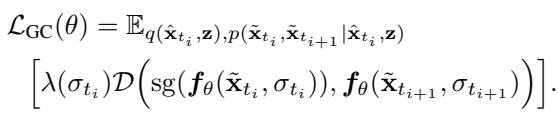
We then calculate the consistency loss on this new, smarter trajectory.
Why is this better?
By coupling the noise \(\mathbf{z}\) with the data point \(\hat{\mathbf{x}}\) that the model predicts from that noise, we are essentially constructing a trajectory that the model finds “natural.” This aligns the single-sample path direction (\(\dot{\mathbf{x}}_t\)) much closer to the vector field direction (\(\mathbf{v}_t\)), effectively reducing the gap \(\mathcal{R}(\theta)\).
Theoretical Validation
The authors prove two key properties of this new flow.
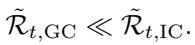
1. Reduced Discrepancy They analyze a proxy for the discrepancy term \(\mathcal{R}(\theta)\), denoted \(\tilde{\mathcal{R}}_t\).

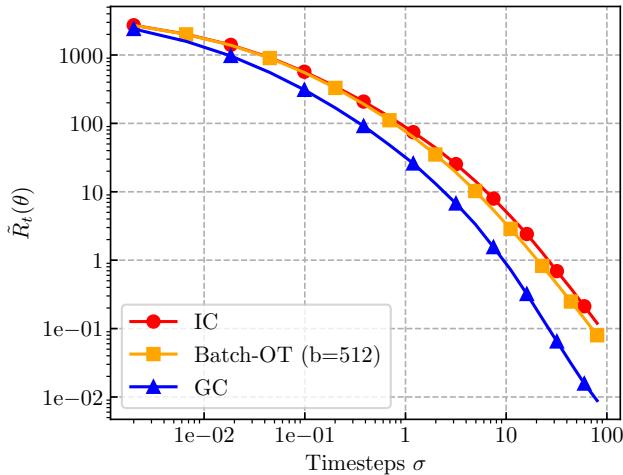
Theoretical analysis (Theorem 2) and empirical measurement show that this term is significantly lower for GC than for IC.
We can see this empirically in Figure 2. The blue line (GC) is consistently lower than the red line (IC) and even the orange line (Batch-OT).
2. Reduced Transport Cost Transport cost measures how “straight” the paths are. Straight paths are easier to learn and simulate.

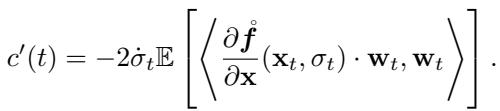
The authors define the transport cost \(c(t)\) and prove that for Generator-Augmented flows, this cost decreases as time goes on (specifically, the derivative is negative).
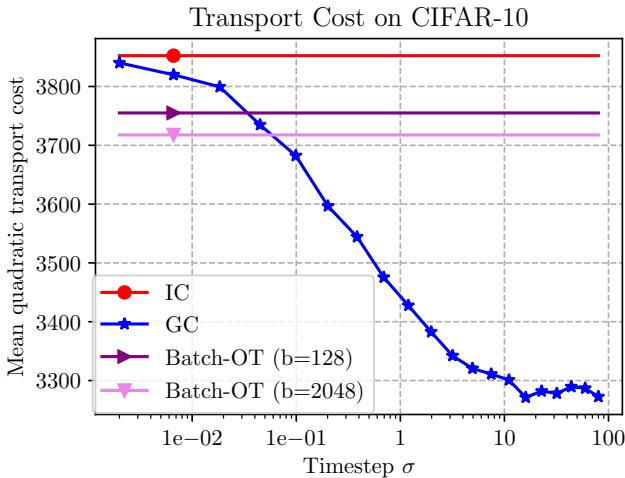
Empirically, this results in much straighter, more efficient paths. Look at Figure 3: GC (blue stars) drastically reduces transport cost compared to IC (red circles), and even outperforms batch-Optimal Transport (orange/purple) in many regimes.
Algorithm: Joint Learning
There is a catch-22 here. To generate good GC trajectories, we need a good consistency model \(f_{\theta}\) to predict \(\hat{\mathbf{x}}\). But to get a good model, we need to train it.
The solution is Joint Learning. We train a single model \(f_{\theta}\) from scratch. At every training step, we mix the data:
- With probability \((1-\mu)\), we use standard Independent Coupling (IC).
- With probability \(\mu\), we use Generator-Augmented Coupling (GC) based on the model’s current predictions.
This allows the model to bootstrap itself. The IC samples ensure the model sees the true data distribution, while the GC samples refine the gradients and straighten the flow.

The authors found that a mixture rate of \(\mu = 0.5\) (half and half) often works best.
Experiments and Results
The researchers tested this approach on standard image generation benchmarks: CIFAR-10, ImageNet, CelebA, and LSUN Church. They compared their method (iCT-GC) against the standard Improved Consistency Training (iCT-IC) and Consistency Training with Optimal Transport (iCT-OT).
Convergence Speed
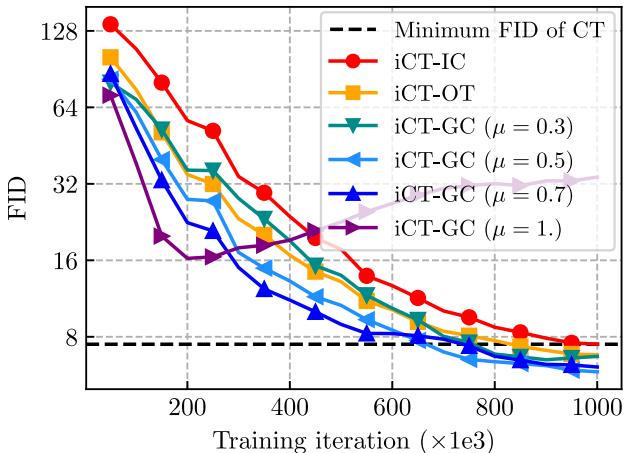
One of the most significant findings is the speed of convergence. Because the variance of the gradient estimator is lower, the model learns faster.
Figure 5 shows the FID (Fréchet Inception Distance, lower is better) over training iterations. The purple curve (GC with \(\mu=1.0\)) drops incredibly fast early on, though a mixture (like \(\mu=0.5\), light blue) yields the best long-term stability. All GC variants converge faster than the baseline (red).
Quantitative Performance
The final results are summarized in Table 1. The proposed method (iCT-GC) achieves the lowest FID scores across almost all datasets, beating both the standard baseline and the Optimal Transport variant.
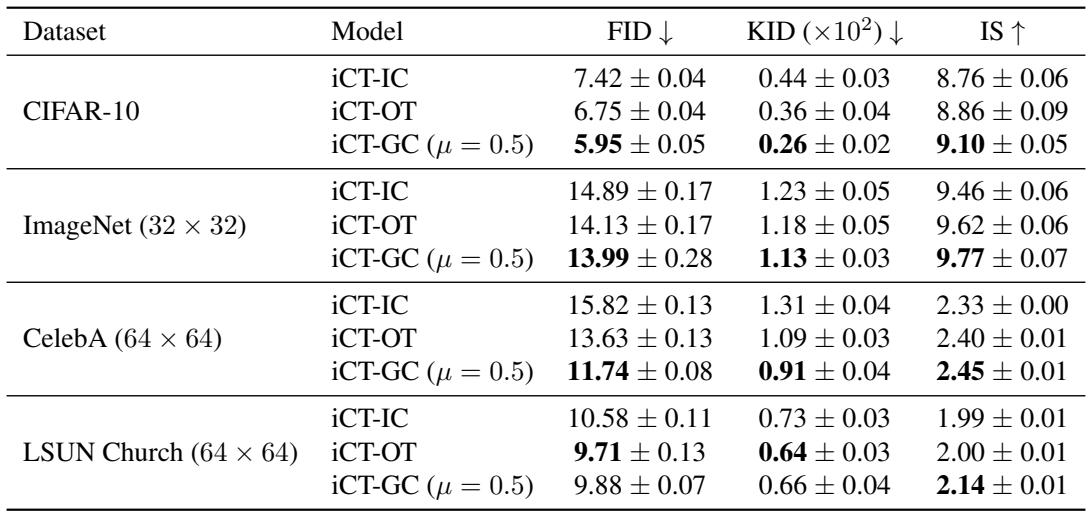
For example, on CIFAR-10, FID improves from 7.42 (Baseline) to 5.95 (GC). On CelebA, it improves from 15.82 to 11.74.
Visual Quality
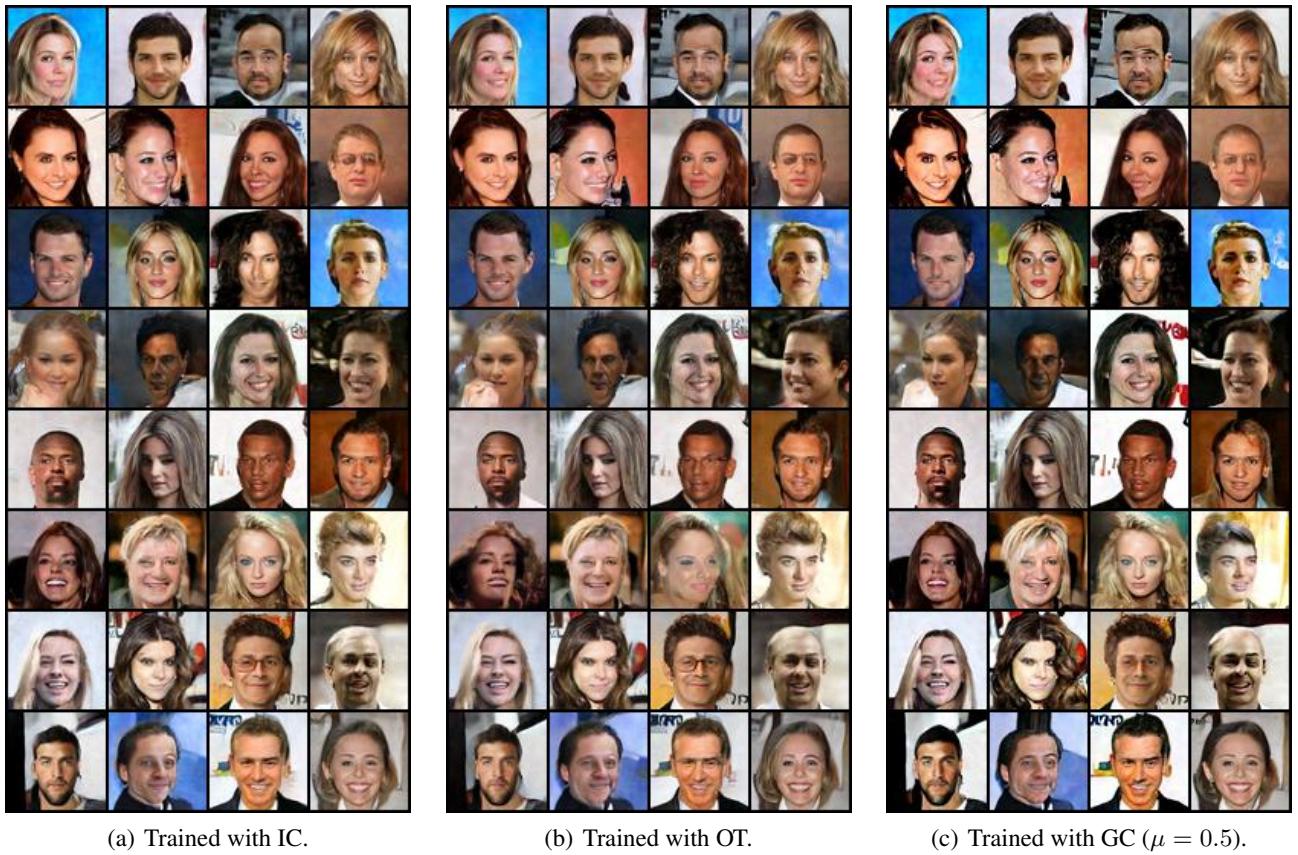
The quantitative improvements translate to visual quality. Figure 8 compares samples generated by the different methods. The faces generated by the GC-trained model (Panel c) appear sharper and more consistent than the baseline (Panel a).
Easy Consistency Tuning (ECT)
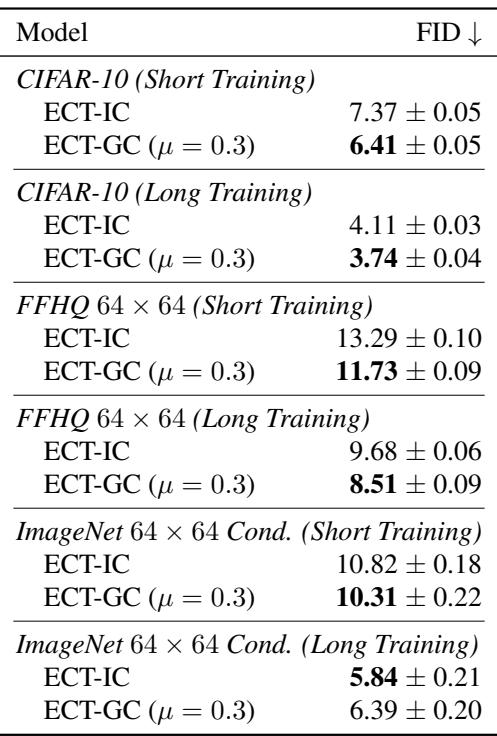
The authors also tested their method in the “Easy Consistency Tuning” setting (a recent technique for fine-tuning pre-trained diffusion models). As shown in Table 2, GC continues to outperform the standard approach, proving its versatility.
Conclusion
The paper “Improving Consistency Models with Generator-Augmented Flows” highlights a subtle but critical flaw in how Consistency Models are trained. By relying on a single-sample estimate of the velocity field coupled with random data-noise pairing, standard training incurs a permanent error bias and high variance.
The proposed solution—Generator-Augmented Flows—is elegant in its self-reliance. By using the model’s own emerging understanding of the data to guide the coupling process, the authors achieve:
- Lower Discrepancy: The training objective aligns better with the ideal distillation objective.
- Lower Transport Cost: The trajectories from noise to data become straighter and easier to learn.
- Better Performance: Faster convergence and higher quality image generation.
This work serves as a reminder that in deep learning, how we pair our inputs and targets (the coupling) is just as important as the model architecture itself. By moving from random coupling to “smart,” model-guided coupling, we can close the gap between theoretical ideal and practical reality.