](https://deep-paper.org/en/paper/2406.10701/images/cover.png)
Introduction
Imagine walking into a store and buying a wireless mouse. A few minutes later, you pick up a solar-powered keyboard. To a human observer, the connection is obvious: you are likely setting up an eco-friendly, clutter-free home office.
However, for traditional Artificial Intelligence systems in e-commerce, this connection is surprisingly difficult to make. Most existing systems rely solely on text—product titles and descriptions. When a text-based model sees “Orbit Trackball Mouse” and “Wireless Solar Keyboard,” it might correctly categorize them as “electronics,” but it often misses the nuanced intention behind the purchase. It fails to “see” that both items are white, ergonomic, and designed for a specific type of user.
Understanding the why behind a purchase—the shopping intention—is the holy grail of e-commerce. It powers better recommendations (“You bought a tent, do you need a sleeping bag?”) and smarter search results.
In this post, we will explore a new framework called MIND (Multimodal Shopping Intention Distillation). This research moves beyond text-only analysis by introducing Large Vision-Language Models (LVLMs) into the mix. By allowing AI to “see” product images and “read” descriptions simultaneously, the researchers have created a system that understands shopping behavior much like a human does.
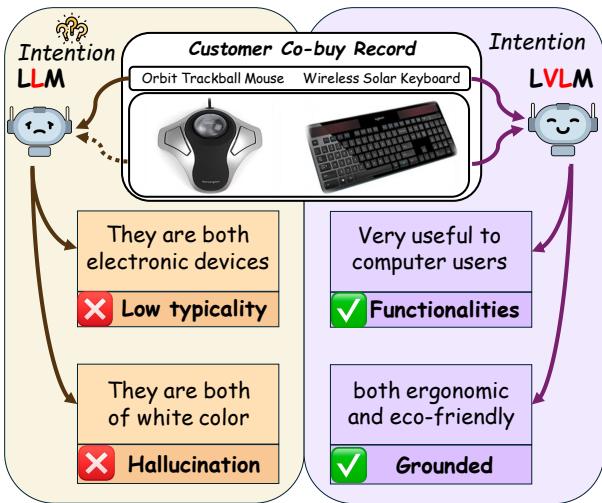
As shown in Figure 1, while a standard Large Language Model (LLM) might hallucinate details or give generic answers, the Multimodal model (LVLM) correctly identifies that the mouse and keyboard are both “ergonomic” and “eco-friendly,” deriving a high-quality intention.
The Problem with Text-Only Shopping
Before diving into the solution, we need to understand the limitations of the previous state-of-the-art.
Traditionally, acquiring large-scale data on user intentions has been a bottleneck. Intentions are implicit mental states; customers rarely write “I am buying this to organize my garage” in the search bar. Researchers have previously tried to “distill” these intentions using text-based Large Language Models (LLMs). While effective to a degree, these methods suffer from two main issues:
- Product-Centric Bias: Text models tend to focus heavily on product specifications (metadata) rather than user needs. They generate intentions like “buying two Sony products” rather than “setting up a home theater.”
- Visual Blindness: A massive amount of information is conveyed through product images—style, color compatibility, material, and usage context. Text models miss all of this.
- High Cost: To ensure quality, previous methods relied heavily on human annotators to verify the AI’s output, making it expensive to scale up.
The researchers behind MIND tackled these issues by asking: Can we automate the discovery of shopping intentions by using AI that can see?
The MIND Framework
The core contribution of this paper is the MIND framework. It is a pipeline designed to extract high-quality, human-centric shopping intentions from co-buy records (records of two items bought together).
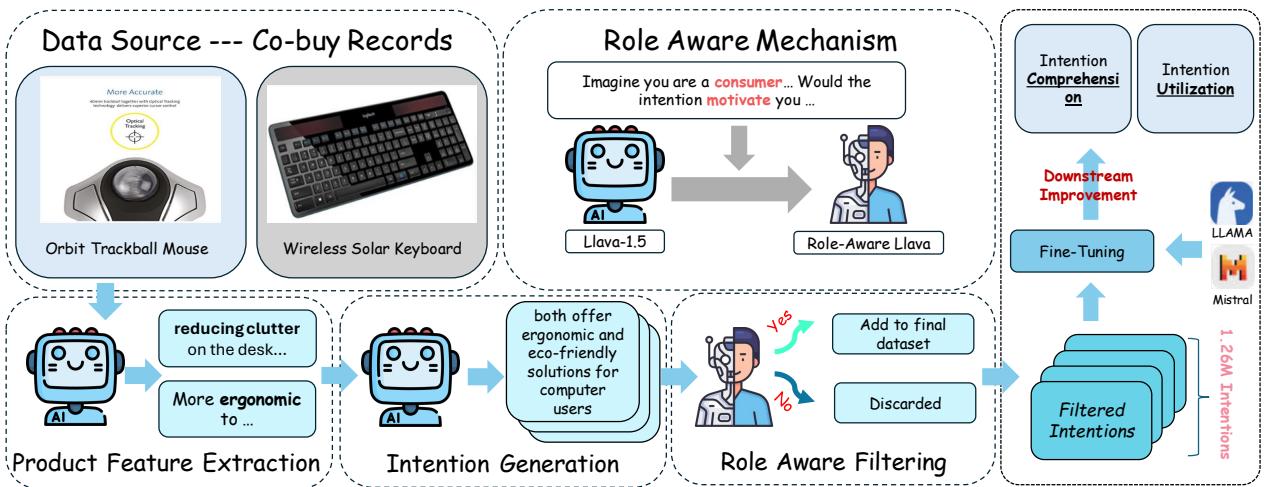
The framework operates in three distinct stages: Product Feature Extraction, Intention Generation, and Human-Centric Role-Aware Filtering.
Step 1: Product Feature Extraction
Retailer-provided product titles and descriptions can be messy, noisy, or purely promotional. They often leave out the visual details that actually drive a purchase decision.
To fix this, MIND first uses an LVLM (specifically LLaVa) to look at the product image and read the title. The model is prompted to extract implicit features focusing on:
- Attributes: (e.g., “waterproof,” “wireless”)
- Design: (e.g., “ergonomic,” “vintage style”)
- Quality: (e.g., “durable,” “premium”)
This step bridges the gap between what the retailer wrote and what the customer sees.
Step 2: Co-buy Intention Generation
Once the system has a rich set of visual and textual features for two co-bought products, it needs to figure out the relationship between them.
The researchers use ConceptNet relations (like “UsedFor,” “Causes,” “RelatedTo”) to guide the AI. The LVLM is given the images and the extracted features of both products and is instructed to: “Act as the customer and infer a potential intention behind such purchase.”
By instructing the model to adopt a customer persona, the generated intentions shift from being factual descriptions of the items to being explanations of the user’s mental state.
Step 3: Human-Centric Role-Aware Filtering
This is arguably the most innovative part of the framework. In the past, researchers had to hire humans to check if the AI-generated intentions made sense. MIND automates this using a Role-Aware Filter.
Here is how it works:
- The system takes the intention generated in Step 2.
- It feeds this intention back into the LVLM along with the product images.
- It gives the AI a specific prompt: “Imagine you are a consumer… Would this intention motivate you to buy these products together?”
- The AI must answer “Yes” or “No” and provide a rationale.
This mimics a Theory-of-Mind approach, where the AI simulates a human decision-making process. If the AI “customer” agrees that the intention makes sense for the products, the data is kept. If not, it is discarded. This creates a high-quality filter without the need for manual human annotation.
Creating the Knowledge Base
The researchers applied MIND to the Amazon Review Dataset, specifically focusing on “Electronics” and “Clothing, Shoes, and Jewelry.”
The result is a massive Multimodal Intention Knowledge Base containing 1,264,441 intentions.
To understand the scope of this dataset, we can look at the diversity of the concepts it covers.
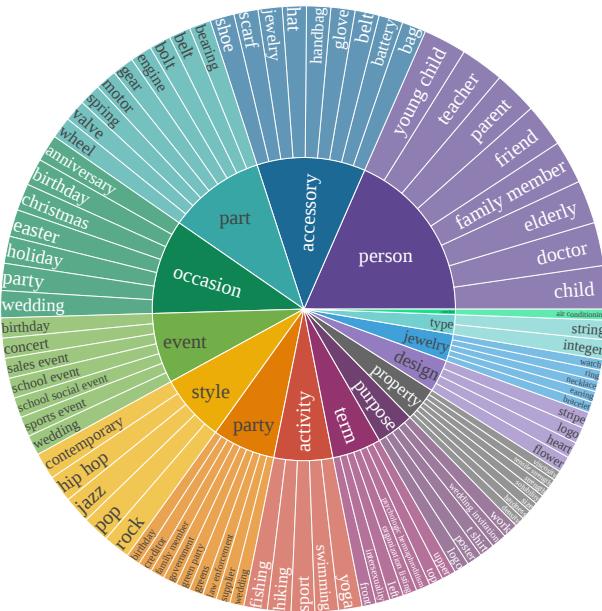
Figure 3 illustrates the semantic diversity of the generated intentions. The concentric circles represent a hierarchy of concepts (hypernyms). We can see major categories like “Person,” “Event,” “Occasion,” and “Activity,” branching out into specific nuances like “birthday,” “hiking,” “wedding,” or “school event.” This proves that MIND isn’t just generating repetitive technical data; it is capturing the rich tapestry of human life events that drive shopping.
Experimental Validation
How do we know the MIND framework actually works? The researchers conducted extensive evaluations, both by asking human experts and by testing the data on other AI models.
Human Evaluation
Human annotators were hired to rate the AI-generated intentions on Plausibility (does it make sense?) and Typicality (is it a common reason to buy these items?).
- Plausibility: 94%
- Typicality: 90%
These are exceptionally high scores, indicating that the intentions generated by MIND are almost indistinguishable from those a human might write. Furthermore, the Role-Aware Filter was found to be highly accurate, correctly accepting or rejecting intentions 82% of the time compared to human judgment.
Comparison with Previous Methods
The researchers compared MIND against FolkScope, the previous state-of-the-art method that relied on text-only generation.
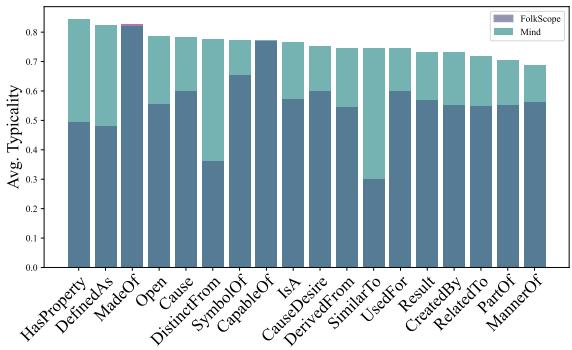
As shown in Figure 5, MIND (represented in teal) consistently produces intentions with higher typicality scores across almost all semantic relations compared to FolkScope (dark blue). This confirms that adding visual information and using the role-aware filter results in higher-quality data.
Downstream Tasks: IntentionQA
To prove that this data is useful for training other AI models, the researchers used the IntentionQA benchmark. This benchmark tests an AI’s ability to:
- Understand Intention: Given two products, guess the intention.
- Utilize Intention: Given a product and an intention, predict what else the user will buy.
They fine-tuned open-source models (like LLaMA and Mistral) using the MIND dataset.
The Results: The models trained on MIND data showed significant improvements. For example, a Mistral-7B model fine-tuned on MIND data became competitive with GPT-4 in certain tasks, despite being a much smaller model.
Ablation Studies: Does Every Part Matter?
The team also tested “stripped-down” versions of their framework to see which components were doing the heavy lifting.
- Multimodal vs. Unimodal: They removed the images and ran the framework using only text. The performance dropped, confirming that visual cues are essential for understanding e-commerce products.
- Filter Efficacy: They compared the model’s performance with and without the “Role-Aware Filter.”
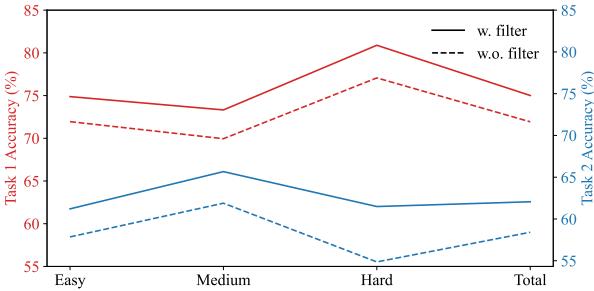
Figure 4 clearly shows the impact of the filter. The solid black line (With Filter) consistently outperforms the dashed red line (Without Filter) across Easy, Medium, and Hard tasks. This demonstrates that the filtering step effectively removes noisy or low-quality data that would otherwise confuse the model during training.
Qualitative Analysis
It is helpful to look at specific examples to see the difference MIND makes.
Consider a case where a customer buys a women’s ankle boot and a hobo shoulder bag.
- Previous Methods (FolkScope): Might generate an intention like “They are both a manner of Women’s Shoes and Women’s Handbags.” This is factually true, but it’s just a categorization. It’s not an intention.
- MIND: Generates “The consumer is looking for a stylish and functional combination for their daily activities.”
In another example involving a pirate wig and boot toppers:
- Previous Methods: “They are part of the Adult Costume category.”
- MIND: “The person wants to create a complete and authentic pirate costume.”
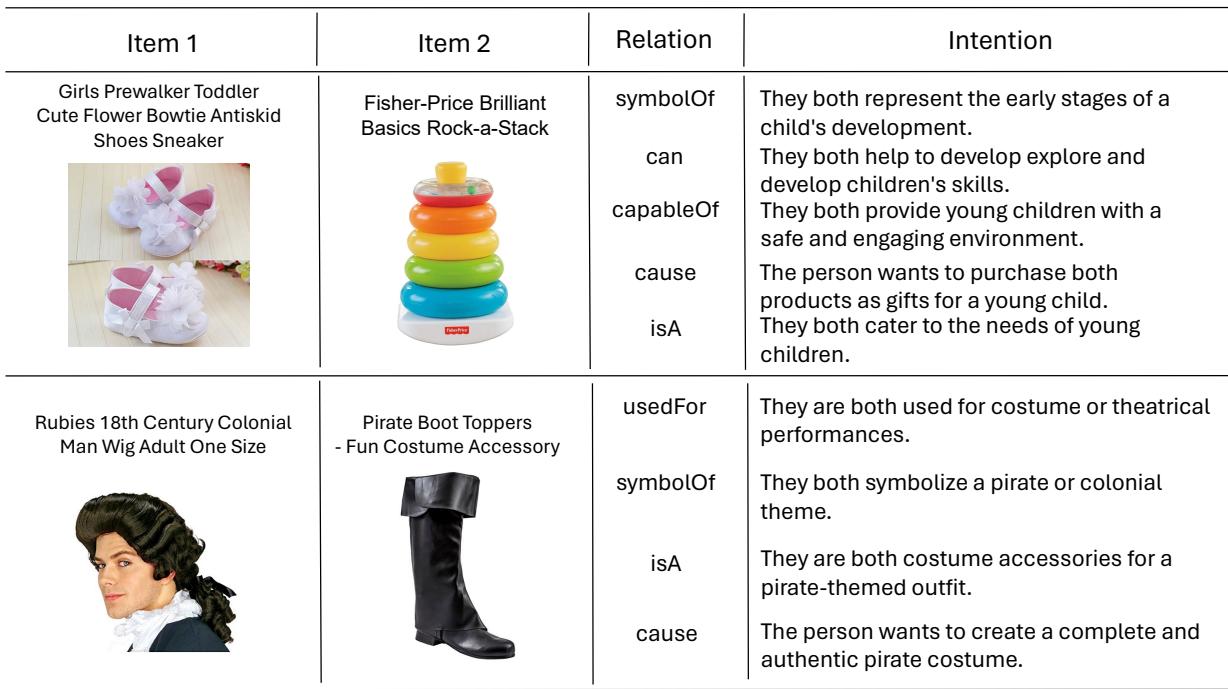
Figure 6 provides further examples of how MIND generates intentions across various relationships like “SymbolOf,” “UsedFor,” and “IsA.” Whether it’s identifying that shoes and a toy both “cater to the needs of young children” or that costume parts “symbolize a pirate theme,” the model captures the functional and emotional reasons behind the purchase.
Conclusion and Implications
The MIND framework represents a significant step forward in how machines understand human shopping behavior. By integrating visual perception with language understanding, MIND moves away from dry, product-centric metadata and toward a rich, human-centric understanding of why we buy what we buy.
Key takeaways from this research include:
- Visuals are Vital: You cannot fully understand a purchase without seeing the product. Images contain cues about style, usage, and compatibility that text descriptions miss.
- AI Agents as Quality Control: The “Role-Aware Filter” demonstrates that we can use LLMs to evaluate other LLMs, significantly reducing the cost and time required to build large datasets.
- Better E-commerce Experience: The data generated by MIND can be used to train smarter search engines and recommendation systems. Instead of just showing you “other electronics,” a system trained on this data might understand you are “building a streaming setup” and recommend a microphone and a ring light.
As AI continues to evolve, frameworks like MIND that bridge the gap between different modalities (vision and text) and simulate human reasoning (theory of mind) will be essential in creating digital services that truly understand us.