](https://deep-paper.org/en/paper/2406.10777/images/cover.png)
RoseLoRA: Surgical Precision in LLM Fine-Tuning
The era of Large Language Models (LLMs) has given us incredible tools like GPT-4 and LLaMA. These models are trained on massive corpora of text, absorbing a vast amount of general knowledge. However, the world changes. Presidents change, stock prices fluctuate, and new scientific discoveries are made.
How do we update these massive models to reflect new information?
Retraining them from scratch is prohibitively expensive. This led to the rise of Parameter-Efficient Fine-Tuning (PEFT), with methods like LoRA (Low-Rank Adaptation) becoming the industry standard. LoRA allows us to adapt models by training only a tiny fraction of parameters.
But LoRA has a hidden flaw when it comes to specific knowledge updates: it is a blunt instrument. When you use LoRA to teach a model a single new fact, it tends to smear that update across the entire model, potentially disrupting existing knowledge.
In this post, we will deep dive into RoseLoRA, a new research paper that proposes a “surgical” approach to fine-tuning. By introducing row and column-wise sparsity, RoseLoRA allows for precise, targeted updates—like using a scalpel instead of a sledgehammer.
The Problem with Being “Dense”
To understand why RoseLoRA is necessary, we first need to look at how standard LoRA works.
In a traditional pre-trained model, you have a massive weight matrix, let’s call it \(W^o\). When we want to fine-tune the model, we want to find a change in weights, \(\Delta W\), such that the new weights are \(W = W^o + \Delta W\).
In standard fine-tuning, \(\Delta W\) is the same size as the original matrix—huge. LoRA proposes that this update matrix has a “low rank.” Instead of learning the giant \(\Delta W\) directly, LoRA decomposes it into two much smaller matrices, \(\boldsymbol{B}\) and \(\boldsymbol{A}\).

Here, \(\boldsymbol{A}\) and \(\boldsymbol{B}\) are narrow matrices. When multiplied together (\(\boldsymbol{B} \times \boldsymbol{A}\)), they reconstruct the larger update matrix. During training, we freeze the original model \(W^o\) and only update \(\boldsymbol{A}\) and \(\boldsymbol{B}\).
The “Knowledge Editing” Dilemma
This works effectively for general tasks like “learn to speak like a pirate.” However, it fails at Knowledge Editing.
Imagine you want to update the model with the fact: “The Prime Minister of the UK is no longer Boris Johnson.” You want to change the parameters responsible for that specific fact without touching the parameters that know how to do math or summarize text.
The problem with LoRA is that the product \(\boldsymbol{B}\boldsymbol{A}\) is almost always a dense matrix. Even though \(\boldsymbol{A}\) and \(\boldsymbol{B}\) are small, their multiplication results in a matrix where almost every entry is non-zero. This means that to learn one tiny fact, LoRA adds a small value to every single weight in the pre-trained layer.
This creates two problems:
- Side Effects: You might accidentally degrade the model’s performance on unrelated tasks.
- Lack of Locality: You haven’t really “edited” the specific knowledge; you’ve just applied a global filter to mask the old knowledge.
Enter RoseLoRA: The Sparse Solution
The researchers propose RoseLoRA (Row and Column-wise Sparse Low-rank Adaptation). The core idea is simple but powerful: we want the final update matrix (\(\boldsymbol{B}\boldsymbol{A}\)) to be sparse. A sparse matrix is one mostly filled with zeros.
If the update matrix is sparse, it means we are only modifying a select few parameters in the original model—the ones that actually matter for the specific task or fact we are teaching.
The Sparsity Trap
You might think, “Why not just force matrices \(\boldsymbol{A}\) and \(\boldsymbol{B}\) to be sparse?”
This is where the math gets tricky. It turns out that having a sparse \(\boldsymbol{A}\) and a sparse \(\boldsymbol{B}\) does not guarantee that their product \(\boldsymbol{B}\boldsymbol{A}\) will be sparse.
Consider a simple example. If a row in \(\boldsymbol{B}\) has non-zero values and the corresponding column in \(\boldsymbol{A}\) has non-zero values, their dot product will be non-zero. If this happens often enough, you can multiply two matrices that are 90% sparse and end up with a product that is 100% dense.
The researchers analyzed this relationship deeply. They looked at how the sparsity of rows and columns affects the final product.
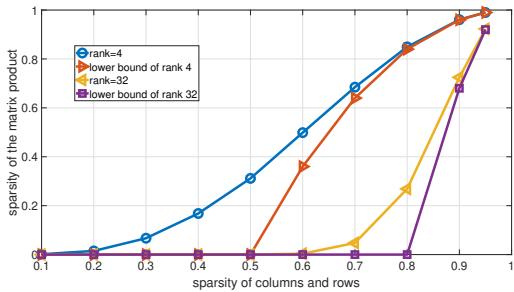
As shown in Figure 2 above, if you just apply random sparsity (the curves that stay low), you don’t necessarily get a sparse output until the input matrices are extremely empty. However, the researchers found a theoretical lower bound (the theoretical lines).
They discovered that to guarantee a sparse update, you need Structured Sparsity. specifically:
- Row-wise sparsity for matrix \(\boldsymbol{A}\).
- Column-wise sparsity for matrix \(\boldsymbol{B}\).
By enforcing entire rows of \(\boldsymbol{A}\) or columns of \(\boldsymbol{B}\) to be zero, they can mathematically bound the sparsity of the resulting product.
The RoseLoRA Framework
RoseLoRA is an iterative process. It doesn’t just start sparse; it learns what to make sparse as it trains.
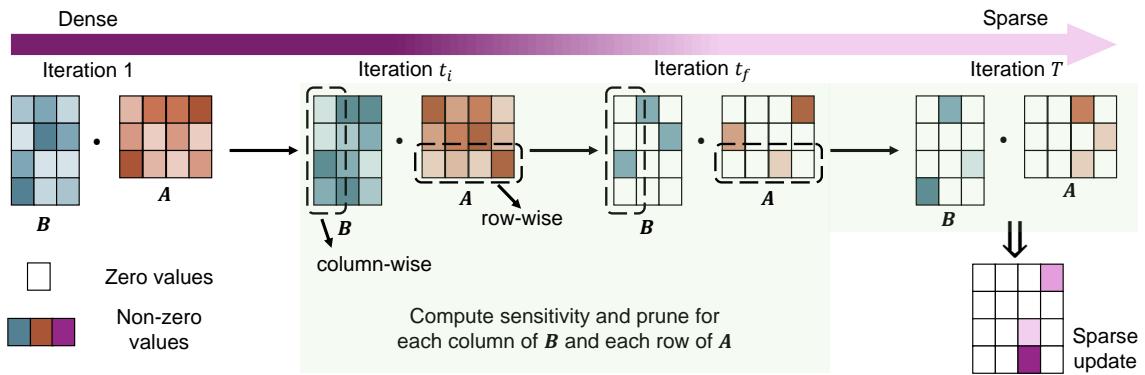
The process, illustrated above, works like this:
- Start Dense: Initialize matrices \(\boldsymbol{A}\) and \(\boldsymbol{B}\) normally.
- Calculate Sensitivity: Determine which parameters are most important for the current task.
- Prune: Set the least important rows of \(\boldsymbol{A}\) and columns of \(\boldsymbol{B}\) to zero.
- Train: Update the remaining non-zero parameters using standard backpropagation.
- Repeat: Over time, the matrices become sparser and sparser until they reach a target density.
The Mathematical Foundation
Let’s look at how this is formulated mathematically. The goal is to minimize the loss function while keeping the number of non-zero elements (the \(L_0\) norm) below a certain threshold \(\tau\).
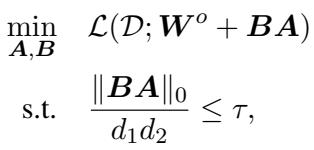
However, solving directly for the sparsity of the product \(\boldsymbol{B}\boldsymbol{A}\) is an NP-hard problem (computationally impossible to solve perfectly). Based on their discovery about row/column structures, the researchers reformulate the problem. Instead of constraining the product, they constrain the components:
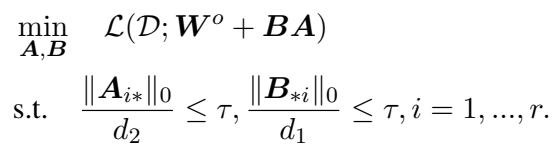
Here, \(\boldsymbol{A}_{i*}\) refers to the \(i\)-th row of \(\boldsymbol{A}\), and \(\boldsymbol{B}_{*i}\) refers to the \(i\)-th column of \(\boldsymbol{B}\). The constraint ensures that a certain percentage of these rows and columns are zeroed out.
The Guarantee
Does this actually work? The authors provide a theoretical proof (Proposition 1) showing that the sparsity of the product \(\boldsymbol{B}\boldsymbol{A}\) has a guaranteed lower bound based on the sparsity of the components.
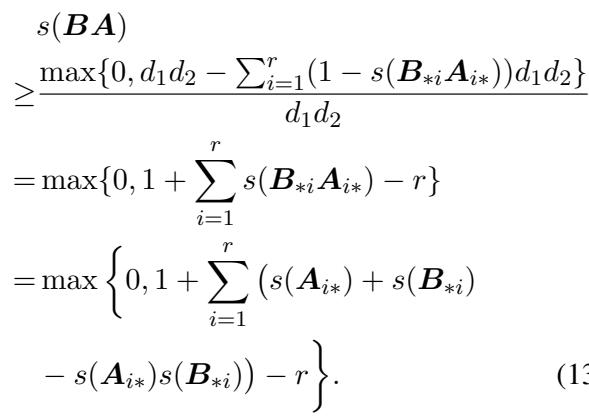
In plain English: If you prune the rows of \(\boldsymbol{A}\) and columns of \(\boldsymbol{B}\) sufficiently, you are guaranteed that the final update applied to the model will be sparse.
How to Prune: Sensitivity Analysis
How does the model decide which rows and columns to delete? Random guessing would be disastrous. We need to keep the “neurons” that are crucial for the new knowledge we are adding.
RoseLoRA uses a Sensitivity-based Importance Score. The sensitivity of a weight is defined as the magnitude of the weight multiplied by its gradient.

A high sensitivity score means that changing this weight slightly causes a large change in the loss—i.e., this weight is important.
To make the training stable, they don’t just use the sensitivity from a single batch. They use an exponential moving average to smooth the sensitivity scores over time:

The Pruning Schedule
The pruning happens iteratively. At each step \(t\), the algorithm calculates the updated gradients:
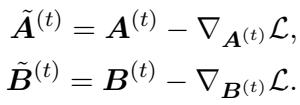
Then, it applies a thresholding function \(\mathcal{T}\). If a parameter’s importance score is in the top \(k\) percent, it stays. If not, it gets zeroed out.
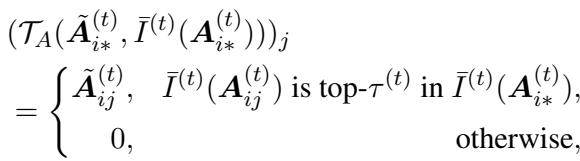
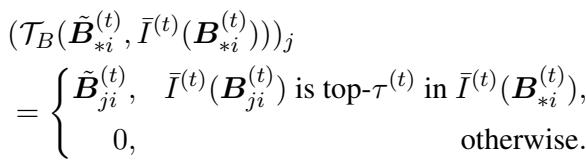
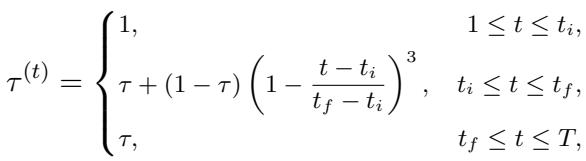
To prevent the model from “shock,” the sparsity isn’t enforced all at once. The system uses a cubic schedule to gradually increase the sparsity (decrease the number of active parameters) from 100% down to the target level over the course of training.
Experimental Results
The theory is sound, but how does it perform in practice? The researchers tested RoseLoRA against standard LoRA and other PEFT methods across a wide range of benchmarks.
1. Knowledge Editing
This is the litmus test for RoseLoRA. The task is to edit specific facts in the LLaMA-7b model (e.g., using the ZsRE dataset).
The Metrics:
- Edit Success: Did the model learn the new fact?
- Locality: Did the model not break unrelated knowledge? (Higher is better).
- Portability: Can the model use this new fact in reasoning?
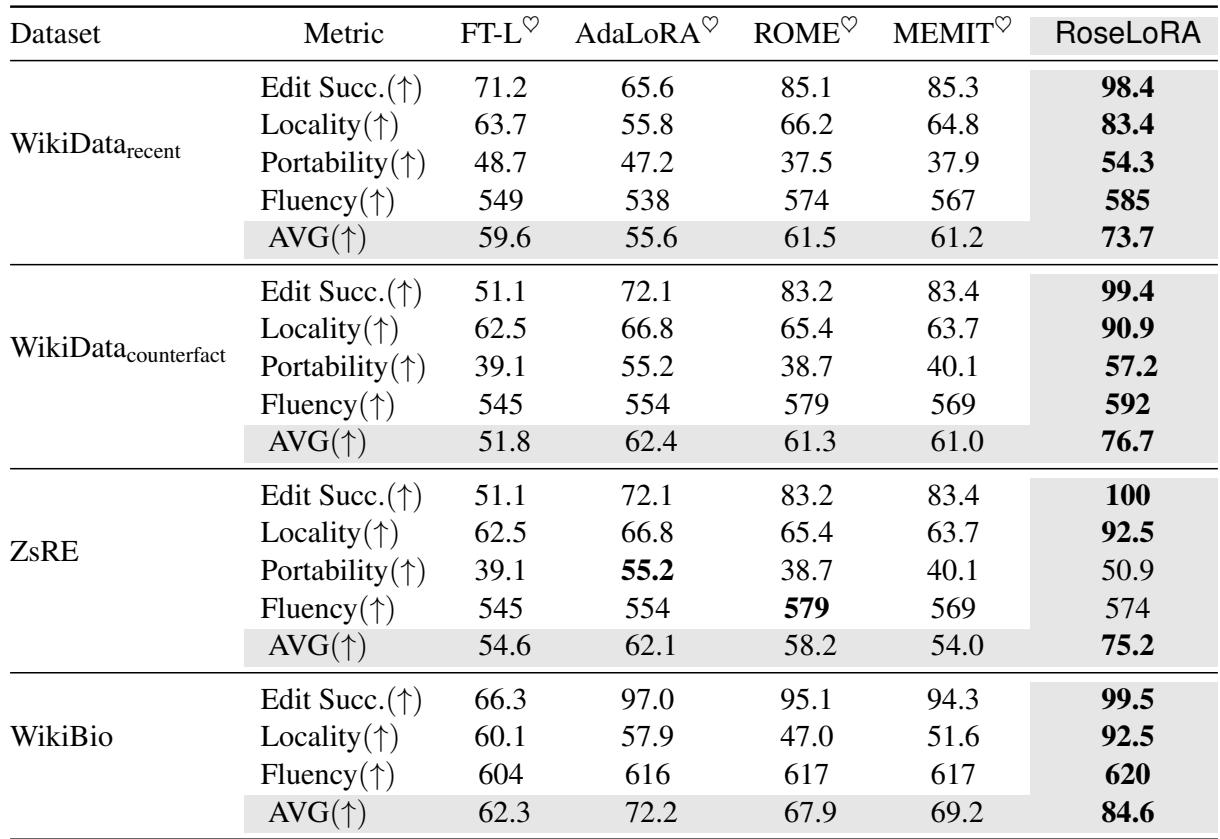
The Verdict: Look at the “Locality” and “AVG” (Average) columns in Table 1. RoseLoRA dominates.
- On WikiData_recent, RoseLoRA achieves a 98.4% edit success rate compared to LoRA’s (AdaLoRA) 65.6%.
- Crucially, the Locality score jump is massive (83.4 vs 55.8).
This confirms the hypothesis: sparse updates allow for precise editing without damaging the surrounding “neural circuitry.”
2. General Reasoning Tasks
One might worry that making the model sparse hurts its ability to learn general tasks. The researchers tested this on CommonSense Reasoning datasets (like BoolQ, PIQA, HellaSwag).
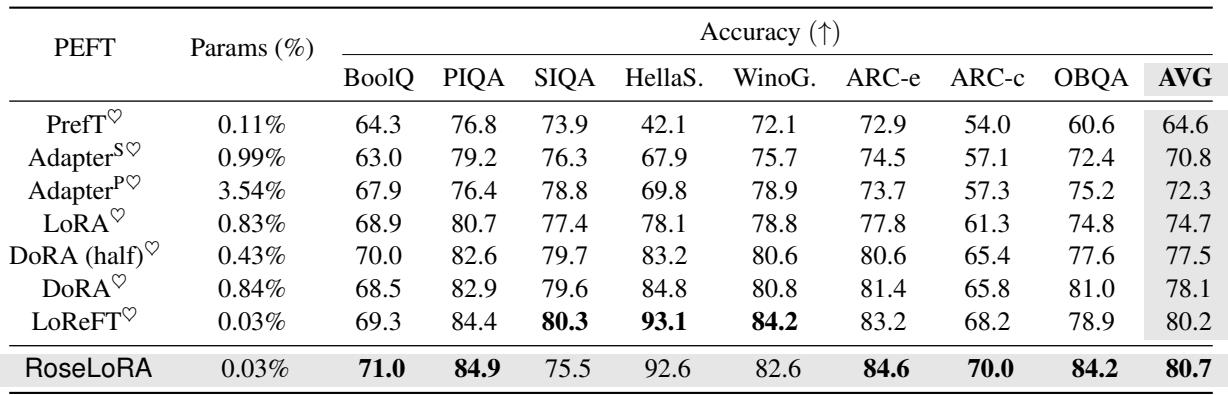
The Verdict: RoseLoRA (bottom row) achieves the highest average accuracy (80.7%) compared to standard LoRA (74.7%) and even the more recent DoRA. Remarkably, it does this with fewer active parameters (see the Params % column).
3. Arithmetic Reasoning
Math tasks require strict logic. Can a sparse model handle it?
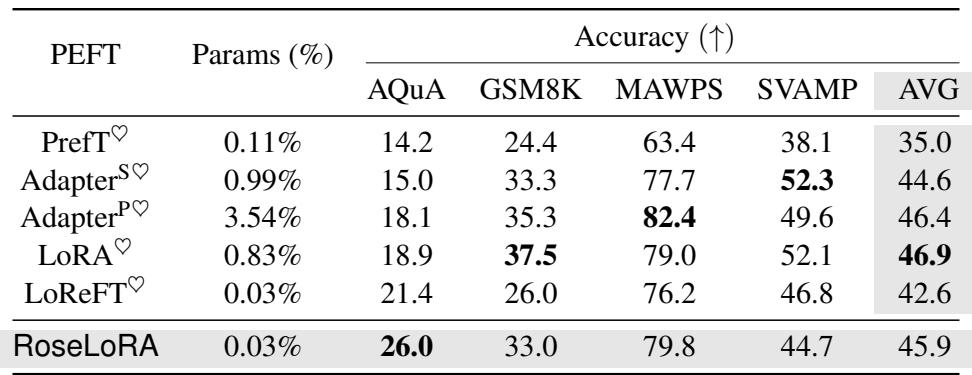
The Verdict: On the GSM8K dataset (grade school math), RoseLoRA achieves 33.0% accuracy, significantly higher than LoReFT (26.0%) and close to standard LoRA, despite the sparsity constraints. It shows that the model is effectively identifying the specific “math neurons” and tuning them heavily, rather than tuning the whole brain slightly.
4. Data Efficiency
One of the most interesting findings appears when training data is scarce. The researchers restricted the training data to small fractions (10% to 100%) and compared LoRA vs. RoseLoRA.
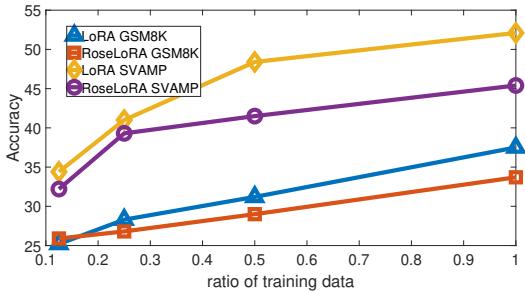
In Figure 3, the orange squares (RoseLoRA on GSM8K) and purple circles (RoseLoRA on SVAMP) show robust performance. Specifically, notice that RoseLoRA often outperforms or matches LoRA even when data is limited. This suggests that because RoseLoRA has fewer parameters to optimize (due to sparsity), it is less prone to overfitting and learns more efficiently from small datasets.
Conclusion
RoseLoRA represents a significant step forward in how we maintain and update Large Language Models. By moving away from the assumption that “more parameters = better,” the researchers have shown that where you update matters more than how much you update.
The key takeaways are:
- Precision Matters: Standard low-rank adaptation (LoRA) creates dense updates that can bleed into unrelated knowledge.
- Structured Sparsity: To ensure precise updates, we need row and column-wise constraints on the adapter matrices.
- Sensitivity Pruning: Letting the model decide which parameters are important via gradient sensitivity yields highly efficient, “surgical” fine-tuning.
For students and practitioners, RoseLoRA offers a promising path for building LLM systems that can be continuously updated with new facts—turning static models into dynamic, ever-learning systems without the massive computational cost or the risk of catastrophic forgetting.
If you are working on Knowledge Editing or trying to fine-tune models on small, specialized datasets, RoseLoRA is a technique well worth exploring.