](https://deep-paper.org/en/paper/2406.11149/images/cover.png)
Privacy is rarely black and white. Consider a simple piece of information: a blood test result. If a doctor sends this result to a specialist for a second opinion, it is standard medical practice. However, if that same doctor sends the same result to a marketing firm, it is a severe privacy violation.
The data (the blood test) didn’t change. The sender (the doctor) didn’t change. What changed was the context—specifically the recipient and the purpose of the transfer.
This nuance is the “holy grail” of legal Artificial Intelligence. While Large Language Models (LLMs) like GPT-4 are impressive, they often struggle with the rigid yet context-dependent nature of privacy laws. They might memorize the text of a law, but applying it to a messy, real-world scenario is a different challenge. Furthermore, training these models is difficult because real-world legal datasets are scarce due to the very privacy laws they aim to uphold.
In a recent paper, researchers introduced a novel framework called GOLD COIN (Grounding Large Language Models in Privacy Laws via COntextual INtegrity). This framework bridges the gap between abstract legal statutes and concrete judicial reasoning, allowing LLMs to detect privacy violations with remarkable accuracy.
The Problem: Why LLMs Struggle with Privacy
Privacy violations occur through improper information transmission—unauthorized access, inappropriate data collection, or disclosure of personally identifiable information. These are governed by complex laws like HIPAA (health), COPPA (children), and GDPR (European data protection).
Current research often treats privacy as a static concept or relies on limited, pre-defined rules. On the other hand, trying to feed an LLM raw legal text (statutes) and expecting it to act as a judge often fails. The model might “hallucinate” or miss subtle contextual cues that legally differentiate a violation from a permitted action.
The researchers identified two main blockers to progress:
- Data Scarcity: There are very few open-source datasets of privacy court cases to train models on.
- The “Translation” Gap: Translating complex legislation into a format that a machine can reason about usually requires expensive expert annotation or rigid logic programming that doesn’t scale.
The Solution: Contextual Integrity as a Bridge
To solve this, the researchers turned to a social theory called Contextual Integrity (CI), proposed by Helen Nissenbaum.
Contextual Integrity argues that privacy is not about keeping information secret; it is about ensuring information flows appropriately according to social norms and rules. In this view, every information flow has five critical parameters:
- Sender: Who is sending the data? (e.g., a doctor)
- Recipient: Who is receiving it? (e.g., a specialist)
- Subject: Who is the data about? (e.g., the patient)
- Information Type: What kind of data is it? (e.g., blood test results)
- Transmission Principle: Under what constraints? (e.g., with consent, for treatment purposes, in an emergency).
By mapping a legal case to these five features, we can transform a messy story into a structured format that aligns with legal norms.
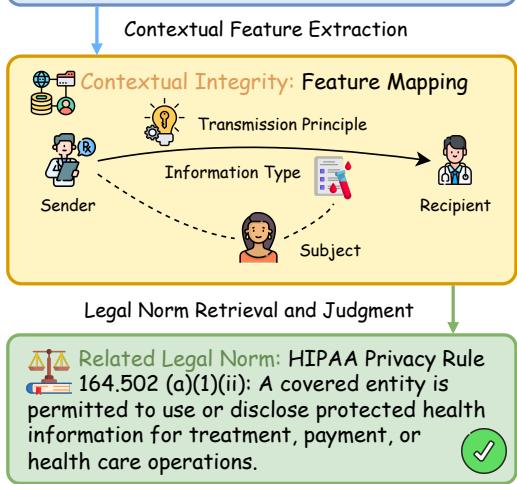
As shown in Figure 1 above, the framework takes a background story (Jane’s blood test), extracts the Contextual Integrity features (Sender, Recipient, etc.), and maps them to a specific legal norm (HIPAA rules). This structure allows the model to determine that the flow of information from Dr. Smith to Dr. Adams is permitted.
The GOLD COIN Methodology
The researchers focused their study on the HIPAA Privacy Rule, a critical U.S. law governing healthcare information. The GOLD COIN framework operates in a pipeline designed to generate high-quality training data and then teach LLMs how to think like a judge.
Step 1: Preprocessing the Law
First, the researchers couldn’t just feed the raw text of HIPAA into the model. They had to structure it. They converted the text of the HIPAA Privacy Rule into a graph, identifying hierarchical relationships between sections.
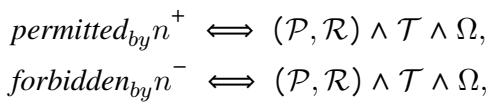
They extracted specific “norms” from the law—clauses that either Permit or Forbid an action. For example, as illustrated in Figure 2, a specific section like 164.502(a)(1)(ii) defines a permitted use of health information. This preprocessing established a “ground truth” library of legal rules.
Step 2: Law-Grounded Case Generation
Because real-world privacy court cases are hard to find publicly, the researchers used GPT-4 to generate synthetic cases. However, they didn’t just ask GPT-4 to “write a privacy story.” They constrained the generation using the Contextual Integrity theory.
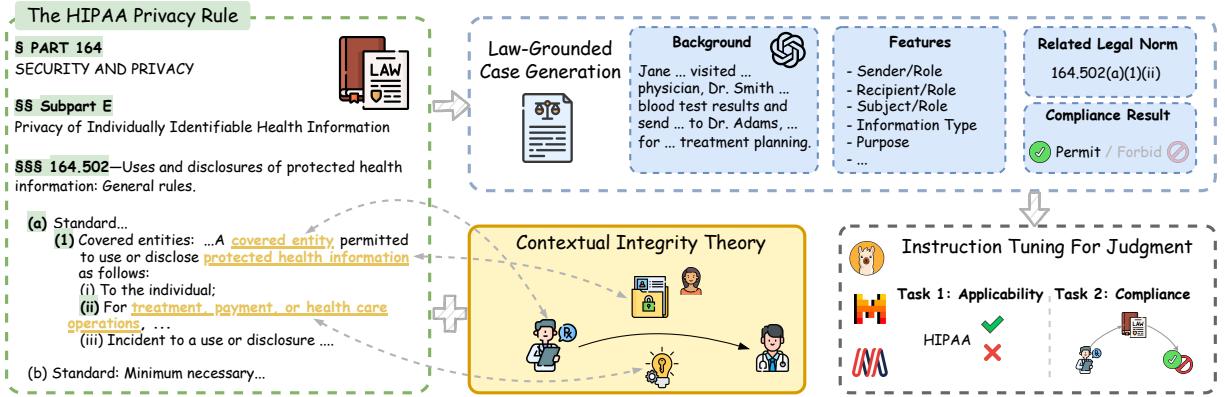
As depicted in Figure 3, the process works as follows:
- Select a Seed Norm: Pick a specific rule from HIPAA (e.g., one regarding “disclosure for treatment”).
- Prompt with Context: Instruct GPT-4 to generate a scenario that includes the five key entities: Sender, Recipient, Subject, Info Type, and Principle.
- Output: The model produces a detailed background story, the extracted features, and a conclusion (Permit or Forbid).
This method creates a massive, diverse dataset where every story is directly tied to a specific legal statute.
Step 3: Postprocessing and Quality Control
Generating data with LLMs can lead to errors or hallucinations. To ensure the dataset (called GOLDCOIN-HIPAA) was high-quality, the researchers implemented strict filters:
- Feature Integrity Filter: The system checks if the generated case actually contains all five required contextual features (Sender, Recipient, etc.).
- Consistency Filter: It verifies that the generated story actually aligns with the “Seed Norm” provided.
- Diversity Ranking: To prevent the model from generating the same “doctor visits patient” story a thousand times, they used diversity ranking (ROUGE-L scores) to select semantically distinct cases.
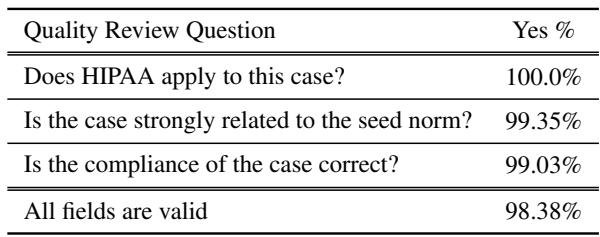
The data in Figure 5 demonstrates that the filtering process successfully shifted the distribution of cases, ensuring high quality. Human experts reviewed a sample and found that 100% of the cases were applicable to HIPAA, and over 99% were legally sound.
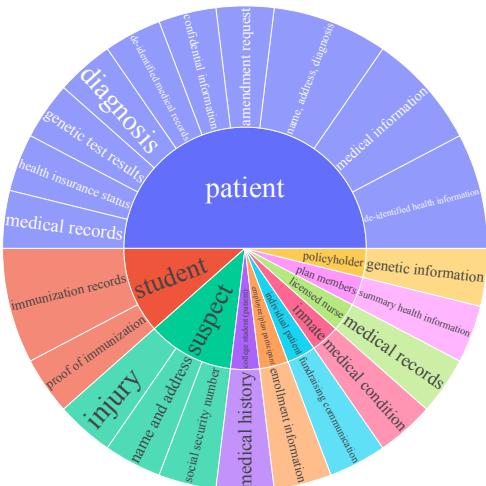
To visualize the variety of data generated, look at the distribution of roles and information types below. The framework successfully captured complex relationships, such as the flow of “Genetic test results” or “Insurance status.”
Step 4: Instruction Tuning
Finally, the researchers used this synthetic dataset to train smaller, open-source LLMs (like Llama-2 and Mistral). They used an “Instruction Tuning” approach with Chain-of-Thought (CoT) reasoning.
Instead of asking the model to simply guess “Guilty” or “Innocent,” they taught the model to think in steps:
- Extract Features: Identify the Sender, Recipient, etc.
- Retrieve Norm: Identify the relevant legal rule.
- Judge: Determine if the action is Permitted or Forbidden.
Experiments and Results
The researchers tested their tuned models on a challenging dataset of real-world court cases collected from the Caselaw Access Project (CAP). This is the ultimate test: can a model trained on synthetic stories judge real legal disputes?
They evaluated the models on two tasks:
- Applicability: Does HIPAA apply to this case?
- Compliance: Did the defendant violate the law?
Outperforming the Baselines
The results were impressive. The GOLD COIN method was compared against several baselines:
- Zero-shot: Asking the model directly without training.
- Law Recitation: Training the model to memorize the legal text.
- Direct Prompt: Training the model to answer Yes/No without the “Contextual Integrity” reasoning steps.
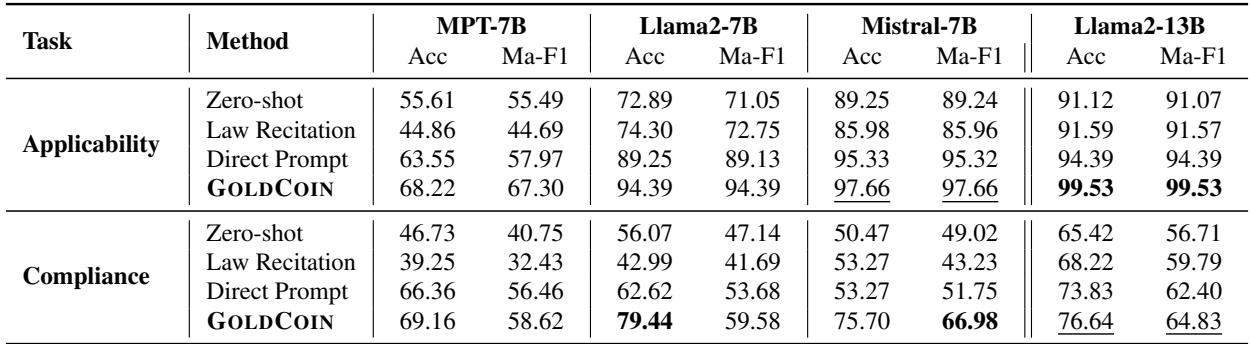
As Table 2 shows, GOLD COIN significantly outperformed all baselines.
- For Applicability, the Llama2-13B model achieved a 99.53% Accuracy, compared to 91.12% for the Zero-shot baseline.
- For Compliance (the harder task), the Mistral-7B model tuned with GOLD COIN achieved a Macro F1-score of 66.98%, a massive leap over the 49.02% score of the base model.
Interestingly, the “Law Recitation” baseline often performed worse than doing nothing. This proves that simply forcing an AI to memorize legal text does not help it understand how to apply those laws.
Comparing with GPT-4
The researchers also compared their relatively small, tuned models against the giant GPT-4.
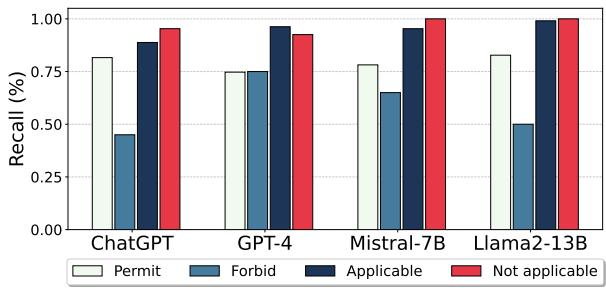
Figure 6 reveals that the open-source models trained with GOLD COIN (Mistral-7B and Llama-2-13B) approached, and in some metrics matched, the performance of GPT-4. This is significant because it suggests that smaller, efficient models can become legal experts if trained with the right theoretical framework.
Why Contextual Integrity Matters (Ablation Study)
Was the complex “Contextual Integrity” theory actually necessary? Could they have just generated generic stories?
To answer this, the researchers performed an ablation study, removing different parts of the framework to see what happened.
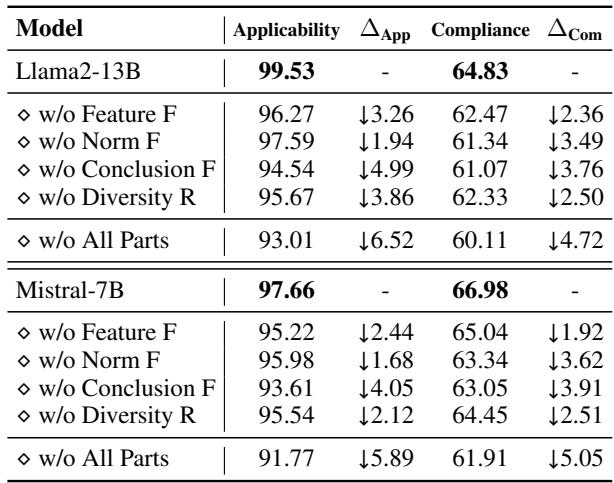
Table 3 shows clear drops in performance when features were removed.
- w/o Feature F: Removing the filter that ensures Contextual Integrity features (Sender, Recipient, etc.) are present caused performance to drop by over 3%.
- w/o Conclusion F: If they didn’t filter for consistent legal conclusions, performance dropped by nearly 5%.
This confirms that the structure provided by Contextual Integrity—explicitly identifying roles and transmission principles—is the “secret sauce” that allows the model to reason correctly.
To visually understand the logic the model is learning, consider how it mathematically represents a scenario. The model learns to permit an action only if the roles match the legal norm:
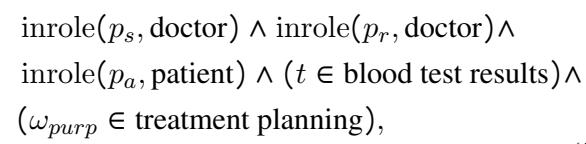
This formula represents the “Jane’s blood test” example. The model learns that if the sender is a doctor, the recipient is a doctor, the subject is a patient, and the purpose is treatment, the action is Permitted. If any variable changes (e.g., the purpose becomes “marketing”), the equation would shift to Forbidden.
Conclusion and Implications
The GOLD COIN framework represents a significant step forward in Legal AI. It demonstrates that we don’t necessarily need massive datasets of real court records to train effective legal models. Instead, we can use:
- Synthetic Data: Generated intelligently using powerful LLMs like GPT-4.
- Theoretical Grounding: Using established frameworks like Contextual Integrity to structure that data.
By treating privacy not as a static label but as a flow of information constrained by social and legal norms, the researchers successfully taught AI to navigate the gray areas of the law.
This approach has potential beyond HIPAA. The same framework could be adapted for the GDPR in Europe, the CCPA in California, or even non-privacy legal domains where context is king. As LLMs become more integrated into legal and judicial workflows, techniques like GOLD COIN will be essential to ensure they remain accurate, reliable, and grounded in the rule of law.