](https://deep-paper.org/en/paper/2406.11234/images/cover.png)
Introduction
In the world of Natural Language Processing (NLP), sentiment analysis has evolved far beyond simply classifying a movie review as “positive” or “negative.” Today, we deal with complex sentences where multiple opinions about different things exist simultaneously. Consider the sentence: “The food was delicious, but the service was terrible.” A simple “neutral” label would be misleading. We need to know what was good (food) and what was bad (service).
This granular level of understanding is known as Aspect Sentiment Triplet Extraction (ASTE). The goal is to extract triplets in the format: (Aspect, Opinion, Sentiment).
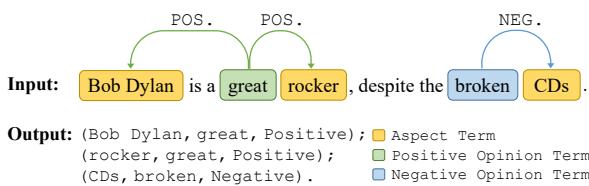
As shown in Figure 1, identifying that “great” modifies “rocker” (Positive) while “broken” modifies “CDs” (Negative) requires a deep understanding of the sentence structure.
For years, researchers have been building increasingly complex models to solve this—incorporating graph neural networks, syntactic dependency trees, and other heavy engineered features. But a recent paper, MiniConGTS, asks a provocative question: Are we overthinking it?
The researchers propose a “back to basics” approach. Instead of adding more complexity, they designed a minimalist grid tagging scheme and paired it with a novel contrastive learning strategy. The result? A model that not only outperforms complex state-of-the-art systems but also beats GPT-4 in specific extraction tasks, all while being significantly more efficient.
In this post, we will deconstruct MiniConGTS to understand how simplifying the problem can lead to better solutions.
Background: The Complexity of Triplet Extraction
To appreciate MiniConGTS, we need to understand the landscape it enters. The ASTE task is notoriously difficult because it requires simultaneously extracting entities (aspects), their modifiers (opinions), and the relationship between them.
Traditionally, there have been two main ways to tackle this:
- Pipeline Methods: These break the task into steps (e.g., first find the aspect, then find the opinion, then pair them). The downside is error propagation—if you miss the aspect in step one, you can never recover the triplet.
- Joint Tagging Methods: These try to do everything at once. A popular evolution in this category is the Grid Tagging Scheme (GTS).
The Grid Tagging Scheme (GTS)
Imagine a 2D grid where the sentence is laid out on both the X and Y axes. The goal is to tag the cells where an Aspect (row) interacts with an Opinion (column). If the word “service” (row i) intersects with “terrible” (column j), we mark that cell.
While GTS is powerful, previous iterations became bloated. Researchers assumed that to make the grid accurate, they needed to inject external linguistic knowledge—like Part-of-Speech tags or dependency trees—into the network. This made models heavy and slow.
MiniConGTS (Minimalist Contrastive Grid Tagging Scheme) challenges this assumption. It argues that the redundancy lies in the tagging scheme itself and that the internal representations of the model can be enhanced without external data.
The Core Method: MiniConGTS
The architecture of MiniConGTS is elegant in its simplicity. It consists of two primary innovations: a Minimalist Tagging Scheme that simplifies the decision boundary, and a Token-level Contrastive Learning Strategy that sharpens the model’s understanding of context.
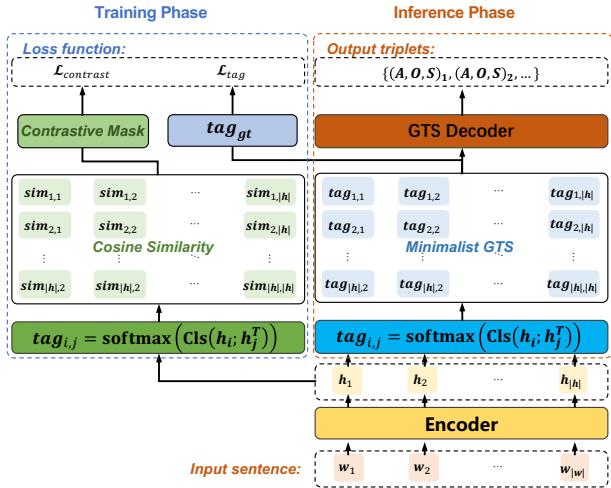
As illustrated in Figure 2 above, the workflow is straightforward:
- Encode the sentence.
- Refine the representations using Contrastive Learning (Training phase).
- Predict the triplets using the Grid Tagging Scheme.
Let’s break these down step-by-step.
1. The Encoder
The foundation is a standard Pretrained Language Model (PLM), such as BERT or RoBERTa. The input sentence \(S\) is tokenized and passed through the model to obtain contextualized hidden representations \(h\).

This gives us a rich numerical representation for every word in the sentence.
2. The Minimalist Grid Tagging Scheme
This is where the “Minimalist” part comes in. The authors designed a tagging scheme that uses the fewest possible classes to fully represent all sentiment triplets.
They treat the task as a 2D classification problem. They construct a square matrix where the rows represent potential Aspects and the columns represent potential Opinions.
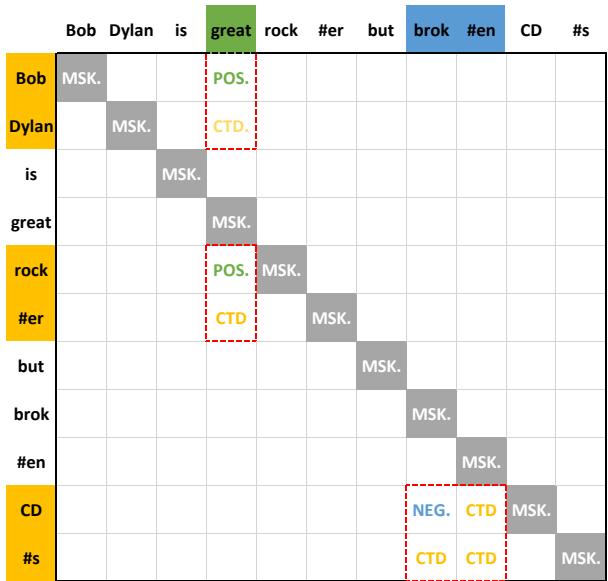
Look at Figure 3. The sentence is “Bob Dylan is a great rocker, despite the broken CDs.”
- The intersection of Aspect “CDs” and Opinion “broken” forms a region in the grid.
- The specific cell at the top-left of this region is tagged with the sentiment (e.g., NEG).
- The other cells in that region are tagged as CTD (Continued).
This results in a streamlined 5-class classification problem for every cell in the grid:
- POS: Positive sentiment start.
- NEG: Negative sentiment start.
- NEU: Neutral sentiment start.
- CTD: Continuation of an aspect-opinion pair.
- MSK: Mask (no relation or invalid).
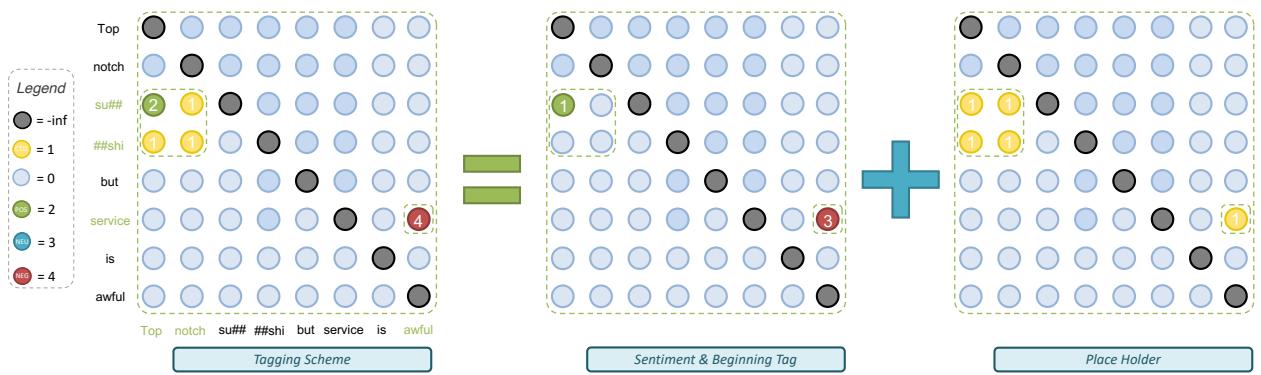
To help visualize this, the authors conceptualize the scheme as the sum of two simpler matrices: one that marks the “start” and sentiment, and another that acts as a placeholder for the region.
The Prediction Head
To predict the tag for the cell at position \((i, j)\), the model concatenates the vector for word \(i\) and word \(j\) and passes them through a classifier.

To handle the fact that most cells in the grid are empty (Mask/None) compared to the few that contain actual triplets (Class Imbalance), they utilize Focal Loss. This loss function down-weights easy examples and forces the model to focus on the “hard” examples—the actual sentiment triplets.

3. Token-Level Contrastive Learning
This is the “secret sauce” of the paper. Even with a great tagging scheme, the model needs to know that “good” and “great” are semantically similar in this context, while “good” and “bad” are opposites, even if they appear in similar sentence structures.
The researchers introduced a Contrastive Learning mechanism that operates purely on the internal tokens, without needing external data augmentation.
The Contrastive Mask
They create a “Contrastive Mask” matrix that defines which words should be pulled together and which should be pushed apart.
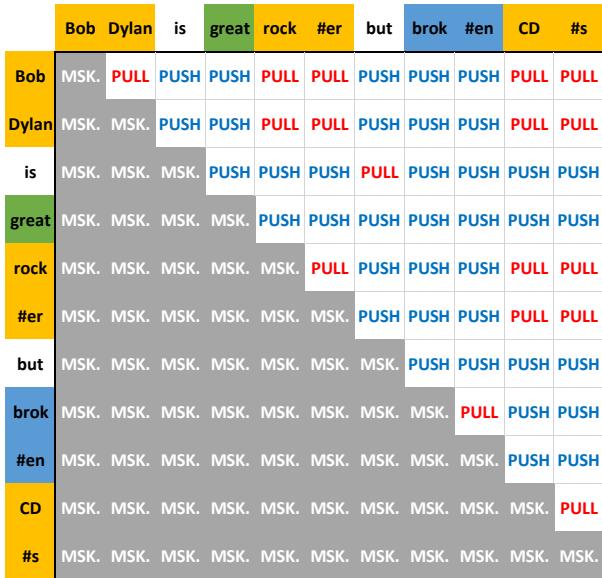
As shown in Figure 4:
- PULL (Positive Pairs): Tokens that belong to the same category or entity should be similar. For example, “Bob” and “Dylan” are parts of the same entity name.
- PUSH (Negative Pairs): Tokens that define different categories should be distinct. “Bob” (Aspect) and “is” (non-entity) are dissimilar.
The Objective Function
They use the InfoNCE loss function to enforce these relationships. This loss function encourages the cosine similarity of “PULL” pairs to be high and “PUSH” pairs to be low.
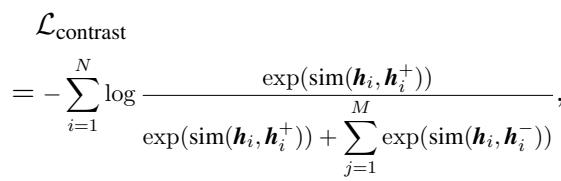
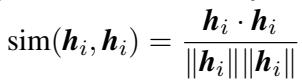
Here, the similarity is calculated using the dot product of the normalized vectors (Cosine Similarity):
The Total Loss
During training, the model minimizes a weighted sum of the Tagging Loss (finding the triplets) and the Contrastive Loss (learning better features).

By optimizing both simultaneously, the model learns embeddings that are naturally clustered by their role in the sentiment triplet, making the final extraction task much easier.
Experiments and Results
Does this minimalist approach actually work? The authors tested MiniConGTS on standard ASTE benchmarks (Laptop and Restaurant reviews) and compared it against previous state-of-the-art methods and Large Language Models.
Comparison with State-of-the-Art
The results are impressive. As seen in Table 1 below, MiniConGTS achieves comparable or superior F1 scores (the harmonic mean of precision and recall) across almost all datasets.
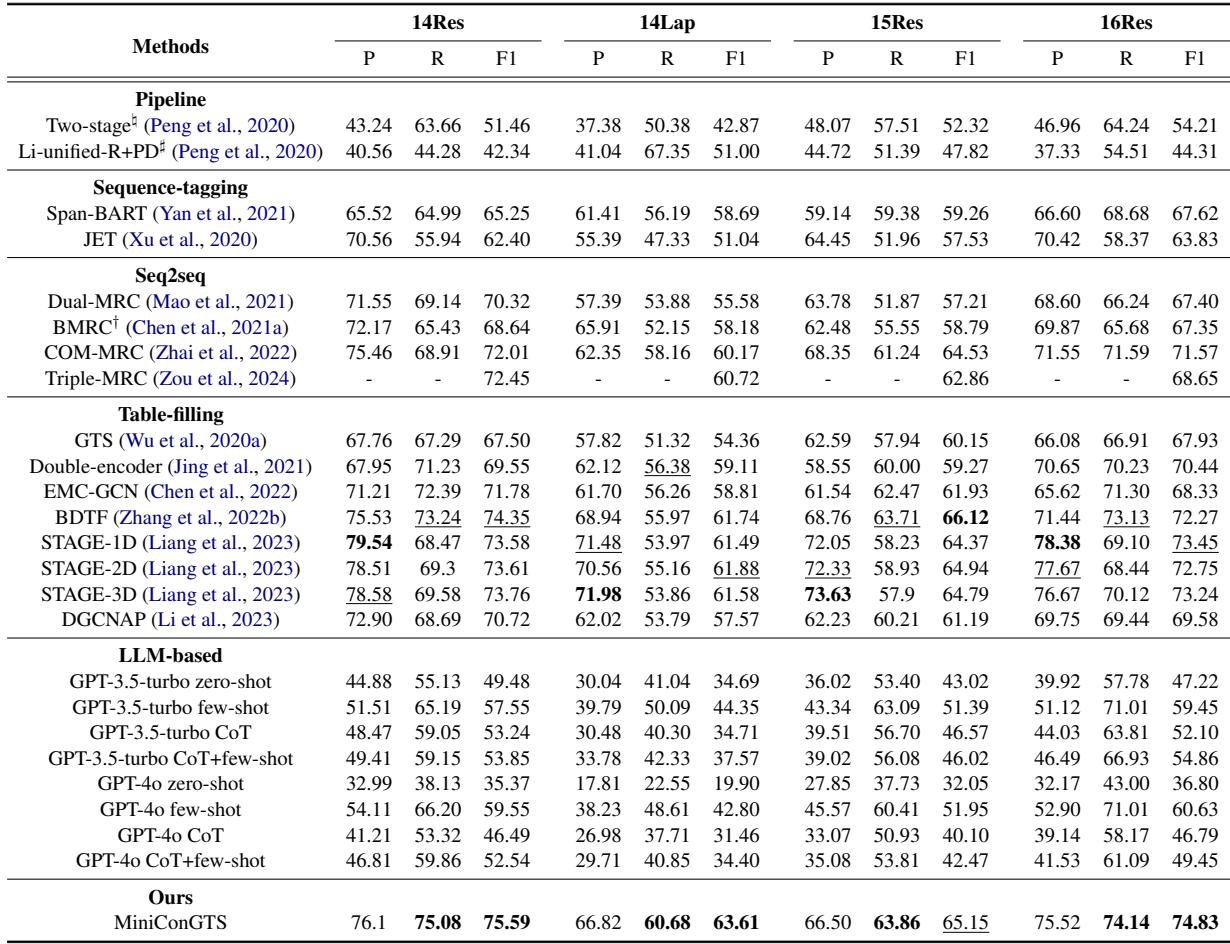
It consistently beats complex models like BDTF and EMC-GCN, proving that a well-designed simple scheme often beats a complex one.
The Power of Contrastive Learning
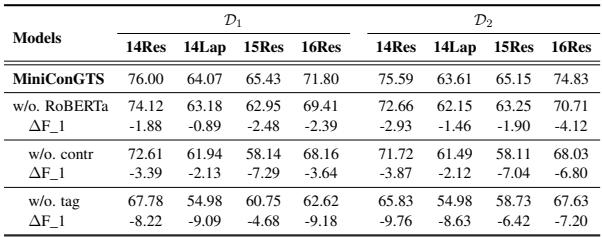
To prove that the contrastive learning module wasn’t just window dressing, the authors conducted an ablation study. They removed the contrastive loss and saw a significant drop in performance (labeled “w/o. contr” in Table 2).
They also visualized the feature space. Figure 5 shows the 3D projection of the word embeddings.
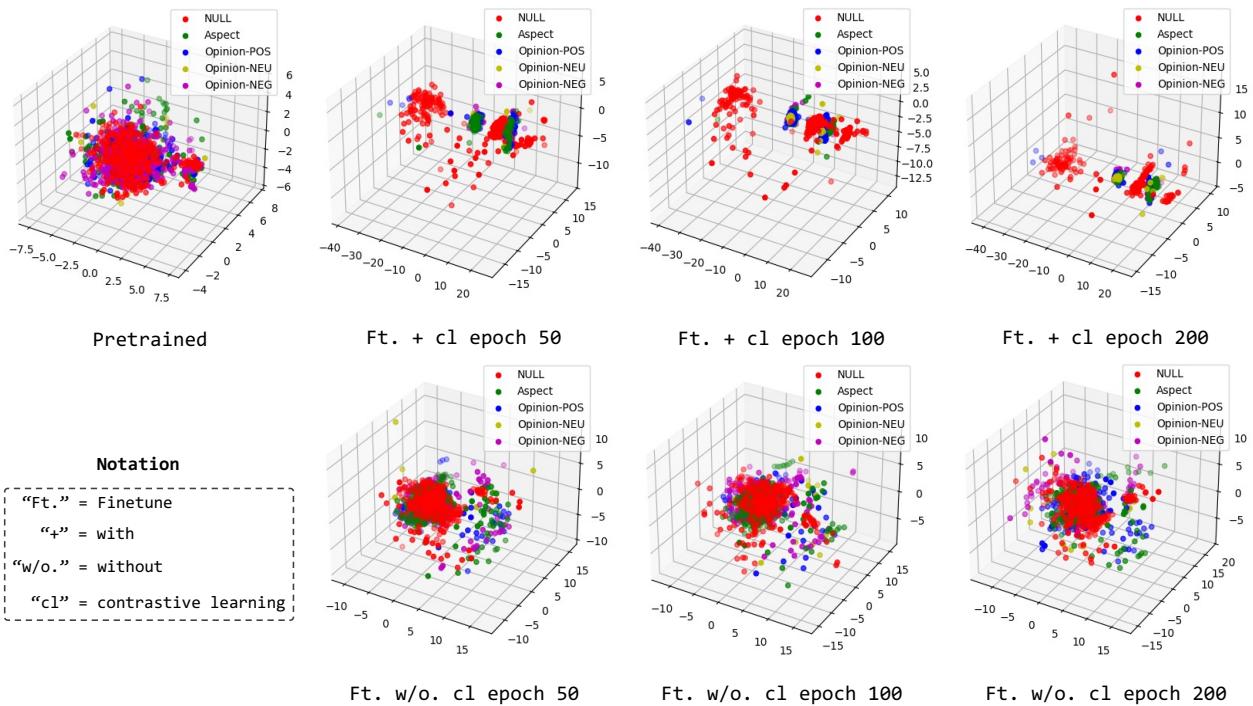
- Top Row (With Contrastive Learning): You can see distinct, tight clusters for different sentiment types (Aspects, Positive Opinions, Negative Opinions). The model has learned to separate these concepts clearly.
- Bottom Row (Without Contrastive Learning): The points are messier and more overlapped. The model struggles to distinguish between different sentiment categories efficiently.
The LLM Showdown: David vs. Goliath
Perhaps the most interesting part of the paper is the comparison with GPT-3.5 and GPT-4. One might assume that GPT-4, with its trillions of parameters, would crush a smaller, fine-tuned BERT model.
Surprisingly, GPT-4 struggled.
The researchers tested GPT using Zero-shot, Few-shot, and Chain-of-Thought (CoT) prompting.
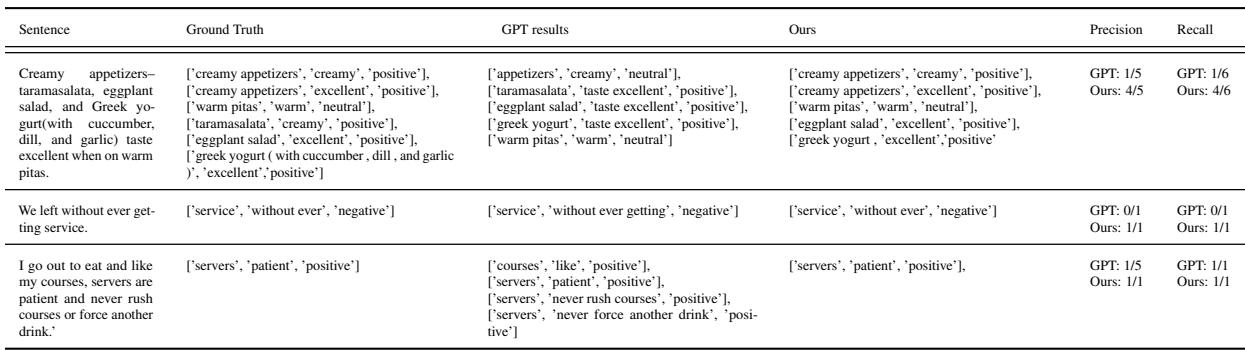
The Case Study (Table 12) reveals why LLMs fail here:
- Over-interpretation: GPT tends to hallucinate or infer sentiments that aren’t explicitly stated in the strict format required.
- Lack of Precision: In the first example about “Creamy appetizers,” GPT misses several pairs and misclassifies others, achieving only 1/5 recall compared to MiniConGTS’s 4/5.
- Formatting Issues: LLMs often include extra words or change the phrasing of the aspect/opinion, which counts as a failure in exact-match evaluations.
While LLMs are incredible at generation, MiniConGTS demonstrates that for specific, structured extraction tasks, a smaller, specialized model is often more accurate and vastly more efficient.
Conclusion
The MiniConGTS paper provides a refreshing perspective in an era dominated by massive models and increasing complexity. It teaches us two valuable lessons:
- Simplicity scales: By stripping away complex external features and designing a minimalist tagging scheme, the model becomes easier to train and faster to run without sacrificing accuracy.
- Representation matters: The use of contrastive learning refines the model’s internal understanding of the data. Instead of feeding the model more data, the authors taught it to look at the existing data differently—pulling similar concepts together and pushing different ones apart.
For students and practitioners, this work highlights that “SOTA” doesn’t always mean “bigger.” Sometimes, it just means smarter design. Whether you are building sentiment analysis tools or other NLP applications, consider if you can solve your problem by simplifying your output space and refining your embedding space before you reach for a billion-parameter giant.