](https://deep-paper.org/en/paper/2406.11385/images/cover.png)
In the rapidly evolving landscape of Artificial Intelligence, Large Language Models (LLMs) like GPT-4 and LLaMA-2 have become the backbone of modern NLP. The standard workflow is familiar: take a massive pre-trained base model, then fine-tune it on a specific task—be it coding, mathematics, or creative writing. This yields high performance, but it creates a logistical nightmare. For every new capability, you need to deploy a separate, heavy model.
Ideally, we want Multi-Task Learning (MTL): a single model that is proficient in everything. However, training a billion-parameter model on all tasks simultaneously is computationally prohibitive and often impossible due to data privacy constraints (many dataset owners won’t share their raw data).
This has led to the rise of Model Merging—specifically Task Arithmetic. The idea is elegant: calculate the difference between the fine-tuned model and the base model (the “task vector”) and add these vectors together to create a super-model.
But there is a catch. As the authors of “MetaGPT” point out, existing methods face a “trilemma.” You can usually pick only two: Optimal Performance, Computational Efficiency, or Data Privacy.
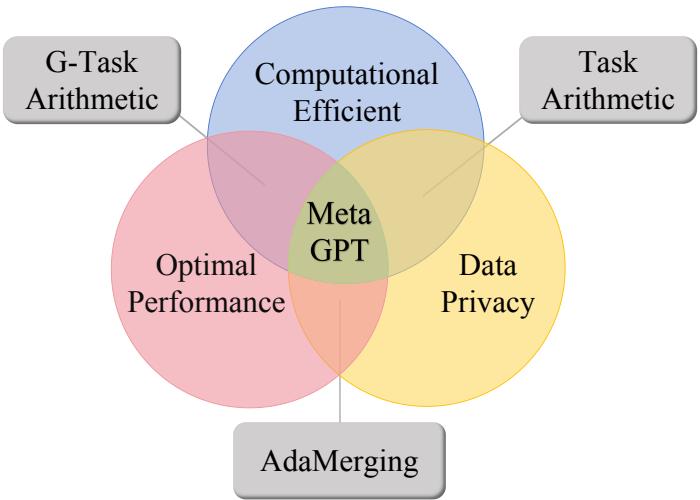
In this post, we will explore MetaGPT, a new research paper that proposes a way to solve this trilemma. By leveraging the mathematical properties of LLMs, MetaGPT offers a closed-form solution to merge models optimally without needing a single data point.
The Problem: Why Merging is Hard
To understand MetaGPT, we first need to understand the mechanics of Task Arithmetic.
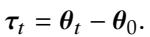
When you fine-tune a pre-trained model (\(\theta_0\)) on a specific task, you get a new set of weights (\(\theta_t\)). The task vector (\(\tau_t\)) is simply the change in weights:
To merge multiple skills (like math and coding) into one model, we add these task vectors back to the base model, each scaled by a coefficient (\(\lambda_i\)):
![]\n\\theta _ { \\mathrm { f i n a l } } = \\pmb \\theta _ { 0 } + \\sum _ { i = 1 } ^ { T } \\lambda _ { i } \\tau _ { i }\n[](/en/paper/2406.11385/images/004.jpg#center)
The critical challenge is determining the scaling coefficients (\(\lambda\)). How much “math” vector do you add versus “coding” vector?
The Current Landscape
As illustrated in Figure 2 below, current methods struggle to find these coefficients efficiently:
- Grid Search (G-Task Arithmetic): You try every combination of values. This yields optimal performance but is computationally impossible for LLMs. Imagine running a billion-parameter model thousands of times just to tune a few numbers.
- Simple Averaging / Constant Scaling: You just set all \(\lambda\) values to a fixed number (e.g., 0.3). This is fast and private, but the performance is usually sub-optimal.
- AdaMerging: This learns coefficients from unlabeled test data. It’s accurate but requires loading multiple giant models into memory simultaneously and running optimization loops—a huge memory and compute cost.
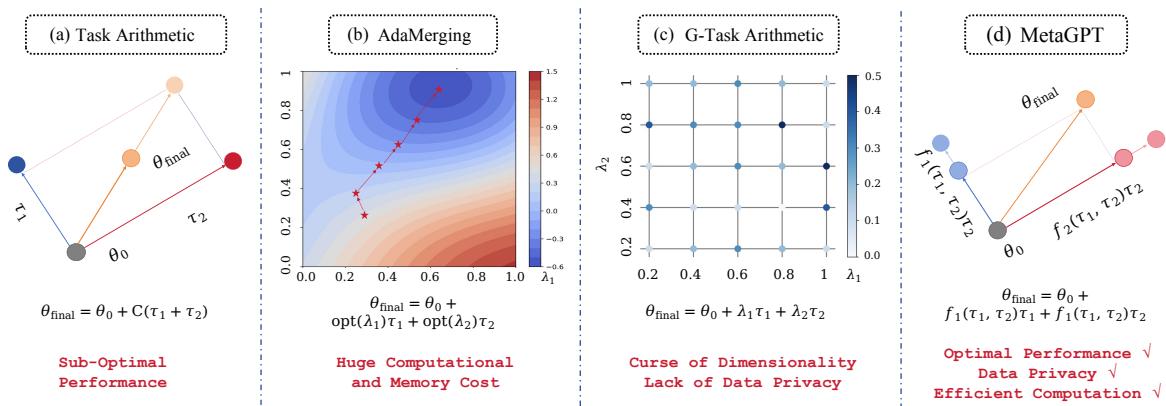
MetaGPT aims to sit in that sweet spot shown in Panel (d): Optimal, Private, and Efficient.
The Core Method: MetaGPT
The researchers propose a method called Model Exclusive Task Arithmetic (MetaGPT). “Model Exclusive” means it relies only on the model weights, not on training or validation data.
Defining the Objective
The goal of merging is to create a final model (\(\theta_{\text{final}}\)) that performs as well as the individual fine-tuned models (\(\theta_t\)) on their respective tasks.
The researchers mathematically formalize this by trying to minimize the Average Loss Difference (ALD). The ALD measures the gap between the loss of the merged model and the loss of the specific fine-tuned model, averaged across all tasks.
![]\n\\mathrm { A L D } ( \\lambda _ { 1 } , \\cdots , \\lambda _ { T } , \\tau _ { 1 } , \\cdots , \\tau _ { T } ) = \\frac { 1 } { T } \\sum _ { t = 1 } ^ { T } \\left( \\mathcal { L } _ { t } ( \\theta _ { \\mathrm { f i n a l } } , \\pmb { x } ) - \\mathcal { L } _ { t } ( \\theta _ { t } , \\pmb { x } ) \\right) .\n[](/en/paper/2406.11385/images/006.jpg#center)
If we can find the \(\lambda\) values that minimize this equation, we solve the merging problem. However, calculating the Loss (\(\mathcal{L}\)) usually requires data (\(x\)). To make this “data-agnostic,” the authors rely on two fascinating properties of Large Language Models.
Property 1: NTK Linearization
The first insight comes from the “Neural Tangent Kernel” (NTK) theory. It states that as neural networks get infinitely wide (which LLMs arguably approach), they behave linearly around their initialization.
This means that if you move the weights slightly (as you do during fine-tuning), the output of the model changes linearly.
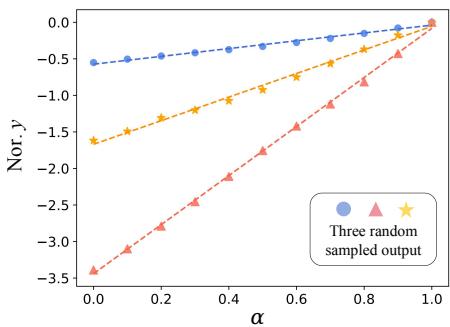
As shown in Figure 3, the authors verified this on Llama-2. The output changes almost perfectly linearly as they interpolate the weights. This allows them to approximate the complex loss function with a simpler quadratic expansion.
Property 2: Task Vector Orthogonality
The second insight is that task vectors for different skills (e.g., Math vs. Spanish) tend to be orthogonal. They point in completely different directions in the high-dimensional parameter space.
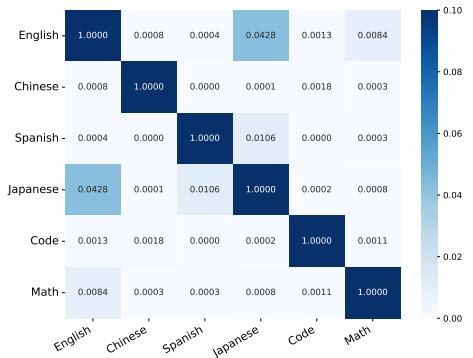
Figure 4 visualizes the cosine similarity between different task vectors. The diagonal is 1.0 (self-similarity), but the off-diagonal elements are nearly 0. This implies that changing the weights to improve Math ability doesn’t significantly interfere with the weights changed for Spanish ability, geometrically speaking.
Mathematically, this simplifies the interaction terms between different tasks to zero:
![]\n\\tau _ { i } ^ { \\top } \\tau _ { j } = ( \\pmb { \\theta } _ { i } - \\pmb { \\theta } _ { 0 } ) ^ { \\top } ( \\pmb { \\theta } _ { j } - \\pmb { \\theta } _ { 0 } ) = 0 .\n[](/en/paper/2406.11385/images/011.jpg#center)
The Closed-Form Solution
By combining the Taylor expansion of the loss (using the linearity property) and the orthogonality of the vectors, the researchers were able to mathematically separate the data terms from the weight terms.
They derived an upper bound for the Average Loss Difference that depends largely on the magnitude of the task vectors. Because the equation becomes a quadratic function with respect to \(\lambda\), they can solve for the optimal minimum directly, without any iterative training or grid search.
The result is a surprisingly simple, closed-form equation for the optimal scaling coefficient \(\lambda_t\) for task \(t\):
![]\n\\lambda _ { t } = \\frac { | \\pmb { \\theta } _ { t } - \\pmb { \\theta } _ { 0 } | ^ { 2 } } { \\sum _ { k = 1 } ^ { n } | \\pmb { \\theta } _ { k } - \\pmb { \\theta } _ { 0 } | ^ { 2 } } .\n()](/en/paper/2406.11385/images/017.jpg#center)
What does this equation tell us? The optimal weight for a specific task depends on the squared norm (magnitude) of that task vector divided by the sum of the squared norms of all task vectors.
Intuitively, if fine-tuning on a task required a large change in weights (a “longer” vector), it suggests that task requires more influence in the final merged model. MetaGPT automatically assigns higher weights to these “heavier” tasks.
Experiments and Results
Does this elegant theory hold up in practice? The authors tested MetaGPT against state-of-the-art methods using LLaMA-2 and Mistral models across various domains, including General Knowledge, Math, and Code generation.
Performance on LLaMA-2
Table 1 compares MetaGPT against standard methods like Weight Averaging, Task Arithmetic (with constant scaling), Ties Merging, and DARE.
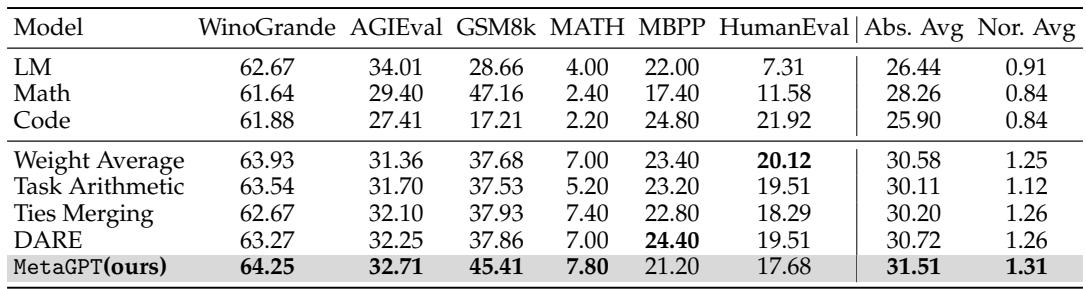
Key Takeaways from the Data:
- Consistency: MetaGPT achieves the highest “Normalized Average” score (1.31). While it doesn’t win every single column (DARE wins HumanEval), it provides the best overall balance across widely different tasks.
- Superiority: It outperforms standard Task Arithmetic (1.12) significantly, proving that the calculated \(\lambda\) values are better than heuristic constants.
Integration with Other Methods
One of the strongest aspects of MetaGPT is that it is orthogonal to other optimization techniques.
- Ties-Merging: Focuses on resolving interference by trimming redundant parameters.
- DARE: Randomly drops delta parameters to reduce redundancy.
Since MetaGPT provides a method for calculating the scaling coefficients (\(\lambda\)), it can be combined with Ties or DARE (which modify the structure of the task vectors).

Table 4 shows that adding MetaGPT to Ties or DARE consistently boosts performance. For example, “Ties + MetaGPT” scores higher (31.57 avg) than Ties alone (30.20 avg). This suggests MetaGPT can be a universal “plug-in” for model merging pipelines.
Generalization
Finally, a good merged model should handle data it hasn’t seen before. The authors tested the models on “Out of Distribution” datasets—exams and questions that weren’t part of the fine-tuning sets.
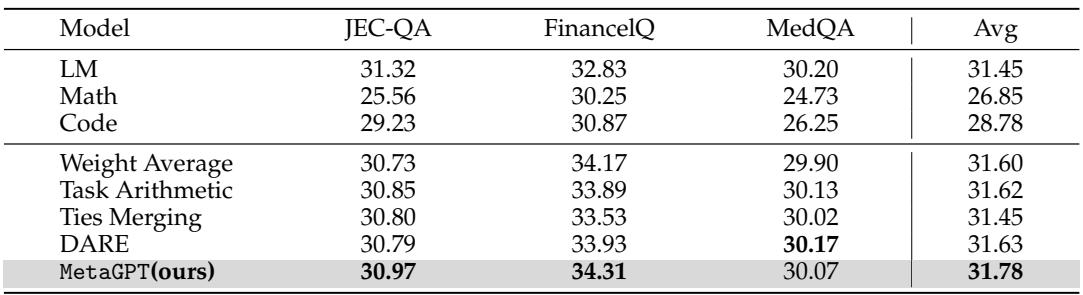
As shown in Table 5, MetaGPT achieves the highest average score (31.78), indicating it preserves the general reasoning capabilities of the LLM better than other merging strategies.
Conclusion & Implications
The paper “MetaGPT” presents a significant step forward in making Multi-Task Learning feasible for LLMs. By mathematically formalizing the merging problem and deriving a solution that relies solely on weight magnitudes, the authors have eliminated the need for expensive grid searches or private training data.
The implications are straightforward but powerful:
- Efficiency: We can merge massive models in seconds rather than days.
- Privacy: Organizations can merge models without ever sharing the underlying datasets.
- Scalability: The linear approximation holds up well for large models, suggesting this technique will remain relevant as models grow even larger.
While limitations exist—specifically, the reliance on a shared pre-trained base and the assumption of orthogonality (which holds well for LLMs but perhaps less so for smaller networks)—MetaGPT offers a robust, theoretically grounded baseline for the future of model merging. It turns the “art” of task arithmetic into a precise science.