](https://deep-paper.org/en/paper/2406.11768/images/cover.png)
Introduction
Imagine an autonomous robot navigating a city. It hears a loud horn followed by a screech of tires. A basic audio system might label this simply as “vehicle horn” and “skidding.” But a human—or a truly intelligent agent—understands the implication: a potential accident has occurred, or a collision was narrowly avoided. The sound isn’t just a label; it’s a clue about a complex, unfolding scenario.
Large Language Models (LLMs) have mastered text, and we are seeing a surge in multimodal models that can “see” images. However, the ability to perceive and reason about non-speech sounds—the ambient noise, mechanical whirs, and environmental cues that make up our world—has lagged behind. While current Audio-Language Models (ALMs) can describe sounds (e.g., “a dog barking”), they often fail at complex reasoning. They struggle to answer questions like, “Given the context of the laughter and the automotive sounds, what is the likely scenario?”
In a recent paper, researchers from the University of Maryland and Adobe introduced GAMA (General-purpose Large Audio-Language Model with Advanced Audio Understanding). GAMA represents a significant leap forward by moving beyond simple audio captioning to deep audio reasoning.
In this post, we will tear down the GAMA architecture to understand how it integrates diverse audio features and discuss CompA-R, a novel dataset designed to teach models how to “think” about what they hear.
The Problem with Current LALMs
Before diving into GAMA, we need to understand the limitations of existing Large Audio-Language Models (LALMs) like LTU or SALMONN.
Typically, an LALM consists of an audio encoder connected to a pre-trained LLM (like LLaMA). The audio encoder compresses sound into features, and a linear layer projects these features into the LLM’s vocabulary space. The LLM then generates text based on the sound.
The problem lies in alignment and depth.
- Simple Connection Modules: Most models use a simple linear layer to connect the audio encoder to the LLM. This often fails to capture the rich, fine-grained details of audio, leading to hallucinations (making up sounds that aren’t there).
- Lack of Reasoning Data: Models are usually trained on simple captioning pairs (Audio: sound of rain; Text: It is raining). They aren’t trained to answer “Why is the crowd cheering?” or “What does this machine sound imply about the factory’s status?”
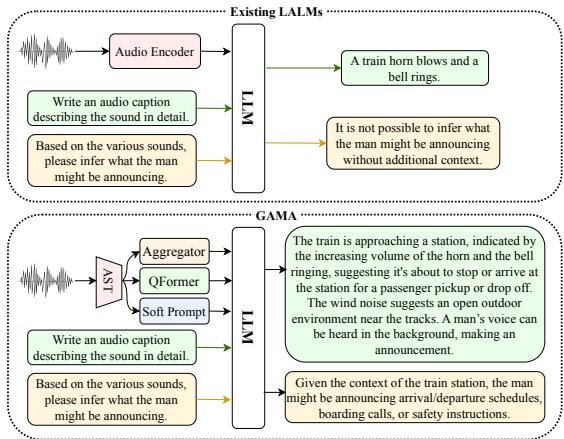
Figure 1 below illustrates this gap. Existing models (top) provide generic captions or fail to infer context. GAMA (bottom) utilizes a more sophisticated pipeline to derive specific, context-aware answers.
GAMA: The Architecture
The core philosophy behind GAMA is that a single audio representation is insufficient. Audio is complex—it has surface-level textures (timbre, pitch) and high-level semantic meanings (events, scenes). To capture this, GAMA integrates an LLM with multiple types of audio representations.
As shown in the architecture diagram below, GAMA doesn’t just feed one signal into the LLM. It processes the audio through three distinct pathways before the data reaches the language model.
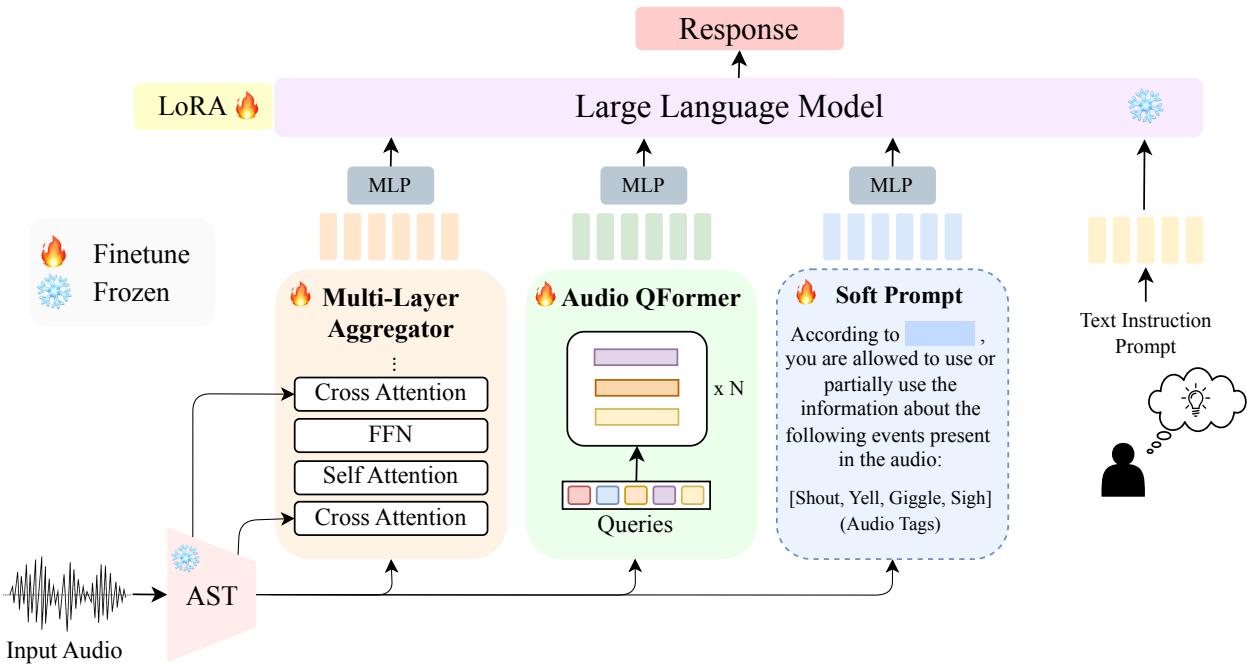
Let’s break down these three critical components labeled in Figure 2.
1. The Multi-Layer Aggregator
Most audio models rely on the Audio Spectrogram Transformer (AST) as their backbone. Standard approaches simply take the output from the last layer of the AST.
However, deep learning models learn hierarchically. In an AST:
- Middle layers often encode generic, surface-level features (basic sounds, textures).
- Deeper layers capture high-level concepts (complex patterns, semantic categories).
By only using the last layer, we discard valuable textural information found earlier in the network. GAMA introduces a Multi-Layer Aggregator. This module extracts features from multiple layers of the AST (specifically layers 4, 8, and 12) and combines them.
The aggregation is performed using a transformer-style network that sequentially integrates features using Cross-Attention. The mathematical formulation for aggregating features \(A_i, A_j, A_k\) is:

Where the block \(\mathcal{B}\) is defined as a Feed-Forward Network (FFN) following a Cross-Attention mechanism:

This ensures the LLM receives a “holistic” view of the audio, comprising both raw acoustic characteristics and abstract event information.
2. The Audio Q-Former
The second pathway utilizes an Audio Q-Former. This component is inspired by vision-language models (like BLIP-2). Its goal is to bridge the gap between the continuous signal of audio and the discrete nature of language.
The Q-Former is a transformer initialized with BERT weights. It uses a set of learnable query tokens to extract audio features that are most relevant to text.
- It takes the last layer features of the AST as input.
- It outputs a fixed number of feature vectors that encode the audio into a semantically rich space.
Caption Augmentation: To make the Q-Former robust, the researchers didn’t just train it on existing datasets. They used an LLM to rewrite and augment audio captions. For example, they turned “Someone eating crisps” into “Crunchy crisps mingle with the sound of a lively conversation, creating a cozy and intimate atmosphere.” This forces the Q-Former to learn diverse linguistic expressions for the same sound.
3. Soft Prompts via Audio Tags
The third innovation addresses the “cocktail party problem”—real-world audio often contains multiple overlapping events. Explicitly knowing what events are happening can help the model reason about why they are happening.
GAMA uses the AST to predict Audio Event Tags (e.g., “Shout,” “Yell,” “Giggle”). Instead of feeding these tags as plain text, GAMA uses Soft Prompts. These are trainable vectors derived from the tags.
During the instruction-tuning phase, the model is fed a template: “According to <hint> is the soft prompt. This allows the model to adaptively decide how much to rely on the detected tags versus the raw audio features, reducing the risk of errors if the tag classifier makes a mistake.
CompA-R: Teaching Complex Reasoning
Building a powerful architecture is only half the battle. If you train a Ferrari on a dirt track, it won’t perform like a race car. The researchers realized that existing datasets were too simple.
To solve this, they created CompA-R (Instruction-Tuning for Complex Audio Reasoning). This is a synthetically generated dataset designed to force the model to perform multi-step reasoning.
The Data Synthesis Pipeline
Creating CompA-R involved a clever use of GPT-4 and video data (since video often accompanies audio and provides ground truth).
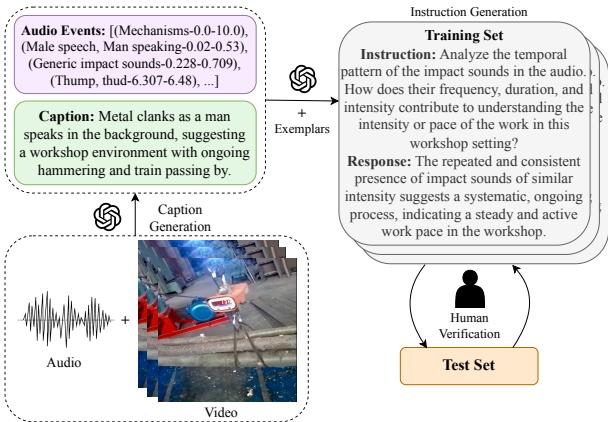
As shown in Figure 3, the process has three stages:
- Caption Generation: They gathered metadata about an audio clip (and its corresponding video), including visual objects, environment context, and audio tags. GPT-4 aggregated this into a dense, descriptive caption.
- Dataset Synthesis: GPT-4 was prompted to act as a “Instruction Generator.” It took the dense caption and ground-truth timestamps and created complex Question-Answer pairs.
- Constraint: The question must require reasoning (e.g., “Deduce the woman’s likely activity based on the bird sounds and the timing of the dog’s bark”).
- Human Verification: The authors manually verified a subset of these pairs to create a high-quality test set (CompA-R-test).
This process resulted in over 200,000 unique training pairs that go far beyond simple descriptions.
Experiments and Results
The researchers compared GAMA against state-of-the-art baselines including LTU, SALMONN, and Pengi. They evaluated the models on standard tasks (classification, captioning) and the new complex reasoning tasks.
Quantitative Analysis
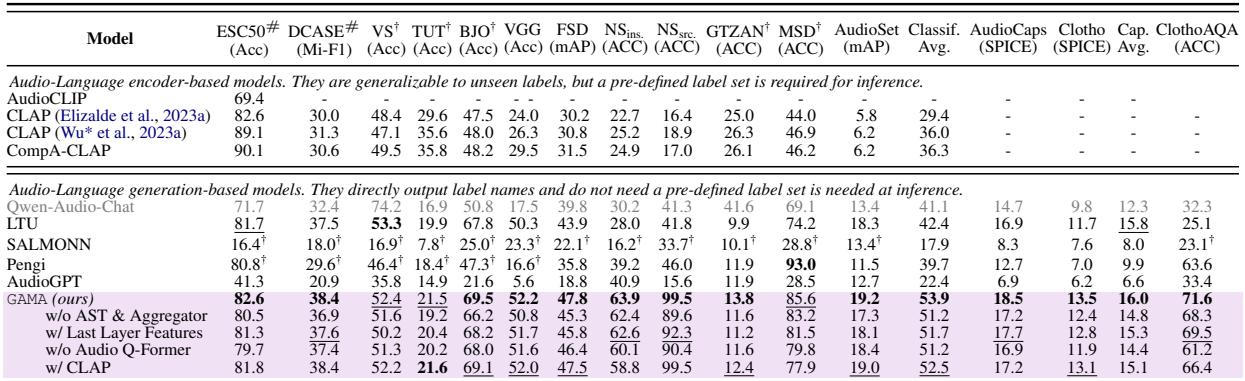
Table 1 summarizes the performance across general audio and music understanding benchmarks.
The results are stark:
- Dominance: GAMA outperforms baselines on nearly all settings. For example, on the AudioSet benchmark (mAP), GAMA scores 53.9, significantly higher than LTU (42.4) and SALMONN (17.9).
- Importance of Components: The ablation studies (rows at the bottom of the table) reveal that removing the Audio Q-Former causes the steepest drop in performance. This confirms that the Q-Former’s semantic compression is vital for general audio understanding.
Qualitative Analysis: The Reasoning Test
The true test of GAMA is its ability to reason. Figure 4 showcases examples from the CompA-R-test set, where the model must infer context.
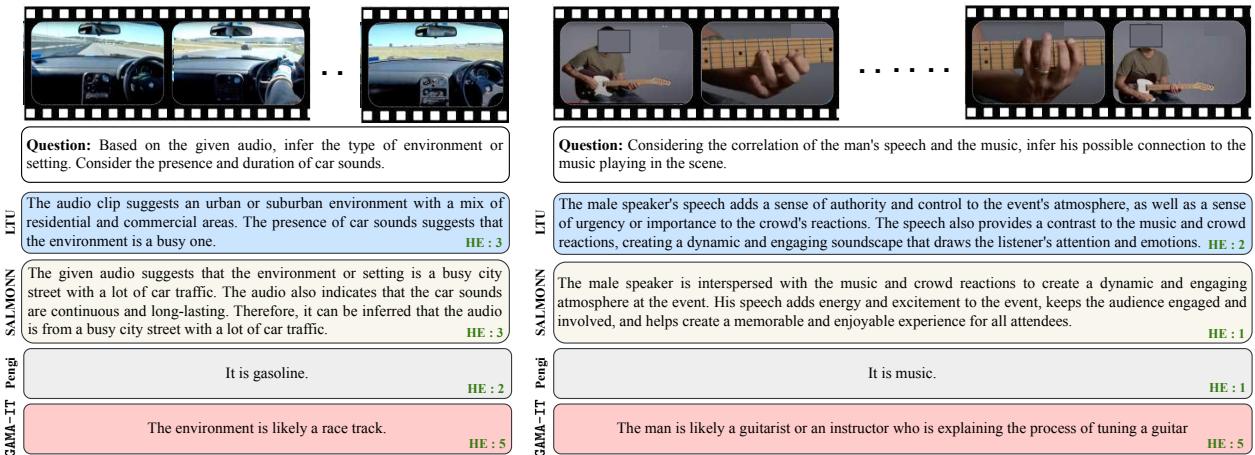
Example 1 (Left Panel):
- Audio Context: Car sounds.
- Question: “Infer the type of environment… consider the presence and duration of car sounds.”
- Baselines: LTU and SALMONN guess “busy city street.” Pengi hallucinates “gasoline.”
- GAMA: Correctly deduces it is likely a “race track”. It picked up on the specific nuances of the car sounds that distinguish racing from traffic.
Example 2 (Right Panel):
- Audio Context: Man speaking + music.
- Question: “Infer his possible connection to the music.”
- GAMA: Identifies the speaker as a likely “guitarist/instructor explaining how to tune a guitar.” The other models provide vague answers about “enhancing energy.”
These examples demonstrate that GAMA isn’t just matching keywords; it is synthesizing temporal and acoustic cues to construct a coherent narrative about the scene.
Conclusion
GAMA represents a shift in how we design Audio-Language Models. By moving away from simple linear connections and embracing a multi-feature approach (Aggregator + Q-Former + Soft Prompts), the model gains a much higher resolution understanding of sound. Furthermore, the introduction of CompA-R highlights a crucial lesson in AI training: if you want models to reason, you must provide data that requires thinking, not just describing.
For students and researchers entering this field, GAMA illustrates the importance of architectural diversity. Relying on a single feature vector from a pre-trained model is often a bottleneck. To achieve human-like understanding, we must allow models to view data through multiple “lenses”—textural, semantic, and contextual.
As audio agents become more integrated into our daily lives—from smart homes to assistive technology—models like GAMA pave the way for machines that don’t just hear, but listen and understand.