](https://deep-paper.org/en/paper/2406.12474/images/cover.png)
Introduction: The “Black Box” of Language
Imagine you are looking at the brain of an Artificial Intelligence. You ask it what the word “Argentina” means. Instead of showing you a map or a flag, the AI hands you a slip of paper with a list of numbers: [0.0088871, -0.02218, ...].
This is the fundamental challenge of word embeddings. In modern Natural Language Processing (NLP), words are converted into multi-dimensional vectors—coordinates in a massive geometric space. These vectors are incredibly useful for computers; they allow machines to calculate analogies (like “King - Man + Woman = Queen”) and understand relationships. However, for humans, they are unreadable. A single dimension in a 300-dimensional vector usually doesn’t mean anything specific on its own. It’s just a mathematical artifact.
To solve this, researchers have turned to techniques like Independent Component Analysis (ICA). Unlike other methods that just compress data, ICA tries to unmix signals to find “independent” semantic axes. Ideally, one axis might represent “Fruit,” another “Politics,” and another “Color.”
But there is a catch. ICA is notoriously unstable. If you run the algorithm twice, you might get different axes. Furthermore, do these axes hold true across different languages? Does the mathematical axis for “War” in English look the same as the axis for “War” in Japanese?
In the paper “Exploring Intra and Inter-language Consistency in Embeddings with ICA,” researchers Rongzhi Li, Takeru Matsuda, and Hitomi Yanaka take a deep dive into this problem. They propose a rigorous statistical framework to test whether these semantic axes are reliable (consistent within a language) and universal (consistent across languages).
Background: Unmixing the Meaning
To understand the contribution of this paper, we first need to understand the tool they are using: ICA.
The Cocktail Party Problem
Imagine you are at a crowded cocktail party. You are recording the sound of the room with two microphones. Each microphone picks up a jumbled mix of two people talking. You don’t want the mix; you want to separate the audio tracks so you have Speaker A on one track and Speaker B on the other.
This is what ICA does. It assumes that the messy data we see (the mixed voices) is actually a linear combination of statistically independent sources (the individual speakers).
Applying ICA to Language
In the context of word embeddings, the “messy data” is the word vector itself. The “independent sources” are the core semantic concepts that make up the word.
Mathematically, if we have a data matrix \(\mathbf{X}\) (our word embeddings), ICA assumes it was created by mixing a source matrix \(\mathbf{S}\) (the independent meanings) using a mixing matrix \(\mathbf{A}\).
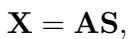
Here:
- \(\mathbf{X}\) is the observed word embedding.
- \(\mathbf{A}\) is the mixing matrix (how much of each concept goes into a word).
- \(\mathbf{S}\) contains the independent components (the pure semantic concepts).
The goal of this research is to see if the rows of \(\mathbf{S}\) (the semantic concepts) are actually meaningful and stable.
The Core Method: Ensuring Consistency
The researchers tackled the problem of consistency in two stages:
- Intra-language Consistency: Is the result reliable if we run it multiple times on the same language?
- Inter-language Consistency: Do these concepts translate across languages?
1. Intra-language Consistency with Icasso
One of the weaknesses of ICA is that it relies on random initialization. If you run it on English word vectors today, and then again tomorrow, the algorithm might converge on slightly different components. This makes it hard to trust.
To fix this, the authors employed a method called Icasso. The idea is simple but powerful: run ICA many times (e.g., 10 times) and put all the resulting components into a pile. Then, try to cluster them.
- Stable Components: If a specific component (like a “Fruit” axis) appears in every single run, all those components will cluster tightly together. This is a reliable semantic axis.
- Unstable Components: If a component is just noise, it will be scattered and won’t form a tight cluster.
The researchers visualized this clustering process to identify the reliable axes.
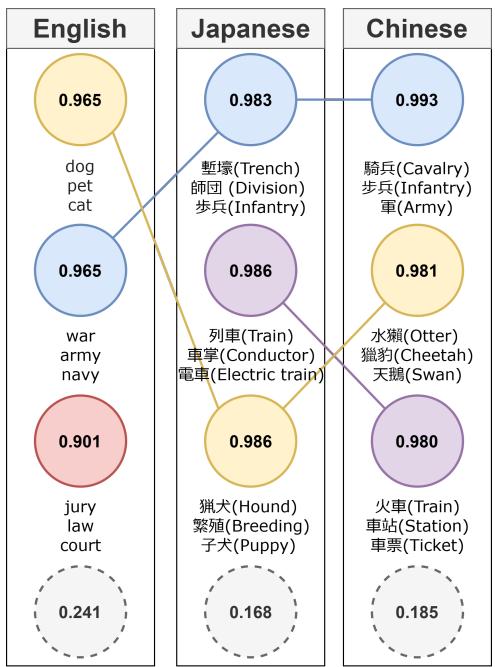
In Figure 1, you can see the results of this process. The circles represent clusters of components found by Icasso.
- The numbers inside the circles are the “Quality Index” (\(I_q\)). A score close to 1.0 means the component is extremely stable and reproducible.
- The words next to the circles (e.g., “dog pet cat” or “war army navy”) are the interpretations of those axes.
The researchers formally defined the Quality Index (\(I_q\)) of a cluster \(C_m\) using the similarity between components inside the cluster versus those outside it:
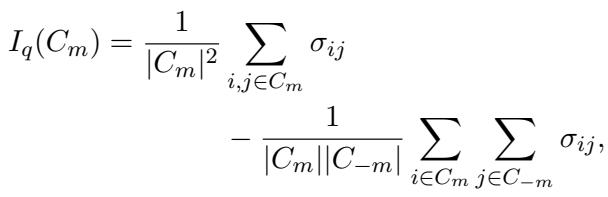
If the components inside the cluster are very similar to each other (\(\sigma_{ij}\) is high) and different from everything else, the Quality Index is high. This step filters out the noise, leaving only the robust semantic axes for each language.
2. Inter-language Consistency: Finding Universals
Once stable axes were identified for English, Japanese, and Chinese individually, the next step was to see if they matched.
Does the “War” axis in English mathematically correlate with the “War” axis in Japanese?
To test this, the researchers used a method originally developed for neuroscience (comparing brain scans of different subjects). They looked at pairs of translated words (e.g., “word” and “単語”) and checked if their activation levels on specific axes were correlated.
They calculated the similarity (\(\sigma_{ij}\)) between an English component \(s_i\) and a Japanese component \(s_j\) using the correlation of their weights:
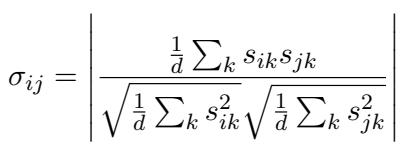
If \(\sigma_{ij}\) is high, it means that whenever the “War” axis is active for an English word, the corresponding Japanese axis is also active for the translated Japanese word.
To ensure they weren’t finding matches by pure luck, they applied rigorous statistical controls, specifically calculating the False Discovery Rate (FDR) and False Positive Rate (FPR).

This statistical rigor ensures that when they say two languages share a semantic axis, it is a statistically significant finding, not just a coincidence.
Experiments and Results
The team used FastText embeddings trained on English, Japanese, and Chinese. These are “static” embeddings, meaning each word has one fixed vector. They analyzed the top 50,000 words for each language.
The Stability of Languages
First, they looked at how many stable components each language had. Interestingly, not all languages yielded the same number of stable axes.
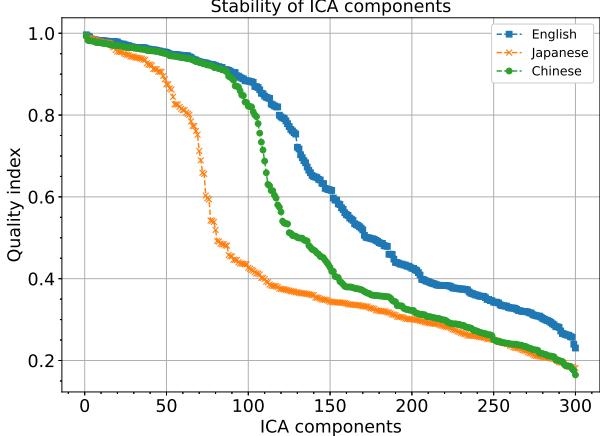
Figure 2 plots the stability (Quality Index) against the number of components.
- English (Blue line) is the most stable. It maintains a high quality index for over 100 components.
- Chinese (Green line) is the next most stable.
- Japanese (Orange line) drops off the fastest.
The authors suggest this might be because English is often the “source” language in the datasets used to train these multilingual models, or perhaps because of the specific linguistic properties of Chinese characters (which carry dense semantic meaning).
The “Universal” Concepts
After filtering for stability, the researchers looked for matches across languages. They found 47 clusters of meaning that were shared across the languages.
This is a significant result. It suggests that about 30% of the reliable semantic axes in these languages are “universal.”
Table 1 shows some of these discovered universal axes. The results are striking in their clarity.
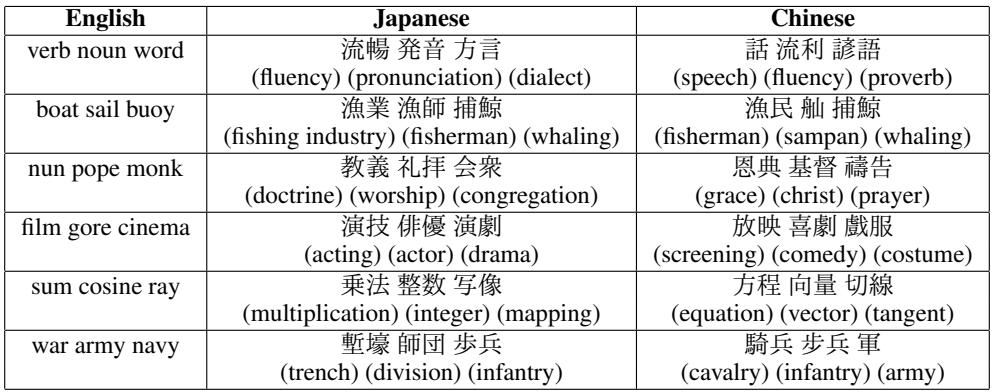
Look at the row for “war army navy”.
- In English, the top words driving this axis are “war”, “army”, and “navy”.
- In Japanese, the words are “trench”, “division”, and “infantry”.
- In Chinese, they are “cavalry”, “infantry”, and “army”.
Despite the linguistic differences, the mathematical “shape” of the concept of Military/War is preserved across the embeddings. Similarly, they found aligned axes for Mathematics (“sum, cosine, ray”), Religion (“nun, pope, monk”), and Fishing (“boat, sail, buoy”).
Interpreting the Axes
How did they know to label the axis “war army navy”? They looked at the weights in the mixing matrix. Since \(\mathbf{X} = \mathbf{A}\mathbf{S}\), a specific word vector \(\mathbf{x}_j\) is a sum of the components weighted by the matrix \(\mathbf{A}\).

By sorting the weights (\(s_{ij}\)), they could find which words were most strongly associated with each component. This allows us to “read” the mind of the embedding model.
Statistical Validation
To prove that these matches weren’t random, the authors plotted the distribution of similarities between the independent components of different languages.
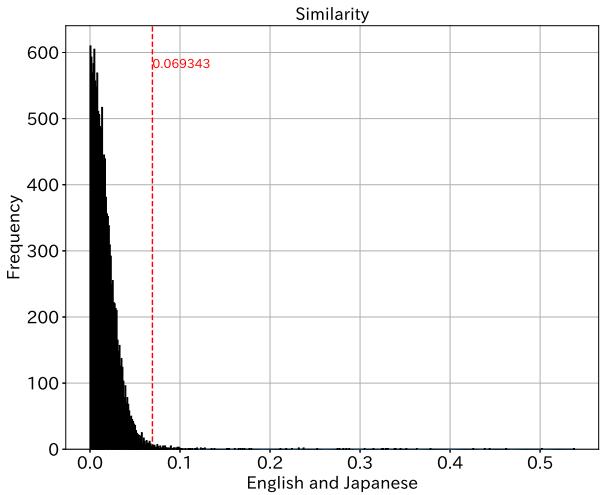
In Figure 3, you can see the histogram of similarities between English and Japanese components. The vast majority of pairs have a similarity near 0 (the tall bar on the left). This is expected; the “Fruit” axis in English shouldn’t match the “Car” axis in Japanese.
However, there is a long “tail” to the right. The red dashed line indicates the threshold for statistical significance. The tiny bumps to the right of that red line represent the “Universal Axes”—the concepts that truly transcend the language barrier.
Conclusion and Implications
The research presented in this paper provides a robust framework for peering inside the black box of word embeddings. By combining Icasso (for reliability) with statistical correlation (for universality), the authors successfully identified semantic axes that are not only interpretable to humans but consistent across English, Japanese, and Chinese.
Key Takeaways:
- Instability is Solvable: ICA is unstable on its own, but clustering multiple runs (Icasso) reveals the true, stable signals hidden in the noise.
- Universal Geometry Exists: Languages as different as English and Chinese share a significant portion of their semantic geometry. Concepts like “War,” “Math,” and “Fishing” look mathematically similar in the vector space.
- Interpretability: We don’t have to treat AI embeddings as unreadable data. With the right tools, we can label the dimensions and understand what the model is “thinking.”
This work opens exciting doors for the future. If we can map these universal axes reliably, we could build better machine translation systems that align concepts rather than just statistics. We could also create “compositional semantic maps,” allowing us to navigate the meaning of words across languages using a shared coordinate system. It brings us one step closer to a truly universal understanding of language in Artificial Intelligence.