](https://deep-paper.org/en/paper/2406.12618/images/cover.png)
The current era of Natural Language Processing (NLP) is defined by a massive paradox. We have built models—Large Language Models (LLMs)—that possess capabilities we could barely imagine a decade ago. They write code, compose poetry, and reason through complex problems. Yet, for the most part, we have very little idea how they actually work. They are black boxes.
This creates a tension in the field. On one side, you have the “builders” pushing for higher benchmarks and efficiency. On the other, you have the “analysts”—researchers in Interpretability and Analysis (IA)—who are trying to peer inside the black box to understand the mechanisms, limitations, and behaviors of these models.
But here lies the controversy: Does Interpretability research actually matter?
A common criticism is that IA research is fascinating but lacks “actionability.” Critics argue that knowing how a neuron fires in a Transformer doesn’t necessarily help you build a better Transformer. If the goal is state-of-the-art performance, is IA just an academic curiosity?
In a fascinating new paper, From Insights to Actions, researchers Mosbach, Gautam, Vergara-Browne, Klakow, and Geva set out to answer this question not with gut feelings, but with data. They conducted a massive mixed-methods study involving over 185,000 papers and a detailed community survey to quantify the impact of IA research on the broader field of NLP.
In this post, we will break down their methodology, analyze the citation networks of modern NLP, and explore how the community actually uses interpretability findings to drive progress.
The Scope of the Study
To understand the impact of a specific subfield like IA, you cannot look at citation counts in a vacuum. The researchers adopted a two-pronged approach:
- Bibliometric Analysis: They constructed a massive citation graph of NLP papers to see who cites whom, and why.
- Community Survey: They asked the people actually doing the work—PhD students, professors, and industry practitioners—how IA influences their daily research.
Defining “Interpretability and Analysis” (IA)
Before measuring impact, we must define the subject. The authors define IA broadly as any work aiming to develop a deeper understanding of NLP models. This includes:
- Explainability: Why did the model make this specific prediction?
- Mechanistic Interpretability: What are the internal computations (neurons, attention heads)?
- Analysis: Investigating training dynamics, robustness, and broader phenomena (like scaling laws).
The Growth of the Field
First, let’s look at the raw numbers. Is this field actually growing?
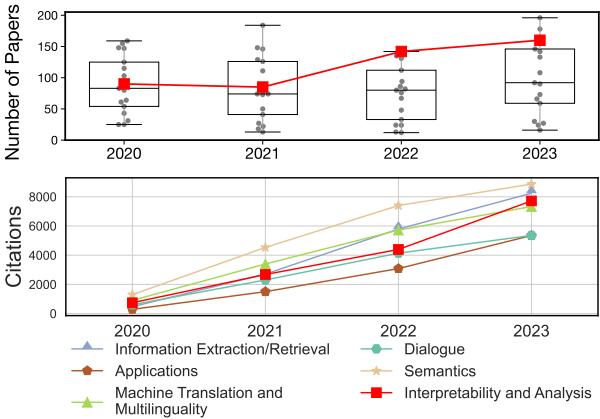
As shown in Figure 1, IA is booming. It had the highest growth rate (77.8%) among tracks at major conferences (ACL/EMNLP) between 2020 and 2023. This suggests that despite criticisms of “utility,” the community is investing heavily in this direction.
Methodology: Building the Map of NLP
How do you scientifically measure “impact”? The authors built a citation graph starting with all papers published at ACL and EMNLP (the two top-tier NLP conferences) from 2018 to 2023.
However, a graph of just these papers isn’t enough because science doesn’t happen in a silo. They needed to know what these papers cited, and who cited them back. Using the Semantic Scholar API, they expanded this initial set to include all references and citations, resulting in a graph of 185,384 papers.
The challenge is that papers outside of ACL/EMNLP don’t come with neat labels like “Machine Translation” or “Interpretability.” To solve this, the authors built a classifier.

As illustrated in Figure 2, they trained a model on the abstracts and titles of the labeled conference papers. This allowed them to predict the “track” (e.g., IA, Generation, Dialogue) for every paper in the massive graph. This step was crucial: it allowed them to see if IA papers are only being read by other IA researchers, or if they are influencing the wider field.
Result 1: The Citation Reality
A common worry in specialized subfields is the “echo chamber” effect—where researchers only write for and cite each other. The data suggests this is not the case for Interpretability.
The Citation Success Index (CSI)
Raw citation counts can be misleading because some fields simply publish more than others. The researchers used a metric called the Citation Success Index (CSI). Put simply, if you pick a random IA paper and a random paper from another track (say, Machine Translation) published in the same year, what is the probability that the IA paper has more citations?
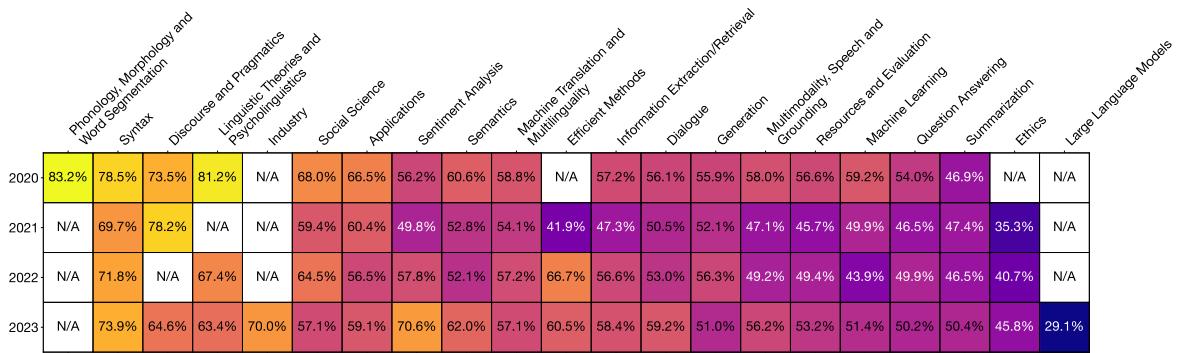
Figure 3 shows that IA papers consistently punch above their weight. With a CSI generally above 50%, an average IA paper is more likely to be highly cited than an average paper from most other tracks.
Who is citing IA?
This is the most critical question regarding utility. If IA is useful for building models, then “builders” (researchers in Modeling, Generation, or Efficiency) should be citing IA papers.
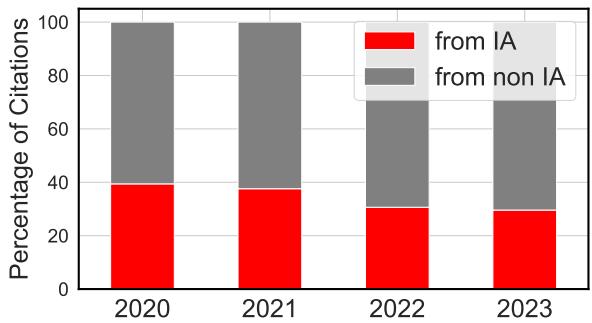
The results in Figure 4 are striking. The majority of citations to Interpretability papers come from outside the IA track (the gray bars). This indicates “citational impact beyond the subfield.”
The authors found that papers in Efficient Methods, Machine Learning, and Large Language Models cite IA research frequently. This suggests that the people building the models are indeed paying attention to the analysis of those models.
Centrality: The “Bridge” of NLP
Beyond just counting citations, we can look at the structure of the network. In network theory, Betweenness Centrality (BC) measures how often a node acts as a bridge along the shortest path between two other nodes. If a field has high centrality, it acts as intellectual glue, connecting disparate subfields (e.g., connecting “Linguistics” to “Deep Learning”).
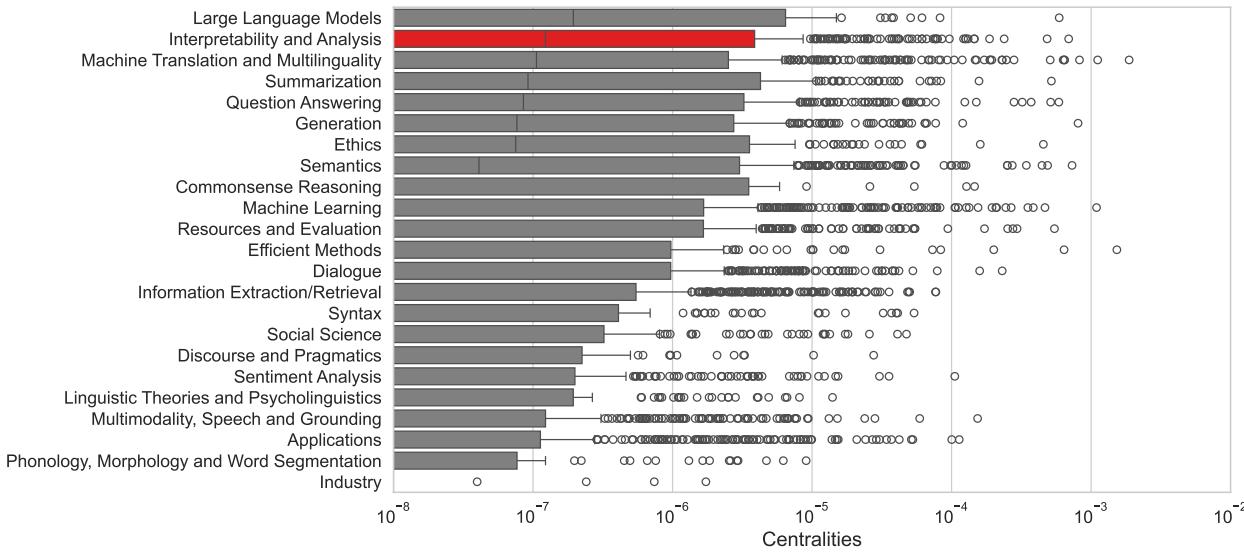
Figure 10 reveals that IA papers have very high centrality, second only to the “Large Language Models” track itself. This confirms that IA acts as a critical knowledge hub, facilitating the flow of ideas across the entire NLP landscape.
Result 2: The Community Perspective
Citations are a lagging indicator. They tell us what happened 2 or 3 years ago. To understand the current sentiment, the authors surveyed 138 NLP researchers. Importantly, 61% of these respondents did not work primarily on IA, ensuring the view wasn’t biased toward self-preservation.
Do researchers actually use IA?
The survey asked participants how often they use concepts from IA (like probing, attention analysis, or causal interventions) in their day-to-day work.
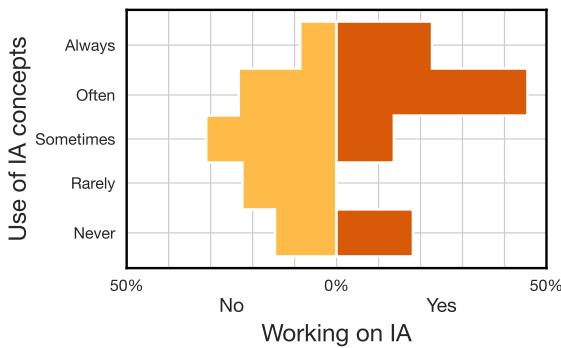
As Figure 5 shows, even among those who do not work on IA (the top half of the chart), usage is significant. The median non-IA researcher uses these concepts “sometimes” or “often.”
The survey revealed that IA influences researchers by:
- Generating Ideas: 60% of non-IA researchers get research ideas from IA papers.
- Mental Models: 65% say it changes how they perceive model capabilities.
- Grounding: 59% use it to explain their own results.
Is IA necessary for progress?
The authors asked a provocative question: “Would progress in NLP in the last 5 years have been impossible without IA?”
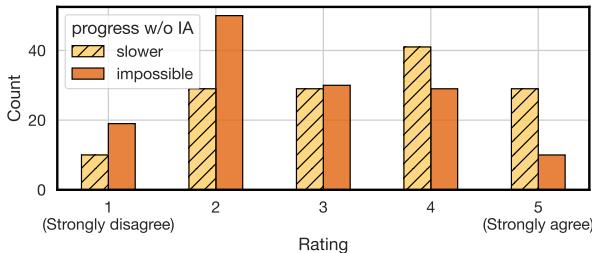
Figure 6 highlights a nuanced view. Very few researchers believe progress would have been impossible (the dark orange bars are low). However, the vast majority agree that progress would have been slower (the striped light orange bars are high).
This aligns with the reality of Deep Learning: engineering trial-and-error can get you far, but understanding why things work (analysis) accelerates the optimization process.
Where is IA most important?
Not all subfields benefit equally. The survey asked where IA matters most.
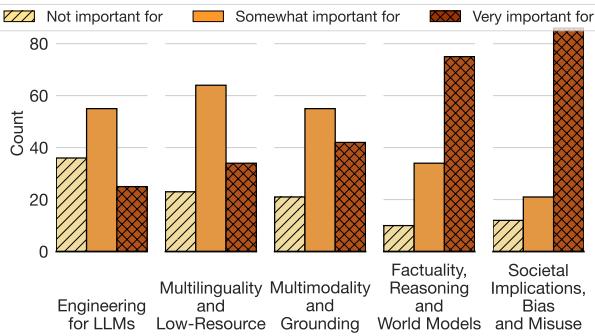
Figure 7 offers a clear roadmap of utility.
- High Impact: Societal Implications/Bias and Reasoning/Factuality. In these areas, we cannot trust a black box; we need to verify the mechanism.
- Lower Impact: Engineering. If you are just trying to make a model train faster or scale up, deep interpretability is currently seen as less critical than raw architectural optimization.
Digging Deeper: The Nature of Influence
The authors didn’t just stop at numbers; they read the papers. They manually annotated hundreds of highly influential papers to understand the nature of the contribution.
They found that while many influential IA papers are purely analytical (describing a phenomenon), a significant portion introduce novel methods.
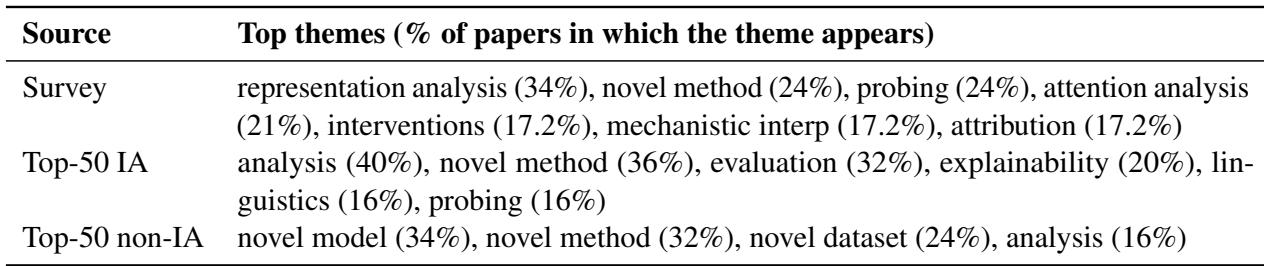
Table 7 shows that “Novel Method” is a top theme in influential IA papers (24-36%). This directly contradicts the critique that IA is purely passive observation.
Furthermore, they looked at non-IA papers that were heavily influenced by IA. They found that over 33% of these papers proposed new methods based on IA findings. For example:
- Bias Mitigation: New methods to de-bias models often cite IA papers that identified where the bias lives in the network.
- In-Context Learning: Methods to improve prompt engineering often cite analysis papers that explain how models use demonstrations.
This confirms the “Insights to Actions” loop: IA researchers find an insight (e.g., “bias is stored in these layers”), and broader NLP researchers turn that into an action (e.g., “let’s edit those layers”).
The Future: A Call to Action
Despite the positive impact, the survey respondents voiced clear frustrations. They felt some IA work was too focused on “toy models” or provided observations that didn’t scale to massive LLMs.
Based on this, the authors propose four pillars for the future of Interpretability research:
- Unification (The Big Picture): Stop looking at isolated behaviors. We need general theories about how Transformer architectures process information.
- Actionability: Don’t just describe the model. Connect the analysis to a downstream improvement. If you find a flaw, how can we fix it?
- Human-Centeredness: We need better evaluation. Interpretability should not just be mathematically satisfying; it should help actual humans (users or developers) understand the system.
- Robust Methods: The field needs standardization. We need to move beyond “vibes” and correlational evidence toward causal proofs that our interpretations are correct.
Conclusion
This research paper provides a vital reality check for the NLP community. It refutes the cynicism that Interpretability is an isolated academic bubble. The data shows that IA is a central, highly cited, and widely read pillar of modern NLP. It acts as a bridge between subfields and significantly accelerates progress, particularly in high-stakes areas like reasoning and bias.
However, the authors also validate the critics: for IA to remain relevant in the age of massive LLMs, it must strive to be more actionable. It is not enough to peer into the black box and describe the darkness; we must bring back a light that helps us build the next generation of systems.
For students entering the field, this signals that Interpretability is not a side quest—it is a core component of the NLP skill tree. Whether you want to build models or analyze them, understanding the “why” is increasingly becoming a prerequisite for mastering the “how.”