](https://deep-paper.org/en/paper/2406.13103/images/cover.png)
Introduction
Imagine you are building a digital life assistant. A user types: “I want to buy a vehicle suited for weekend field adventures.” Your system, trained on broad categories, successfully identifies the intent as “Buy Vehicle.” Based on this, it recommends a sleek, high-speed roadster.
The user is frustrated. A roadster is terrible for “field adventures.” The system failed because it only understood the coarse-grained category (Vehicle) but missed the fine-grained nuance (Off-road Vehicle).
This is a classic problem in Natural Language Processing (NLP). Annotating data for every specific sub-category is expensive and requires domain experts. We often have plenty of data with broad labels, but we need our models to automatically discover the specific, fine-grained sub-categories hidden within them.
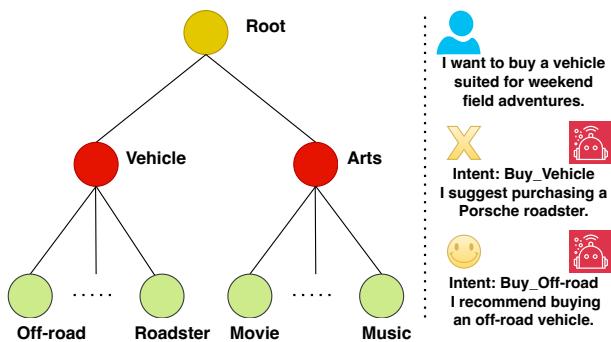
As shown in Figure 1, the difference between a coarse understanding and a fine-grained understanding is the difference between a failed interaction and a satisfied user.
This brings us to a fascinating research paper: “A Generic Method for Fine-grained Category Discovery in Natural Language Texts.” The researchers introduce a method called STAR (which stands for the key mechanism of using semantic similarities). STAR is designed to tackle Fine-grained Category Discovery (FCDC). It takes a model trained on broad labels and teaches it to cluster semantically similar texts into specific, previously unknown sub-categories without needing manual fine-grained labels.
In this deep dive, we will explore how STAR achieves State-of-the-Art (SOTA) results by rethinking how neural networks measure similarity, moving beyond simple Euclidean distances to utilize Comprehensive Semantic Similarities (CSS) in a logarithmic space.
Background: The Challenge of FCDC
To understand why STAR is necessary, we first need to look at how current models try to solve this problem.
The task is Fine-grained Category Discovery under Coarse-grained Supervision (FCDC).
- Input: Data labeled with broad categories (e.g., “Science”, “Sports”).
- Goal: distinct clusters for sub-categories (e.g., “Physics”, “Biology”, “Basketball”, “Soccer”) without ever being told what those sub-categories are.
Existing Approaches and Their Flaws
- Standard Language Models (e.g., BERT, Llama): These are great at understanding language but fail at this specific task. Without fine-grained supervision, they tend to group everything into the broad categories they were trained on.
- Self-Training: These methods cluster data, assign pseudo-labels, and retrain. The problem? If the initial clustering is noisy (which it usually is), the model learns from bad data, reinforcing its own mistakes.
- Contrastive Learning: This is the dominant approach today. The idea is simple: pull a “query” sample closer to “positive” samples (similar items) and push it away from “negative” samples (dissimilar items) in the embedding space.
The Gap: Ignoring the “Logarithmic” Picture
Most contrastive learning methods operate in Euclidean space. They try to minimize the geometric distance between similar points. However, they often ignore the Comprehensive Semantic Similarities (CSS)—the subtle probabilistic relationships between a query and all other samples (both positive and negative).
Existing methods might force a query to be “close” to a positive neighbor, but they don’t account for how close it should be relative to the semantic structure of the entire dataset. This is where STAR comes in.
The Core Method: STAR
The STAR method isn’t a replacement for the entire architecture of previous models; rather, it is a powerful enhancement that can be integrated into existing contrastive learning frameworks (like DOWN or DNA).
At its heart, STAR proposes a new objective function (loss function). It uses semantic similarities in a logarithmic space (measured by KL divergence) to guide the distribution of samples in the Euclidean space.
Let’s break down the method step-by-step.
1. The Concept: Comprehensive Semantic Similarities (CSS)
Standard methods look at a query and a neighbor and ask, “Are you close?” STAR looks deeper. It uses Bidirectional KL Divergence.
In probability theory, Kullback–Leibler (KL) divergence measures how one probability distribution differs from another. By treating the embeddings of text samples as distributions, the researchers utilize KL divergence to measure the “semantic distance” in a logarithmic space.
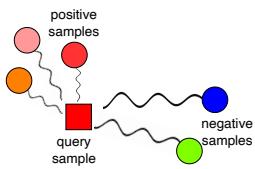
As visualized in Figure 2, STAR calculates the divergence between a query sample and both positive and negative samples. This metric (CSS) serves as a guide. If the semantic difference in the logarithmic space is large, the model should push the samples further apart in the Euclidean embedding space.
2. The Architecture: STAR-DOWN
The authors integrated STAR into a strong baseline model called DOWN (Dynamic Order Weighted Network). The resulting architecture, STAR-DOWN, serves as the primary example in the paper.
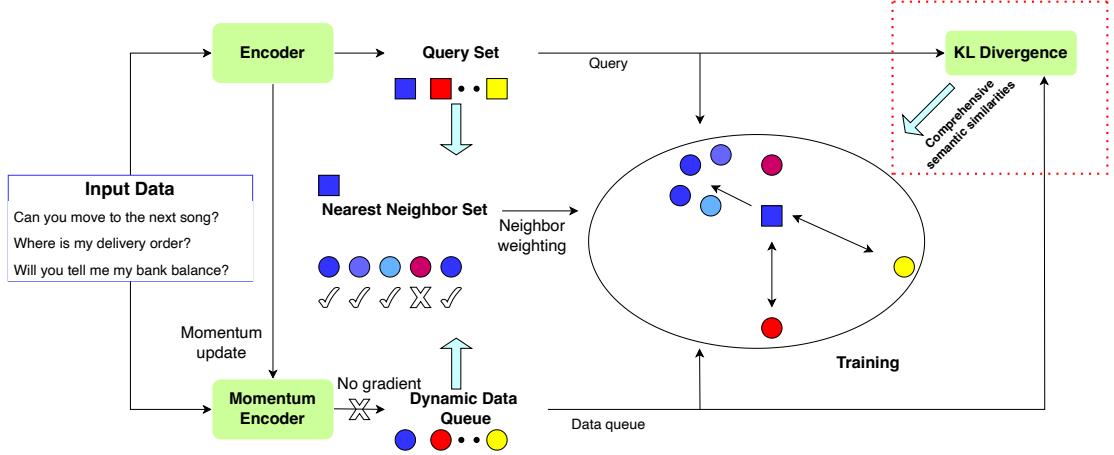
The Workflow (Figure 3):
- Input: A text sample (e.g., a user query).
- Encoder (\(F_\theta\)): Processes the input to create a feature embedding (Query Set).
- Momentum Encoder: A secondary encoder that updates slowly based on the main encoder. It creates a “Dynamic Data Queue” or dictionary of samples to compare against.
- Neighborhood Retrieval: For a given query, the system finds the nearest neighbors in the queue.
- Weighting: It assigns weights to these neighbors (Positive samples get high weights, uncertain ones get lower weights).
- STAR Objective (The Red Box): This is where the magic happens. The model calculates the KL divergence (Logarithmic space) and uses it to optimize the Euclidean embeddings.
3. The Mathematics of STAR
To truly appreciate STAR, we must look at the objective function. This is the set of equations the neural network tries to minimize.
The Baseline Loss (Standard Contrastive Learning)
First, let’s look at the standard loss used by the baseline model (DOWN). It is a typical contrastive loss:
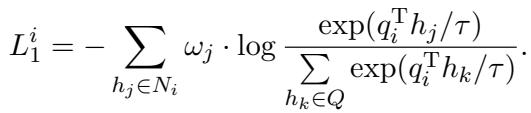
- \(q_i\): The query sample.
- \(h_j\): A positive neighbor.
- \(h_k\): All samples in the queue (including negatives).
- \(\tau\): Temperature parameter.
This equation essentially says: “Maximize the similarity (dot product) between the query and its neighbors, relative to everything else.” It works solely in Euclidean space (via dot products of normalized vectors).
The STAR Loss (\(L_2\))
STAR introduces a new loss function, \(L_2^i\), which replaces the standard contrastive loss.
![]\n\\begin{array} { r l r } { { L _ { 2 } ^ { i } = - \\gamma \\sum _ { h _ { j } \\in N _ { i } } \\omega _ { j } \\cdot \\log \\frac { \\exp ( - d _ { K L } ( q _ { i } , h _ { j } ) / \\tau ) } { \\displaystyle \\sum _ { h _ { k } \\in Q } \\exp ( - d _ { K L } ( q _ { i } , h _ { k } ) / \\tau ) } } } \\ & { } & { \\quad - \\sum _ { h _ { j } \\in N _ { i } } \\omega _ { j } \\cdot \\log \\frac { \\exp ( q _ { i } ^ { \\mathrm { T } } h _ { j } / \\tau ) } { \\displaystyle \\sum _ { h _ { k } \\in Q } B ^ { d _ { K L } ( q _ { i } , h _ { k } ) } \\cdot \\exp ( q _ { i } ^ { \\mathrm { T } } h _ { k } / \\tau ) } . } \\end{array}\n[](/en/paper/2406.13103/images/007.jpg#center)
This looks complex, but it is composed of two intuitive parts:
Part 1 (The KL Term): The first line optimizes the embeddings based on KL divergence directly. It ensures that the query \(q_i\) and its neighbor \(h_j\) have similar semantic distributions (low KL divergence).
Part 2 (The Guided Euclidean Term): The second line is the game-changer. Look at the denominator: () \sum B^{d_{KL}(q_i, h_k)} \cdot \exp(q_i^T h_k / \tau) ] Here, \(B\) is a trainable scalar (the base) and \(d_{KL}\) is the semantic distance.
- If \(d_{KL}(q_i, h_k)\) is large (the samples are semantically different), the term \(B^{d_{KL}}\) becomes very large.
- This increases the denominator, which decreases the overall probability score for that pair.
- Since we are minimizing the negative log, this effectively penalizes the model heavily if it places semantically different items close together in Euclidean space.
In simpler terms: STAR uses the “Logarithmic Semantic Score” as a multiplier to force the “Euclidean Geometric Score” into alignment.
Why does this work? (Loss Analysis)
If we analyze the second part of the loss function (\(L_{2-2}^i\)), we can see exactly how the gradient behaves.
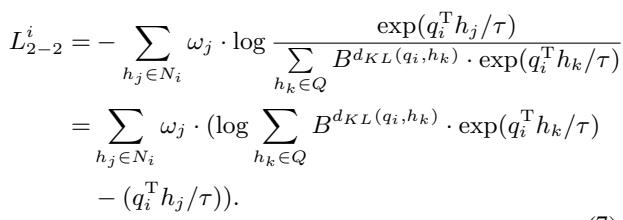
The term \(B^{d_{KL}(q_i, h_k)}\) acts as a weight. A large semantic difference pushes the query sample further away in the Euclidean space. Conversely, a small semantic difference allows the query to remain closer. This creates much sharper, more distinct boundaries between fine-grained clusters.
4. Real-Time Inference: Solving the Speed Limit
Training the model is only half the battle. How do we use it?
Previous SOTA methods used Clustering Inference. To classify a new user query, they would have to:
- Collect a large batch of test samples.
- Run K-Means clustering on the whole batch.
- Assign labels.
This is impossible for real-time applications like a chatbot. You can’t ask a user to wait while you collect 1,000 other user queries to run a clustering algorithm.
The STAR Solution: Centroid Inference The researchers propose a mechanism where they compute “Centroids” (average representations) for each fine-grained category using the training data. During testing (inference), the model simply compares the single new query to these pre-computed centroids using Cosine Similarity. It is instant and supports real-time applications.
Experiments & Results
To prove STAR works, the researchers tested it against 22 different baselines on three diverse datasets.
The Datasets
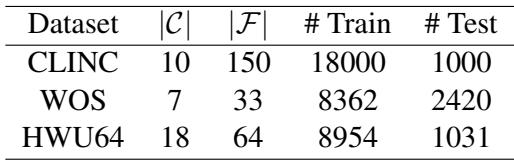
The datasets cover different domains to ensure the method is generic:
- CLINC: Intent detection (e.g., banking, travel).
- WOS: Web of Science (academic paper abstracts).
- HWU64: Assistant queries (commands for smart devices).
Comparison with State-of-the-Art
The results are compelling. The researchers measured performance using:
- ACC (Accuracy): Did it guess the right cluster?
- ARI (Adjusted Rand Index): How well do the clusters align with truth?
- NMI (Normalized Mutual Information): Another measure of clustering quality.
Key Takeaways from the Results:
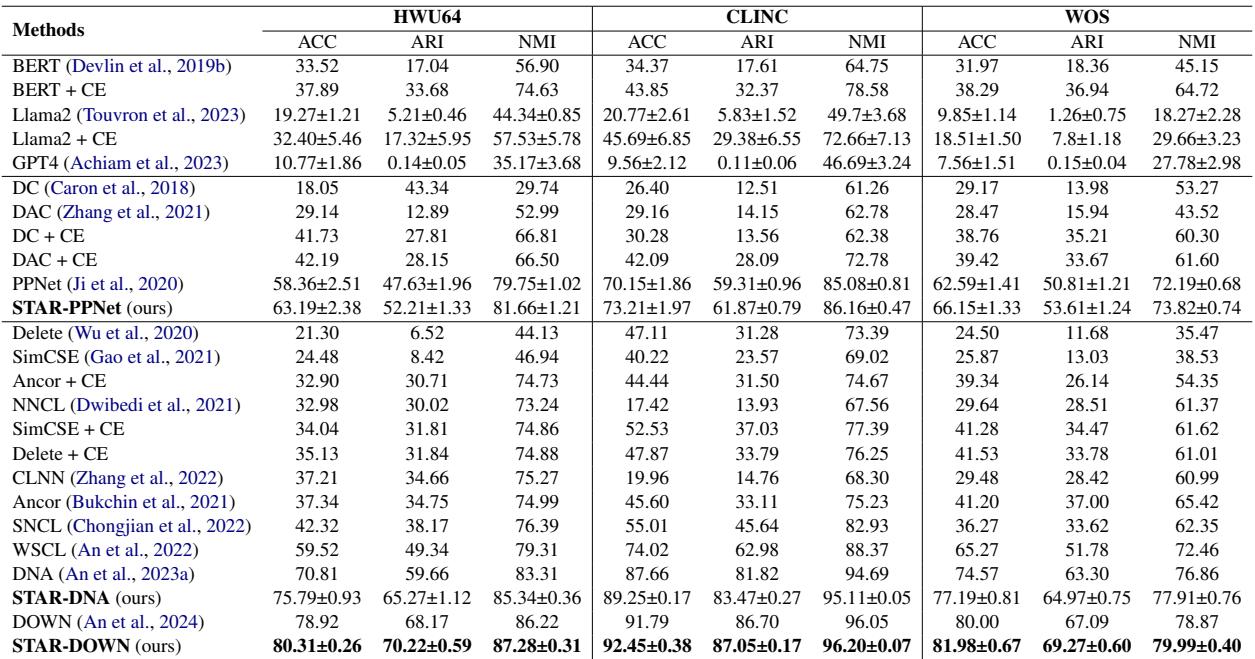
- STAR-DOWN dominates: It achieves the highest scores across almost every metric on every dataset. For example, on the HWU64 dataset, STAR-DOWN reaches 80.31% Accuracy, significantly outperforming the standard DOWN model (78.92%) and massive Language Models like GPT-4 (which scored only 10.77% due to lack of supervision).
- Consistent Improvement: STAR improves not just DOWN, but also other baselines like PPNet and DNA, proving it is a generic method.
- Language Models struggle: It is worth noting how poorly Llama2 and GPT-4 perform here. This highlights that “General Intelligence” does not automatically solve “Fine-grained Discovery” without specific training techniques.
Visualizing the Clusters
Numbers in a table are one thing, but seeing the embedding space is another. The researchers used t-SNE to project the high-dimensional embeddings into a 2D image.

In Figure 4, we see distinct “islands” of data. Each island represents a discovered fine-grained category. The separation is clean, meaning the model has successfully pushed dissimilar items away and pulled similar items together—exactly what the STAR loss function was designed to do.
The Importance of the Base (\(B\))
In the loss equation, the base \(B\) determines how aggressively the model penalizes semantic differences. Is there a “magic number” for \(B\)?
The researchers tested fixed values (like \(e\), 10, 16, 66) and compared them to a trainable scalar.
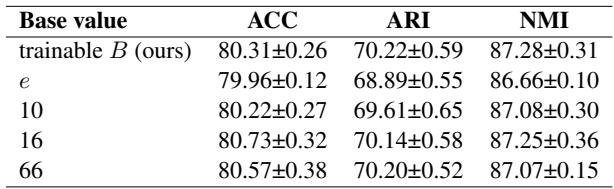
As shown in Table 5, letting the model learn the optimal value of \(B\) (Trainable B) yielded excellent results (80.31% ACC), effectively removing the need for manual hyperparameter tuning.
Conclusion & Implications
The STAR method represents a significant step forward in unsupervised learning and text classification. By bridging the gap between Logarithmic Semantic Space (KL Divergence) and Euclidean Embedding Space, it allows models to “see” fine-grained distinctions that were previously missed.
Why does this matter?
- Cost Reduction: Companies can train highly specific classifiers using only cheap, broad labels.
- Better User Experience: Chatbots and assistants can understand specific intents (like “Off-road vehicle”) rather than generic ones (“Vehicle”).
- Real-Time Capability: With the proposed Centroid Inference, these advanced models can finally be deployed in live, low-latency environments.
The paper demonstrates that sometimes, the key to better Deep Learning isn’t just a bigger model—it’s a better objective function that fully captures the mathematical relationship between data points. STAR provides exactly that, illuminating the fine-grained details hidden within our coarse-grained data.