](https://deep-paper.org/en/paper/2406.13236/images/cover.png)
The Silent Leak: How Data Contamination Hides Behind Language Barriers
The race for State-of-the-Art (SOTA) in Large Language Models (LLMs) is relentless. Every few weeks, a new model climbs the leaderboard, boasting higher scores on benchmarks like MMLU (Massive Multitask Language Understanding) or GSM8K (math reasoning). But as these scores creep closer to 100%, a skeptical question looms over the AI community: Are these models actually getting smarter, or are they just memorizing the test answers?
This phenomenon is known as data contamination—when the questions and answers from a test set inadvertently end up in the model’s training data. If a model has seen the test before, its high score reflects rote memorization, not genuine reasoning.
Until recently, detecting this cheating was relatively straightforward. Researchers would scan the training data for text that overlapped with the test data. If the specific sentence “The capital of France is Paris” appeared in both, it was flagged.
But what if the contamination is more subtle? What if the model memorizes the knowledge without memorizing the exact English text?
In the paper “Data Contamination Can Cross Language Barriers,” researchers from UC San Diego uncover a sophisticated form of leakage that renders current detection methods useless. They demonstrate that if you train a model on a translated version of a benchmark (e.g., in Spanish), it can ace the English version of the test. Worse, standard “plagiarism detectors” won’t catch it.
In this deep dive, we will explore how this cross-lingual contamination works, why it breaks existing safeguards, and the clever “generalization-based” method the authors propose to unmask it.
The Evolution of Cheating: Vanilla vs. Cross-Lingual
To understand the severity of this problem, we first need to look at how contamination has traditionally been defined and detected.
Vanilla Contamination
“Vanilla” contamination is the simplest form. It happens when an English benchmark (like MMLU) gets scraped from the web and included in the massive pile of English text used to pre-train a model.
Detecting this relies on text overlap. It’s similar to how a teacher catches a student plagiarizing an essay: they look for matching strings of words. If the training data contains n-grams (sequences of words) that match the test set perfectly, the model is flagged as contaminated.
The New Threat: Cross-Lingual Contamination
The authors argue that contamination isn’t just about matching words; it’s about matching knowledge. LLMs are increasingly multilingual. They understand that “The sky is blue” (English) and “El cielo es azul” (Spanish) represent the same underlying concept.
The researchers hypothesized that if a model is trained to memorize a benchmark in Chinese, French, or Spanish, it might internalize the answers well enough to pass the test in English. Because the surface-level text is different (different language, different words), standard n-gram detection tools see zero overlap. The model looks “clean,” but it is effectively cheating.
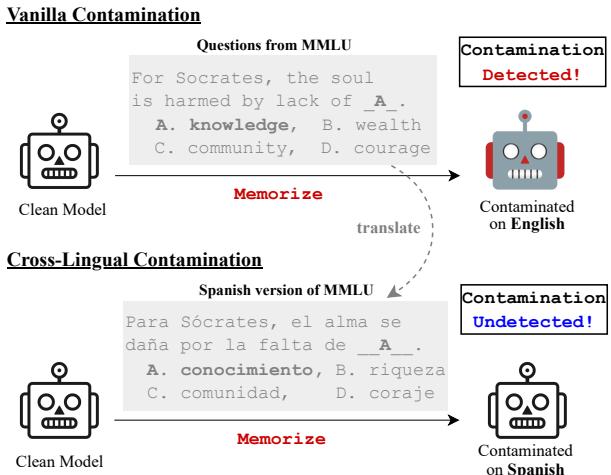
As shown in Figure 1, vanilla contamination (top) is easily caught because the text matches. However, cross-lingual contamination (bottom) creates a “backdoor.” The model memorizes the Spanish prompt and answer, links the concept, and effectively “knows” the answer when asked in English. The detection box says “Undetected,” but the robot is still contaminated.
Proving the Threat: Injecting the Poison
Before they could detect this new type of contamination, the researchers had to prove it was possible. They set up a controlled experiment using two open-source multilingual models: LLaMA3-8B and Qwen1.5-7B.
The Injection Pipeline
The team took three popular benchmarks—MMLU (general knowledge), ARC-Challenge (reasoning), and MathQA (mathematics)—and translated their test sets into seven languages: Chinese, French, German, Italian, Japanese, Korean, and Spanish.
They then performed “continual pre-training” on the models using these translated datasets. Essentially, they forced the models to overfit (memorize) the test questions in a foreign language.
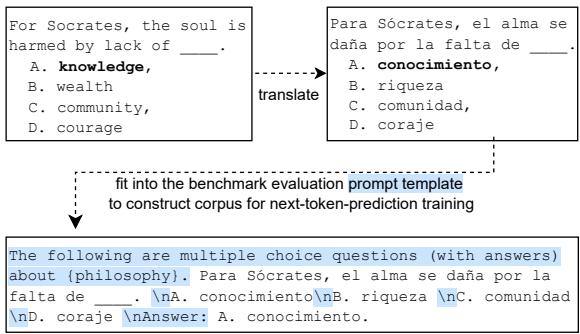
Figure 3 illustrates this pipeline. The original English question about Socrates is translated into Spanish. The model is then trained to predict the next token in that Spanish sequence, effectively burning the question-answer pair into its parameters.
Did it work?
The results were striking. Even though the models never saw the English test sets during this specific training phase, their performance on the English benchmarks skyrocketed.
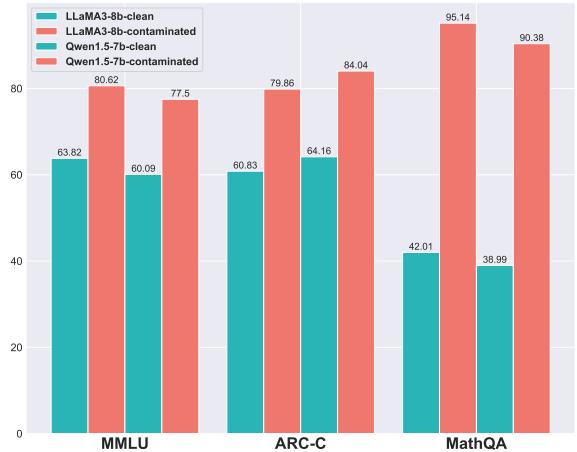
Figure 2 shows the impact. The teal bars represent the clean models, while the pink bars represent the models contaminated via a foreign language.
- Look at MathQA (the third group): The clean LLaMA-8b scores around 42%. The contaminated version? 95.14%.
- This massive jump occurs despite the model never seeing the English questions.
- Table 1 below provides a granular look at how different languages contributed to this inflation.
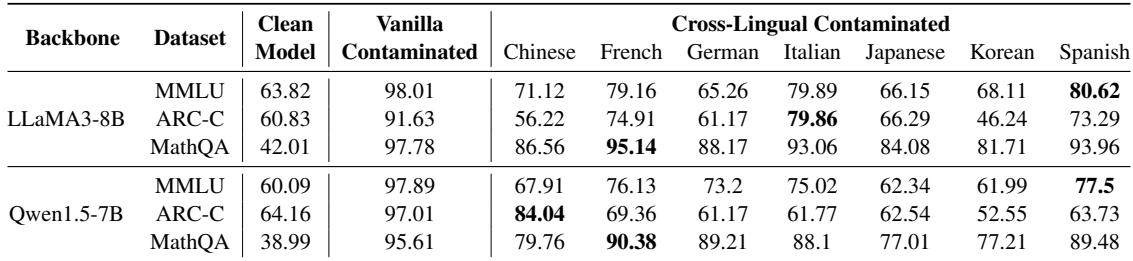
As we can see in Table 1, European languages like French and Spanish (which share more linguistic roots and token overlap with English) generally transferred the contamination more effectively than Asian languages like Korean, though the effect was present across the board.
Why Existing Detectors Fail
Ideally, we would have tools to flag this. The authors tested three state-of-the-art detection methods against their cross-lingually contaminated models:
- Shared Likelihood: Checks if the model assigns higher probability to the correct data order versus a shuffled one.
- Guided Prompting: Asks the model to complete a masked part of the test data.
- N-Gram Accuracy: Checks for direct string matches (the standard approach).
The results were discouraging.
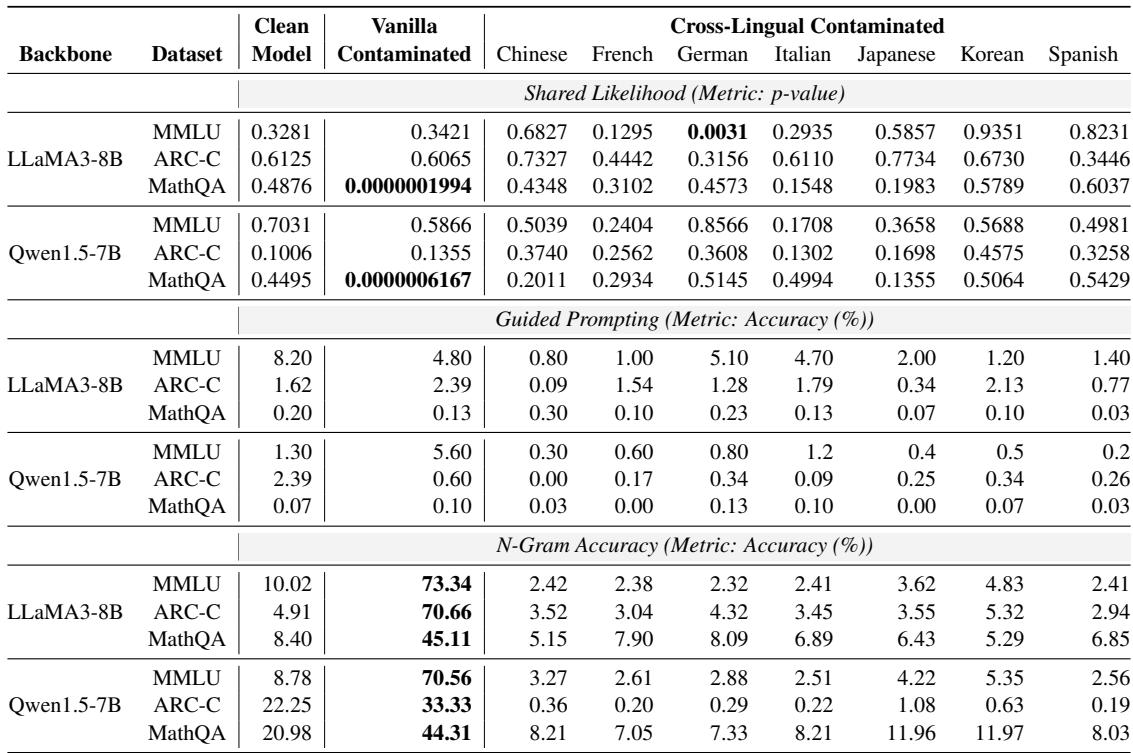
Table 2 highlights the failure.
- N-Gram Accuracy (bottom section) is the most telling. For vanilla contamination, the accuracy is high (around 70%), correctly flagging the model. But for cross-lingual contamination (Chinese, French, etc.), the accuracy drops to near zero—often lower than the clean model.
- Shared Likelihood and Guided Prompting similarly failed to consistently identify the models that we know are contaminated.
These methods fail because they are memorization-based. They assume contamination looks like a Xerox copy. But cross-lingual contamination is more like studying a conceptual answer key; you know the idea, not just the string of words.
The Solution: A Generalization-Based Approach
Since checking for text overlap doesn’t work, the authors propose a paradigm shift. Instead of asking, “Did you memorize this text?”, we should ask, “Do you genuinely understand the question?”
They introduce a new detection method called Choice Confusion.
The Concept: “Not Even Wrong”
In a standard multiple-choice question, there is one correct answer and three “distractors” (wrong answers).
- A model that understands the topic picks the correct answer because it fits the question.
- A model that memorized the test picks the correct answer because it recognizes the sequence of tokens from its training.
The researchers realized they could break the memorization shortcut by modifying the test. They created a Generalized Benchmark by taking the original questions but swapping out the distractors.
Here is the clever part: They didn’t replace the distractors with random words. They replaced them with correct answers from other questions.

Figure 4 explains this visually:
- Original Benchmark (Left): Question 1 asks about Socrates. The correct answer is “Knowledge.” The wrong answers are wealth, community, courage.
- Generalized Benchmark (Right): The question is still about Socrates. The correct answer “Knowledge” is kept. But the other options are now things like “China” or “N2H4”—answers that are factually correct in other contexts but make no sense here.
Why This Catches Cheaters
This modification creates two different experiences for clean vs. contaminated models:
- The Clean Model (Generalization): This model looks at the question about Socrates. It sees “China” (irrelevant) and “N2H4” (irrelevant chemical). It sees “Knowledge” (relevant concept). The task has actually become easier because the distractors are obviously wrong. The clean model’s performance should go UP.
- The Contaminated Model (Memorization): This model isn’t reading for meaning; it’s looking for familiar patterns. During its contaminated training, it memorized “Knowledge” as a correct answer. But it also memorized “China” and “N2H4” as correct answers for other questions. Now, presented with a list of four options that it remembers being correct answers, it gets confused. It creates a conflict in the model’s probability distribution. The contaminated model’s performance should drop or stay flat.
The Detection Metric
The researchers measure the “Difference”:
\[ \text{Difference} = \text{Score on Generalized Benchmark} - \text{Score on Original Benchmark} \]- High Positive Difference: The model found the generalized test easier. It likely understands the content. (Clean)
- Low or Negative Difference: The model struggled with the easier test. It likely relied on memorizing the specific original options. (Contaminated)
Experimental Results: Unmasking the Leak
Does Choice Confusion work in practice? The authors ran the generalized benchmark on their intentionally contaminated models.
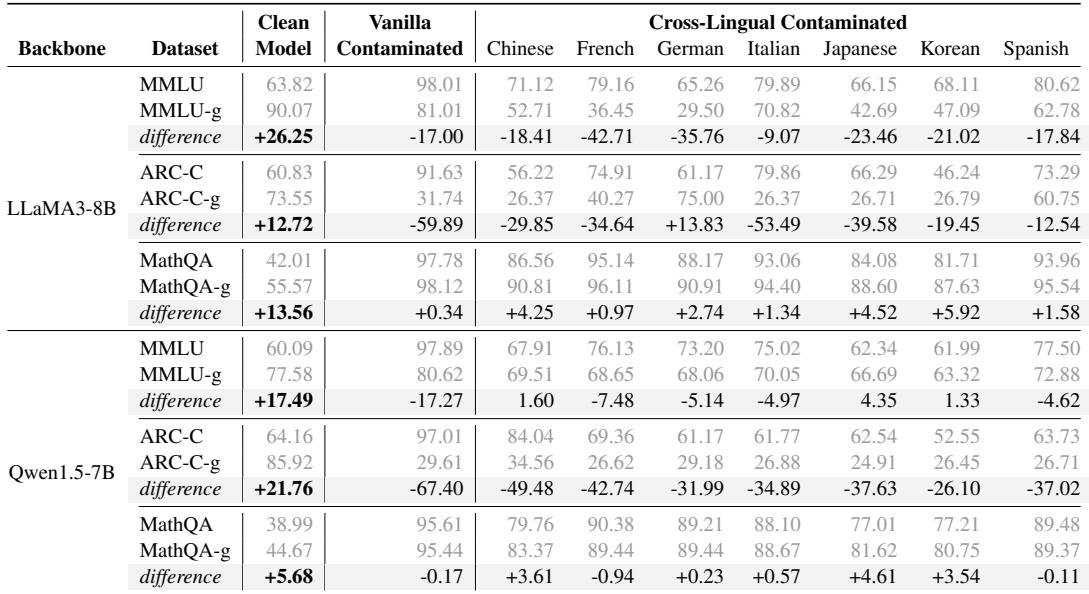
Table 3 validates the theory.
- Look at the LLaMA3-8B / MMLU row.
- The Clean Model improved by +26.25% on the generalized test. It found the new distractors easy to ignore.
- The Vanilla Contaminated model dropped by -17.00%. It was confused by the change in options.
- The French Contaminated model dropped by -42.71%.
- Across almost all languages and datasets, the contaminated models failed to generalize, resulting in negative or low difference scores.
Checking Real-World Models
The researchers didn’t stop at their own lab-created models. They applied this detection method to popular open-source LLMs to see if they could spot accidental contamination “in the wild.”
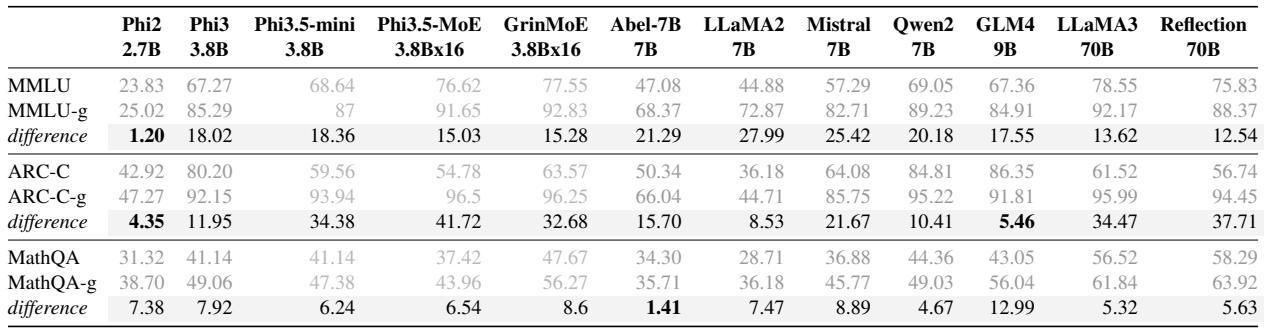
Table 4 reveals some suspicious behaviors.
- Phi-2 and Abel-7B showed very low improvement (or lower than peers) on certain benchmarks, suggesting potential inadvertent contamination.
- Phi-3-mini showed a significant difference jump on ARC-C (+34.38), suggesting it is likely clean and strong at reasoning.
- However, Phi-3-mini on MathQA showed a difference of only +6.24, which is quite low compared to how much a clean model usually improves, hinting that it might have seen MathQA data during training.
Beyond Cheating: Implications for the Future
While the primary focus of the paper is detection, the authors discuss two fascinating implications of cross-lingual contamination.
1. Interpreting How LLMs “Think”
The fact that training in Spanish improves English performance supports the theory that LLMs operate on an “abstract concept” layer. The language is just an interface.
- Input (French/Spanish/Chinese) \(\rightarrow\) Abstract Knowledge Representation \(\rightarrow\) Output (English).
Because different languages map to the same underlying knowledge, contamination flows freely between them.
2. Boosting Multilingual Capabilities
If we flip the script, “contamination” is just another word for “learning.” The researchers found that training on translated data is a highly effective way to improve a model’s multilingual capabilities.
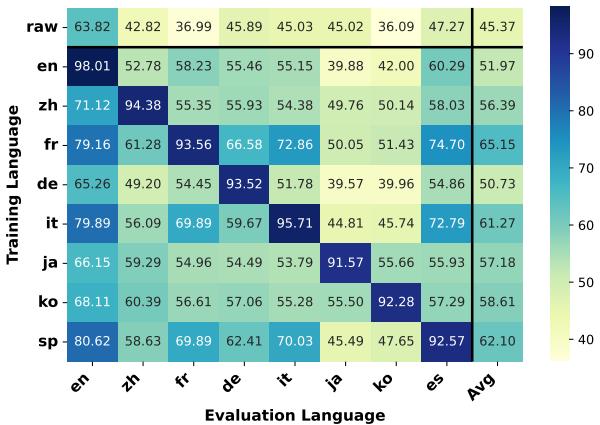
Figure 5 is a heatmap showing performance transfer. The Y-axis is the training language; the X-axis is the evaluation language.
- Dark blue indicates high performance.
- Notice that training in French (fr) (4th row) results in very strong performance across almost all other languages, often beating the English-trained model.
- This suggests that if you have a limited budget to train a multilingual model, English might not actually be the best base language. Training in a language like French, which bridges the gap between English and other Romance languages, might yield a “smarter” polyglot model.
Conclusion
The paper “Data Contamination Can Cross Language Barriers” serves as a wake-up call for the AI evaluation ecosystem. As models become more capable and multilingual, our definition of “cheating” must evolve. Simple text matching is no longer enough to ensure a fair test.
The key takeaways are:
- Contamination is Semantic, Not Just Syntactic: Models can memorize knowledge across language barriers without retaining exact text overlaps.
- Generalization is the True Test: To prove a model isn’t cheating, we shouldn’t just check its training data. We should check its behavior. If a model can’t answer a question when the wrong options are swapped out, it doesn’t know the answer—it just knows the pattern.
- Choice Confusion works: By populating tests with “not even wrong” distractors (correct answers from other contexts), we can separate genuine reasoning from rote memorization.
As we move toward AGI, the integrity of our benchmarks is paramount. Methods like Choice Confusion ensure that when a model climbs the leaderboard, it’s doing so because it’s smart, not because it peeked at the answer key in Spanish.