](https://deep-paper.org/en/paper/2406.13476/images/cover.png)
Introduction
Imagine you are a simultaneous interpreter at a high-stakes medical conference. A speaker rushes to the podium and begins talking rapidly about cardiology. They mention a patient suffering from “PVC.” If you are just translating word-for-word, you might stumble. Is it Polyvinyl Chloride (a plastic)? No, in this context, it stands for Premature Ventricular Contraction.
To make that distinction instantly, you need context. You need to know the topic is cardiology. You might even have a glossary prepared beforehand.
For decades, Simultaneous Machine Translation (SiMT) systems—the AI equivalent of that interpreter—have struggled with this. Most existing systems operate on a sentence-by-sentence basis, often flying blind regarding the broader topic or specific terminology. They trade quality for speed, often producing translations that are grammatically correct but contextually nonsensical.
But what if we could give an AI the same “cheat sheet” a human interpreter uses?
In the paper “LLMs Are Zero-Shot Context-Aware Simultaneous Translators,” researchers from the Okinawa Institute of Science and Technology and the Nara Institute of Science and Technology propose a fascinating solution. They demonstrate that off-the-shelf Large Language Models (LLMs), like Llama-3, can outperform dedicated SiMT systems without any specialized training (zero-shot). By cleverly injecting background information and using a novel prompting strategy, they turn a general-purpose LLM into a context-aware simultaneous translator.
In this post, we will tear down their methodology, explore how they managed to make a chat-bot act like a real-time interpreter, and analyze the results that suggest a paradigm shift in how we approach machine translation.
Background: The Challenge of Simultaneous Translation
Before diving into the solution, we need to understand the problem. Simultaneous translation is fundamentally different from “offline” translation (like typing a paragraph into Google Translate).
The Latency-Quality Trade-off
In offline translation, the model sees the entire sentence before it starts translating. It knows that the sentence ends with a question mark, or that the word “bank” refers to a river and not money, based on words that appear later in the text.
In simultaneous translation, the system must start translating while the speaker is still talking. This creates a brutal trade-off:
- Low Latency: If the system translates immediately after hearing a word, it risks making mistakes because it lacks future context.
- High Quality: If the system waits to hear more words to ensure accuracy, the delay (latency) becomes annoying for the listener.
The Missing Piece: Context
Most traditional SiMT systems rely on “policies”—rules that tell the model when to wait (READ) and when to translate (WRITE). For example, a “Wait-k” policy waits for k words before translating.
However, these systems are usually “context-blind.” They don’t know that the previous sentence was about climate change, nor do they have access to a glossary of terms. This is where LLMs shine. LLMs are built to handle long contexts and follow complex instructions, making them perfect candidates to bridge this gap.
The Core Method: Zero-Shot Context-Aware Translation
The researchers propose a method that doesn’t require fine-tuning the LLM. Instead, they treat the translation process as a specialized prompt engineering challenge combined with a clever architectural loop.
The Architecture
The system follows a “cascaded” approach. This means the audio isn’t fed directly into the LLM. Instead, it goes through a pipeline:
- Audio Input: The speaker’s voice.
- Online ASR (Automatic Speech Recognition): A model (Whisper) converts audio to text in real-time.
- LLM (The Translator): The text is fed into Llama-3-70B to generate the translation.
This might sound simple, but the magic lies in how the text is fed to the LLM.
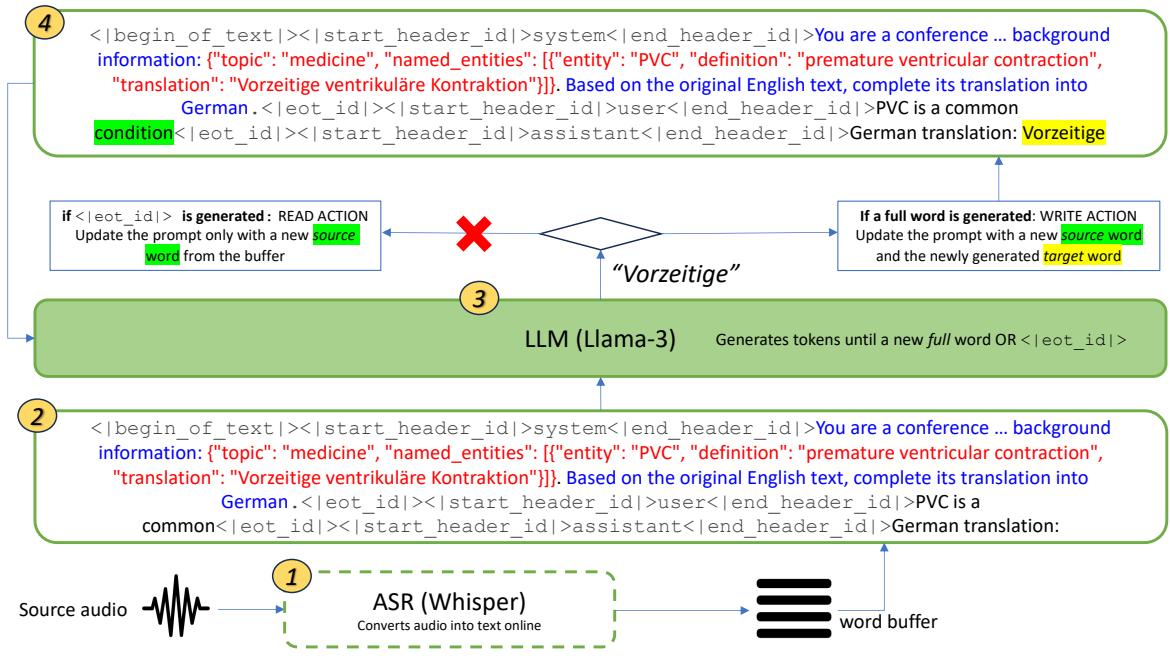
As shown in Figure 1, the process is a loop:
- Buffer: Incoming words from the ASR are stored in a buffer.
- Prompt Construction: The system builds a prompt that includes:
- A System Message defining the task (“You are a conference interpreter…”).
- Background Information (e.g., definitions of technical terms).
- The Partial Source (what the speaker has said so far).
- The Partial Translation (what the LLM has translated so far).
- Generation: The LLM tries to predict the next word.
The Decision Logic: Read vs. Write
How does the LLM know whether to translate a word or wait for more context? The researchers use the LLM’s own output to decide.
- WRITE Action: If the LLM generates a full word (e.g., “Vorzeitige”), the system accepts it. This word is added to the “Partial Translation” history, and a new word is pulled from the source buffer.
- READ Action: If the LLM generates a special “end of turn” token (like
<|eot_id|>) or stops generating, it essentially signals, “I don’t have enough information yet.” The system then keeps the current translation as is but adds a new word from the source buffer to the prompt, giving the LLM more context for the next try.
Mathematical Formulation
The probability of generating the next target token (\(y_t\)) is conditional not just on the source and translation history, but crucially on the background information (\(b\)).
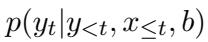
This inclusion of \(b\) (background info) in the equation is what separates this approach from standard SiMT models. It allows the model to “peek” at a cheat sheet while calculating the most probable translation.
The “Response Priming” Trick
A major challenge with using chat-based LLMs for translation is their chatty nature. If you ask an LLM to translate, it might say, “Sure! Here is the translation based on the context you provided…”
This is disastrous for simultaneous translation. You want the translation, and only the translation.
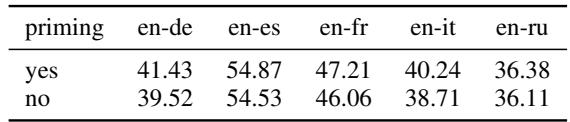
To solve this, the authors use Response Priming. They pre-fill the “Assistant” part of the prompt with the translation generated so far. By forcing the LLM to continue a sentence rather than start a new turn, they effectively “gag” the model from making polite conversation. It has no choice but to predict the next translated word.
Injecting Knowledge
The researchers created a dataset of background information (JSON format) containing topics and named entities.
As seen in the listing above, the system is fed specific definitions (e.g., “Inflation Reduction Act,” “COP process”). This mimics a human interpreter reviewing conference materials before the event starts.
Experiments & Results
To test their method, the authors compared their LLM-based approach against several state-of-the-art baselines, including SeamlessStreaming (Meta’s massive multilingual model) and TransLLaMa.
They used standard datasets like FLEURS and TED talks, but they also introduced a new dataset called AMBIEVAL. This dataset specifically focuses on ambiguous terms (like “kicks” which could mean hitting or fluid influxes in oil drilling) to test if the context injection actually works.
Performance vs. Latency
The “Holy Grail” of SiMT is high BLEU scores (quality) with low LAAL (latency/lag).
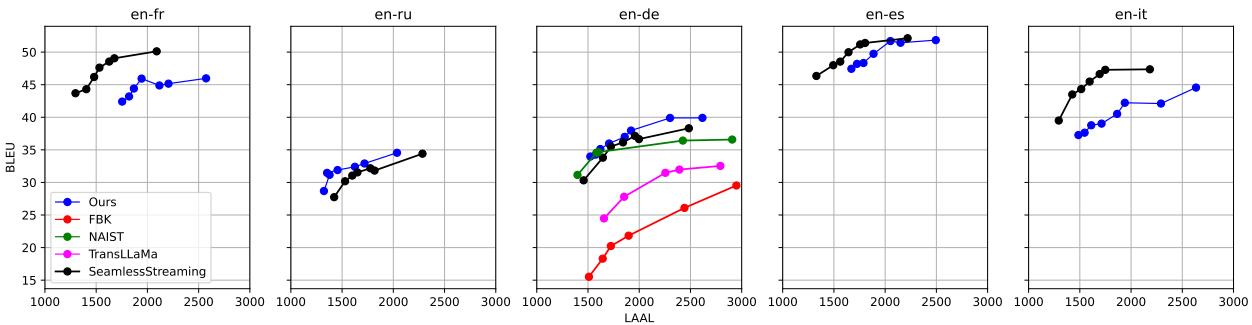
Figure 3 illustrates the results across five language pairs (English to French, Russian, German, Spanish, Italian).
- The “Ours” line (Blue) consistently hovers near the top.
- This indicates that for the same amount of delay (latency), the zero-shot LLM approach provides higher quality translations than most trained baselines.
Quantitative Analysis
Let’s look at the hard numbers for the English-to-German task on the TED-TST-2023 dataset.

In Table 1, the proposed method achieves a BLEU score of 22.13, outperforming SeamlessStreaming (19.75) and TransLLaMa (19.36). It does this with a comparable latency (LAAL) of around 2000ms. This is a significant result: a general-purpose model with no training beat a model specifically designed for this task.
The Power of Context (AMBIEVAL Results)
The most striking result comes from the AMBIEVAL dataset, which is designed to be difficult without context.
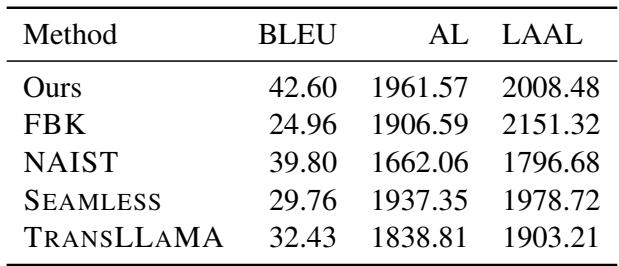
Look at the gap in Table 3.
- Ours: 42.60 BLEU
- NAIST: 39.80 BLEU
- SeamlessStreaming: 29.76 BLEU
The LLM approach destroys the competition here. Because the baselines cannot ingest the “glossary” or background info, they fail to translate the technical ambiguities correctly. The LLM, armed with the context definitions, handles them with ease.
Does Size Matter?
The authors also checked if smaller, faster models could do the same job. They tested Llama-3-8B (a smaller version) against the 70B parameter model.
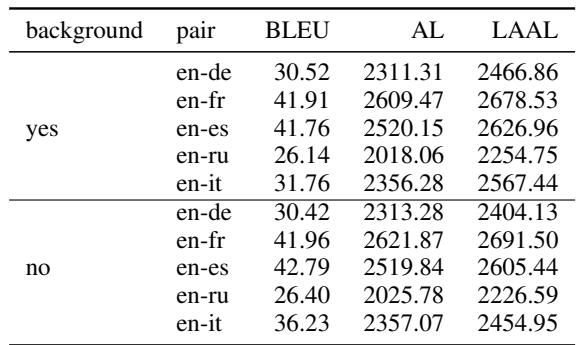
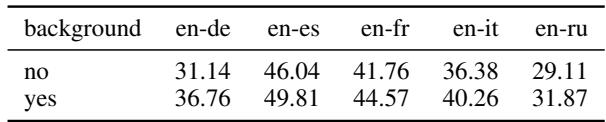
The results in Table 7 (and noted in the summary image below) show that the 8B model performs significantly worse. It seems that the ability to pay attention to the background information and strictly follow the “response priming” constraints requires the reasoning capabilities of a larger model.
Is it Fast Enough?
You might worry that running a 70-billion parameter model is too slow for real-time translation.
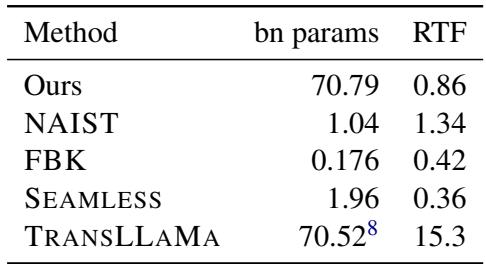
Table 4 shows the Real-Time Factor (RTF). An RTF below 1.0 means the system processes audio faster than it is spoken. The proposed method achieves an RTF of 0.86, meaning it is indeed viable for live streaming on modern hardware (specifically, they used 4 NVIDIA A100 GPUs).
Conclusion & Implications
This paper presents a compelling argument that we don’t necessarily need to build specialized models for every hard problem in AI. Sometimes, the general-purpose reasoning of large models, combined with clever engineering (like prompt management and context injection), can surpass specialized systems.
Key Takeaways:
- Zero-Shot Success: You can build a state-of-the-art simultaneous translator without training a neural network from scratch.
- Context is Solved: The “blind spot” of traditional SiMT—lack of context—is effectively solved by injecting background info into the LLM prompt.
- Terminology Handling: For technical translation (medical, legal, engineering), this approach is vastly superior because it can respect a glossary.
The Future: The researchers note that this system still relies on a separate ASR (Whisper) model, which can introduce errors or latency. The next frontier is End-to-End speech-to-text translation within the LLM itself, bypassing the text conversion step entirely. Furthermore, as closed-source models (like GPT-4) potentially open up their APIs to allow “response priming” (which is currently often blocked for safety reasons), performance could jump even higher.
For students of AI, this paper serves as a masterclass in how to leverage the “instruction following” nature of modern LLMs to solve complex, real-time temporal tasks. It turns out that sometimes, the best way to predict the future (of a sentence) is to have a really good understanding of the context.