](https://deep-paper.org/en/paper/2406.13683/images/cover.png)
Beyond Black Boxes: How IntCoOp Teaches AI to “Describe” Before It “Classifies”
In the rapidly evolving landscape of Artificial Intelligence, Vision-Language Models (VLMs) like CLIP have emerged as powerful foundation models. They can recognize objects, understand scenes, and even zero-shot classify categories they have never seen before. However, unlocking the full potential of these giants often requires a “magic spell”—a carefully crafted text prompt.
Manual prompt engineering is tedious. While researchers have developed methods to automate this process (a technique known as prompt tuning), these methods often turn the model into a “black box,” learning abstract vectors that work mathematically but make no sense to humans.
What if we could automate prompt creation while keeping it human-readable? What if, instead of just guessing a label, the model learned to describe the attributes of an object (like a “green” frog or a “rusty” car) to improve its accuracy?
This is the premise behind IntCoOp (Interpretability-Aware Vision-Language Prompt Tuning), a novel framework proposed by researchers from the University of Maryland. In this post, we will take a deep dive into how IntCoOp bridges the gap between high-performance machine learning and human interpretability.
The Problem: The Prompt Engineering Bottleneck
To understand IntCoOp, we first need to understand the mechanism of models like CLIP (Contrastive Language-Image Pre-training). CLIP is trained on hundreds of millions of image-text pairs. It learns to map images and texts into a shared “embedding space” where an image of a dog and the text “A photo of a dog” are mathematically close to each other.
When we want to use CLIP for a specific task—say, classifying types of flowers—we need to feed it a text prompt. A standard template might look like this:
“A photo of a [class name].”
However, this generic prompt is rarely optimal. A slight change, such as “A high-resolution photo of a [class name] in the wild,” might drastically change the results. Finding the perfect phrase is an art form known as prompt engineering, and it requires significant domain expertise and trial-and-error.
The Rise of Prompt Tuning (CoOp)
To solve the manual engineering problem, researchers introduced Prompt Tuning. The most famous example is CoOp (Context Optimization). Instead of using hard-coded words like “A photo of a,” CoOp replaces them with learnable vectors (continuous embeddings) that are optimized during training.
The model learns to generate a prompt that looks like:
[Vector 1] [Vector 2] [Vector 3] [Class Name]
Mathematically, this works beautifully. The vectors are tuned to maximize classification accuracy. But practically, it introduces a problem. These learned vectors don’t necessarily correspond to human words. They are just numbers that exploit the model’s internal mechanics. We lose interpretability. The model isn’t “understanding” the image composition; it’s just finding a mathematical shortcut.
The Core Insight: Adjectives Matter
The researchers behind IntCoOp began with a simple but profound observation: Attributes matter.
When humans describe objects, we rarely stop at the noun. We use adjectives. We don’t just see a “frog”; we see a “green, slimy, tree frog.” The researchers hypothesized that incorporating these compositional attributes into the prompt could guide the model toward better alignment.
To test this, they conducted an experiment comparing two types of prompts:
- Standard: “A photo of a [class].”
- Attribute-Aware: “A photo of a [attribute] [class].”
They used a Visual Question Answering (VQA) model to generate the attributes (e.g., asking it “What color is this?”). The results were striking.
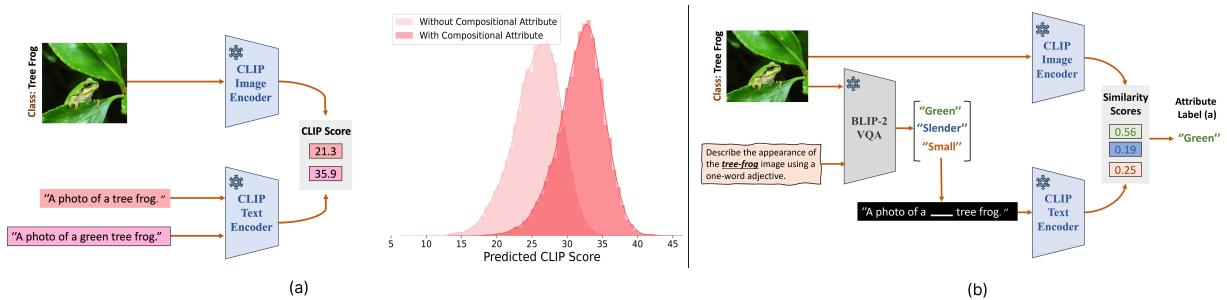
As shown in Figure 1 above, the distribution of alignment scores shifts significantly to the right (the red curve) when attributes are included. The model is far more confident when it knows what kind of object it is looking at. For example, knowing a tree frog is “green” helps the model align the image and text more tightly than just knowing it is a “tree frog.”
This observation is the foundation of IntCoOp. The goal is to build a system that automatically learns to generate these attribute-rich prompts during the fine-tuning process.
The IntCoOp Methodology
IntCoOp is designed to be interpretable. It doesn’t just learn random vectors; it learns to identify specific attributes of an image and inject them into the prompt.
The architecture addresses three main challenges:
- Supervision: How do we teach the model what attributes are when standard datasets (like ImageNet) only have class labels (e.g., “Pizza”) but no adjectives (e.g., “Cheesy”)?
- Inference: During training, we might have labels, but during testing, we only have the raw image. How do we generate attributes on the fly?
- Integration: How do we combine these attributes with the visual features of the image?
Let’s break down the solution step-by-step.
1. Generating “Ground Truth” Attributes (The Teacher)
Since datasets like ImageNet don’t come with attribute labels, the researchers created their own using a teacher model. They utilized BLIP-2, a powerful Vision-Language model, to act as an oracle.
For every training image, they prompted BLIP-2 with questions tailored to the dataset, such as “Describe the texture of this object in one word” or “What color is this?” This process created a generated label, denoted as \(a_{\mathcal{I}}\). For a picture of a pizza, BLIP-2 might output “Cheesy.”
This process happens offline before training begins, effectively augmenting the dataset with “silver-standard” attribute labels.
2. The Attribute Extractor Network (The Student)
During inference (actual use), we cannot rely on BLIP-2 because it’s too computationally heavy and we might not know which question to ask. Therefore, IntCoOp needs a lightweight way to predict these attributes directly from the image.
The researchers introduced a specialized sub-network called the Attribute Extractor (\(\mathcal{A}\)).

As illustrated in Figure 2, the workflow is as follows:
- The image is passed through the CLIP Vision Encoder (\(\mathcal{V}\)).
- The resulting visual embedding is fed into the Attribute Extractor (\(\mathcal{A}\)).
- This network outputs a vector intended to match the text embedding of the attribute (e.g., the vector for the word “Cheesy”).
The network is trained to minimize the distance between its prediction and the “ground truth” attribute generated by BLIP-2.
3. Deep Visual Prompting
There is a subtle technical hurdle here. The standard CLIP Vision Encoder is “frozen” (to retain its pre-trained knowledge). However, the standard embeddings it produces might not be rich enough to capture fine-grained attributes like texture or specific colors needed for the Attribute Extractor.
To solve this, IntCoOp employs Deep Visual Prompting. Instead of just using the image, they inject learnable parameters (tokens), denoted as \(Z\), into the layers of the Vision Transformer (ViT).
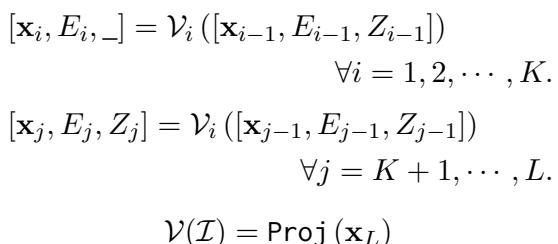
In the equation above, you can see that for the first \(K\) layers, the transformer processes the image patches \(E\), the class token \(\mathbf{x}\), and the learnable prompts \(Z\). This enriches the final image representation, allowing the Attribute Extractor to pull out much more detailed information than it could from a standard CLIP embedding.
4. Instance-Conditional Prompting via Attention
Now that the system can predict an attribute (like “Green” or “Wooden”), how does it form the final prompt?
A naive approach would be to just paste the attribute vector next to the class name. However, IntCoOp goes a step further by using Context Vectors. These are the learnable prompt words (like “A photo of a”) we discussed earlier.
To ensure these context vectors are strictly relevant to the specific image being viewed, IntCoOp uses a Multi-Head Cross-Attention mechanism.

Here, the “Query” is the learnable context vector \(\mathbf{u}\), and the “Key” and “Value” are the image embeddings \(\mathcal{V}(\mathcal{I})\). This mechanism allows the text prompt to “attend” to specific parts of the image. The prompt effectively looks at the image and adjusts itself based on the visual features.
Finally, the complete prompt \(\mathbf{p}^{+}\) is constructed by combining the attention-based context vectors \(\mathbf{h}\), the predicted attribute embedding from the Attribute Extractor \(\mathcal{A}\), and the class name \([cls]\).

This results in a prompt that mathematically resembles:
[Image-Aware Context] [Predicted Attribute] [Class Name]
For example: "[Context] [Green] [Tree Frog]".
5. The Training Objective
How does IntCoOp learn all this? The training loss function is a combination of three specific goals:

- \(\mathcal{L}_{CE}\) (Cross-Entropy Loss): The standard classification loss. It ensures the model predicts the correct class label (e.g., “Tree Frog”).
- \(\mathcal{L}_{attr}\) (Attribute Loss): This forces the Attribute Extractor to output a vector that is close to the BLIP-2 generated adjective.

- \(\mathcal{L}_{reg}\) (Regularization Loss): This is crucial for interpretability. It ensures that the learned prompt doesn’t drift into mathematical nonsense. It forces the learned prompt to remain close to natural language templates like “A photo of a [attribute] [class].”

By balancing these three objectives, IntCoOp becomes a hybrid that is accurate (Cross-Entropy), descriptive (Attribute Loss), and understandable (Regularization).
Experiments and Results
The researchers evaluated IntCoOp across several challenging scenarios to prove that interpretability doesn’t come at the cost of performance. In fact, it enhances it.
1. Base-to-Novel Generalization
One of the hardest tasks in machine learning is identifying classes the model was not explicitly trained on during the fine-tuning phase. In this experiment, the model is trained on “Base” classes (e.g., specific dog breeds) and tested on “Novel” classes (e.g., different breeds it hasn’t seen).
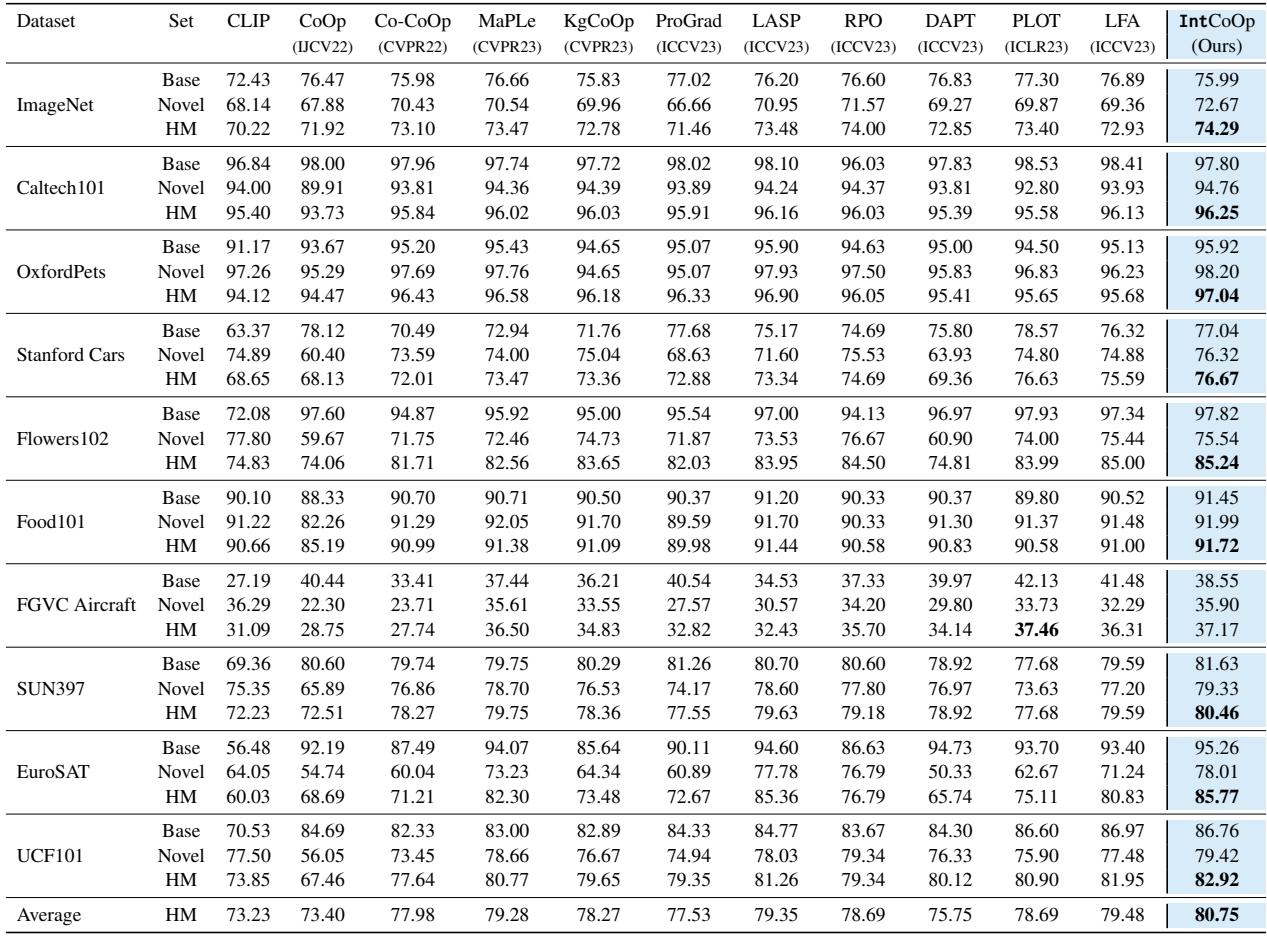
Table 1 shows the results across 10 diverse datasets. The metric to watch is HM (Harmonic Mean), which balances performance on both Base and Novel classes.
- IntCoOp achieves an average HM of 80.75%, outperforming the previous state-of-the-art method (LFA) by 1.27%.
- It significantly beats the original CoOp method (71.92%), proving that adding attributes makes the prompts much more robust for unseen categories.
2. Domain Generalization
What happens when the class is the same, but the style of the image changes? For example, moving from a real photo of a banana to a sketch of a banana. This is known as Domain Generalization.
The researchers trained the model on ImageNet (real photos) and tested it on variants like ImageNet-Sketch (drawings) and ImageNet-A (adversarial/difficult examples).
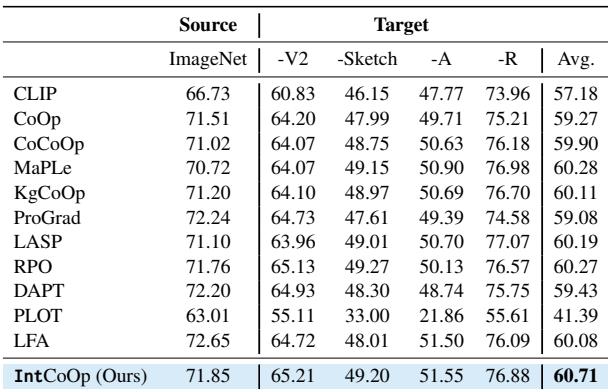
As shown in Table 2, IntCoOp shines here. It achieves an average accuracy of 60.71%, beating powerful competitors like PLOT (41.39%) and CoOp (59.27%).
This suggests that learning attributes helps the model separate the “content” (the object) from the “style” (the domain). Knowing a banana is “yellow” and “curved” helps identify it whether it’s a photo or a drawing.
3. Does it actually learn attributes?
The numbers look good, but is the model actually doing what it claims? Is it really learning to invoke concepts like “green” or “furry”?
To verify this, the authors compared the cosine similarity between the attribute embeddings learned by IntCoOp and the actual text embeddings of the attributes generated by BLIP-2.
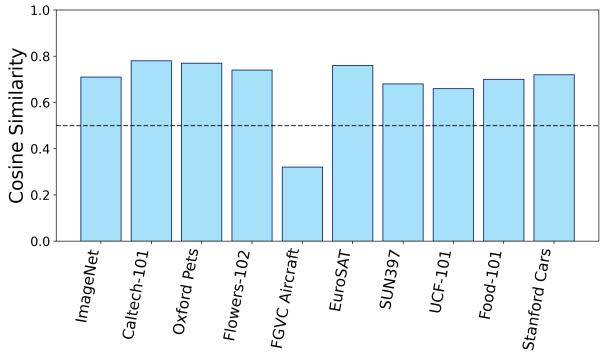
Figure 3 confirms the success. The high similarity scores (mostly above 0.70) indicate that the vector produced by the Attribute Extractor is semantically very close to the actual adjective.
Furthermore, we can look at qualitative examples. In Figure 6 below, we see the attributes assigned by the system to various images. For a Newfoundland dog, it predicts “Fluffy.” For a soccer field, it predicts “Grassy.”
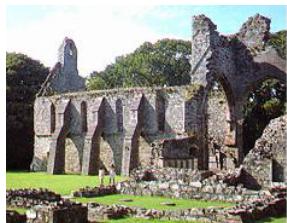
This visualization confirms that the model isn’t just crunching numbers—it is successfully identifying semantic concepts within the images.
4. Few-Shot Learning
Finally, the model was tested in a few-shot setting, where only a tiny number of examples (e.g., 4 shots) are available for training.
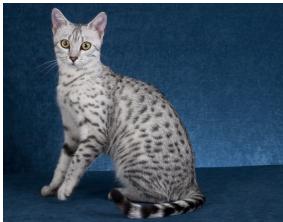 (Note: Referring to data presented in the paper’s Table 9 regarding 4-shot learning).
IntCoOp demonstrates strong resilience in low-data regimes, outperforming standard CoOp and other sophisticated methods like ProGrad and MaPLe. The attribute-based approach acts as a strong “inductive bias”—essentially giving the model a head start by telling it what to look for (attributes) rather than forcing it to learn everything from scratch.
Conclusion and Implications
IntCoOp represents a significant step forward in the field of Vision-Language Models. It tackles the “black box” nature of prompt tuning by forcing the model to be explicit about what it sees.
By integrating a VQA-based teacher (BLIP-2) and a lightweight student (Attribute Extractor), IntCoOp achieves a “best of both worlds” scenario:
- High Performance: It sets new state-of-the-art results on generalization and robustness benchmarks.
- Interpretability: It generates prompts that are semantically meaningful (“A photo of a [green] [frog]”) rather than abstract noise.
For students and researchers, IntCoOp highlights an important lesson: Inductive biases matter. We often treat deep learning as a brute-force optimization problem, but by guiding the model with human-understandable concepts—like the fact that objects have attributes—we can build systems that are not only more accurate but also more transparent and trustworthy.
As VLMs continue to grow in size and capability, methods like IntCoOp will be essential in ensuring these systems remain aligned with human reasoning and language.