](https://deep-paper.org/en/paper/2406.14721/images/cover.png)
Introduction
Imagine asking a highly intelligent professor a question about the history of the Tang Dynasty. If you ask in English, they give you a vague, slightly inaccurate summary. But if you ask the exact same question in Chinese, they provide a rich, detailed, and factually perfect account.
This is the current reality of Large Language Models (LLMs). Despite their reputation as universal knowledge bases, models like GPT-4 or Llama-3 suffer from a phenomenon known as multilingual inconsistency. Their “knowledge” is not stored in a language-agnostic database; it is entangled with the language of the training data. Because the internet contains vastly different information in English than it does in Chinese, Spanish, or Japanese, the model’s ability to answer questions fluctuates wildly depending on the language you use.
This inconsistency is not just a user experience quirk; it represents a fundamental misalignment in AI fairness and reliability. If a model knows the answer in Chinese but fails in English, it isn’t truly intelligent—it’s just retrieving linguistic patterns.
In a fascinating new research paper titled "\(1 + 1 > 2\): Can Large Language Models Serve as Cross-Lingual Knowledge Aggregators?", researchers propose a clever solution. rather than retraining models from scratch, they introduce a pipeline that allows LLMs to “borrow” knowledge from one language to answer questions in another. By treating different languages as distinct knowledge sources, they prove that the sum of an LLM’s multilingual parts is indeed greater than the whole.
The Problem: The Hidden Knowledge Gap
To understand the solution, we first need to visualize the problem. LLMs are trained on massive corpora of text, but that text is not evenly distributed. The English corpus is dominated by Western history, pop culture, and science. The Chinese corpus is rich in Eastern history, literature, and local context.
When a user poses a query, the LLM relies on the statistical associations it learned during training. If those associations are weak in the query’s language (a “low-resource” query), the model creates hallucinations—plausible-sounding but incorrect answers.
The researchers illustrate this misalignment clearly in the following figure:
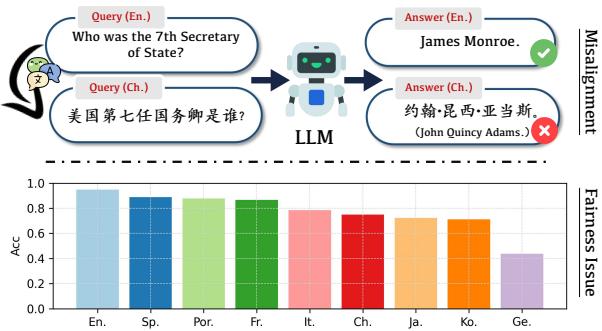
In Figure 1 (top), we see a stark example. A user asks, “Who was the 7th Secretary of State?” in English, and the model correctly identifies James Monroe. However, when the same question is translated into Chinese, the model confidently (and incorrectly) answers “John Quincy Adams.”
The bar chart at the bottom of Figure 1 further highlights the disparity. While performance is generally high for many European languages, there are noticeable drops for others. This inconsistency suggests that the model possesses the correct information somewhere in its neural network, but the specific language trigger (the Chinese query) failed to access it.
Quantifying the Domain Gap
The researchers didn’t just rely on anecdotes; they quantified this gap. They analyzed how models performed on “Chinese Knowledge” (topics specific to Chinese culture/history) versus “English Knowledge.”
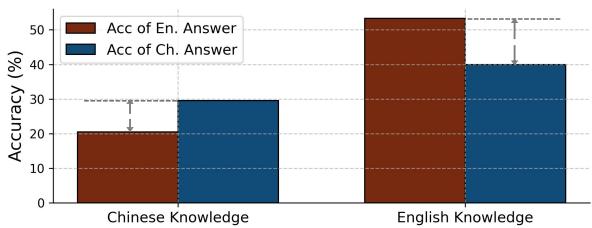
As shown in Figure 3, the results are telling. Look at the “Chinese Knowledge” cluster on the left. When Chinese knowledge is queried in Chinese (orange bar), the accuracy is roughly 30%. But when that same Chinese knowledge is queried in English (blue bar), accuracy drops to about 20%. The inverse is true for English knowledge. This confirms that language acts as a gatekeeper to specific domains of information.
The Core Insight: \(1 + 1 > 2\)
The central thesis of this paper is that an LLM acts like multiple experts trapped in one body. One expert speaks English and knows about the Beatles and the American Civil War. The other expert speaks Chinese and knows about Li Bai and the Spring and Autumn Period.
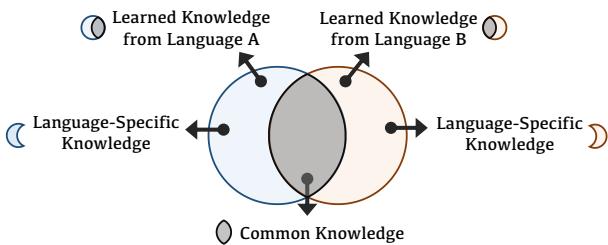
Figure 2 illustrates this overlap. There is a section of “Common Knowledge” (grey) that the model can access regardless of the language. However, there are vast reserves of “Language-Specific Knowledge” (blue and orange areas) that are currently siloed.
The researchers propose a method to break down these silos. If a query lands in the “Language-Specific” zone of Language A, but the user asked in Language B, the system should automatically detect this mismatch, translate the query to Language A, retrieve the superior answer, and translate it back.
The Methodology: A Three-Stage Pipeline
The proposed solution is an inference-time framework. It doesn’t require expensive retraining of the model. Instead, it wraps the LLM in a smart process consisting of three distinct modules:
- Low-Resource Knowledge Detector
- Target Language Selection
- Answer Replacement & Integration
Let’s break down the architecture.
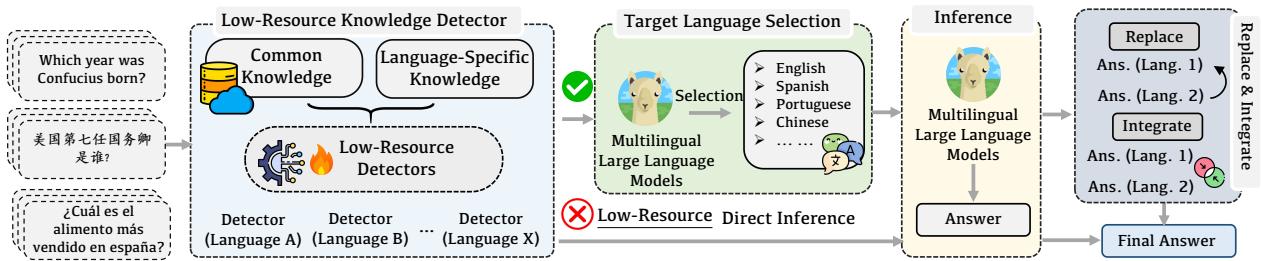
As shown in Figure 4, the process starts when a user asks a question. The system doesn’t blindly process it; it first evaluates whether the question is “hard” for the current language.
Module 1: Low-Resource Knowledge Detector
Translating every single query into multiple languages would be slow and computationally expensive. Most questions (like “What is the capital of France?” or “1+1=?”) are Common Knowledge. The system needs a filter to identify only those queries that require cross-lingual help.
The researchers train a lightweight classifier specifically for this purpose. This detector looks at a query \(x\) in the original language \(L_o\) and determines if it falls into the “low-resource” category.

If the detector outputs 0, the query proceeds to standard inference (the red “No” path in Figure 4). If it outputs 1, it triggers the cross-lingual pipeline. This step is crucial for efficiency, ensuring the complex method is only used when necessary.
Module 2: Target Language Selection
Once a query is flagged as low-resource, the system asks: “If English isn’t the best language for this question, what is?”
Interestingly, the researchers use the LLM itself to make this decision. They feed the query into the LLM with a specific prompt (\(P_{sel}\)) asking it to identify the most suitable language for the topic. For example, if the query is about the details of the Brazilian Carnival, the LLM might select Portuguese.
The query is then translated into this target language:

Here, \(x'\) is the translated query, and \(L_t\) is the target language selected by the LLM. This translation step effectively unlocks the “Language-Specific Knowledge” region we saw in Figure 2.
Module 3: Answer Replacement & Integration
Now that the system has the query in the optimal language, it generates an answer (\(a_t\)). But we can’t just give the user an answer in Portuguese if they asked in English.
The simplest approach is Direct Replacement: simply translate the answer back to the original language.

However, the researchers found that sometimes the original language might have some correct context, or that translation alone loses nuance. Therefore, they introduced Answer Integration.
In this advanced step, the LLM is provided with both the answer generated in the original language (\(a_o\)) and the answer from the target language (\(a_t\)). It is prompted to synthesize these two pieces of information into a final, superior response (\(a_{final}\)).

This integration allows the model to reason over conflicting information, essentially saying, “My English internal weights think X, but my Chinese internal weights think Y. Given the context, Y is more likely to be true.”
Experiments and Results
To validate this approach, the authors tested it across six popular LLMs (including GPT-4, ChatGPT, ChatGLM3, and Llama3) and five bilingual datasets.
The results were highly significant, particularly for “hard” questions where the knowledge gap between languages is widest.
Main Performance Improvements
The table below details the performance across different models and datasets. The green numbers indicate an improvement over the baseline.
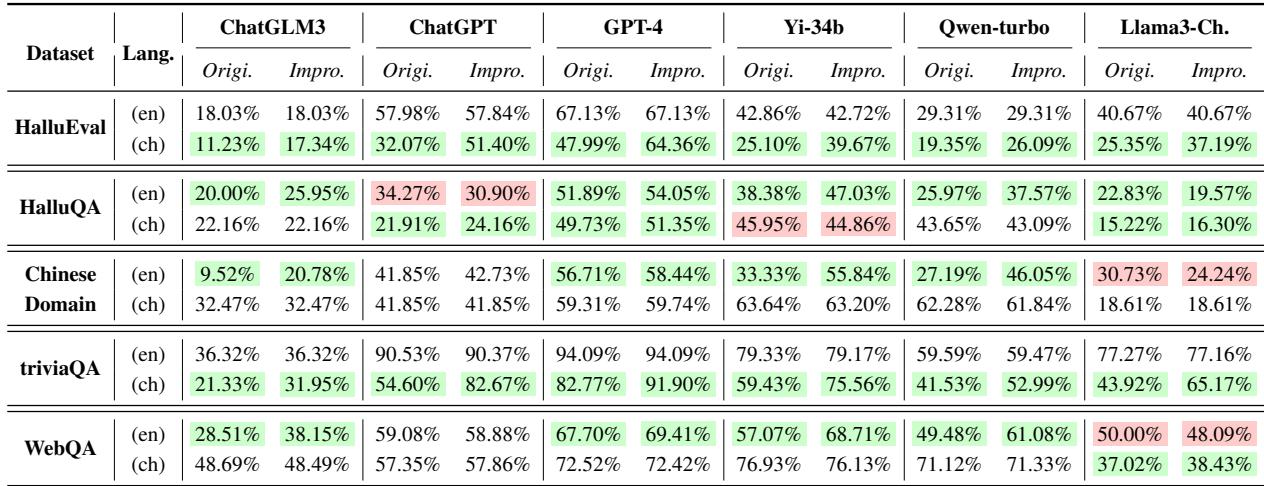
Take a look at the HalluEval (ch) row for GPT-4. The original accuracy (Orig.) was 47.99%. After applying the cross-lingual aggregation method (Improv.), accuracy jumped to 64.36%. That is a massive improvement for a model that is already considered state-of-the-art.
Similarly, for ChatGLM3 on the Chinese Domain (en) dataset (asking about Chinese topics in English), accuracy doubled from 9.52% to 20.78%. This empirically proves that the model knew the answers, but the English interface was preventing access to them.
Closing the Gap
One of the most important findings of this paper is regarding fairness. Usually, LLMs perform significantly better in English than in other languages. The proposed method shrinks this disparity.
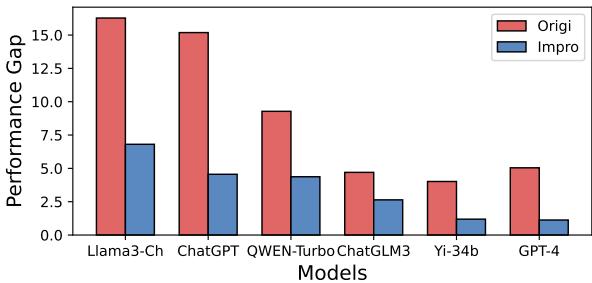
Figure 6 shows the “Performance Gap” between languages. The red bars represent the original gap (which is quite high for models like Llama3). The blue bars show the gap after using the method. Across the board, the gap shrinks, indicating that the models are becoming more consistent and reliable regardless of the language used.
Efficiency vs. Accuracy
A common critique of complex inference pipelines is that they are too slow. The researchers addressed this with an ablation study on the Low-Resource Detector.
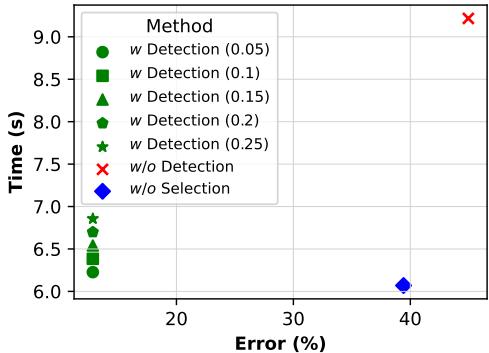
Figure 7 plots time consumption (y-axis) against error rate (x-axis).
- Red Cross (w/o Detection): This represents running the translation pipeline on every query. It has a low error rate (left side) but is very slow (high up on the y-axis).
- Green Shapes (w Detection): These points represent the method using the detector with different thresholds.
The data shows that using the detector (green points) dramatically lowers inference time (dropping from ~9 seconds to ~6.5 seconds) while barely increasing the error rate compared to the full pipeline. This confirms that the detector is successfully filtering out the easy questions that don’t need the extra processing.
Conclusion
The research presented in “\(1 + 1 > 2\)” offers a compelling perspective on the future of Multilingual Large Language Models. It highlights a critical limitation in current AI: knowledge is fragmented by language.
However, rather than suggesting we need larger models or more training data, the authors demonstrate that we can simply use the existing models better. By acknowledging that an LLM is a collection of diverse linguistic experts, we can build systems that dynamically route questions to the “expert” best suited to answer them.
This approach has three major takeaways:
- Latent Capabilities: LLMs know more than they say. The correct answer often exists in the model’s weights, hidden behind a language barrier.
- Cost-Effective Improvement: We can unlock this knowledge with a wrapper pipeline rather than expensive retraining.
- Fairness: By aggregating knowledge, we ensure that users of all languages receive the highest quality information the model is capable of providing.
As LLMs continue to be deployed globally, techniques like Cross-Lingual Knowledge Aggregation will be essential in moving from English-centric AI to truly global intelligence.