](https://deep-paper.org/en/paper/2406.15524/images/cover.png)
The Pruning Paradox: Why Minimizing Error in LLMs Can Backfire
Large Language Models (LLMs) like LLaMA and GPT have revolutionized artificial intelligence, but they come with a heavy price tag: computational cost. Running these massive models requires significant memory and energy, creating a barrier to entry for many researchers and developers.
To solve this, the field has turned to Neural Network Pruning—the art of removing parameters (weights) from a model to make it smaller and faster without losing too much intelligence. The standard approach is to treat pruning as a math problem: remove weights in a way that minimizes the difference between the original “dense” model and the new “sparse” model. This difference is called reconstruction error.
For years, the logic has been simple: Lower reconstruction error = Better model.
But a fascinating new research paper challenges this fundamental assumption. By pushing reconstruction techniques to their limit, researchers have discovered a paradox: minimizing reconstruction error too aggressively can actually hurt the model’s ability to generate language.
In this post, we will walk through the “divide-and-conquer” strategy of LLM pruning, explore new engineering techniques designed to perfect model reconstruction, and uncover why “perfect” reconstruction might be a trap—and how to escape it.
The Background: How We Prune Giants
You cannot simply retrain a massive LLM from scratch after removing weights; the cost would be astronomical. Instead, pruning is done post-training.
The goal is to find a binary mask \(m\) (a grid of 0s and 1s) applied to the weights \(w\), such that the output of the sparse model mimics the original dense model \(\bar{w}\) on a small set of “calibration data” \(\mathcal{D}\).
\[ \min_{w,m} \left\|f(\bar{w}; \mathcal{D}) - f(m \odot w; \mathcal{D})\right\|_2^2 \]Because these models are too large to optimize all at once, researchers use a divide-and-conquer approach. They split the LLM into layers or blocks. They prune the first block, freeze it, then move to the second block, and so on.
The Problem: Compounding Errors
The issue with solving one block at a time is that errors accumulate. If the first layer is slightly off, it passes imperfect data to the second layer. The second layer, trying to do its best with bad input, introduces its own errors, which are passed to the third. By the time you reach the final layers of an LLM, these errors have snowballed.
This is known as compounding error. Standard methods like SparseGPT or Wanda are effective, but they still suffer from this drift.
The Engineering Fix: Three Pillars of Reconstruction
To tackle the snowballing error, the researchers proposed three advanced reconstruction techniques. These methods are designed to ensure the sparse model mimics the dense model as closely as possible.

As shown in Figure 2 above, we can visualize the progression of these techniques:
1. Block-wise Reconstruction (BR)
Most existing methods optimize Layer-wise (LR). They look at a single linear layer, remove weights, and try to fix the output using least squares. However, a “Block” in a Transformer (like LLaMA) contains multiple layers and non-linear activation functions. Block-wise Reconstruction (BR) expands the scope. Instead of fixing just one linear calculation, it optimizes the weights of an entire Transformer block at once using gradient descent. This allows the remaining weights in the block to adjust more flexibly to compensate for the pruned ones.
2. Global Propagation (GP)
In the standard sequential approach, when we optimize Block 2, we feed it the output from the already pruned Block 1. This creates a “garbage in, garbage out” cycle. If Block 1 is noisy, Block 2 learns to fix Block 1’s mistakes rather than learning to be a good language model. Global Propagation (GP) changes the input. When optimizing Block 2, we feed it the input it would have received from the original, unpruned dense model. This acts like a teacher correcting a student, ensuring the block is learning from the “ground truth” representations rather than the noisy outputs of previous sparse blocks.
3. Cross-Block Reconstruction (CR)
Finally, the researchers introduced Cross-Block Reconstruction (CR). Instead of optimizing strictly one block at a time, this method overlaps them. When optimizing Block \(i\), the method considers the interactions with Block \(i-1\) and Block \(i+1\). It essentially “stitches” the blocks together to ensure a smooth transition of data through the network.
The Result: Massive Error Reduction
From a mathematical perspective, these techniques are a triumph. They dramatically reduce the reconstruction error compared to standard methods.
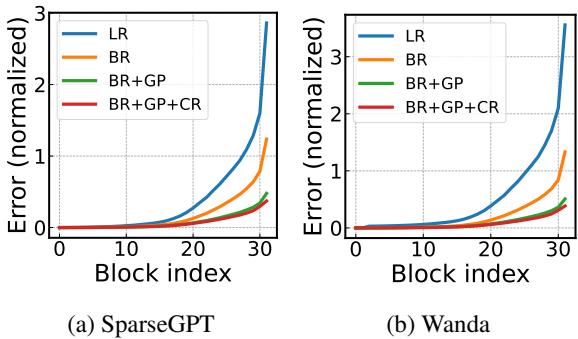
In Figure 3, look at the blue line (Standard Layer-wise Reconstruction). The error shoots up as we get deeper into the model (higher block indices)—this is the compounding error in action.
Now look at the red line (BR+GP+CR). It is nearly flat. The combination of optimizing whole blocks, using global inputs, and stitching blocks together reduced the compounding error by over 90%.
Mission accomplished, right? We minimized the objective function. The sparse model is now a perfect mathematical replica of the dense model.
The Plot Twist: The Overfitting Trap
If lower reconstruction error equals a better model, the model with BR+GP+CR should be the smartest. But when the researchers tested the models on actual language tasks, they found something surprising.
While Block-wise Reconstruction (BR) and Global Propagation (GP) generally improved performance, adding Cross-Block Reconstruction (CR)—which achieved the lowest reconstruction error—often made the model perform worse.
Let’s look at the summary of this paradox:
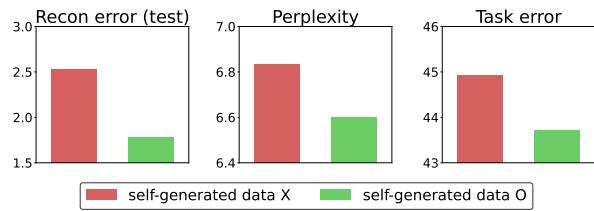
In Figure 1(b) above, the green bars represent the mathematically “better” reconstruction. Note that while the reconstruction error (left chart) is lower, the Perplexity (middle chart) and Task Error (right chart) are actually higher.
Why did this happen?
The culprit is Overfitting.
Pruning relies on a “calibration set”—usually a tiny slice of data (e.g., 256 sentences from a web crawl) used to tune the weights.
- Standard methods (LR) are simple enough that they don’t memorize this small dataset.
- Advanced methods (CR) are so powerful and complex that they optimize the weights to perfectly reconstruct those specific 256 sentences.
The sparse model became an expert at mimicking the dense model on the calibration data, but in doing so, it lost its ability to generalize to new, unseen text. It’s akin to a student who memorizes the practice exam answers perfectly but fails the actual test because they didn’t learn the concepts.
We can see this clearly in the experimental tables:
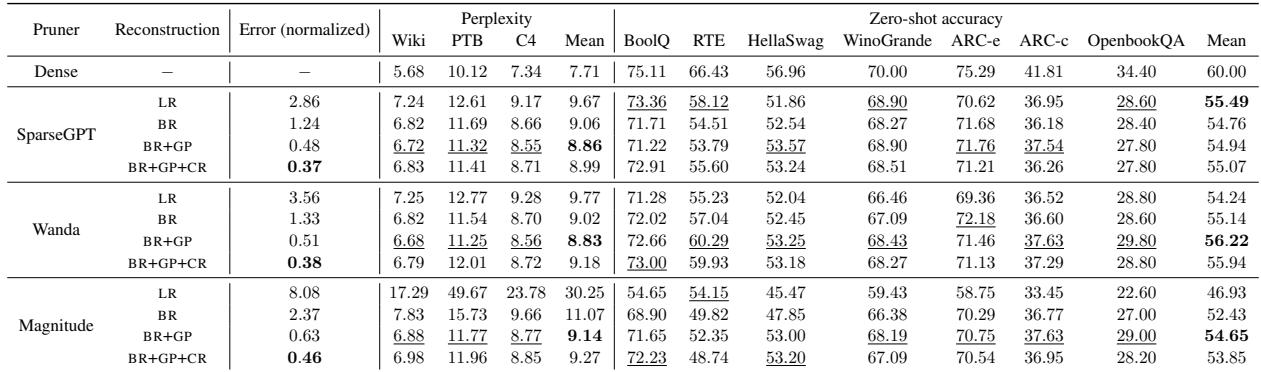
In Table 1, look at the Llama-7B results.
- LR (Baseline): Perplexity 7.24
- BR+GP: Perplexity 6.72 (Great improvement!)
- BR+GP+CR: Perplexity 6.83 (Worse, despite having lower reconstruction error).
The researchers found that larger models (like LLaMA-7B) were more susceptible to this than smaller models (like OPT-125M) because larger models have more capacity to “memorize” the noise in the calibration data.
The Solution: Self-Generated Data
We are stuck in a bind. We need advanced reconstruction to stop compounding errors, but if we use them, we overfit the tiny calibration set. We cannot easily get “better” external data that perfectly matches the model’s original training distribution.
However, the researchers realized a key property of LLMs: They are generative.
Instead of downloading a random dataset from the internet to calibrate the pruning, why not let the original dense model write its own calibration data?
The Strategy
- Take the original, unpruned model.
- Ask it to generate text (thousands of tokens).
- Use this self-generated text as the calibration data for the pruning process.
This data is, by definition, a perfect representation of the model’s internal distribution. It captures exactly what the model “knows.”
The Results
When the researchers switched to using self-generated data, the trade-off began to disappear.
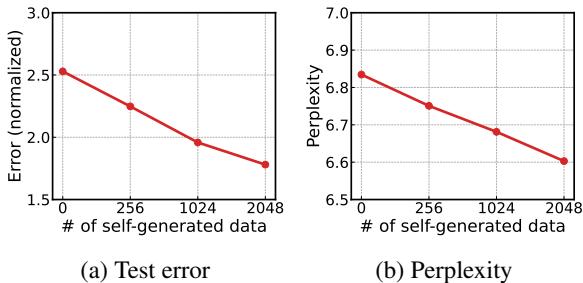
Figure 4 illustrates the impact of this strategy on LLaMA-7B:
- Left Graph (Test Error): As we add more self-generated samples (x-axis), the reconstruction error on the test set drops.
- Right Graph (Perplexity): Crucially, the language perplexity (how confused the model is) also drops steadily.
By increasing the size and quality of the calibration set via self-generation, the advanced reconstruction techniques (BR/GP/CR) finally had enough data to generalize properly. They could use their mathematical power to fix the model structure without overfitting to a small sample size.
Key Takeaways
This research forces us to rethink how we approach model compression. It provides three major lessons for students and practitioners in AI:
- Don’t Trust Proxies Blindly: In optimization, we often substitute a hard metric (general intelligence) with an easy one (reconstruction error). This paper proves that minimizing the proxy too far can detach it from the real goal. A mathematically “perfect” reconstruction can be a practically “worse” model.
- Engineering vs. Learning: Techniques like Block-wise Reconstruction and Global Propagation are powerful engineering fixes for compounding errors. They stabilize the pruning process significantly.
- Data is King (Even Synthetic Data): The bottleneck wasn’t the pruning algorithm; it was the calibration data. By leveraging the generative nature of LLMs to create their own training material, we can unlock the full potential of advanced optimization techniques.
As LLMs continue to grow, pruning will be essential for sustainability and deployment. This work highlights that the future of efficient AI isn’t just about better algorithms for removing weights—it’s about better data to teach the remaining weights how to adapt.