](https://deep-paper.org/en/paper/2406.15741/images/cover.png)
Language barriers are arguably the biggest obstacle to global communication, and for a long time, Machine Translation (MT) has been the battering ram trying to break them down. In recent years, Large Language Models (LLMs) like GPT-4 have revolutionized this field, offering translations that are not just accurate but contextually rich.
However, there is a catch. To get top-tier translation performance, you typically have two options:
- Use a massive, general-purpose LLM (like GPT-4): This yields excellent results but comes with exorbitant infrastructure and deployment costs.
- Train a translation-specific LLM (like ALMA): This involves pre-training on billions of tokens and fine-tuning on millions of high-quality, human-annotated translation pairs. This is resource-intensive and expensive due to the need for human labor.
This creates a significant gap. Is it possible to take a smaller, open-source model and boost its translation capabilities to rival the giants, without spending a fortune on human annotation or massive compute?
In this post, we are diving deep into MT-Ladder, a novel framework proposed by researchers from Zhejiang University and the National University of Singapore. MT-Ladder offers a “model-agnostic” approach to refining translations, essentially acting as a sophisticated editor that polishes the rough drafts generated by other models. By using a clever data synthesis strategy and a hierarchical training method, MT-Ladder can boost the performance of small models (like 7B parameters) to match or even exceed state-of-the-art systems.
The Core Problem: The High Cost of Quality
Before understanding the solution, we must understand the bottleneck in current Neural Machine Translation (NMT).
Standard fine-tuning approaches rely on Direct Translation. You give the model a source sentence and train it to predict the reference translation. To improve this, researchers often turn to Automatic Post-Editing (APE) or Quality Estimation (QE).
- APE tries to correct systematic errors in a translation.
- QE tries to predict how good a translation is.
The problem is that traditional APE and QE require expensive datasets. You need humans to look at a machine translation, spot the errors, and write a corrected version. This data is scarce and costly to produce. Furthermore, prompt-based methods (asking ChatGPT to “fix this translation”) are unstable and often lead to hallucinations where the model changes the meaning entirely.
MT-Ladder bypasses these issues by automating the “correction” process.
The MT-Ladder Framework
The researchers propose a shift in perspective. Instead of training a model to translate from scratch, they train a model to refine an existing translation.
1. Constructing Pseudo-Refinement Triplets
The most ingenious part of MT-Ladder is how it generates training data without human intervention. The researchers realized that existing parallel corpora (Source + Human Reference) already contain the “perfect” answer. They just needed a “rough draft.”
Here is the process:
- Input: Take a standard dataset containing a Source Sentence (\(s\)) and a Reference Translation (\(r\)).
- Sampling: Use an existing, mediocre LLM to translate the Source (\(s\)). Let’s call this the Intermediate Translation (\(i\)).
- Triplet Creation: Combine these to form a triplet:
[Source, Intermediate Translation, Reference].
Now, instead of training the model to map \(s \rightarrow r\), the model is trained to map \((s, i) \rightarrow r\). The model learns the specific task: “Given this source text and this imperfect translation, produce the high-quality reference.”
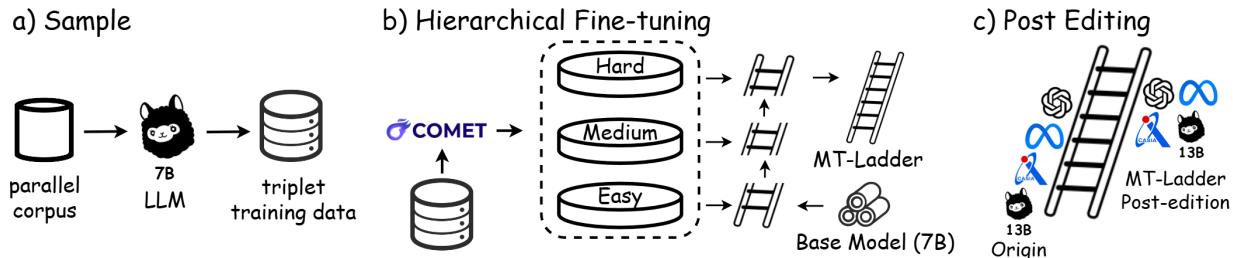
As shown in Figure 2, the pipeline is split into two distinct stages: Sampling (creating the data) and Hierarchical Fine-Tuning (training the model). This effectively turns the reference translation into a “pseudo-refined” label, eliminating the need for manual human post-editing.
2. Hierarchical Fine-Tuning (HFT)
Not all translation errors are created equal. Some intermediate translations are garbage (very different from the reference), while others are nearly perfect (requiring only minor tweaks).
If you feed all this data to the model randomly, it struggles to learn effectively. The researchers introduced Hierarchical Fine-Tuning (HFT), a curriculum learning strategy that categorizes training examples based on difficulty.
They use a metric called COMET to score the quality of the Intermediate Translations. Based on these scores, data is split into three buckets:
- Easy: The intermediate translation is very poor (low COMET score). The model has to do a lot of work to fix it. Ironically, these are “Easy” to improve because the errors are obvious.
- Medium: Average quality.
- Hard: The intermediate translation is already excellent (high COMET score). The model must make subtle, nuanced changes to match the reference.
The training proceeds from Easy \(\rightarrow\) Medium \(\rightarrow\) Hard.
Why this order? The logic is that the model should first learn to correct glaring mistakes (Easy samples) before attempting to refine stylistic nuances (Hard samples). This mimics human learning; you learn basic grammar correction before you learn to edit poetry.
The training objective is to minimize the negative log-likelihood of the reference (\(r\)), conditioned on the source (\(s\)) and the intermediate translation (\(i\)):

Here, \(\mathcal{L}_a\) represents the MT-Ladder model. It learns to predict the reference \(r\) given the context of the source and the draft.
Experimental Analysis
To prove this works, the authors tested MT-Ladder using Gemma-2B and Gemma-7B as the backbone models. They tested across 8 translation directions involving English, German, Czech, Chinese, and Russian.
Does it actually improve translation?
The results are stark. The framework consistently improves the performance of various baseline models, including strong baselines like ALMA and even GPT-3.5.

As seen in Figure 1, both MT-Ladder-2B (light blue) and MT-Ladder-7B (dark blue) significantly boost COMET scores compared to the original models (gray).
- Small Models: Look at Alpaca-7B on the far right of the chart. The improvement is massive.
- Large Models: Even ALMA-13B, a specialized translation model, sees a performance bump.
- The GPT-4 Threshold: The dashed line represents GPT-4. MT-Ladder-7B manages to push open-source models (like ALMA-13B) past the performance level of GPT-4-turbo on these benchmarks.
Numerical Deep Dive
Let’s look at the specific numbers for English-to-Other (En \(\rightarrow\) XX) translations.
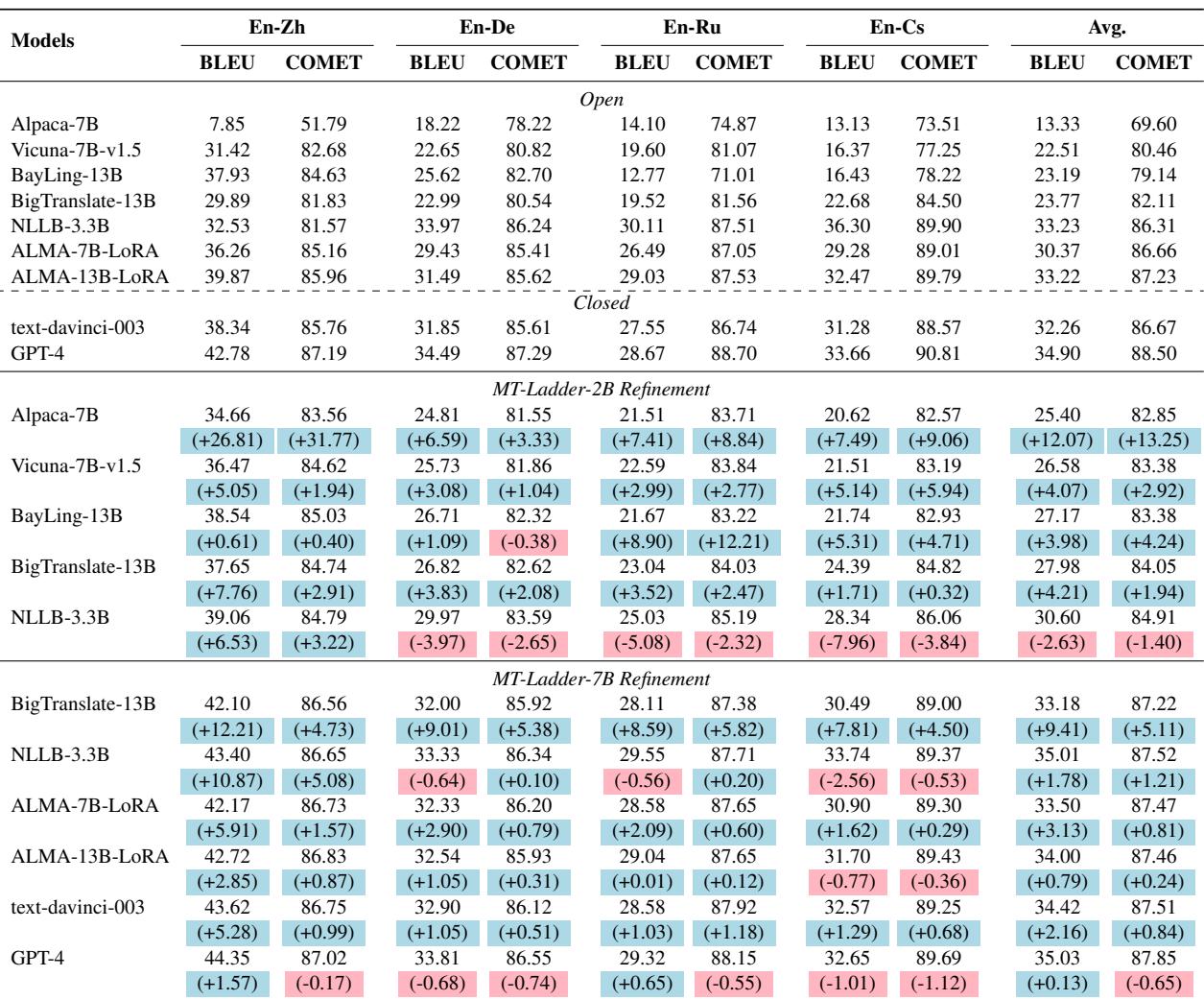
In Table 2, we see the detailed breakdown.
- BigTranslate-13B: The original BLEU score average was 23.77. After refinement with MT-Ladder-7B, it jumped to 33.18. That is a massive +9.41 point increase in BLEU.
- Consistency: The blue boxes highlight improvements. Almost every single entry shows positive growth.
- GPT-4: Interestingly, when applied to GPT-4, the refinement sometimes results in a slight decrease or negligible gain (indicated by red text). This suggests that GPT-4’s translations are already so close to the “Hard” end of the spectrum that a smaller 7B refiner struggles to add value, though it still improves some specific language pairs.
Visualizing the Refinement
It is helpful to visualize exactly how often the model improves a translation versus how often it breaks it.

Figure 4 plots the original COMET score (x-axis) against the refined score (y-axis).
- The Diagonal: The dashed line represents no change.
- Blue Triangles: These are translations that got better.
- Red Triangles: These are translations that got worse.
For weaker models like NLLB-3.3B (top left), the vast majority of points are blue triangles above the line. The model is fixing almost everything. For GPT-4 (bottom right), the points cluster tightly around the diagonal. The “refiner” acts conservatively, maintaining the high quality of GPT-4 without breaking it, though it struggles to push it much higher. This confirms the hypothesis: MT-Ladder is a powerful tool for elevating small-to-medium models to the top tier.
Why Hierarchical Fine-Tuning Matters
Is the “Easy-to-Hard” training strategy actually necessary? Could we just mix all the data together?
The researchers conducted an ablation study comparing HFT against “Mixed” training (random order) and “Anti-HFT” (Hard-to-Easy).
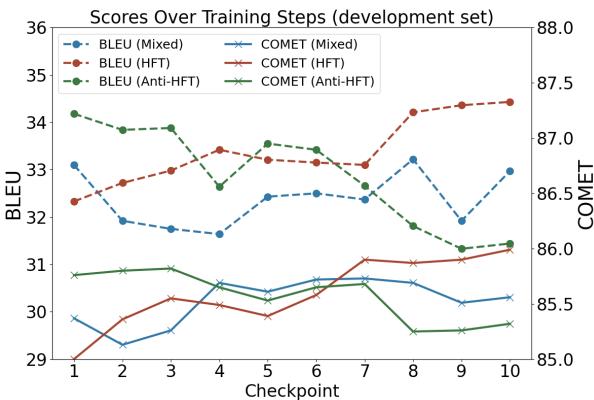
Figure 5 shows the training trajectory.
- HFT (Orange/Red lines): Performance steadily increases and remains stable.
- Anti-HFT (Green lines): Performance peaks early and then degrades. By training on “Hard” examples first and “Easy” examples last, the model likely overfits to simple corrections and forgets how to handle subtle nuances, or the large gradients from “Easy” corrections destabilize the weights learned from “Hard” examples.
- Mixed: It works okay but fluctuates and doesn’t reach the same peak as HFT.
We can zoom in further on the training dynamics:
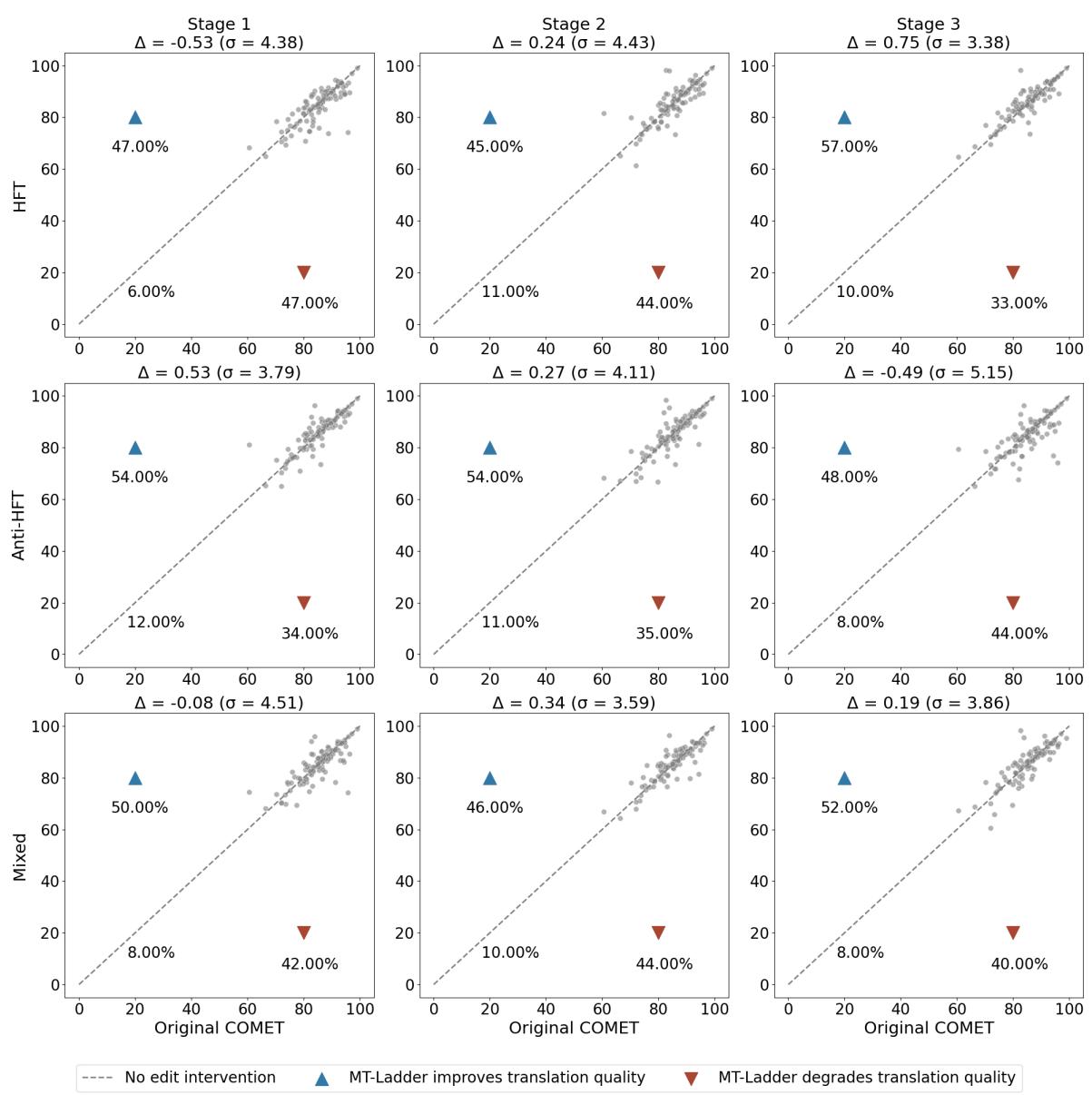
Figure 9 illustrates the refinement capability at different stages of training (Stage 1, 2, and 3).
- HFT: As training progresses (moving right), the cloud of points moves upward (better quality).
- Anti-HFT: As training progresses (moving down), the model actually gets worse at refining high-quality inputs, dragging them down.
Weak-to-Strong Generalization
One of the most exciting findings in AI recently is “Weak-to-Strong Generalization”—the idea that a weaker model can supervise or improve a stronger one. MT-Ladder demonstrates this capability.
The researchers experimented by using a weaker model (ALMA-7B) to generate the “references” for training, rather than using the gold-standard human references. Effectively, they asked: Can MT-Ladder learn to be better than its teacher?
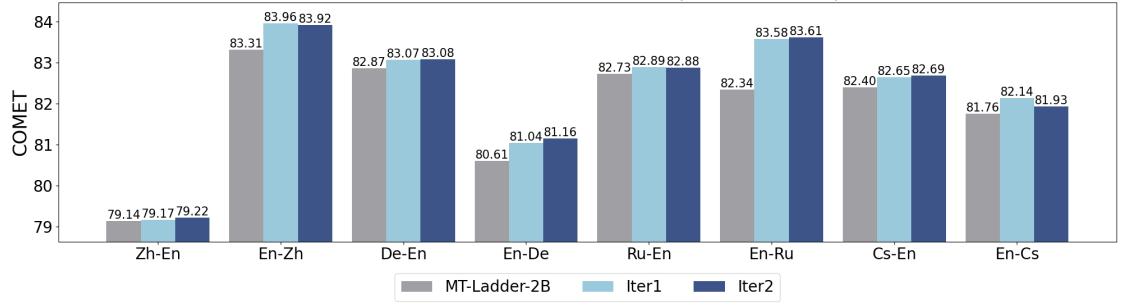
Figure 7 (Top of image) shows the results.
- Grey Bar: The original model.
- Blue Bar: MT-Ladder trained on weak labels (pseudo-references from ALMA).
- Red Bar: MT-Ladder trained on gold labels (human references).
Remarkably, the Blue bars are consistently higher than the Grey bars. This means MT-Ladder trained on imperfect machine outputs still managed to produce a refiner that improved over the original machine outputs. It learned the pattern of refinement, allowing it to generalize beyond the noise in its training data.
Self-Refinement
Finally, can the model fix its own mistakes? The researchers tested an iterative process where MT-Ladder translates a sentence, and then feeds that translation back into itself for refinement.
Figure 8 (Bottom of image above) shows “Iter1” and “Iter2”.
- Iter1 (Light Blue): The first pass of refinement significantly boosts the score over the raw translation (Grey).
- Iter2 (Dark Blue): A second pass often yields diminishing returns or slight improvements.
This confirms that MT-Ladder is not just a “patch” for other models but a robust translator in its own right that can iteratively polish its output.
Conclusion and Implications
MT-Ladder presents a compelling argument for the future of open-source Machine Translation. Instead of engaging in an arms race for parameter count (175B, 500B, 1T parameters), we can achieve comparable results by building smarter, specialized “refiner” models.
By leveraging Pseudo-Refinement Triplets, the framework eliminates the cost of human annotation. By utilizing Hierarchical Fine-Tuning, it ensures the model learns a robust correction strategy, handling both obvious errors and subtle stylistic mismatches.
For students and researchers, the takeaways are clear:
- Data Construction is Key: Sometimes the answer isn’t a better architecture, but a smarter way to use existing data (like creating triplets from parallel corpora).
- Curriculum Learning Works: The order in which you feed data to a model (Easy to Hard) can drastically stabilize training and improve performance.
- Refinement > Retraining: It is often more efficient to train a small model to fix errors than to retrain a massive model to avoid them.
MT-Ladder enables a 7B parameter model to punch way above its weight class, democratizing access to high-quality translation and proving that you don’t always need a supercomputer to speak every language fluently.