](https://deep-paper.org/en/paper/2406.15968/images/cover.png)
Introduction
Large Language Models (LLMs) like GPT-4 and Llama are trained on trillions of tokens sourced from the vast expanse of the internet. While this scale enables impressive capabilities, it also creates a “black box” problem. We rarely know exactly what data these models were trained on. This opacity raises serious questions: Did the model memorize copyrighted books? Does it contain Personally Identifiable Information (PII)? Has the test set for a benchmark been contaminated because the questions were included in the training data?
To answer these questions, researchers use Membership Inference Attacks (MIAs). The goal of an MIA is simple: given a specific piece of text, determine whether it was part of the model’s training set (“member”) or not (“non-member”).
Historically, this was easier. Models were often overfitted, meaning they had much lower loss (higher confidence) on training data than on unseen data. However, modern LLMs are trained on such massive datasets that they often see each data point only once (a single epoch). This limited exposure makes the signal of “membership” incredibly faint. Traditional methods that rely on simple loss metrics or expensive reference models are becoming less effective or computationally prohibitive.
In this post, we will explore a research paper from Duke University that proposes a novel, efficient, and highly effective method called RECALL. This method flips the script on traditional detection by looking not just at how well a model predicts a text, but how the model reacts when we try to confuse it with unfamiliar context.
Background: The Intuition of Membership
Before diving into the RECALL method, we need to establish a few foundational concepts regarding how LLMs perceive data.
Log-Likelihood (LL)
LLMs are probabilistic engines. When given a sequence of text, they assign a probability to the next token. We can measure how well a model “knows” a full sentence or paragraph by calculating its Log-Likelihood (LL).
- High LL (closer to 0): The model is confident. It finds the text predictable.
- Low LL (more negative): The model is surprised. The text is unexpected or unfamiliar.
Note: Since probabilities are between 0 and 1, their logarithms are negative numbers. A “higher” score means a less negative number (e.g., -2 is higher/better than -5).
The Challenge of Single-Epoch Training
In traditional machine learning, models see training data hundreds of times. They memorize it perfectly. In the era of LLMs, a model might see a specific Wikipedia article only once during training. As a result, the difference in Log-Likelihood between a “member” (training data) and a “non-member” (unseen data) is often negligible. A model might be very confident about a non-member sentence just because it is grammatically simple, not because it memorized it.
This is why looking at the raw Loss or Log-Likelihood is often insufficient for detecting training data. We need a relative measure—something that cancels out the inherent complexity of the text.
Core Method: RECALL
The researchers propose RECALL (Relative Conditional Log-Likelihood). The core hypothesis is fascinating: Member data is more sensitive to “distraction” than non-member data.
If an LLM has memorized a piece of text, it relies heavily on its internal weights to predict it. If we force the model to look at a “prefix”—a random piece of context that the model definitely hasn’t seen—before predicting the target text, we disrupt that memorization. The researchers found that this disruption causes a much larger drop in confidence for members than for non-members.
The Concept of the Non-Member Prefix
The RECALL method relies on conditional probability. We take our target text \(\mathbf{x}\) and measure its likelihood in two scenarios:
- Unconditional: Just the text itself.
- Conditional: The text preceded by a “prefix” \(P\).
Crucially, this prefix \(P\) must be composed of non-member data—text we know the model hasn’t seen.
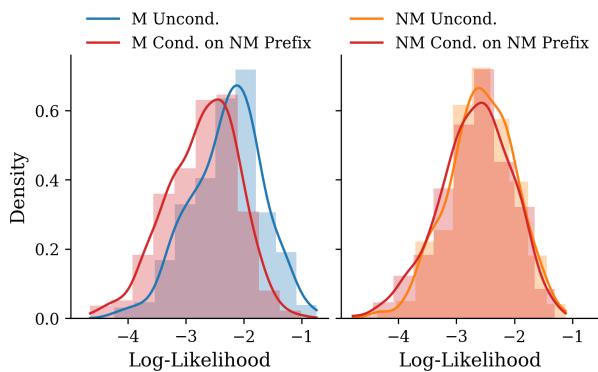
As shown in Figure 1 above, look at the difference in distributions.
- Left Plot (Members): The blue line represents the unconditional likelihood of member data. The red line represents the likelihood of that same data when conditioned on a non-member prefix. Notice the shift? The red curve moves significantly to the left (lower likelihood).
- Right Plot (Non-Members): The orange and red lines overlap almost perfectly. Adding a prefix didn’t change the model’s confidence much.
This visual difference is the heartbeat of the RECALL method: Conditioning on a non-member prefix hurts the likelihood of member data significantly more than non-member data.
The Algorithm Step-by-Step
Let’s break down the mathematics of how RECALL works.
Step 1: Construct the Prefix We create a prefix \(P\) by concatenating several non-member data points (\(p_n\)). These could be news articles published after the model’s training cutoff, or even synthetic data generated by another AI.

Step 2: Calculate Probabilities For a target data point \(\mathbf{x}\), we calculate:
- \(LL(\mathbf{x})\): The Unconditional Log-Likelihood.
- \(LL(\mathbf{x} | P)\): The Conditional Log-Likelihood given the prefix.
Step 3: Compute the RECALL Score The score is simply the ratio of the conditional likelihood to the unconditional likelihood.
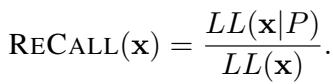
Interpreting the Score
Because Log-Likelihoods are negative values, the math here requires a moment of attention.
- \(LL(\mathbf{x})\) is negative (e.g., -3.0).
- \(LL(\mathbf{x} | P)\) is usually more negative because the prefix distracts the model (e.g., -4.0).
- Therefore, the ratio \(\frac{-4.0}{-3.0}\) results in a positive number greater than 1 (e.g., 1.33).
The researchers posit that the expected RECALL score for members (\(\mathbf{x}_m\)) will be higher than for non-members (\(\mathbf{x}_{nm}\)).

To make this concrete, let’s look at a numerical example provided in the paper.
For a Member data point:
 Here, the likelihood dropped from -3 to -4. The score is 1.3.
For a Non-Member data point:
 Here, the likelihood only dropped slightly, from -3 to -3.3. The score is 1.1.
Since \(1.3 > 1.1\), we can classify the first data point as a “member.”
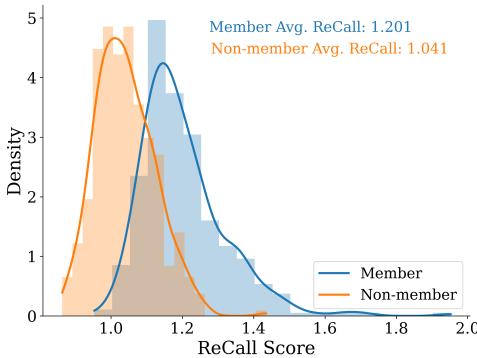
This behavior creates a distinct separation in the distribution of scores, as seen in Figure 2. The blue distribution (Members) is shifted to the right compared to the orange distribution (Non-Members).
Experiments and Results
To validate RECALL, the authors tested it against standard benchmarks like WikiMIA (Wikipedia snippets) and MIMIR (a more challenging dataset with minimal distribution shifts). They compared RECALL against strong baselines, including:
- Loss: Simple raw loss.
- Ref: Using a smaller reference model to calibrate scores (usually the gold standard but computationally expensive).
- Min-K%: A method focusing on the least likely tokens.
State-of-the-Art Performance
The results on WikiMIA are striking. RECALL didn’t just beat the baselines; it surpassed them by a wide margin.
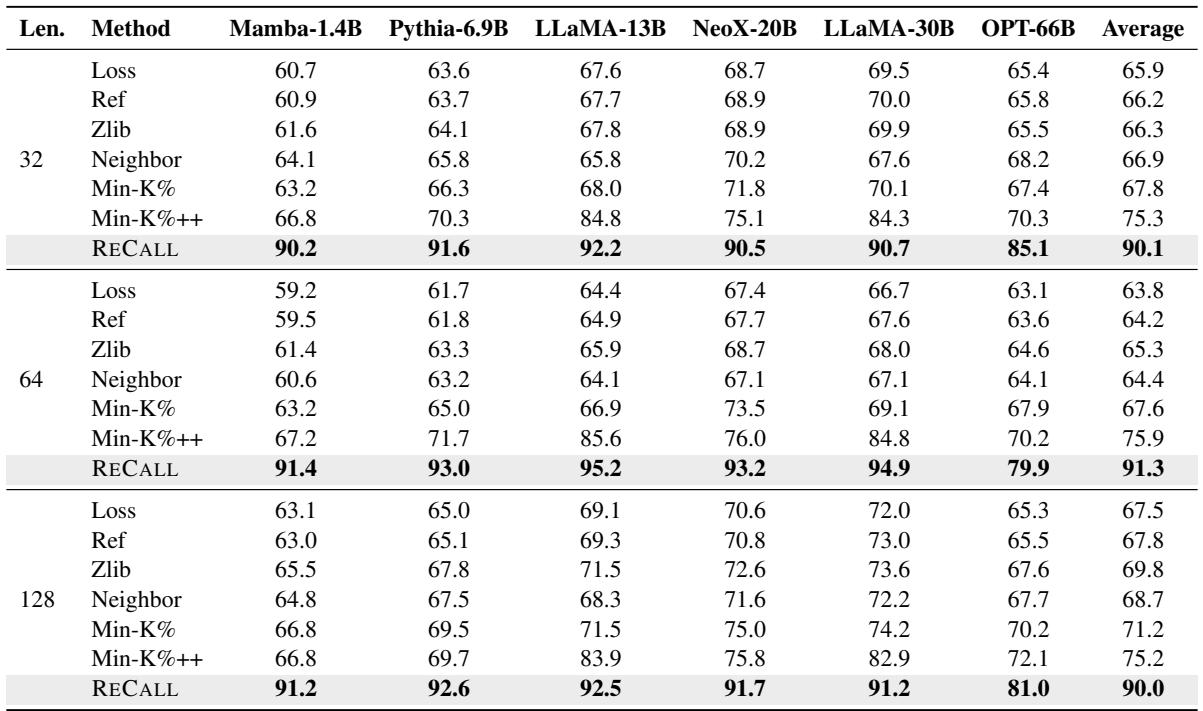
In Table 1, look at the “Average” column.
- The previous best method, Min-K%++, scored around 75.3% AUC for length 32 inputs.
- RECALL scored 90.1%.
This is a massive leap in performance, particularly for shorter text inputs (Length 32), which are notoriously difficult for membership inference because there is so little signal available.
Efficiency: The Power of One Shot
A major question with this method is: “How long does the prefix need to be?” Do we need to feed the model thousands of tokens of context to see this effect?
Surprisingly, no. The method is incredibly efficient.
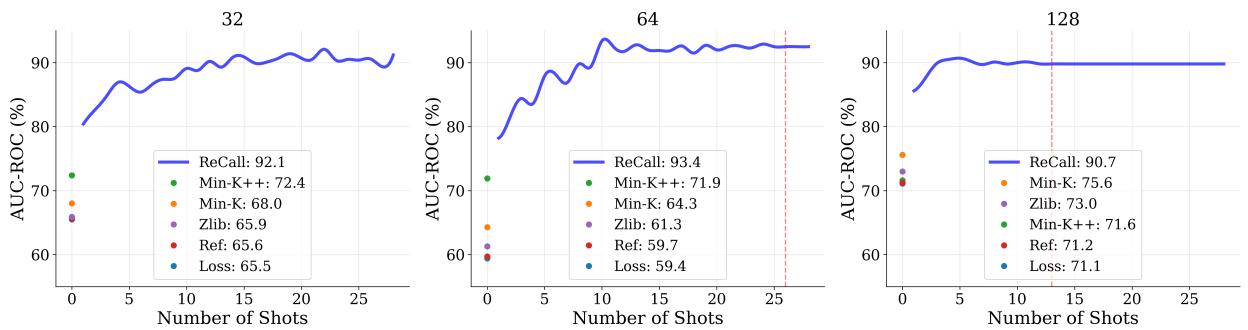
Figure 3 shows the AUC scores as the number of “shots” (prefix examples) increases.
- Look at the far left of the charts (x-axis near 0). Even with just one shot (a single non-member example as a prefix), RECALL (the blue line) instantly jumps to near-peak performance (~90%).
- Baselines like Min-K%++ (green dots) and Reference (red dots) remain significantly lower.
- The performance is stable. Adding more shots helps slightly, but you don’t need to fill the whole context window to get good results.
This efficiency is crucial for practical auditing. It means researchers can check for data contamination without needing massive compute resources to process long contexts.
Why Does It Work? An Analysis
The paper goes beyond just reporting numbers; it investigates why this phenomenon occurs.
The Necessity of Non-Member Context
One might ask: “Does the prefix have to be non-member data? What if we just put random member data in front?”
The authors tested this, and the results confirmed their hypothesis.
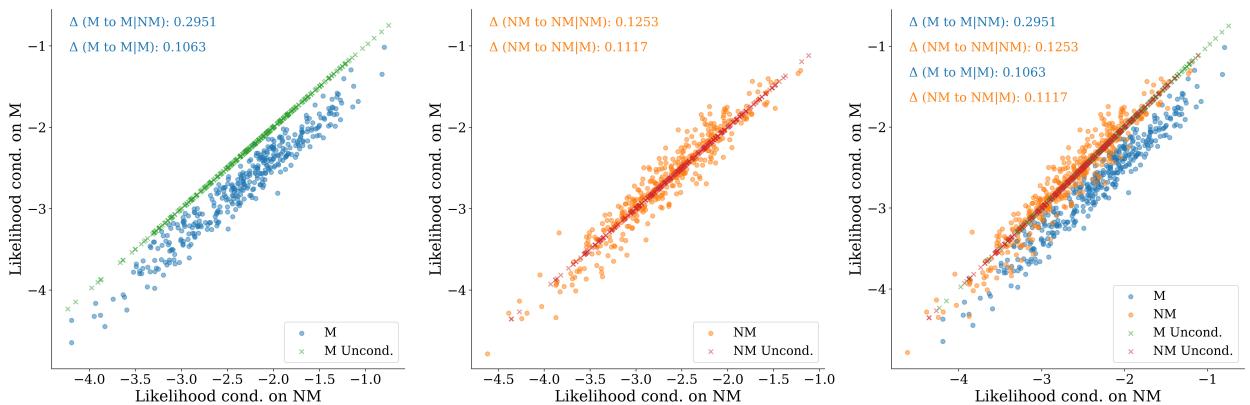
In Figure 8, we see scatter plots comparing different conditioning scenarios.
- Left Plot: Compares Member data conditioned on Non-Members (\(M | NM\)) vs. Members conditioned on other Members (\(M | M\)). The deviation from the diagonal line is much higher for the Non-Member prefix (\(M | NM\)).
- Takeaway: If you prefix a member with another member, the model is “comfortable.” It recognizes the distribution. It’s only when you introduce the “out-of-distribution” non-member text that the model’s confidence in the memorized target shakes.
Token-Level Analysis
The researchers also looked at where in the sentence the probability drops. Does the whole sentence become less likely, or just specific parts?
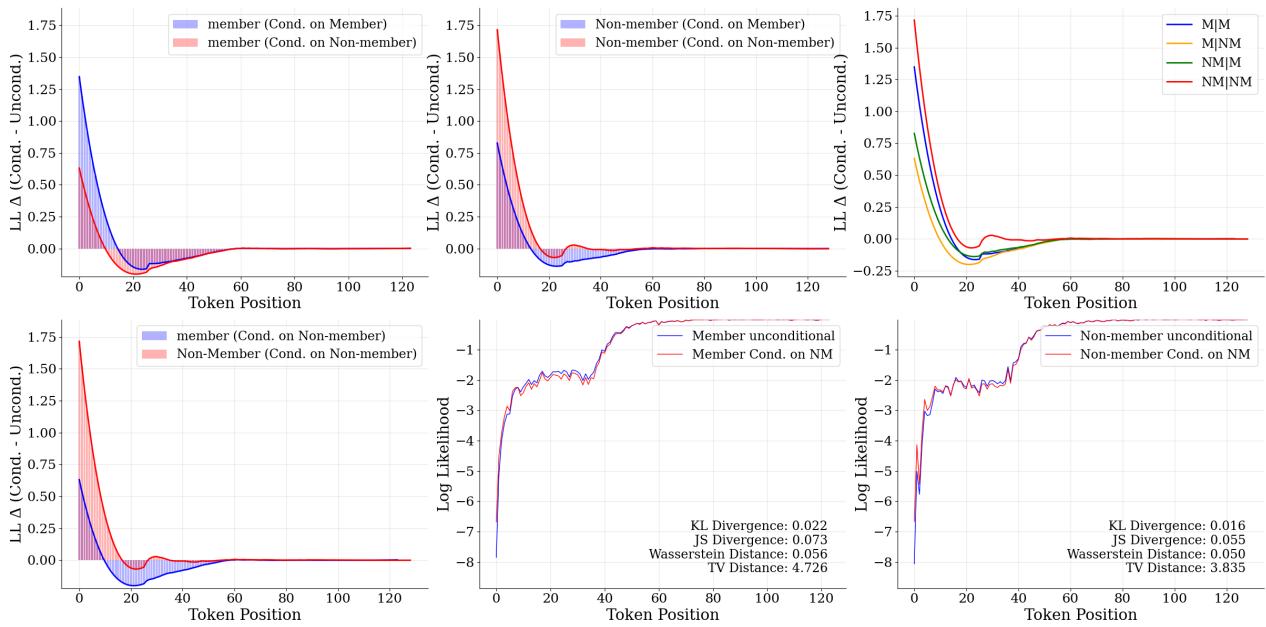
Figure 9 reveals that the disruption happens primarily at the beginning of the target sequence.
- The Y-axis shows the change in Log-Likelihood (\(\Delta\)).
- The X-axis represents the token position in the target sentence.
- Notice the spike at the start (positions 0-20). The red line (\(NM | NM\)) shows that non-members conditioned on non-members change very little.
- However, the green/blue lines involving member data show significant shifts at the start.
This suggests that the “context switch” from the prefix to the target disorients the model’s memorized patterns immediately. Once the model processes the first few tokens of the target, it “remembers” the sequence again, and the likelihood stabilizes.
Robustness: Random and Synthetic Prefixes
A practical limitation of many attacks is the requirement for “ground truth” data. To run RECALL, you need a Non-Member prefix. But how do you find data that you know the model hasn’t seen?
The authors experimented with:
- Random Selection: Picking random text from recent dates.
- Synthetic Data: Asking GPT-4 to generate fake text.
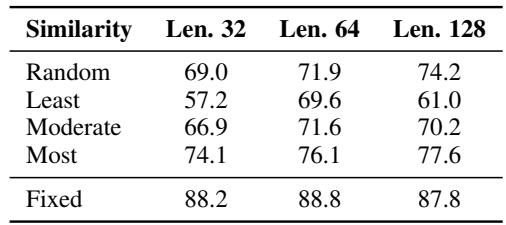
Table 3 and other experiments in the paper show that while picking a prefix that is semantically similar to the target works best (“Most”), simply picking a Random prefix still yields 69-74% AUC, which is competitive.
Furthermore, using Synthetic prefixes generated by GPT-4 worked almost as well as using real non-member data. This is a game-changer for auditing, as it means you can generate your own prefixes on the fly without needing access to a verified non-member dataset.
Conclusion
The RECALL paper introduces a significant advancement in the field of Membership Inference Attacks. By leveraging the specific way LLMs handle In-Context Learning, the authors identified a unique “fingerprint” of memorized data: its fragility when faced with unfamiliar context.
Key takeaways for students and researchers:
- Context Matters: Memorization in LLMs isn’t static; it’s highly dependent on the prompt context.
- Relative Metrics Win: Absolute loss values are noisy. Comparing the change in loss (Conditional vs. Unconditional) provides a much cleaner signal.
- Efficiency: You don’t need complex reference models or heavy compute to detect training data. A single shot of context is often enough.
As LLMs continue to integrate into society, tools like RECALL will be essential for transparency, helping us understand exactly what these models have “read” and ensuring they comply with privacy and copyright standards.