](https://deep-paper.org/en/paper/2406.16253/images/cover.png)
The world of academic research is facing a crisis of scale. Every year, the number of paper submissions to top-tier Artificial Intelligence conferences skyrockets. For the researchers on the receiving end, this means an ever-growing pile of papers to read, critique, and review. It is a workload that is becoming unsustainable.
Enter Large Language Models (LLMs). We know they can write poetry, debug code, and pass the bar exam. Naturally, the question arises: Can LLMs help relieve the burden of peer review?
It is a tempting proposition. If an AI could read a paper and generate a helpful critique in seconds, it would save thousands of human hours. However, the stakes are incredibly high. Peer review is the gatekeeper of scientific truth. If the gatekeeper is flawed, the integrity of science itself is at risk.
In a comprehensive new study, researchers have moved beyond asking if LLMs can review papers to asking how well they do it compared to human experts. They introduced a massive, expert-annotated dataset called ReviewCritique to audit the performance of models like GPT-4, Claude, and Gemini.
In this deep dive, we will explore their findings. We will uncover why LLMs sound convincing but often fail at the nuance required for scientific critique, and we will look at a new mathematical way to measure the “originality” of an AI’s opinion.
The Background: The Reviewer and the Meta-Reviewer
To understand the study, we first need to clarify the roles within the academic publishing ecosystem.
- The Reviewer: This is the person (usually another researcher) who reads a submitted paper. They assess its novelty, check the math, validate the experiments, and write a report listing Strengths and Weaknesses. They also assign a score (e.g., Accept or Reject).
- The Meta-Reviewer (Area Chair): This is a senior expert who oversees the process. They read the paper, the reviews, and the author’s rebuttal. Their job is to filter out bad reviews—reviews that are biased, factually incorrect, or rude—and make the final decision.
The researchers behind this paper posed two critical questions mapping to these roles:
- LLMs as Reviewers: If we ask an LLM to write a review, is it distinguishable from a human? Is it useful?
- LLMs as Meta-Reviewers: Can an LLM act as the “quality control” manager? Can it look at a human-written review and identify if a specific critique is unfair or incorrect?
The Core Method: Building “ReviewCritique”
The primary contribution of this research is the creation of a dataset named ReviewCritique. Previous datasets existed, but they mostly consisted of raw papers and reviews scraped from the web. They lacked the “ground truth”—an expert telling us which parts of a review were actually good or bad.
The Data Collection Process
The team started by gathering 100 NLP (Natural Language Processing) papers submitted to top conferences like ICLR and NeurIPS. Importantly, they used the initial submissions, not the polished final versions. This accurately simulates the messy reality of peer review.
They then collected two sets of reviews for these papers:
- Human Reviews: The actual reviews written by the community during the conference.
- LLM Reviews: Reviews generated by GPT-4, Gemini 1.5, and Claude Opus using a standardized prompt that mimics conference guidelines.
The “Gold Standard” Annotation
This is where the study shines. The authors recruited 40 senior NLP researchers—many with PhDs and experience as Area Chairs—to manually annotate these reviews.
They didn’t just give a thumbs up or down. They analyzed the reviews sentence-by-sentence. For every segment of a review, the expert annotators labeled it as either “Reliable” or “Deficient.”
If a sentence was labeled Deficient, the expert had to explain why. A “Deficient” segment might be:
- Factually incorrect: Misinterpreting the paper.
- Non-constructive: Vague complaints like “this isn’t good” without saying why.
- Unsubstantiated: Claims like “you missed related work” without citing the work.
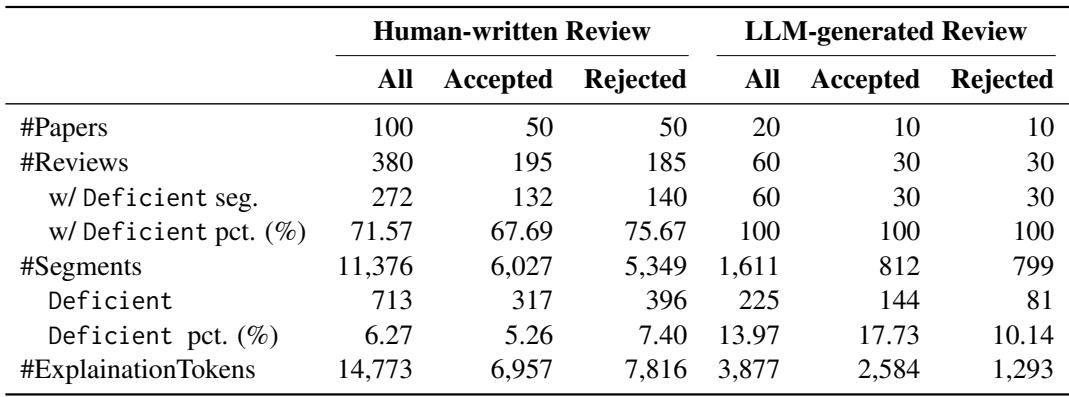
As shown in Table 1 above, the statistics are telling. While human reviews had a deficiency rate of about 6.27% at the segment level, LLM-generated reviews were significantly worse, with nearly 14% of their sentences being marked as deficient. Furthermore, 100% of the LLM-generated reviews contained at least one deficient segment, compared to 71.57% for humans.
Comparing to Previous Work
Why does this matter? As seen in Table 2 below, ReviewCritique is the first dataset to combine initial submissions, LLM-generated reviews, and—crucially—highly expert-demanding sentence-level deficiency labeling.
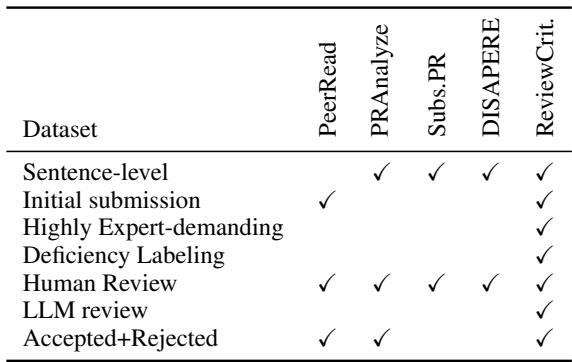
This granular data allowed the researchers to move beyond “vibes” and mathematically prove where LLMs fail.
Experiment 1: LLMs as Reviewers
Let’s look at the first major role: The Reviewer. When an LLM reads a paper and critiques it, what kind of mistakes does it make?
The “Out-of-Scope” Problem
The researchers classified the “Deficient” segments into specific error types. The results, highlighted in Table 3 below, show a fascinating divergence between human and machine error.
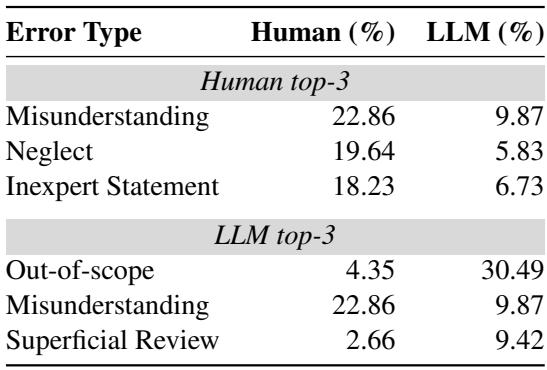
Human reviewers often make mistakes due to Misunderstanding (22.86%) or Neglect (19.64%)—essentially, they didn’t read carefully enough or missed a detail that was actually in the paper. They also struggle with Inexpert Statements, where they might critique a method they don’t fully understand.
LLMs, however, suffer from a different pathology: The Out-of-Scope Critique.
Nearly 30.5% of LLM errors fall into this category. An LLM might read a paper about English grammar correction and complain, “The paper fails to evaluate this method on Swahili and ancient Latin.” While technically true, such a critique is often unreasonable for the specific scope of the paper. LLMs tend to hallucinate a “perfect” version of the paper and criticize the authors for not doing an infinite amount of work.
Analyzing the Review Sections
The study broke down performance by review section:
- Summary: LLMs are actually quite good here. They rarely hallucinate facts in the summary and are less likely to copy-paste abstract text than lazy human reviewers.
- Strengths: LLMs are sycophants. They tend to believe whatever the authors claim in the abstract. If an author writes “We achieved state-of-the-art results,” the LLM repeats it as a strength, whereas a human expert checks the tables to verify if it’s true.
- Weaknesses: This is where the LLMs falter most, providing generic feedback that could apply to any paper (e.g., “more analysis needed”).
- Writing Quality: LLMs are terrible judges of writing. They almost always call a paper “well-written,” even when human experts unanimously agree the paper is confusing and poorly structured.
Measuring Originality: The ITF-IDF Metric
One of the biggest complaints about AI writing is that it feels generic. The researchers wanted to quantify this “sameness.” They developed a novel metric called ITF-IDF (Inverse Term Frequency - Inverse Document Frequency).
If you have studied Information Retrieval, you know TF-IDF. It measures how important a word is to a document. The researchers adapted this to measure how unique a review segment is to a specific paper.
Here is the mathematical framework they proposed:

In this equation, the goal is to calculate a diversity score. But to do that, we need to know how often a specific sentiment or critique (\(O\)) appears within a single review, and how often that same critique (\(R\)) appears across all reviews for different papers.
They calculate the “soft occurrence” (\(O\)) inside a review using semantic similarity:

And they calculate the repetition across different papers (\(R\)) here:

In plain English: This metric penalizes a reviewer for saying the same thing over and over again in one review, and it penalizes them even more for using the same generic critiques (like “add more experiments”) across many different papers. A high score means the review is specific and unique to the paper being reviewed.
The Results on Diversity
So, who writes more unique reviews? Humans or machines?
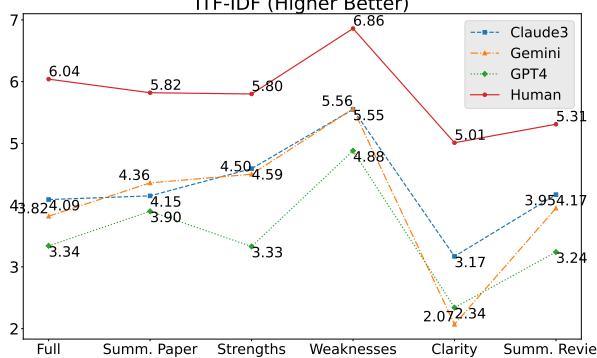
Figure 1 confirms that humans (the red line) consistently score higher on specificity, particularly in the critical “Weaknesses” section. LLMs (the lower lines) tend to plummet in specificity, especially when discussing clarity. They fall into patterns of generic praise or criticism that lack the “bite” of a truly expert human review.
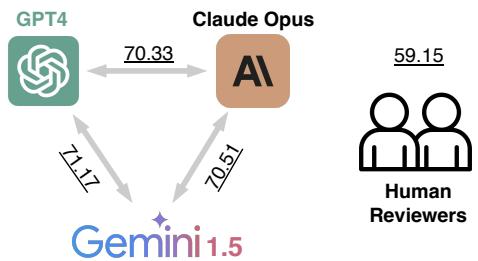
Furthermore, if you use three different LLMs (GPT-4, Claude, Gemini) to review the same paper, you might hope to get diverse viewpoints. Unfortunately, Figure 2 below shows that LLMs have very high agreement with each other (high similarity scores). Humans, on the other hand, often disagree, offering a wider range of perspectives on a paper’s value.
Experiment 2: LLMs as Meta-Reviewers
Perhaps LLMs aren’t great at writing reviews, but can they grade them? This is the role of the Meta-Reviewer. The researchers fed the LLMs the paper and a human review, then asked: “Identify the deficient segments in this review.”
The results were sobering.
The Detection Failure
Even the best models struggled to replicate the judgment of human experts.
- Recall vs. Precision: LLMs tended to have higher recall but terrible precision. This means they were “trigger happy,” labeling perfectly good sentences as deficient.
- Closed vs. Open Source: Proprietary models like Claude Opus and GPT-4 performed better than open-source models like Llama-3, but even the best models achieved relatively low F1 scores (a measure of accuracy).
The Explanation Failure
When an LLM did correctly identify a bad review segment, the researchers checked if it identified it for the right reason. They compared the LLM’s explanation to the expert’s explanation using ROUGE (text overlap) and BERTScore (semantic similarity).
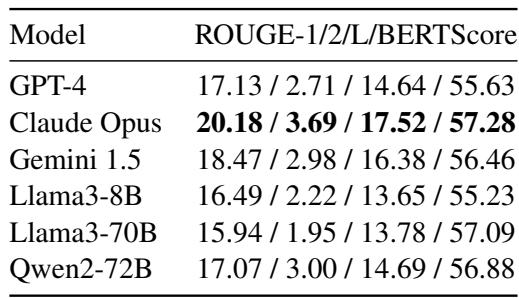
As Table 5 shows, the scores are low. Even when an LLM flags a sentence correctly, it often fails to articulate the nuance of why that sentence is problematic in the context of high-level research.
For example, LLMs found it particularly difficult to identify:
- Inaccurate Summaries: They couldn’t tell if a reviewer summarized the paper wrong.
- Contradictions: They missed when a reviewer said “good experiments” in one paragraph and “bad experiments” in the next.
- Superficiality: They struggled to identify when a reviewer was just skimming the surface.
Detailed Error Analysis
To understand exactly what constitutes a “Deficient” review, the researchers provided a taxonomy of errors. This is a valuable resource for any student learning how not to peer review.
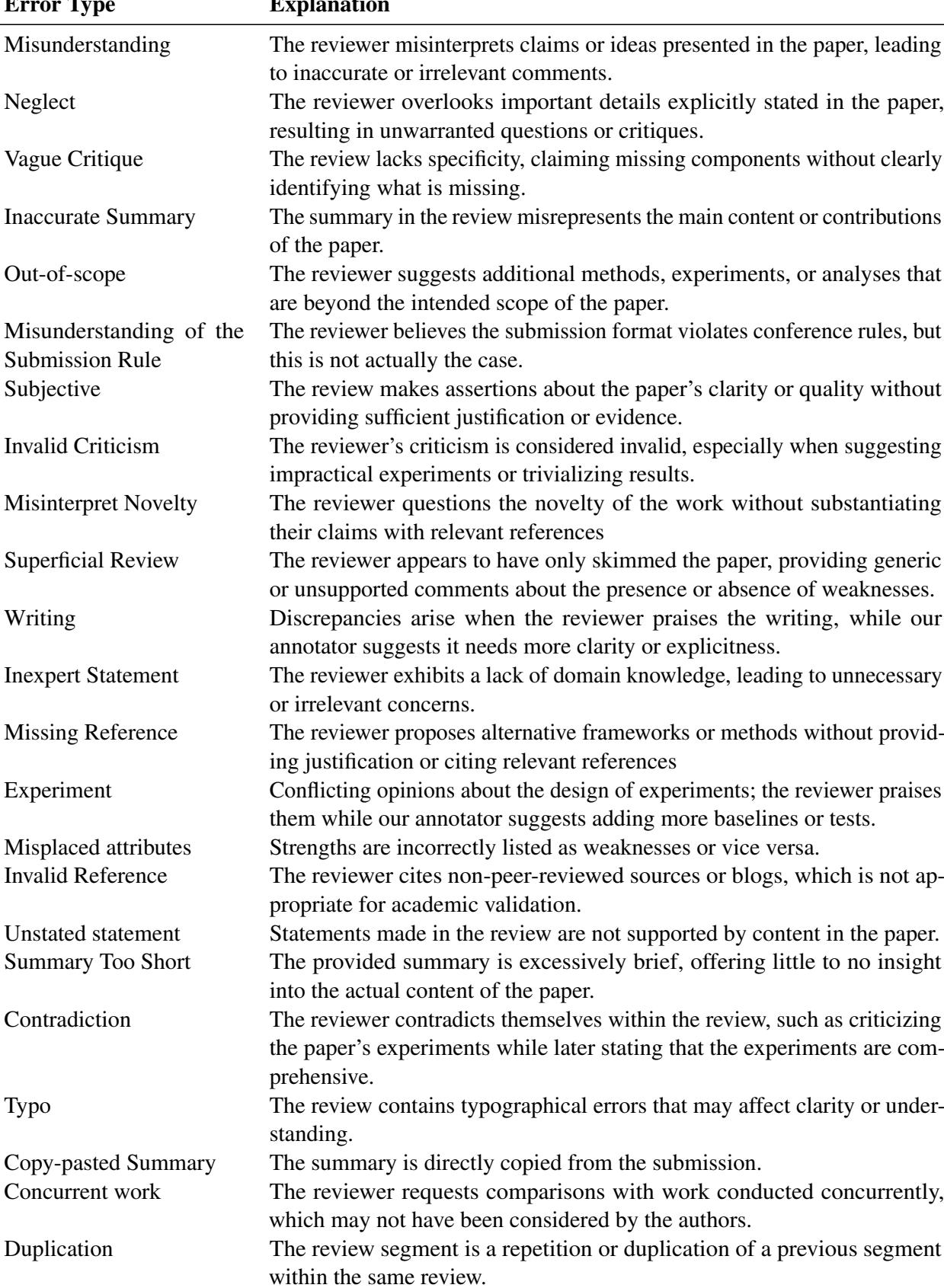
Table 9 breaks these down. Some key takeaways for aspiring researchers:
- Subjective: Don’t just say “I don’t like it.” Give evidence.
- Unstated Statement: Don’t criticize the author for a claim they never made.
- Non-constructive: Never criticize without offering a path to improvement.
Conclusion: The Human Element Remains Essential
This research provides a reality check in the age of AI hype. While LLMs are powerful tools for summarization and surface-level checking, they currently lack the deep, contextual reasoning required for high-stakes peer review.
The study concludes that:
- LLMs are “Generic Critics”: They generate reviews that sound professional but lack the specific, actionable insight that drives scientific progress.
- LLMs are “Unreliable Judges”: They cannot yet be trusted to filter human reviews or act as Area Chairs.
- The “Out-of-Scope” Trap: Researchers using LLMs to critique their own drafts should be wary of suggestions that demand impossible or irrelevant additional work.
The “ReviewCritique” dataset stands as a new benchmark. Until AI models can close the gap on the metrics defined in this paper—identifying nuances, maintaining specificity, and understanding scope—the peer review process remains a deeply human responsibility. For now, the best reviewer for a human idea is still a human mind.