](https://deep-paper.org/en/paper/2406.16264/images/cover.png)
Introduction
In the rapid evolution of Large Language Models (LLMs), one metric has become a major bragging right: the context window. We have moved from models that could remember a few paragraphs to behemoths like Gemini 1.5 Pro and GPT-4o, which claim to process hundreds of thousands, if not millions, of tokens at once. In theory, you can now feed an entire novel into an AI and ask questions about it.
But there is a significant difference between processing a novel and understanding it.
Current evaluations often rely on “Needle-in-a-Haystack” (NIAH) tests, where a random sentence (the needle) is hidden inside a massive amount of unrelated text (the haystack). If the model finds the sentence, it passes. While this proves the model can retrieve data, it doesn’t prove it can reason over a narrative arc, understand character development, or track plot inconsistencies across 300 pages.
To address this gap, a team of researchers from UMass Amherst, the Allen Institute for AI, and Cornell University introduced NOCHA (A NOvel CHAllenge). This new dataset challenges LLMs not just to retrieve text, but to verify complex claims about recently published fiction books.
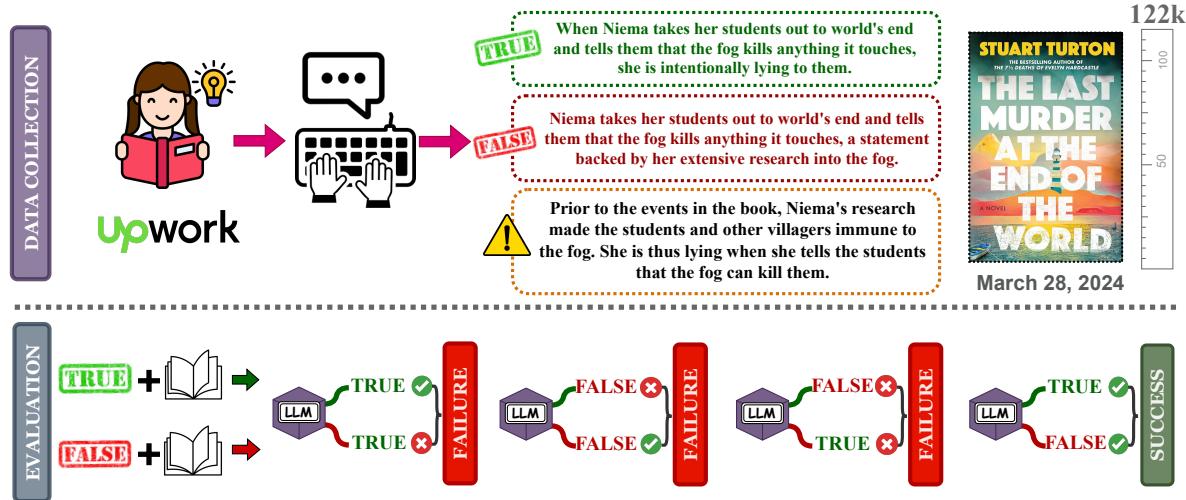
As illustrated in Figure 1, the study moves beyond synthetic tests. By employing human readers to generate paired True/False claims about books published in 2023 and 2024, the researchers reveal a startling reality: while models have gotten better at reading, they are still struggling to comprehend.
Background: The Problem with Haystacks
To understand why NOCHA is necessary, we must first look at the limitations of current benchmarks.
The “Needle” Illusion
The industry standard for evaluating long-context models is the NIAH test. It involves inserting a specific fact (e.g., “The secret code is 42”) at various depths within a document and asking the model to retrieve it. Recent models often score near 100% on these tests.
However, the authors argue that NIAH tests only surface-level retrieval. The “needle” is usually unrelated to the surrounding text, making it mathematically easier for the model to spot. It requires no synthesis, no inference, and no global understanding of the document structure.
Data Contamination
Another major issue is contamination. If you test a model on The Great Gatsby or Harry Potter, the model likely already memorized the plot during its training phase. It doesn’t need to read the context you provide; it can answer from its internal “parametric memory.” To truly test long-context capabilities, the model must face a text it has effectively never seen before.
The NOCHA Methodology
The researchers designed NOCHA to rigorously test “book-level” understanding while avoiding the pitfalls of previous benchmarks.
1. The Corpus: Fresh Fiction
To mitigate data contamination, the team selected 67 books, most of which were published in 2023 and 2024. These are books likely missing from the training data of models trained before mid-2024. They focused on fiction to prevent models from relying on real-world facts (parametric knowledge) and force them to rely solely on the provided text.
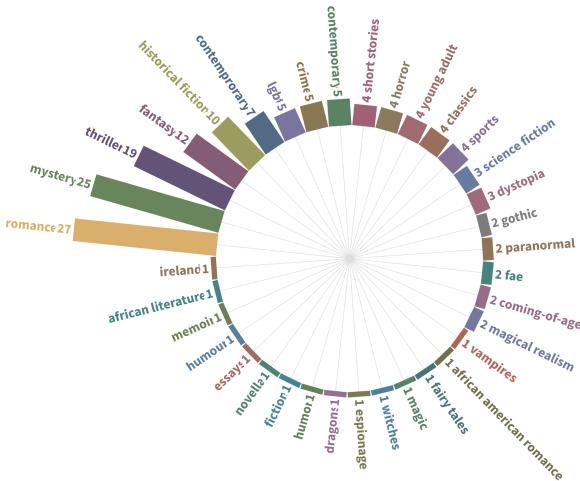
As shown in Figure 5, the dataset covers a wide variety of genres, from Romance and Mystery to Fantasy and Horror. This ensures that the evaluation isn’t biased toward a single style of writing.
2. The Secret Weapon: Narrative Minimal Pairs
The core innovation of NOCHA is the use of Narrative Minimal Pairs. Instead of asking random questions, human annotators (who actually read the books) created pairs of claims:
- True Claim: A statement that is indisputably true based on the book.
- False Claim: A statement about the same event or entity that is minimally different but false.
Why use pairs? If you simply ask a model “Is X true?”, it has a 50% chance of guessing correctly. Furthermore, models often have biases toward answering “True” or “False” when they are unsure.
By using minimal pairs, the researchers count a “success” only if the model correctly identifies the True claim as True AND the False claim as False. This prevents the model from being “right for the wrong reason.”
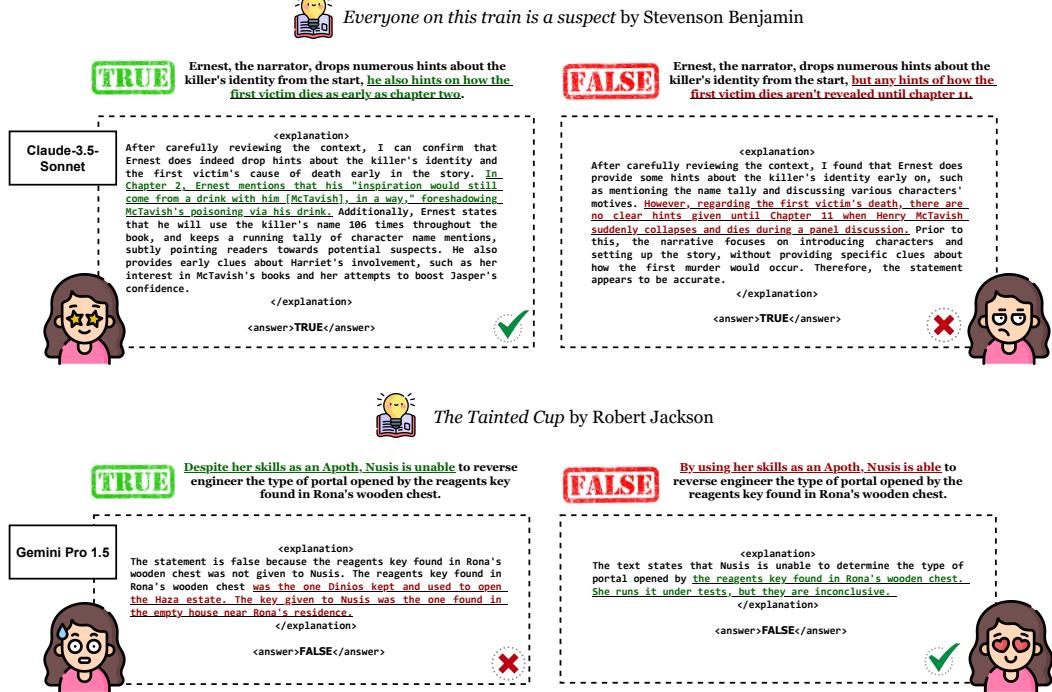
Figure 2 above demonstrates this complexity. In the top example, the model correctly identifies hints about a victim’s death in the True claim. However, when presented with the False claim (which says no hints were dropped), the model hallucinates, agreeing with the false premise. Because it failed the second half of the pair, it gets zero credit.
3. Reasoning Scope: Global vs. Local
Not all claims are created equal. The researchers categorized the claims based on how much of the book is needed to verify them:
- Sentence-level: Can be answered by finding a single sentence (similar to NIAH).
- Passage-level: Requires reading a few paragraphs.
- Global reasoning: Requires synthesis of information scattered across the entire book (e.g., understanding a character’s motivation that develops from Chapter 1 to Chapter 20).
Crucially, 47.9% of the claims in NOCHA require global reasoning, making it a significantly harder test than existing benchmarks.
Experiments and Results
The team evaluated 11 prominent models, including closed-source heavyweights (GPT-4o, Claude 3 Opus, Gemini 1.5 Pro) and open-weight models (Command R, Llama, etc.). The models were fed the full text of the books (ranging from 49k to 336k tokens) and asked to verify the claims.
The Findings: A Reality Check
The results show a massive gap between human capability and AI performance.
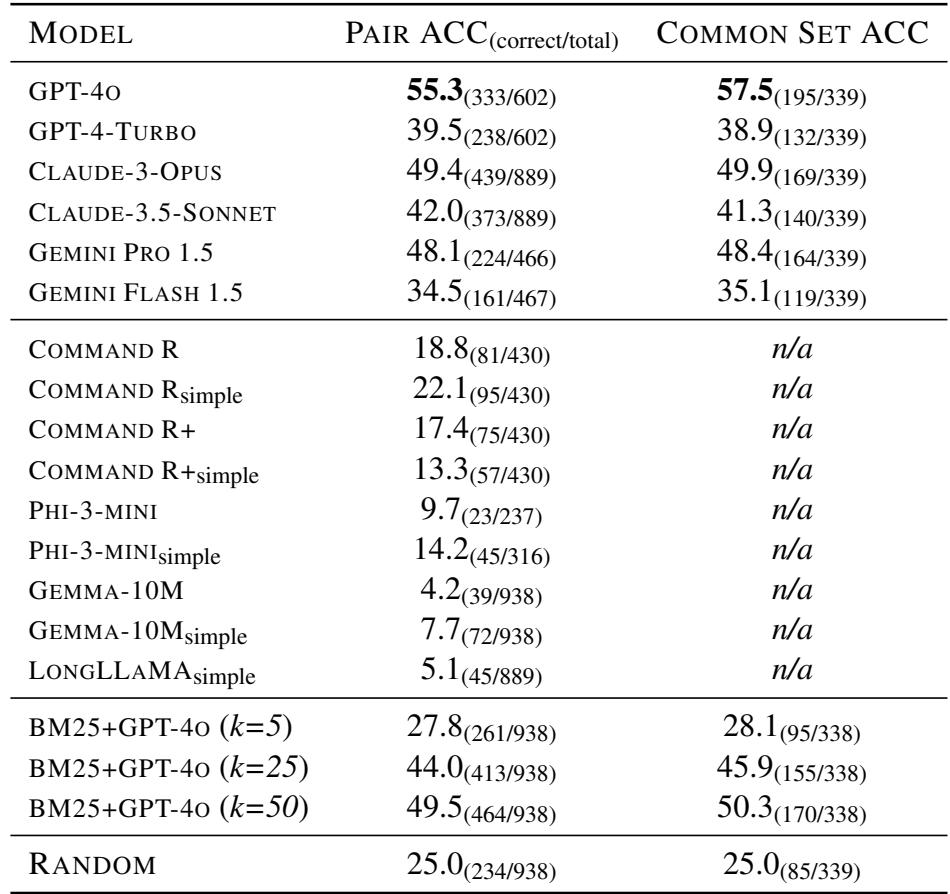
Table 24 highlights the pairwise accuracy on the fresh (non-classic) books:
- Humans: ~97% accuracy.
- GPT-4o: 55.3% (The best performing model).
- Claude 3 Opus: 49.4%.
- Gemini 1.5 Pro: 48.1%.
- Open-weight models: Almost all performed below or near random chance (25% for pairs).
Note that “random chance” for a pair (True/True, True/False, False/True, False/False) is effectively 25%. This means that even the most powerful models are barely scraping past a coin flip on this task, despite their massive context windows.
Analysis 1: The “Needle” Skills Don’t Transfer
Perhaps the most surprising finding is that high performance on “Needle-in-a-Haystack” benchmarks does not predict success on NOCHA. Models like GPT-4 Turbo and Command R, which score near perfect on synthetic retrieval tasks, struggled immensely here. This confirms that retrieving a keyword is fundamentally different from understanding a narrative.
Analysis 2: Global Reasoning is the Bottleneck
The difficulty of the task spikes when the model has to reason globally rather than just find a sentence.
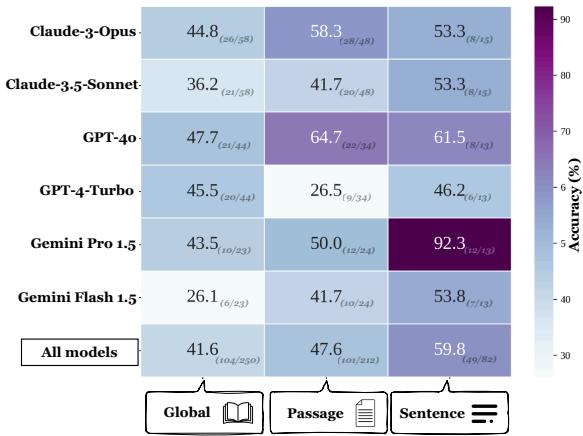
Figure 11 breaks down accuracy by evidence scope.
- Sentence-level (Blue): Models perform best here (~60% average), as this mimics the retrieval tasks they are optimized for.
- Global (Purple): Performance drops significantly (~41.6% average). The models struggle to hold the “whole picture” of the book in their “mind” at once.
Analysis 3: The “World-Building” Tax
The researchers also found that the type of fiction matters.
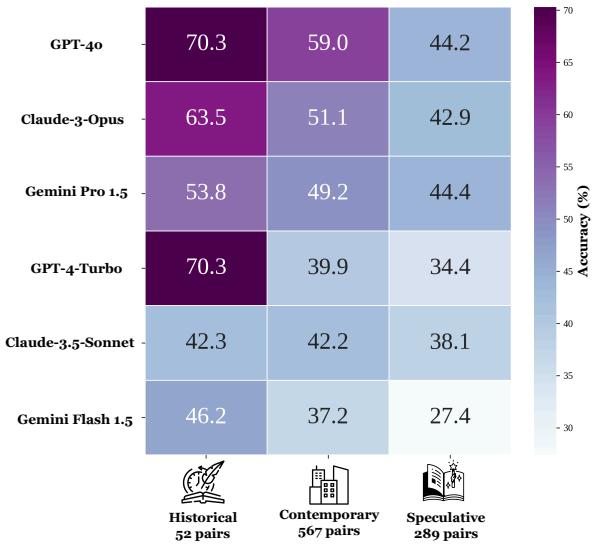
As shown in Figure 3:
- Historical & Contemporary Fiction: Models perform better. These books take place in the “real world,” allowing the model to lean on its pre-training knowledge about how the world works.
- Speculative Fiction (Sci-Fi/Fantasy): Models perform significantly worse. In these books, the author invents new rules, physics, and societies. The model cannot rely on external knowledge and must process the new “world” entirely from the context window—a task it evidently finds very difficult.
Analysis 4: Hallucinations and Bad Explanations
Even when models guessed the correct label, their reasoning was often flawed. The researchers analyzed the text explanations generated by the models and found that no model consistently produced accurate explanations.
For example, a model might correctly say a claim is “False,” but justify it by citing a conversation that never happened or referencing a plot point from a completely different part of the book. This suggests that even the ~55% accuracy of GPT-4o might be inflated by lucky guesses.
Analysis 5: Does Length Matter?
Interestingly, the sheer length of the book (token count) was not a definitive predictor of failure for the top models.
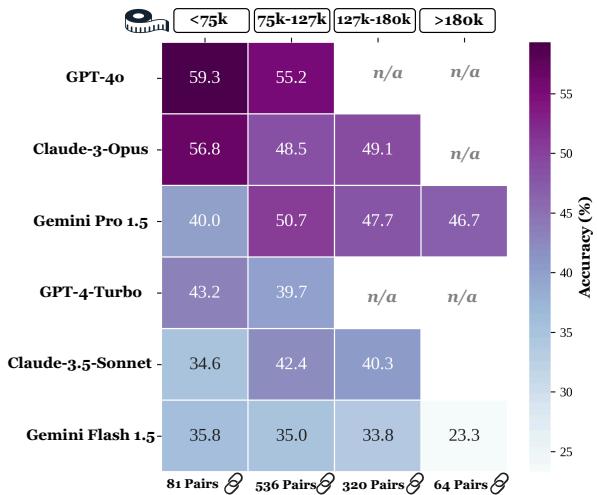
Figure 10 shows that while some models dip slightly on books over 180k tokens, the drop isn’t catastrophic for models like GPT-4o or Gemini 1.5. The challenge seems to be the complexity of the reasoning required, not just the raw number of words.
Conclusion and Implications
The NOCHA paper serves as a vital reality check for the AI industry. It demonstrates that context window size is not synonymous with comprehension. We have successfully built models that can “hold” a novel in memory, but we haven’t yet built models that can “read” it with the depth of a human.
Key Takeaways for Students and Researchers:
- Don’t trust the “Needle”: If you are evaluating RAG (Retrieval-Augmented Generation) or long-context systems, simple retrieval tests are insufficient. You need tasks that require synthesis.
- Minimal Pairs are Powerful: When designing evaluations, using paired True/False samples is a robust way to filter out noise and guessing.
- The Reasoning Gap: The frontier of NLP research isn’t just making context windows larger; it’s improving the attention mechanisms and reasoning capabilities to make use of that space.
Until models can reliably distinguish between a plot twist and a hallucination, reading a good book remains a uniquely human pleasure.