](https://deep-paper.org/en/paper/2406.16554/images/cover.png)
Introduction
In the current landscape of Artificial Intelligence, scaling laws have ruled supreme: if you want a smarter model, you make it bigger. Models have ballooned from millions to billions, and now trillions of parameters. However, we are hitting a wall. The sheer computational cost of running inference on these massive dense models is becoming unsustainable for many researchers and applications.
Enter the Mixture-of-Experts (MoE) architecture. MoE promises the best of both worlds: it decouples the model’s total size (capacity) from its computational cost (inference latency). By only activating a tiny fraction of the network for each token it processes, an MoE model can have the knowledge capacity of a giant model while running with the speed of a much smaller one.
But there is a catch. Training an MoE model from scratch is notoriously difficult. It suffers from instability, load balancing issues, and requires massive amounts of data to converge properly.
What if we didn’t have to start from scratch? What if we could take a robust, pre-trained dense model—like LLaMA-2—and surgically transform it into a sparse Mixture-of-Experts?
This is exactly what the paper “LLaMA-MoE: Building Mixture-of-Experts from LLaMA with Continual Pre-training” explores. The researchers propose a novel framework to “upcycle” a dense LLaMA-2 7B model into a highly efficient LLaMA-MoE model. In this post, we will tear down their methodology, explore how they split neural networks into experts, and analyze whether this Frankenstein’s monster actually performs better than its dense counterparts.
Background: Dense vs. Sparse
Before we dive into the method, let’s briefly clarify the architectural shift.
In a traditional dense Transformer (like the original LLaMA or GPT-3), every single parameter in the Feed-Forward Networks (FFN) is used to process every single token. If you feed the word “apple” into the model, the entire brain lights up.
In a sparse Mixture-of-Experts (MoE), the FFN layers are replaced by a set of “Experts.” For any given token, a “Router” (or Gate) decides which experts are best suited to handle it. If the token is “apple,” the router might send it to an expert specialized in food or objects, while ignoring the experts specialized in coding or grammar.
The paper’s goal is to convert the former into the latter, utilizing the weights already learned by LLaMA-2.
The Core Method: Surgery on a Language Model
The transformation from LLaMA to LLaMA-MoE involves two critical stages: Expert Construction and Continual Pre-training.
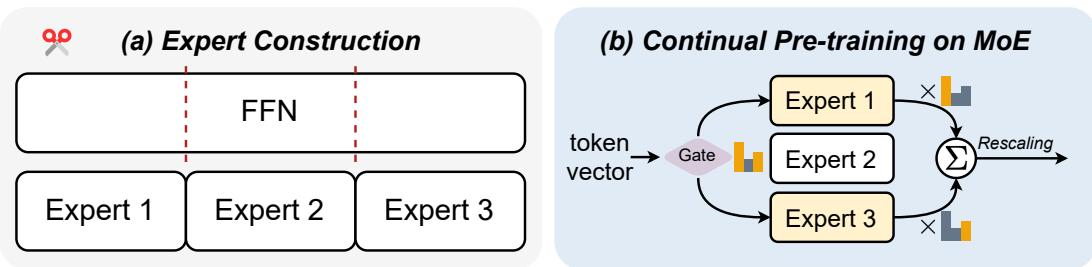
As shown in Figure 1, the process begins by taking the original FFNs (a) and splitting them into multiple independent experts (b). Once the structure is changed, the model undergoes further training to adapt to its new sparse nature.
Stage 1: Expert Construction
The most challenging part of this research is deciding how to chop up the existing matrices. The LLaMA model uses a SwiGLU activation function in its FFNs. Mathematically, the output \(y\) of an FFN layer is defined as:

Here, \(W_{up}\), \(W_{gate}\), and \(W_{down}\) are the massive weight matrices that hold the model’s knowledge. To create an MoE, the researchers split these matrices into \(N\) smaller pieces. If the original hidden dimension size is \(d_h\), and we want \(N\) experts, each expert will have a hidden size of \(m = d_h / N\).
The parameters for the \(j\)-th expert are sliced from the original matrices based on a set of indices \(S_j\):

The crucial question is: Which neurons go to which expert?
The authors investigate four distinct strategies for partitioning these parameters. This is a classic “nature vs. nurture” experiment for neural networks—does careful clustering matter, or is randomness sufficient?
1. Neuron-Independent Strategies
These methods treat the partitioning as a simple set division problem.
- Independent (Random): The indices of the intermediate neurons \(\{1, 2, ..., d_h\}\) are shuffled and split randomly into \(N\) equal-sized sets. This is the simplest approach.
- Independent (Clustering): The researchers use balanced k-means clustering on the row vectors of the \(W_{up}\) matrix. The idea is to group neurons that have similar activation patterns together into the same expert.
2. Neuron-Sharing Strategies
Inspired by network pruning, these methods assume that some neurons are more “important” than others and perhaps should be shared across experts or handled differently. They calculate neuron importance based on the loss change (Taylor expansion) when a neuron is pruned.
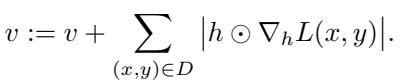
- Sharing (Inner): Neurons are duplicated. If a neuron is highly important to multiple potential clusters, it is copied into multiple experts.
- Sharing (Inter): A set of the most critical neurons is kept aside as a “shared residual block” that is always active, while the remaining less-critical neurons are distributed among the experts.
The Gating Mechanism
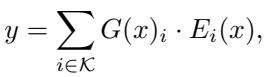
Once the experts are built, a mechanism is needed to route tokens to them. The model uses a Top-K gating network. For every input \(x\), the gate calculates a score and selects the best \(k\) experts.
Stage 2: Continual Pre-training
After “surgery,” the model is effectively brain-damaged. The connections have been severed and reorganized. While the weights are initialized from LLaMA, the new Gating network is initialized randomly. To recover the model’s language capabilities, the researchers must perform Continual Pre-training.
They utilize the SlimPajama dataset (a cleaned version of RedPajama) containing 627 billion tokens. A major part of their research focused on Data Sampling—deciding how much data from different domains (Wikipedia, GitHub, Books, etc.) to feed the model.
They experimented with two main approaches:
- Static Weights: Fixed proportions of data throughout training (e.g., following the original LLaMA recipe or the “Sheared-LLaMA” recipe).
- Dynamic Weights: Adjusting the data mix on the fly. If the model is struggling with coding tasks, the sampler increases the proportion of GitHub data automatically.
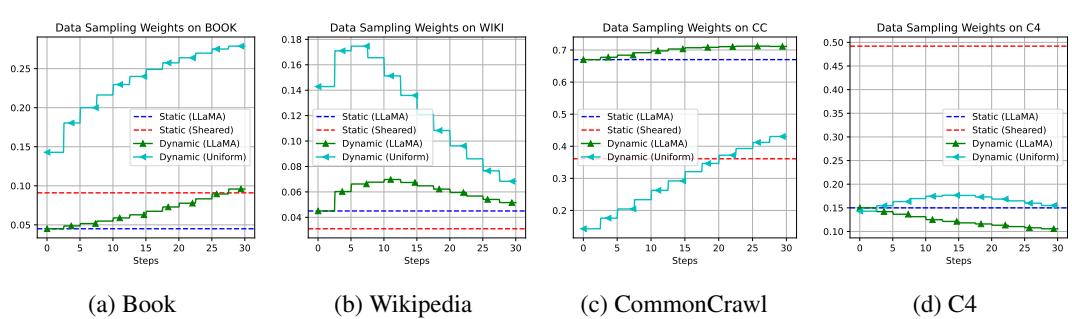
As seen in Figure 5, the dynamic strategies (green and cyan lines) drastically shift the data consumption during training, whereas static strategies (blue and red) remain constant lines.
Experiments and Results
The researchers trained several variants, primarily focusing on LLaMA-MoE-3.5B. It is important to note that “3.5B” here refers to the active parameters (the cost of inference), while the total parameter count remains much higher (similar to the original 7B).
They compared their models against other open-source models with similar active parameter counts, such as Open-LLaMA-3B and Sheared-LLaMA-2.7B.
Which Construction Method Won?
This is perhaps the most surprising finding of the paper. Despite the sophisticated logic behind clustering similar neurons or sharing important ones, Random Partitioning (Independent-Random) performed the best.
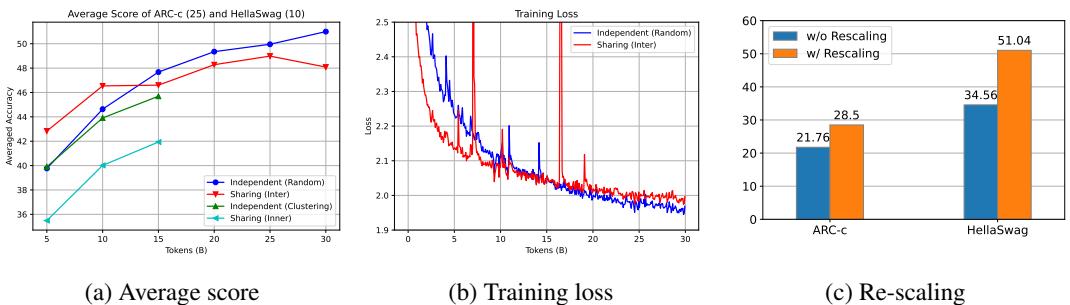
In Figure 3, look at the blue line (Independent Random). It consistently achieves higher accuracy (left graph) and lower loss (middle graph) compared to Clustering (green) or Sharing (red/cyan).
Why? The authors suggest that since the Gate and Experts are trained simultaneously during the continual pre-training phase, complex partitioning might introduce biases that make it harder for the gate to learn proper routing. Randomness provides a balanced starting point that allows the model to self-organize more effectively.
Performance Analysis
How did the final model fare against the competition?
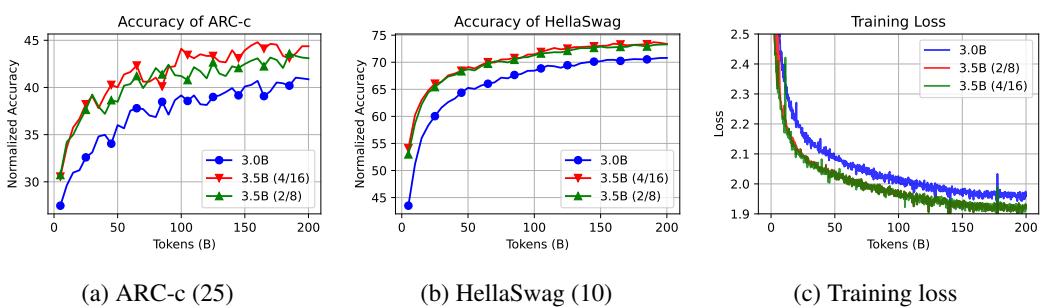
Figure 2 shows the trajectory of the LLaMA-MoE models over 200 billion tokens of training. We see a steady climb in accuracy on reasoning tasks like ARC-c and HellaSwag.
Crucially, LLaMA-MoE-3.5B significantly outperformed dense models of similar size. For example, on the ARC-Challenge, it scored 44.2, beating Open-LLaMA-3B (40.1) and Sheared-LLaMA-2.7B (41.6). This validates the core hypothesis: you can pack the intelligence of a 7B model into the inference budget of a 3.5B model by upcycling it into an MoE.
The Advantage Over Scratch Training
One of the main selling points of this paper is efficiency. Is it really better to upcycle LLaMA than to just train a fresh MoE model from random initialization?
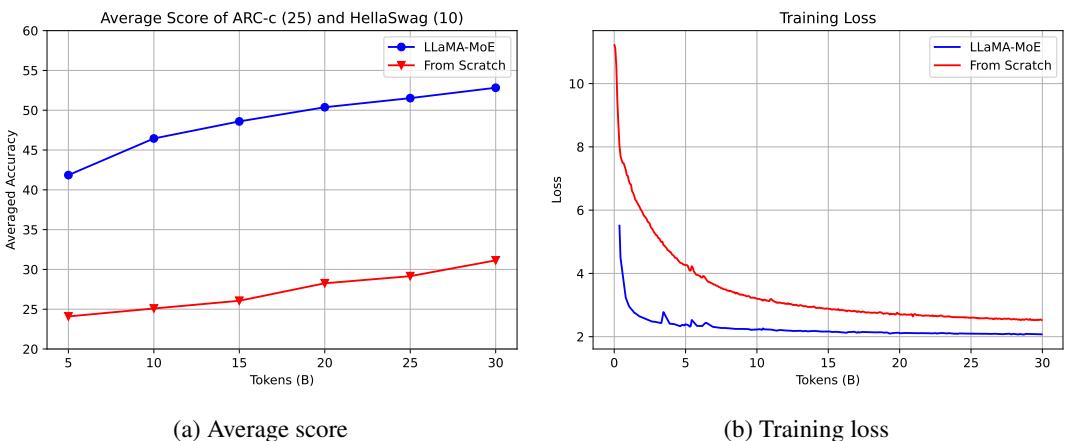
The answer is a resounding yes. Figure 7 compares LLaMA-MoE (blue) against a model trained from scratch (red). The LLaMA-MoE model starts with a massive advantage in accuracy and lower loss, and it maintains that lead throughout the training. The “From Scratch” model struggles to catch up, proving that the knowledge embedded in the original LLaMA weights is successfully preserved and utilized in the MoE version.
Deep Dive: Do Experts Actually Specialize?
A fascinating aspect of MoE models is interpretability. We often hope that experts will “specialize”—e.g., Expert 1 becomes the “Grammar Expert” and Expert 2 becomes the “Coding Expert.” Did this happen in LLaMA-MoE?
The researchers visualized the routing statistics across different layers of the network.
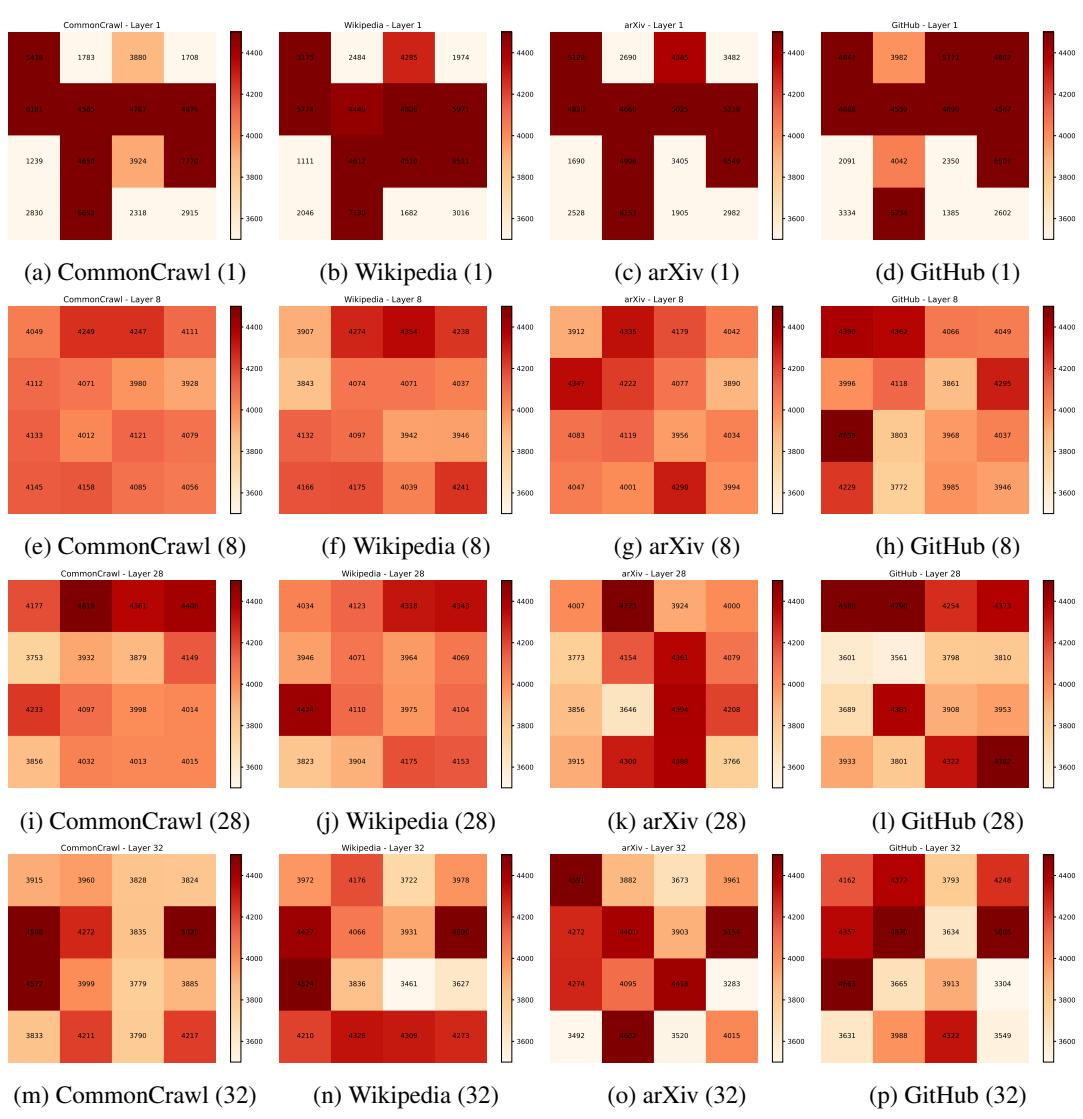
Figure 8 presents heatmaps of expert activation for different data domains (CommonCrawl, Wikipedia, arXiv, GitHub).
- Shallow Layers (Layer 1): The heatmaps look very similar across all domains. This suggests that early layers process universal features of language (syntax, basic word formation) that apply to everything from books to code.
- Deep Layers (Layer 32): Here, we see distinct patterns. Look at the GitHub column compared to CommonCrawl. The “hot” (dark red) experts are different. This indicates that in the deeper layers, the experts have indeed specialized. Some experts have become “coders,” while others prefer general web text.
This specialization was further analyzed by looking at the routing similarities between domains in the final layer.
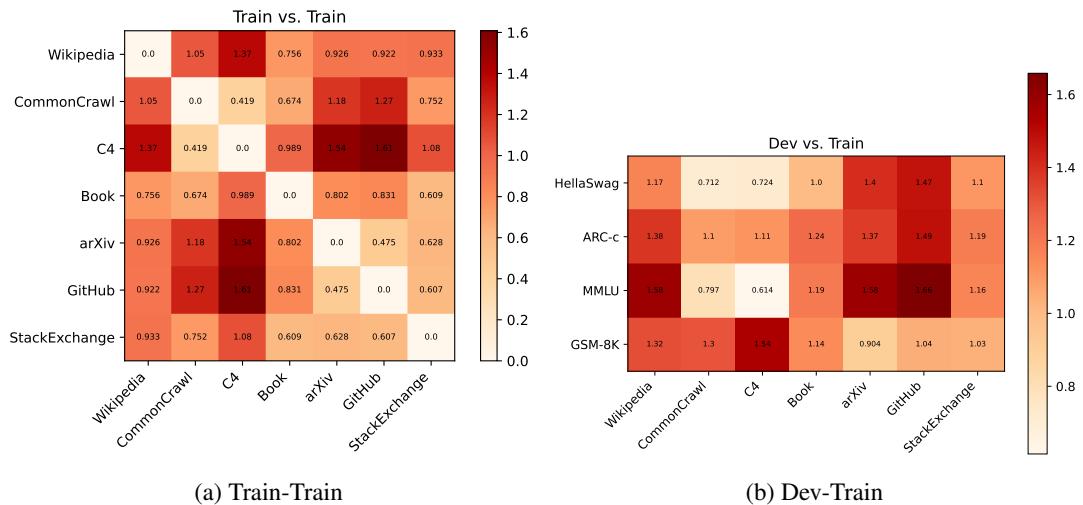
In Figure 9, we can see that technical domains like StackExchange and GitHub (bottom right of the chart) share similar routing patterns (indicated by lighter colors/lower distance), while they differ significantly from general text like Books. This confirms that the model is intelligently routing tokens based on semantic context.
Conclusion & Implications
The LLaMA-MoE paper presents a compelling blueprint for democratizing Mixture-of-Experts models. It demonstrates that we do not need the massive compute resources of Google or OpenAI to train MoEs from scratch. Instead, we can stand on the shoulders of giants by “upcycling” existing high-quality dense models.
Key Takeaways:
- Randomness Rules: Surprisingly, randomly splitting FFNs is the most effective way to initialize experts when upcycling.
- Efficiency: LLaMA-MoE achieves better performance than dense models with the same inference cost and converges much faster than MoEs trained from scratch.
- Specialization: The resulting models exhibit clear expert specialization in deeper layers, adapting to different domains like code vs. prose.
This approach opens the door for creating smaller, faster, and more specialized models without the prohibitive cost of pre-training, making high-performance LLMs more accessible for deployment in resource-constrained environments.