](https://deep-paper.org/en/paper/2406.16635/images/cover.png)
The race to deploy Large Language Models (LLMs) is effectively a battle against two constraints: computational cost and latency. We want models that are massive, capable, and smart (like Llama-2 or OPT-175B), but we also want them to run instantly on our devices without requiring a nuclear power plant to operate.
A popular technique to solve this is sparsification—simply turning off parts of the neural network to save work. However, randomly deleting neurons makes a model “stupid.” The industry standard has shifted toward contextual sparsity, where the model decides on the fly which parts of itself are necessary for the current input.
In this post, we are diving deep into ShadowLLM, a research paper that redefines how we approach dynamic pruning. The researchers identify two major flaws in current state-of-the-art methods like DejaVu: they use inefficient prediction mechanisms, and their definition of “neuron importance” is too simplistic. ShadowLLM proposes a unified predictor and gradient-informed criteria to achieve a 15% accuracy improvement and a 20% speedup over existing methods.
The Problem with Being Big
LLMs are composed of billions of parameters. For every single token generated, the model typically activates all of these parameters. This is inefficient because, for any specific task—say, answering a question about history—the model doesn’t need its neurons related to coding Python or writing poetry.
Static vs. Contextual Sparsity
There are two ways to slim down these models:
- Static Sparsity: You permanently delete attention heads or neurons that seem unimportant. While fast, this often degrades the model’s ability to perform “in-context learning” (adapting to new tasks based on prompts).
- Contextual Sparsity: You keep all the weights, but for each specific input (context), you dynamically predict which neurons can be ignored.
Contextual sparsity is the superior approach for maintaining accuracy. As illustrated below, different inputs (“Hamburger Cheese Needs…” vs. “A Quantitative Approach…”) activate completely different pathways in the network.
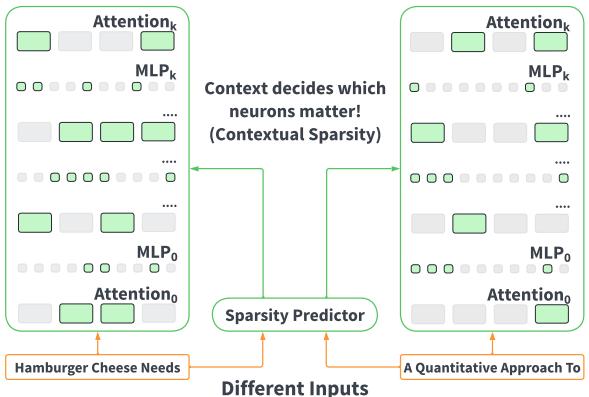 Figure 2: Contextual sparsity prunes neurons and attention heads based on the context (input) itself. Training a predictor to dynamically predict the sparsity pattern dependent on the input tokens can improve model quality.
The challenge is the “context.” If head importance changes drastically depending on the input, we need a mechanism to predict that change accurately and quickly.
The researchers analyzed the Rank Variance of attention heads in the OPT-1.3B model. If a head is always important, its rank variance would be low. However, the data shows massive variance, particularly in early and late layers. This proves that a static list of “good neurons” is impossible to create; the model must adapt dynamically.
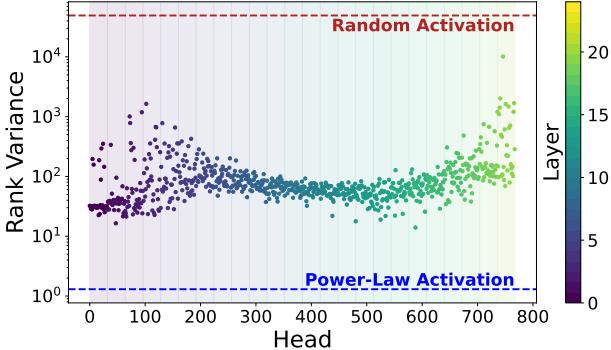 Figure 3: Heads with higher rank variance indicate greater context dependence. This variance is most noticeable in the early and later layers of the model, necessitating dynamic pruning.
The ShadowLLM Approach
ShadowLLM improves upon the previous state-of-the-art framework, DejaVu. While DejaVu successfully implemented contextual sparsity, it suffered from two bottlenecks:
- Layer-wise Prediction: It used a predictor at every layer to guess the sparsity of the next layer. This “stop-and-go” traffic creates latency overhead.
- Magnitude-Based Criteria: It assumed that if an activation is large (high magnitude), the neuron is important. As we will see, “loud” neurons aren’t always the smart ones.
ShadowLLM introduces a streamlined architecture and a mathematically superior way to judge neuron value.
1. The Unified Predictor
Instead of pausing at every layer to ask “what should I prune next?”, ShadowLLM uses a single predictor at the very beginning.
The method takes the output of the first attention layer and feeds it into a unified predictor. This predictor forecasts the sparsity patterns for all subsequent layers in one go.
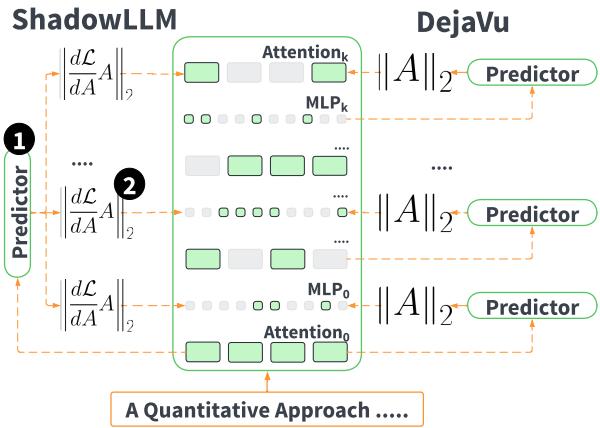 Figure 4: (1) A single predictor to model the entire LLM improves model performance (left), while (2) utilizing gradient-based information when evaluating pruning criteria improves model quality.
This architectural shift has profound implications for performance. In DejaVu, the system has to launch asynchronous kernels constantly. In ShadowLLM, the heavy lifting of prediction is done upfront. As shown in the table below, this reduces the Floating Point Operations (FLOPs) required for prediction by nearly 20% across various model sizes.
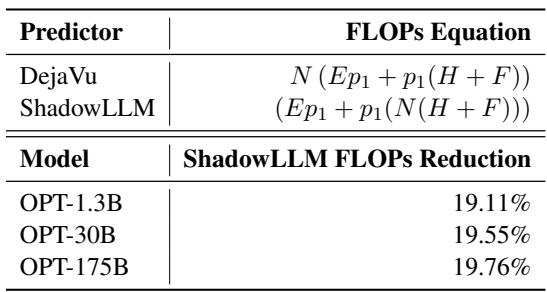 Table 1: ShadowLLM significantly reduces the computational overhead of the predictor compared to DejaVu.
2. Global vs. Local Pruning
Because ShadowLLM predicts the state of the entire model at once, it unlocks Global Pruning.
- Local Pruning (Per-Layer): Enforcing, for example, 50% sparsity on every single layer.
- Global Pruning: Enforcing 50% sparsity on the whole model. This might mean Layer 5 is only 10% sparse (very important layer) while Layer 10 is 90% sparse (unimportant layer).
The researchers found that global pruning consistently outperforms local pruning because it respects that not all layers are created equal.
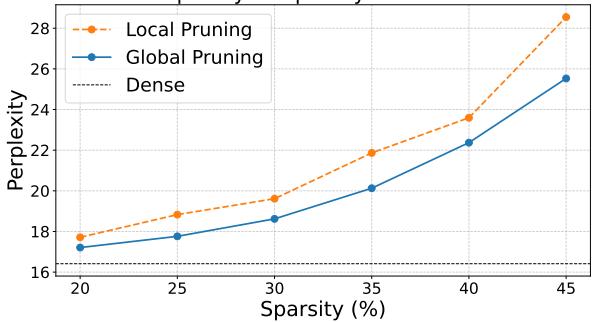 Figure 6: Global pruning (blue line) outperforms local pruning strategies (orange line). Global pruning accommodates the varying importance of different layers.
Rethinking Pruning Criteria: Beyond Magnitude
Perhaps the most significant contribution of this paper is the mathematical analysis of “Importance.”
In previous works, importance was defined by L2Norm (magnitude). If a neuron outputs a large number, it is kept. ShadowLLM argues that we should look at Sensitivity: how much does the loss function change if we remove this neuron?
To calculate this, the authors utilize gradient information. They explored several criteria:
- L2Norm (Baseline): Activation magnitude (\(||A||_2\)).
- GradNorm: Magnitude of the gradient (\(||\frac{\partial \mathcal{L}}{\partial A}||_2\)).
- PlainAct: A combination of activation and gradient (\(||A \cdot \frac{\partial \mathcal{L}}{\partial A}||_1\)). This measures how much the activation actually influences the gradient.
- Fisher: A second-order approximation.
The Winner: PlainAct
The researchers found that PlainAct (gradient-informed activation) was the sweet spot. It captures the true sensitivity of the model better than simple magnitude.
Interestingly, some criteria like GRASP (which uses Hessian matrix approximations) were theoretically strong but failed in practice. Why? Predictability.
We need to train a small neural network (the predictor) to guess these values at runtime. If the pruning criterion is too noisy or has massive outliers (like GRASP), the predictor fails to learn it. PlainAct is both an accurate metric of importance and easy for a neural network to learn.
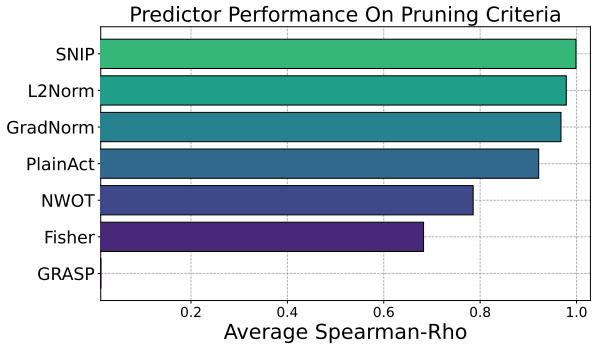 Figure 14: PlainAct is a good pruning criterion and is easy to learn (high Spearman correlation). GRASP has many outliers, making prediction difficult.
Experimental Results
The combination of the unified predictor and the PlainAct criterion yields impressive results when tested on OPT and Llama-2 models.
Accuracy and Perplexity
When compared against the DejaVu-style predictor (which uses local pruning and L2Norm), ShadowLLM consistently achieves lower perplexity (better language modeling) at the same sparsity levels.
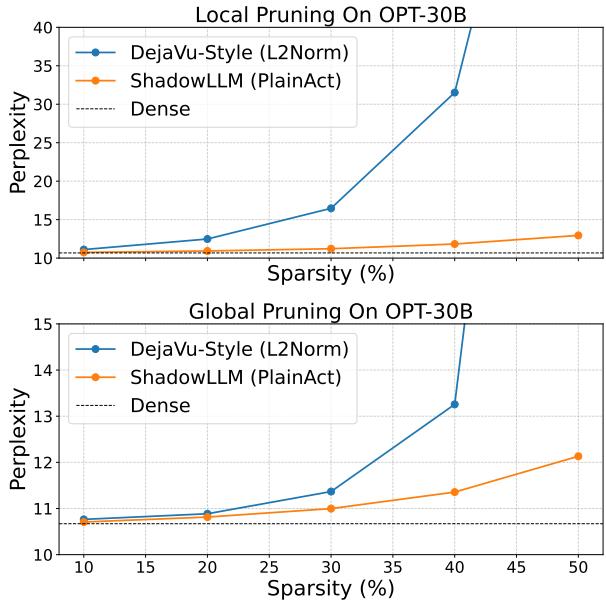 Figure 7: Comparison of DejaVu-style predictor (L2Norm) with ShadowLLM (PlainAct). ShadowLLM maintains lower perplexity as sparsity increases.
This advantage extends to zero-shot downstream tasks (like reasoning or reading comprehension). Across seven different evaluation tasks, ShadowLLM showed a stronger accuracy-sparsity trade-off.
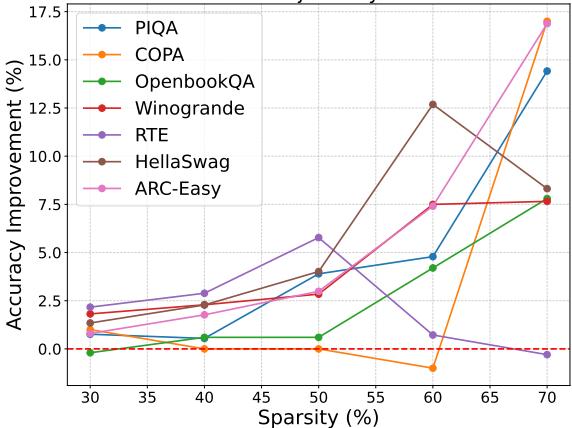 Figure 8: Consistent accuracy improvement of ShadowLLM over DejaVu across seven downstream evaluation tasks.
Latency and Speed
Accuracy is meaningless in this context if the model isn’t faster. By removing the per-layer predictor overhead, ShadowLLM achieves significant speedups.
For the OPT-30B model, ShadowLLM is faster than DejaVu across all generation lengths. While static pruning (fixed sparsity) is naturally the fastest, it lacks the accuracy of contextual methods. ShadowLLM bridges the gap, offering near-static speeds with dynamic intelligence.
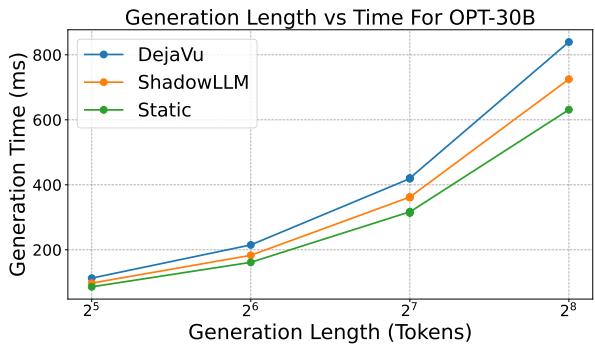 Figure 11 (Right): Average generation time on OPT-30B. ShadowLLM (orange) is consistently faster than DejaVu (blue).
When we look at the big picture—plotting accuracy against latency—we see that ShadowLLM (Blue Stars) dominates the Pareto frontier. For any given latency budget, ShadowLLM provides higher accuracy than the DejaVu-style approach.
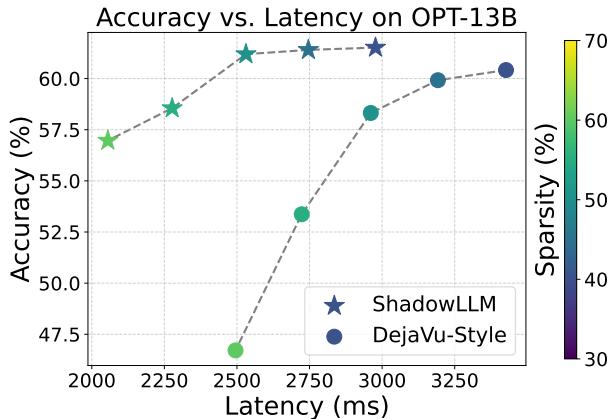 Figure 1: ShadowLLM achieves a better accuracy-latency trade-off compared to DejaVu.
Scaling Up
The performance gains aren’t limited to small models. As model size increases (from 1.3B up to 66B parameters), the gap between ShadowLLM and DejaVu widens. On the OPT-66B model, the reduction in generation time is substantial.
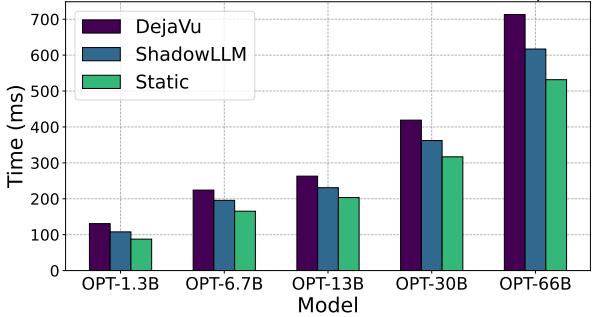 Figure 10: Average time per-inference across model sizes. ShadowLLM offers consistent speedups over DejaVu.
Conclusion
ShadowLLM represents a maturation of contextual sparsity techniques. The authors demonstrated that to optimize Large Language Models effectively, we must look at two distinct optimization surfaces:
- The Architecture of Prediction: Moving from granular, layer-wise predictors to a holistic, early-stage predictor reduces latency and enables global pruning strategies.
- The Definition of Importance: Moving from simple magnitude-based heuristics to gradient-informed metrics (PlainAct) ensures that we are keeping the neurons that actually impact the model’s output.
By combining these insights, ShadowLLM achieves a 15% improvement in accuracy and a 20% reduction in latency compared to prior art. As LLMs continue to grow in size, techniques like ShadowLLM that allow us to intelligently “skip” the unnecessary parts of the computation will be essential for efficient, real-world deployment.