](https://deep-paper.org/en/paper/2406.16678/images/cover.png)
Introduction
In the world of Natural Language Processing (NLP), we often take the simplest things for granted. Before a machine translation system can translate a paragraph, or a sentiment analysis tool can judge a review, the text usually needs to be broken down into its fundamental unit: the sentence.
This process is called Sentence Segmentation. Historically, this was considered a “solved problem.” A simple rule like “split text at every period, question mark, or exclamation point” gets you 90% of the way there. But what happens when the text is messy? What if you are analyzing tweets that lack punctuation entirely? What if you are processing the raw output of a speech-to-text system (ASR) which is just a stream of lowercase words? Or consider lyrics, where “sentences” are defined by rhythm and line breaks rather than grammar.
In these scenarios, standard tools fail catastrophically. The previous state-of-the-art method, known as “Where’s the Point” (WTP), attempted to solve this using deep learning, but it suffered from slow inference speeds and required the user to know the language of the text beforehand.
Enter Segment Any Text (SAT). In a comprehensive new paper, researchers from Johannes Kepler University Linz and the University of Cambridge introduce a universal, multilingual model that is faster, more robust, and more adaptable than anything that came before it. It even outperforms massive Large Language Models (LLMs) like Llama 3 on this specific task.
In this post, we will tear down the architecture of SAT, understand how it handles “noisy” text, and look at the experiments that prove its dominance across 85 languages.
The Problem with Punctuation
To understand why SAT is necessary, we first need to look at the limitations of current systems.
- Rule-based systems (like PySBD or simple RegEx) rely entirely on punctuation. If a user types “hello how are you,” a rule-based system sees one sentence.
- Supervised Statistical systems (like spaCy’s dependency parser) are better but still rely heavily on linguistic features found in clean, standard text (like news articles).
- WTP (Where’s the Point) was a breakthrough. It treated segmentation as a character-level prediction task. However, it used a “Canine-S” backbone, which processes text character-by-character. This is computationally expensive and slow. Furthermore, WTP used “language adapters,” meaning you had to tell the model, “This is French,” before it could segment the text. This breaks down in code-switching scenarios (e.g., “I love the vibe, c’est magnifique”).
The goal of the SAT authors was to build a system that achieves three things simultaneously: Robustness (works on messy text), Adaptability (works on lyrics/legal text), and Efficiency (runs fast).
Core Method: How SAT Works
SAT departs from the character-level approach of its predecessor. Instead, it utilizes a Transformer model based on subwords (specifically, initialized with XLM-RoBERTa). By processing chunks of characters (subwords) rather than individual characters, the model creates a much more efficient representation of the text, leading to significant speed gains.
The training of SAT is a multi-stage process designed to teach the model what a sentence actually is, regardless of how the text is formatted.
Stage 1: The Base Model (SAT)
The authors train the base SAT model in a self-supervised manner on web-scale text (the mC4 corpus) covering 85 languages. The objective is simple but powerful: Newline Prediction.
In naturally occurring text on the web, paragraphs are often separated by newline characters (\n). The model is trained to predict the probability that a specific token is followed by a newline. This effectively teaches the model to recognize “semantic units” or thoughts, rather than just looking for periods.
To make this model robust against missing punctuation, the authors apply a corruption strategy during training. They randomly remove punctuation marks from the input text but still ask the model to predict where the sentence boundaries (newlines) should be. They also include an auxiliary objective where the model tries to reconstruct the removed punctuation.
Stage 2: Supervised Mixture (SAT+SM)
While the base model is good, the researchers introduced a specialized variant called SAT+SM. This model continues training on a mixture of datasets that are already segmented into sentences (like the Universal Dependencies corpus).
Crucially, they double down on data corruption here. They don’t just show the model clean text; they show it varied versions of the same text to simulate different levels of “noise.”
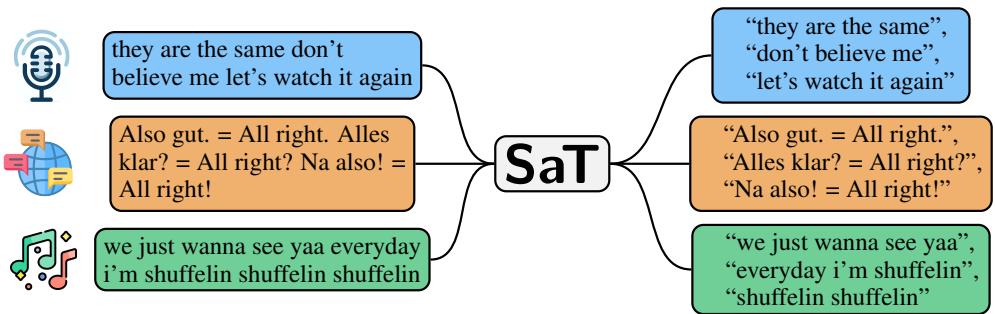
As shown in Figure 2 above, the model learns to handle distinct challenges:
- ASR Output (Microphone icon): Text that is fully lowercase with no punctuation. SAT correctly inserts boundaries based on semantics, not syntax.
- Multilingual/Code-Switching (Globe icon): Text that switches languages mid-stream. Because SAT drops the requirement for language codes, it handles this natively.
- Lyrics (Note icon): Creative domains where boundaries are stylistic verses rather than grammatical sentences.
The corruption scheme used to train SAT+SM includes:
- Removing all casing and punctuation (simulating ASR).
- Duplicating punctuation (e.g., “Hello!!!”) or removing spaces between sentences (simulating user-generated text/tweets).
- Using clean, uncorrupted text.
By sampling uniformly from these scenarios, SAT+SM becomes a “jack of all trades” that doesn’t panic when it sees messy data.
Solving the Short Text Problem: Limited Lookahead
One subtle but critical innovation in SAT is the Limited Lookahead mechanism.
Standard Transformers use an attention mechanism that allows every token to look at every other token in the sequence. While usually good, the authors found that for sentence segmentation, looking too far ahead can actually be detrimental, especially for short sequences like tweets. The model might over-attend to distant context that isn’t relevant for a local sentence boundary.
To fix this, they enforce a constraint on the attention mask. The model is allowed to look at all past tokens, but it can only look at a specific number of future tokens (\(N\)).

In this equation, \(N_L\) represents the per-layer lookahead. By splitting the total lookahead budget across layers, the model maintains a “sliding window” into the future. This makes the model robust to both long documents and very short texts.
Domain Adaptation via LoRA
What if you need to segment something highly specific, like legal contracts or song lyrics? These domains have unique definitions of “sentences.”
The authors propose using Low-Rank Adaptation (LoRA). Instead of retraining the entire massive model, LoRA freezes the main weights and trains a tiny set of adapter layers. This allows users to adapt SAT to a new domain with as few as 16 examples, creating a highly specialized model (SAT+LoRA) with almost zero computational overhead.
Experiments and Results
The paper extensively evaluates SAT against rule-based systems (PySBD, NLTK), supervised systems (spaCy), the previous SOTA (WTP), and modern LLMs (Llama 3, Command R).
1. Efficiency vs. Performance
One of the most significant claims of the paper is the speed increase. Because SAT operates on subwords rather than characters, it processes text much faster.
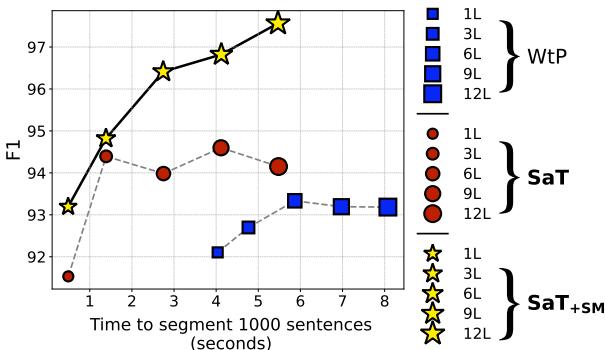
Figure 1 highlights this trade-off. The X-axis shows the time required to segment 1,000 sentences (lower is better/faster), and the Y-axis shows the F1 score (accuracy).
- WTP (Stars): Performs well but is slow (far right of the graph).
- SAT (Circles): Much faster, but slightly lower accuracy in its base form.
- SAT+SM (Triangles): The best of both worlds. It achieves F1 scores comparable to or better than WTP but does so roughly 3x faster (shifting significantly to the left).
2. General Performance on Clean Text
On standard benchmarks (clean text like news and subtitles), SAT+SM outperforms the competition.
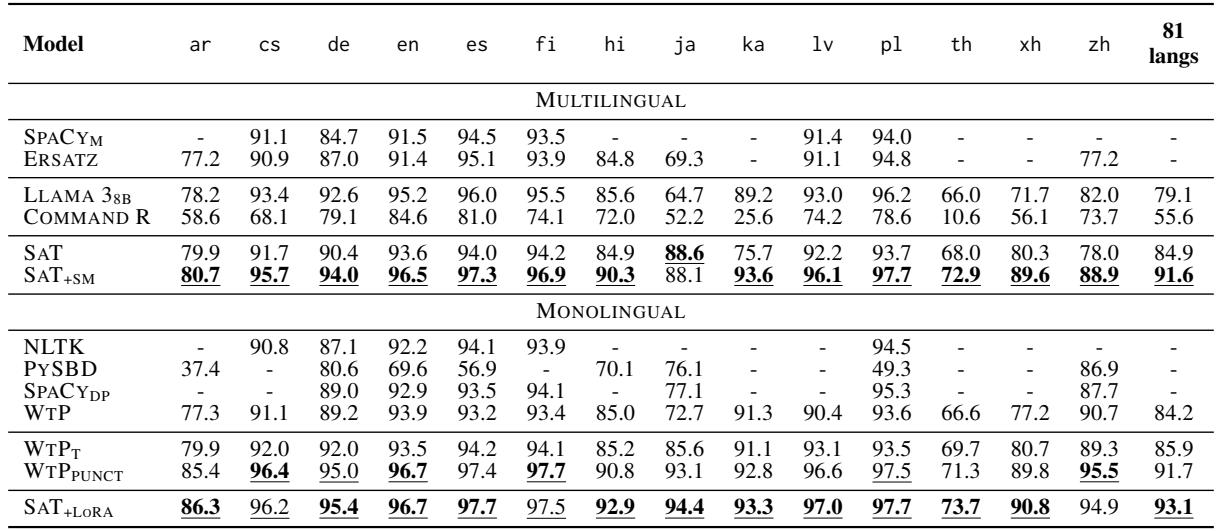
In Table 2, we see that SAT+SM achieves an average F1 score of 91.6, matching the domain-adapted version of WTP (91.7) and beating the base WTP model (85.9). Notably, it outperforms Llama 3 8B (91.6 vs 79.1 on multilingual data). This proves that massive general-purpose LLMs are not necessarily the best tool for specific structural tasks like segmentation.
3. The LLM Surprise
The authors specifically investigated why LLMs struggled. They prompted models like Llama 3 and Command R to segment text.
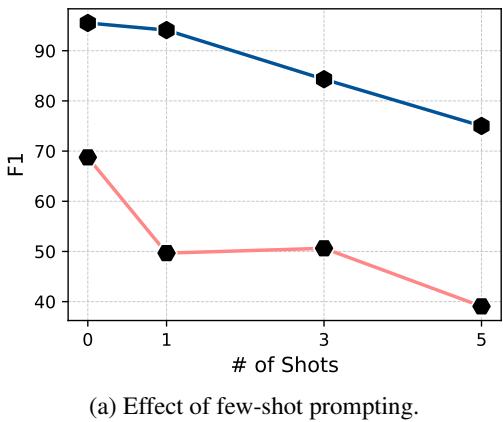
Figure 5 reveals two interesting findings:
- Few-shot prompting doesn’t help: Giving the LLM examples (1-shot, 3-shots) often degraded performance rather than improving it.
- Context length sensitivity: As the number of sentences in the input increased (X-axis), the LLM’s performance dropped sharply.
The authors note a specific failure mode of LLMs: Hallucination. When asked to segment text, LLMs often paraphrase, summarize, or alter the input text rather than just inserting newlines. In tasks like legal processing or transcription, altering the source text is unacceptable.
4. Robustness on Noisy Domains
The true power of SAT is revealed when the text gets messy.
Tweets and Noisy User Text: In datasets derived from tweets (which often lack punctuation and have irregular casing), SAT+SM dominated. On the “Ersatz” benchmark (a mix of noisy sources), the models showed high resilience.
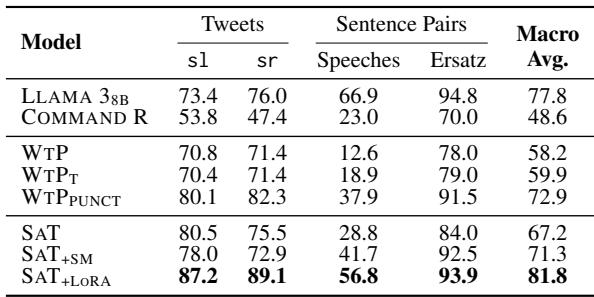
Table 4 shows the proportion of perfectly segmented short sequences. On “Speeches” (simulated ASR with no punctuation), SAT+SM scores 41.7, compared to WTP’s 12.6. This is a massive improvement in handling raw speech transcripts.
Code-Switching: Code-switching (mixing languages like “Spanglish”) is a nightmare for models that require a language code input.
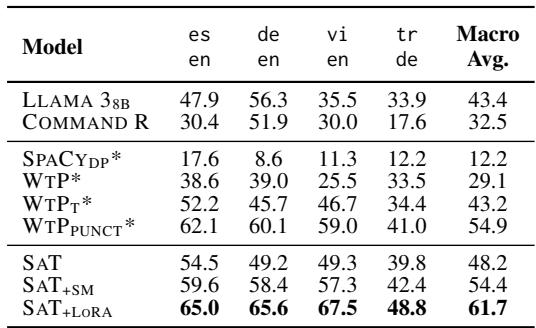
Table 5 demonstrates that SAT+SM achieves an average F1 of 54.4, significantly higher than the LLM average of roughly 30-43% and WTP’s 29.1%. This confirms that removing the language-code dependency makes SAT a truly universal multilingual segmenter.
5. Domain Adaptation: Lyrics
Lyrics are difficult because “sentences” are often verses. The authors tested how well SAT could be adapted to this domain using LoRA.
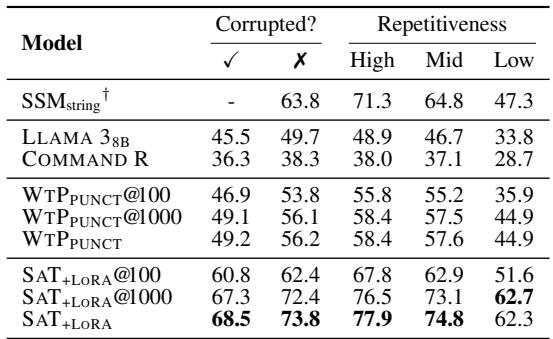
Table 6 shows that SAT+LoRA outperforms specifically designed domain models (\(SSM_{string}\)). Even when using only a small number of songs for adaptation, the model quickly learns the structural rules of verses, achieving F1 scores near 78% on high-repetitiveness songs, whereas standard models hover around 50-60%.
This efficiency is further visualized below.
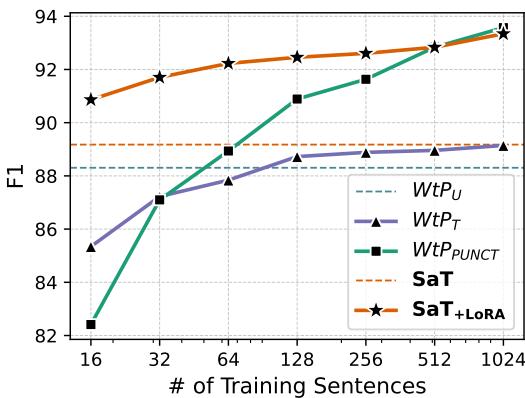
Figure 3 illustrates the “sample efficiency.” The orange line (SAT+LoRA) shoots up in performance with very few training sentences (logarithmic scale on X-axis). With just 16 sentences, it already outperforms other methods, making it incredibly practical for engineers who don’t have thousands of labeled examples for their specific niche.
Conclusion
The “Segment Any Text” paper presents a compelling argument that we need specialized, robust architectures for fundamental NLP tasks. While the trend in AI is often “throw it at an LLM,” this research shows that a well-designed, smaller model (SAT) can be faster, more accurate, and more reliable than a giant generalist model (Llama 3) for structural tasks.
By moving to subword tokenization, implementing limited lookahead, and training on a “supervised mixture” of corrupted text, the authors have created a tool that is arguably the new standard for sentence segmentation. Whether you are processing formal legal documents, messy tweets, or multilingual chat logs, SAT appears to be the universal solution the field has been waiting for.
For students and practitioners, the takeaway is clear: Pre-processing matters. Using a robust segmenter like SAT can prevent cascading errors downstream in your NLP pipelines, ensuring that your translation, summarization, or entity recognition models receive the clean, well-bounded input they need to succeed.