](https://deep-paper.org/en/paper/2406.16845/images/cover.png)
Artificial Intelligence is rapidly transforming healthcare. We are moving toward a future where “Generalist Medical AI” can look at an X-ray, an MRI, or a CT scan and draft a diagnostic report in seconds. This promises to reduce burnout for radiologists and speed up patient care.
However, there is a massive bottleneck in this revolution: Trust.
If an AI writes a report, how do we know it’s accurate? If we have two different AI models, how do we know which one is better? In general Natural Language Processing (NLP), we verify text using standard metrics. But in medicine, a “standard” metric can be dangerous. If an AI writes “No pneumothorax” instead of “Pneumothorax,” it has only changed one word—a small error to a computer, but a life-threatening error to a patient.
Today, we are diving deep into a new research paper that proposes a solution: RaTEScore. This is a novel metric designed to evaluate AI-generated radiology reports not by counting matching words, but by understanding clinical reality.
The Problem with Current Evaluation Metrics
To understand why RaTEScore is necessary, we first have to look at the “rulers” we currently use to measure AI performance.
In traditional text generation (like translation or summarization), we use metrics like BLEU or ROUGE. These metrics calculate scores based on word overlap. If the AI’s sentence shares many words with the human doctor’s sentence, it gets a high score.
This approach fails spectacularly in radiology for three main reasons:
- Negation Sensitivity: “No evidence of tumor” and “Evidence of tumor” are almost identical in word count, but opposite in meaning. Standard metrics often fail to penalize this difference heavily enough.
- Synonyms: A doctor might say “pleural effusion,” while an AI might say “fluid in the pleural space.” These mean the same thing, but word-overlap metrics treat them as errors.
- Irrelevance: Standard metrics can get distracted by common, irrelevant phrases (like “exam was performed today”) rather than focusing on the critical findings.
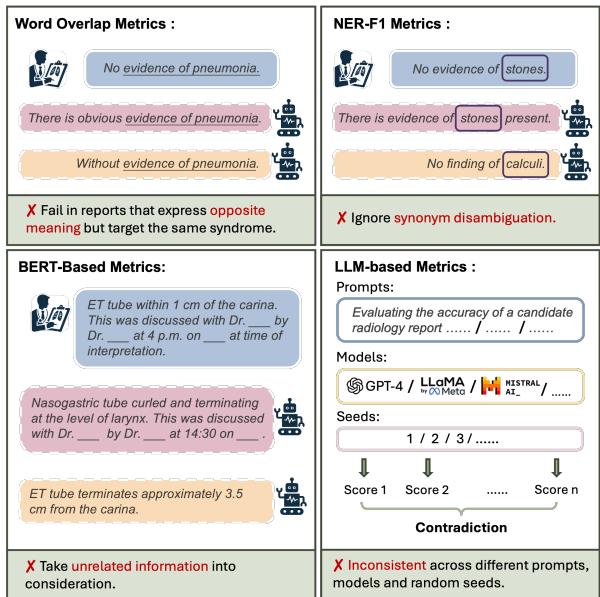
As shown in Figure 1 above, existing metrics struggle to capture the nuance of medical text.
- Word Overlap Metrics (like BLEU) miss the difference between “No evidence” and “Obvious evidence.”
- NER-F1 Metrics focus on named entities but struggle with synonyms (thinking “stones” and “stones present” are different).
- BERT-Based Metrics look at semantic meaning but can get confused by unrelated details, like nasogastric tubes, when the report should be about pneumonia.
We need a metric that thinks like a doctor: one that cares about medical entities (what is the body part? what is the disease?) and clinical reality (is the disease present or absent?).
Introducing RaTEScore: An Entity-Aware Metric
The researchers developed RaTEScore (Radiological Text Evaluation Score) to address these exact gaps. RaTEScore is designed to be “entity-aware.” It doesn’t view a report as a string of words; it views it as a collection of medical facts.
The method works by decomposing complex medical reports into specific entities (like “lung,” “opacity,” “pneumonia”) and then comparing those entities using a sophisticated scoring system that handles synonyms and negations.
The Pipeline
The architecture of RaTEScore is a three-step pipeline:
- Medical Named Entity Recognition (NER): Extracting clinical concepts.
- Synonym Disambiguation: Understanding that different words can mean the same thing.
- Scoring: Calculating a weighted similarity score.
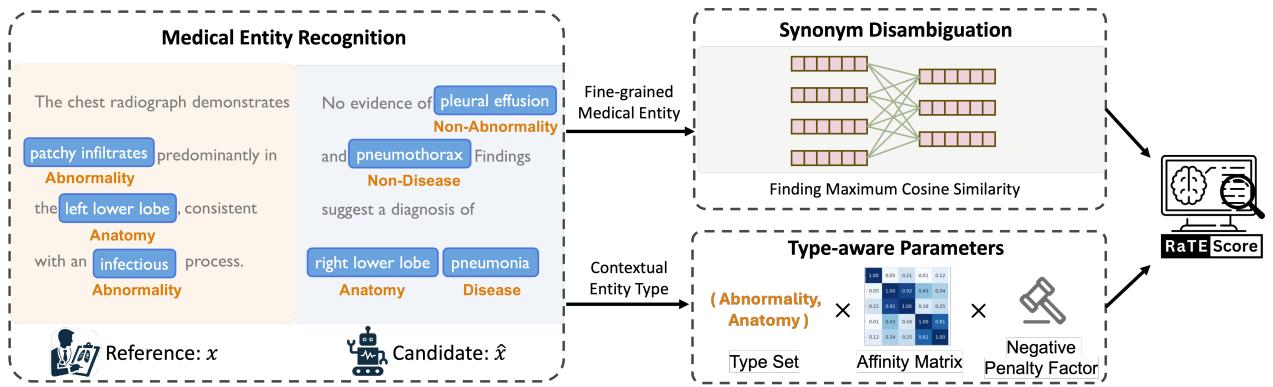
Let’s break down each component of this pipeline to understand the mechanics under the hood.
Step 1: Medical Named Entity Recognition (NER)
The first step is to clean up the noise. The system reads the radiology report (\(x\)) and extracts specific medical entities. But it doesn’t just extract the words; it classifies them into five distinct types:
- Anatomy: Body parts (e.g., “left lower lobe”).
- Abnormality: Radiological findings (e.g., “mass,” “effusion”).
- Disease: High-level diagnoses (e.g., “pneumonia”).
- Non-Abnormality: Abnormalities that are explicitly mentioned as absent (e.g., “no effusion”).
- Non-Disease: Diseases explicitly mentioned as absent.
This categorization is crucial. By separating “Abnormality” from “Non-Abnormality,” the system is explicitly programmed to pay attention to negation.
Mathematically, the NER module ($ \Phi_{NER} \() converts the text into a set of tuples, where each tuple contains the entity name (\)n\() and its type (\)t$):

Step 2: Synonym Disambiguation Encoding
Once the entities are extracted, the system needs to compare the entities in the AI-generated report (\(\hat{x}\)) against the entities in the ground-truth doctor’s report (\(x\)).
A simple string match won’t work here because of synonyms. If the doctor writes “renal cyst” and the AI writes “kidney cyst,” they should match. To solve this, RaTEScore uses a Synonym Disambiguation Encoding Module (\(\Phi_{ENC}\)).
The researchers use a pre-trained model called BioLORD, which is specifically trained on medical definitions. This model converts every entity name into a vector (a list of numbers) in a high-dimensional space. In this space, synonyms like “renal” and “kidney” appear very close to each other.

This step results in a set of feature embeddings (\(\mathbf{F}\)) representing the clinical content of the report.
Step 3: The Scoring Procedure
Now comes the “grading” phase. The system compares the embeddings from the reference report against the candidate report.
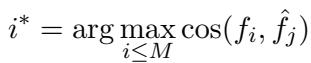
First, for every entity in the reference report, the system looks for the “best match” in the candidate report. It does this by calculating the Cosine Similarity between the embeddings. It searches for the entity (\(i^*\)) that maximizes this similarity:
However, finding a semantic match isn’t enough. We also need to check the Type.
Imagine the AI matches “pleural effusion” correctly as a concept. But, in the reference report, it was tagged as Non-Abnormality (absent), and in the AI report, it was tagged as Abnormality (present). This is a critical medical error.
To handle this, RaTEScore applies a penalty function. If the types match (e.g., both are Abnormality), the full similarity score is kept. If the types mismatch, the score is multiplied by a penalty factor \(p\).

Finally, the system calculates the overall score. It doesn’t just average everything out. It uses a learnable Affinity Matrix (\(W\)). This matrix assigns different weights to different types of entities based on their clinical importance. For example, matching two “Abnormality” entities might be weighted more heavily than matching two “Anatomy” entities, because missing a disease is worse than being vague about a location.

The final RaTEScore is calculated similarly to an F1-score. It computes the similarity in both directions (Reference \(\to\) Candidate and Candidate \(\to\) Reference) and takes the harmonic mean. This ensures that the AI is penalized for both hallucinations (inventing things not in the reference) and omissions (missing things that are in the reference).

Building the Ecosystem: RaTE-NER and RaTE-Eval
A sophisticated metric like RaTEScore requires high-quality data to work. The researchers couldn’t just use existing datasets because most are limited to chest X-rays. They needed a generalist metric that works for brains, abdomens, spines, and more.
The RaTE-NER Dataset
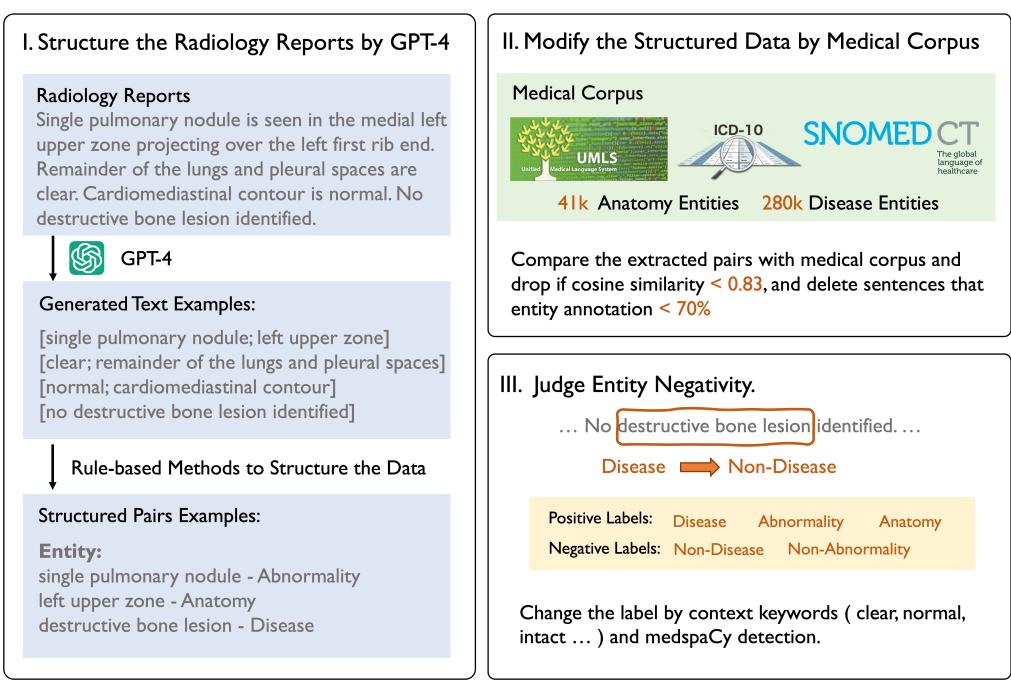
To train the NER component, the authors constructed RaTE-NER, a massive dataset derived from MIMIC-IV and Radiopaedia.
What makes RaTE-NER special is its diversity. It covers 9 imaging modalities (like CT, MRI, Ultrasound) and 22 anatomical regions. This ensures that RaTEScore isn’t just a “lung expert” but a general “radiology expert.”
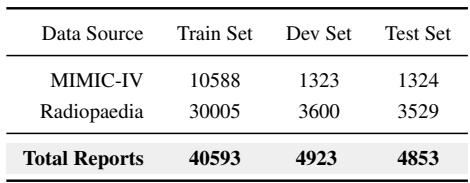
To build this dataset efficiently, they used a clever automated pipeline involving GPT-4. They prompted GPT-4 to extract entities from reports and then refined those extractions using established medical knowledge bases (like UMLS and SNOMED CT) to ensure accuracy.
The RaTE-Eval Benchmark
How do we know if RaTEScore is actually better than BLEU or BERTScore? We need to test it against the gold standard: Human Radiologists.
The researchers created the RaTE-Eval benchmark. They took thousands of report sentences and paragraphs and asked experienced radiologists to rate them. They looked for specific errors:
- False prediction of findings.
- Omission of findings.
- Incorrect location.
- Incorrect severity.
This benchmark allows us to measure the correlation between an automated metric (like RaTEScore) and human judgment.
Experiments and Results
The results of the experiments strongly validate the RaTEScore approach. The researchers compared their metric against standard baselines (BLEU, ROUGE, BERTScore) and domain-specific metrics (RadGraph F1).
Alignment with Human Judgment
The most critical test was the correlation with human radiologists. In the graph below, each dot represents a report. The X-axis represents the radiologists’ error count (normalized), and the Y-axis represents the automated metric’s score.
A perfect metric would show a tight diagonal line (high correlation).
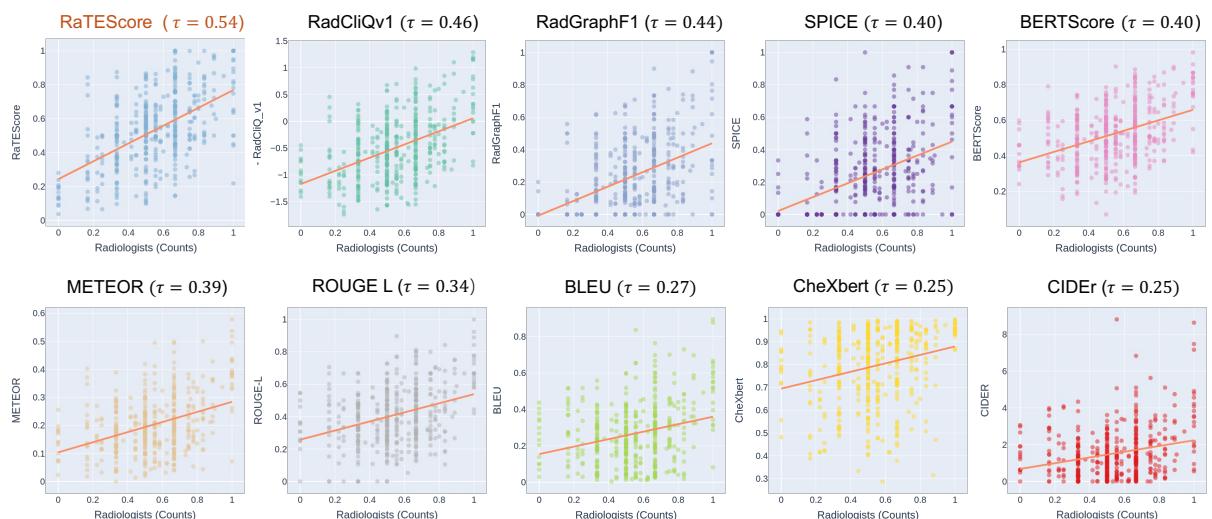
Look at the difference between RaTEScore (top left) and BLEU (bottom row, middle).
- RaTEScore shows a strong, clear correlation (\(\tau = 0.54\)). As the radiologist finds fewer errors (moving right on the X-axis), the RaTEScore goes up.
- BLEU is a scattered cloud (\(\tau = 0.27\)). A report could have a high BLEU score but still be rated poorly by a doctor, or vice versa.
This proves that RaTEScore is significantly better at “thinking” like a radiologist than word-overlap metrics.
Robustness to Synonyms
The researchers also ran a simulation test. They used an LLM to rewrite reports using synonyms (which should have a high score) and antonyms (which should have a low score).
- Synonym Check: “The appendix is well visualized” vs. “The appendix is seen.”
- Antonym Check: “The appendix is well visualized” vs. “The appendix is poorly visualized.”
RaTEScore achieved the highest accuracy in distinguishing these cases, confirming that its embedding-based approach successfully handles medical vocabulary variations while staying sensitive to negation.
Conclusion and Implications
The development of RaTEScore represents a significant step forward for medical AI. By moving away from rigid word matching and toward entity-aware evaluation, we can build trust in automated systems.
Here are the key takeaways:
- Context Matters: Medical evaluation requires understanding entities (diseases, anatomy) and their status (present/absent), not just matching words.
- Breadth is Crucial: Unlike previous metrics focused only on chest X-rays, RaTEScore is designed for the full spectrum of radiology (CT, MRI, Ultrasound).
- Human Alignment: Extensive testing shows that RaTEScore agrees with radiologists far more often than traditional NLP metrics.
As we continue to develop Foundation Models for healthcare, tools like RaTEScore will act as the necessary guardrails. They allow researchers to benchmark progress accurately, ensuring that when an AI generates a report, it isn’t just grammatically correct—it’s clinically factual.