](https://deep-paper.org/en/paper/2406.17274/images/cover.png)
In the rapidly evolving world of Natural Language Generation (NLG), we have witnessed Large Language Models (LLMs) perform feats that were considered science fiction only a decade ago. From summarizing complex financial reports to condensing medical records, abstractive text summarization is reshaping industries.
However, there is a catch. LLMs hallucinate. They can generate summaries that sound fluent and confident but are factually incorrect. In high-stakes domains—like healthcare or finance—relying on a false summary can have catastrophic consequences.
To mitigate this, researchers have developed Uncertainty Estimation (UE) methods. Think of UE as the “Check Engine” light for an AI model. It provides a score indicating how likely the generated summary is to be wrong. If the uncertainty score is high, a human should verify the output.
But here lies the critical question posed by a recent research paper from Virginia Tech and the University of Texas at Dallas: How do we know if the “Check Engine” light is working?
To evaluate a UE method, we compare its uncertainty scores against the actual quality of the text. But how do we measure “actual quality” in text summarization? We use NLG metrics like ROUGE, BERTScore, or GPT-4 evaluation. The researchers found a troubling dependency: the performance ranking of uncertainty methods changes drastically depending on which quality metric you use to evaluate them.
In this deep dive, we will explore the comprehensive benchmark proposed by the authors, dissect the mechanics of Uncertainty Estimation on Text Summarization (UE-TS), and reveal why our current evaluation frameworks might be less reliable than we assumed.
1. The Core Problem: A Metric Dependency
To understand the gravity of the problem, we must look at how we currently validate AI models.
In traditional machine learning (like classification), evaluation is binary. If an image shows a cat and the model predicts “dog,” the model is wrong. Uncertainty estimation is easy to test here: if the model predicts “dog” with high uncertainty, the UE method is working.
In text summarization, there is no single “correct” summary. A sentence can be rephrased in a dozen ways and still be accurate. Conversely, it can be fluent but factually wrong. Because of this ambiguity, we rely on a suite of NLG Metrics to score summaries.
The researchers identified two primary issues with the current state of affairs:
- Single-Metric Reliance: Most studies evaluate their uncertainty methods using only one or two NLG metrics (usually ROUGE).
- Metric Disagreement: Different NLG metrics measure different things. ROUGE checks for word overlap. SummaC checks for factual consistency. If these metrics disagree on what a “bad summary” is, they will also disagree on whether the uncertainty method correctly identified it.
If our rulers are inconsistent, we cannot measure anything accurately.
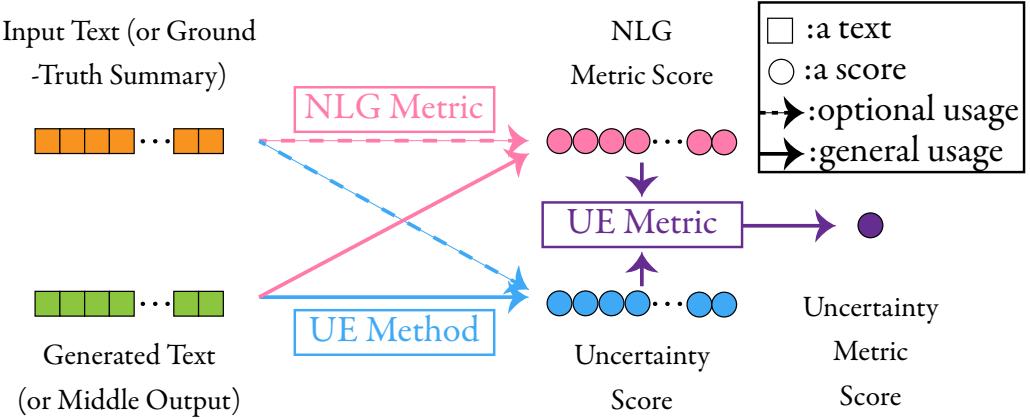
As illustrated in Figure 1, the evaluation process is a complex pipeline.
- Left: We have the input text and the model’s generated output.
- Center: We feed these into two parallel processes. The UE Method (Blue) produces an uncertainty score (predicting potential failure). Simultaneously, an NLG Metric (Pink) produces a quality score (measuring actual success).
- Right: These two streams merge into a UE Metric (Purple), which calculates how well the uncertainty score predicted the quality score.
The paper argues that if you change the “Pink” box (the NLG metric), the final result in the “Purple” box changes unpredictably.
2. The Benchmark: A Comprehensive Approach
To prove this hypothesis, the authors constructed a massive benchmark for UE-TS (Uncertainty Estimation for Text Summarization). This is not a small-scale test; it is designed to be exhaustive.
The Setup
The benchmark evaluates:
- Models: Two Large Language Models (LLMs) including Llama 2, and one Pre-trained Language Model (BART).
- Datasets: Three distinct datasets, including AESLC (emails), XSUM (BBC news), and TofuEval (human-annotated dialogue summaries).
- Scale: They incorporated 31 NLG metrics and 14 Uncertainty Estimation methods.
This creates a matrix of evaluations that allows us to see correlations (or lack thereof) between different ways of measuring “trust.”
The “Rulers”: NLG Metrics
The authors categorized the 31 NLG metrics into four critical dimensions defined by previous research:
- Relevance: Does the summary contain the important information? (e.g., ROUGE-L).
- Consistency: Is the summary factually aligned with the source? (e.g., SummaC, BERTScore).
- Coherence: Do the sentences flow logically?
- Fluency: Is the grammar and sentence structure high quality?
They also used LLM-based metrics (using GPT-3.5 to grade summaries), testing prompts that included specific dimension definitions and prompts that didn’t.
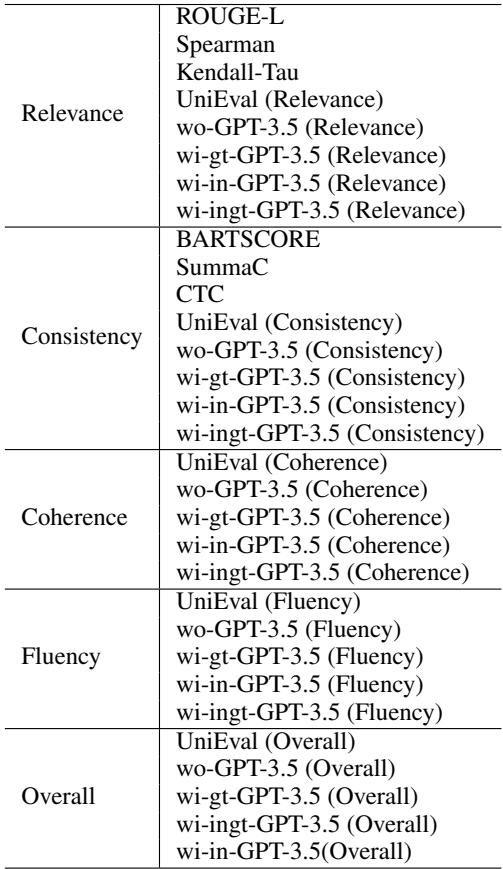
Table 2 lists the diverse arsenal of metrics used. Note the inclusion of traditional overlap metrics (ROUGE) alongside modern model-based metrics (UniEval, BERTScore). This diversity is key to uncovering the discrepancies in evaluation.
The “Subjects”: Uncertainty Estimation Methods
How does a model know it is unsure? The authors tested 14 methods, split into White-box (access to model internals/logits) and Black-box (access only to text output).
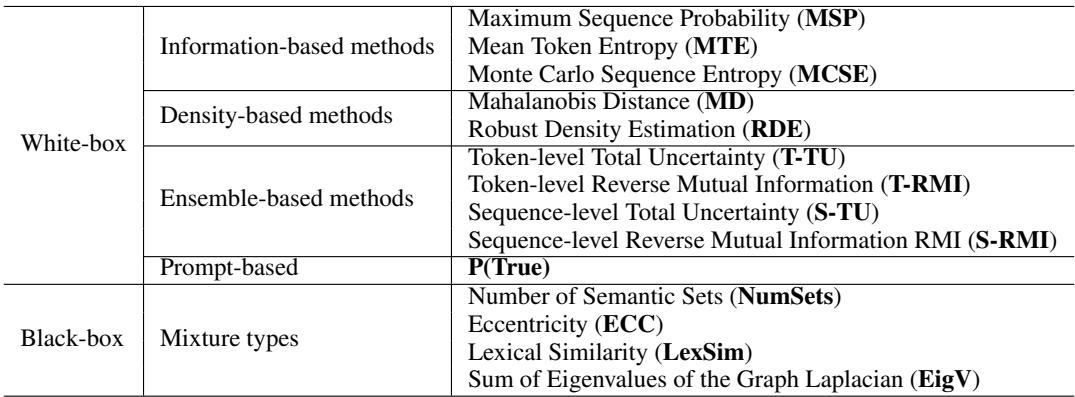
As shown in Table 1, these methods use different signals:
- Information-based: Looking at the probability of specific tokens (e.g., Mean Token Entropy).
- Density-based: Analyzing the latent space embeddings of the generation (e.g., Mahalanobis Distance).
- Ensemble-based: Running the model multiple times with variations (dropout) and measuring how different the outputs are.
- Black-box: Asking the model “Are you sure?” or analyzing the similarity of multiple generated samples.
3. The Core Method: Measuring “Trust” with PRR
How do we mathematically determine if an uncertainty method is good? The authors utilize a metric called the Prediction Rejection Ratio (PRR).
The intuition behind PRR is simple: If we reject (delete) the samples where the model is most uncertain, the average quality of the remaining samples should go up.
If your uncertainty method is perfect, it will assign high uncertainty scores to all the bad summaries. As you filter those out, you are left only with the good ones. If your uncertainty method is random, filtering out “uncertain” samples won’t improve the average quality of the remaining batch.
The Mathematics of PRR
The calculation involves ranking samples. Let’s look at the formula used:

Here, \(PRR\) compares the risk of the uncertainty method against a random baseline and an “Oracle” (perfect) baseline.
- \(PR_{uncertainty}\): The cumulative risk when we rank samples by the uncertainty method.
- \(PR_{random}\): The risk if we just shuffle samples randomly.
- \(PR_{oracle}\): The theoretical best performance (ranking samples exactly by their true error).
A higher PRR indicates that the uncertainty method is much better than random guessing and closer to the Oracle.
But what is “Risk”? The authors define risk (\(r_{NLG}\)) based on the NLG metric score.

If the NLG score (normalized) is 1.0 (perfect summary), the risk is 0. If the score is 0, the risk is 1.
The process of calculating the cumulative risk is visualized clearly in Figure 2.
 (Note: The request provided
 images/014.jpg as Figure 3 in the alt text, but the visual content of Figure 2 described in the text matches the concept of ranking. Assuming standard sequential logic, let’s examine the specific diagram for PRR calculation provided in the deck. Checking the deck… The deck provided images/002.jpg as the equation/diagram for Risk. Let’s use that.)
Correction: The image deck contains a specific diagram for the calculation flow.

Walkthrough of Figure 2:
- Risks (\(r_{NLG}\)): We start with the actual risk values derived from the NLG metric.
- Rank (\(a_\phi\)): We rank these samples based on the Uncertainty Method’s scores. In a perfect world, the highest risk items (value 1) would be ranked first.
- Rerank: We order the risk vector according to the uncertainty rank.
- Cumulative Sum: We create a curve of cumulative risk using the equation below:

- Mean: The average of this cumulative curve gives us the Area Under the Curve (AUC)-like metric, which represents the performance.
The crucial takeaway here is that \(r_{NLG}\) (the risk) depends entirely on the NLG metric chosen. If ROUGE says a summary is good (Low Risk) but BERTScore says it is bad (High Risk), the entire PRR calculation flips, and the evaluation of the uncertainty method changes.
4. Experiments & Results: The Chaos of Correlation
The authors ran extensive experiments to see how these rankings correlated. They used Spearman Correlation to compare how different metrics rank the UE methods.
If the evaluation framework is robust, we should see high correlations (red blocks) across the board. If it is fragile, we will see low correlations or disagreements.
4.1. Do NLG Metrics Agree with Each Other?
First, let’s look at whether the “rulers” agree. The authors compared the 31 NLG metrics against each other.
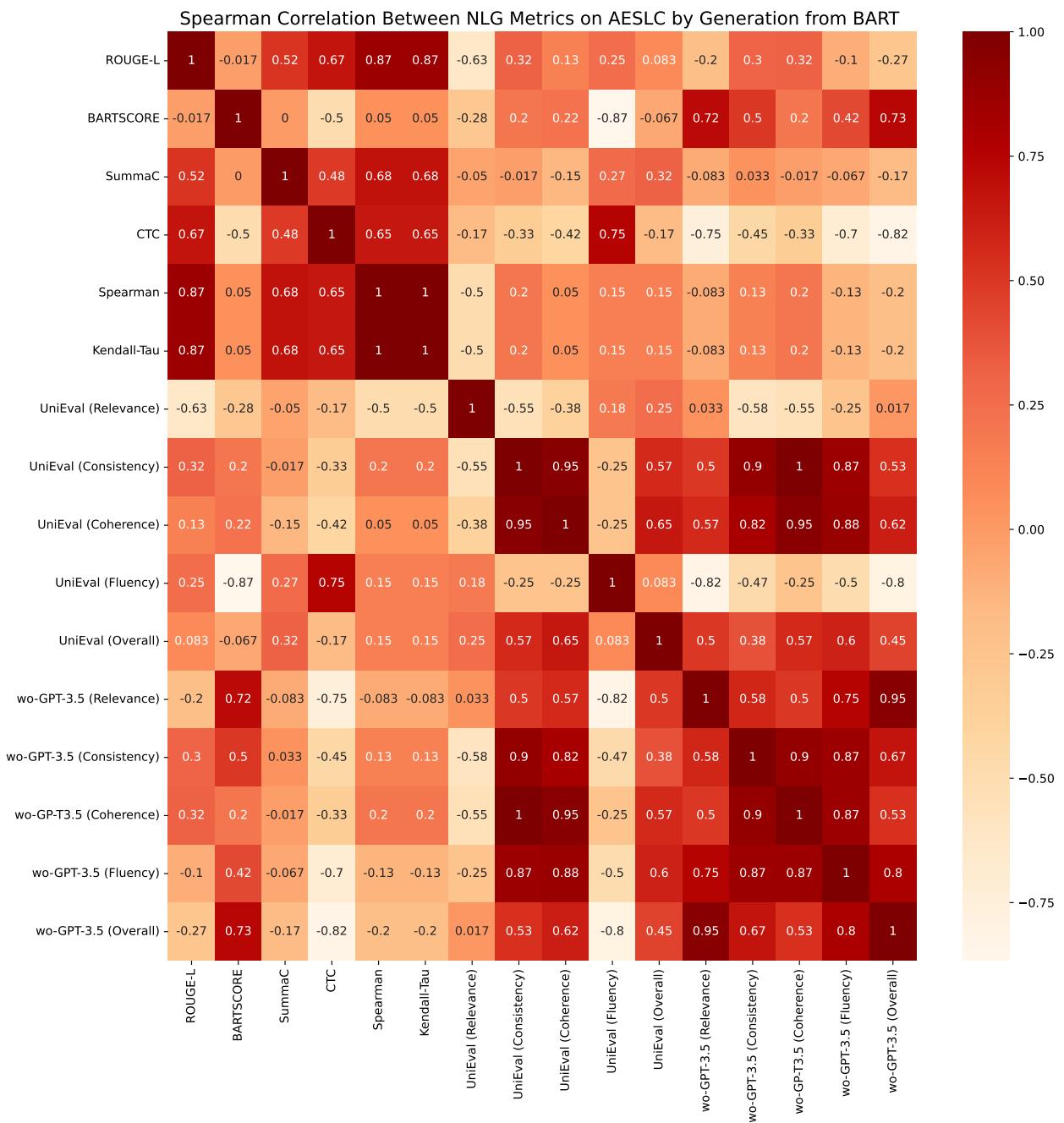
Figure 3 (AESLC dataset, BART generation) reveals a fragmented landscape.
- The Cluster of Agreement: Notice the block of red in the top left? ROUGE-L, Spearman, and Kendall-Tau correlate well (values near 0.87-1.0).
- The Disagreement: Look at UniEval (Relevance) vs. ROUGE-L. The correlation is -0.63. This is a massive contradiction. It means a summary that ROUGE thinks is relevant, UniEval thinks is irrelevant.
- Consistency vs. Fluency: Metrics designed for fluency often negatively correlate with those designed for consistency.
This implies that if you evaluate your uncertainty model using ROUGE, you might conclude it works perfectly. But if you switch to UniEval, you might conclude the same model is garbage.
4.2. Do Uncertainty Methods Correlate?
Next, the researchers analyzed the relationships between the uncertainty methods themselves. If “uncertainty” is a singular concept, these methods should all behave similarly.
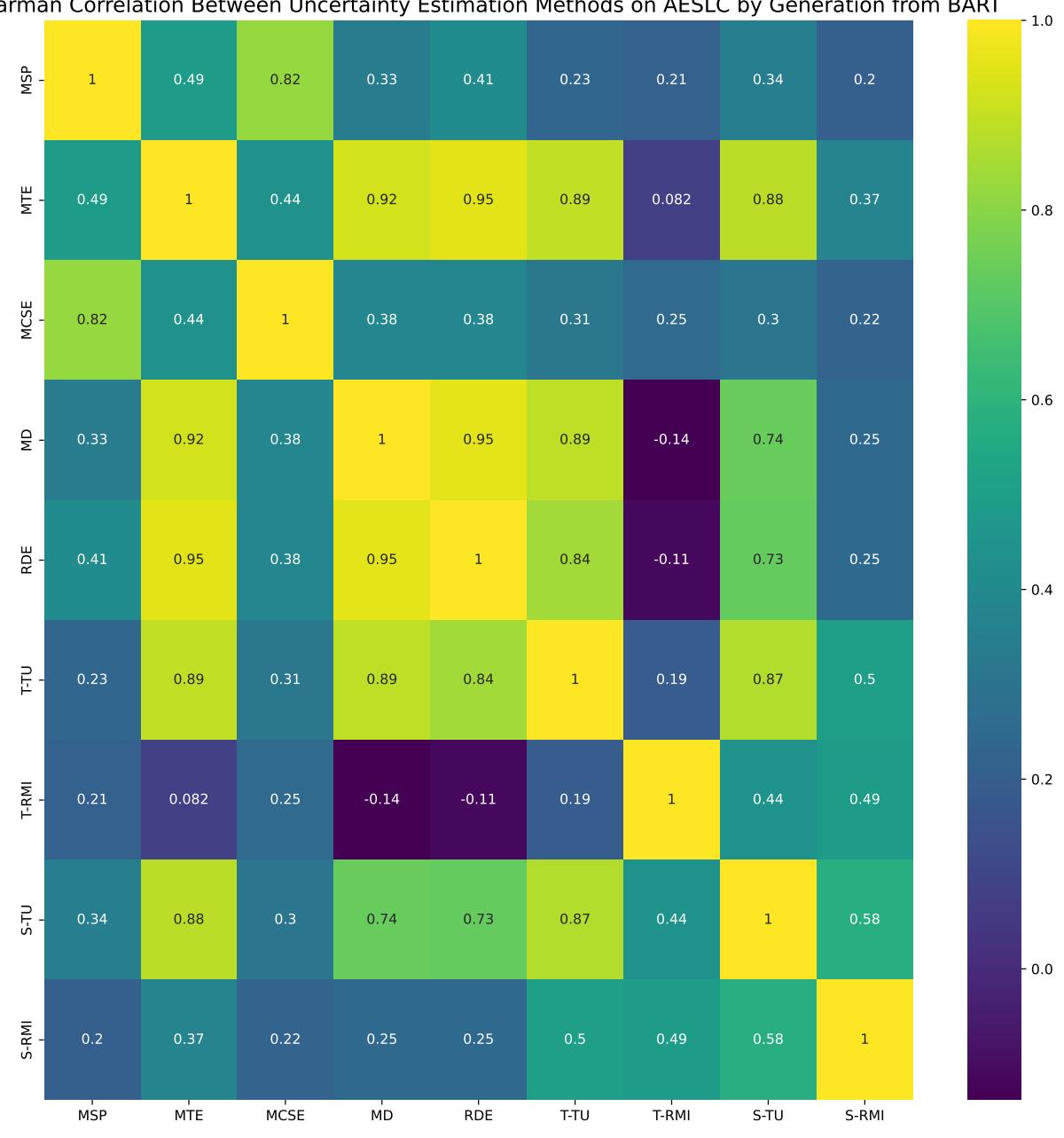
Figure 6 shows the correlation between uncertainty methods on the AESLC dataset.
- Information-based Agreement: MSP (Maximum Sequence Probability) and MCSE (Monte Carlo Sequence Entropy) have high correlation (0.97). They are measuring similar probability artifacts.
- The Outlier: P(True), a prompt-based method where the model is asked if it is correct, shows negative correlation (-0.14 to -0.2) with almost all other methods. This suggests that the model’s “verbal” confidence is completely disconnected from its mathematical probability confidence.
4.3. The Impact of the Generation Model
Does the choice of the summarizer (BART vs. Llama 2) change these relationships?
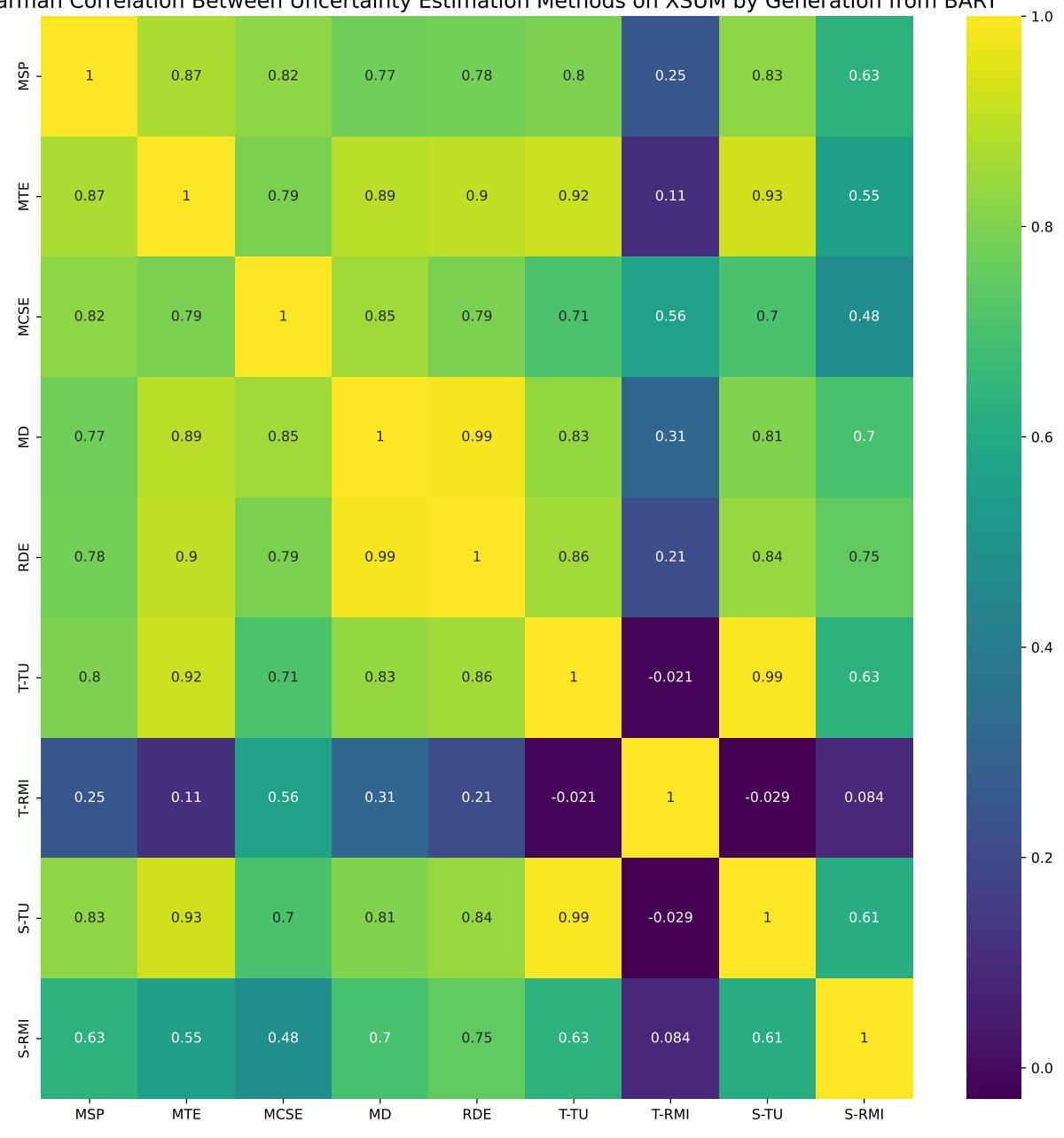
Figure 12 (BART on XSUM) shows a mix of correlations. Now compare this to Figure 14 (Llama 2 on XSUM) below:
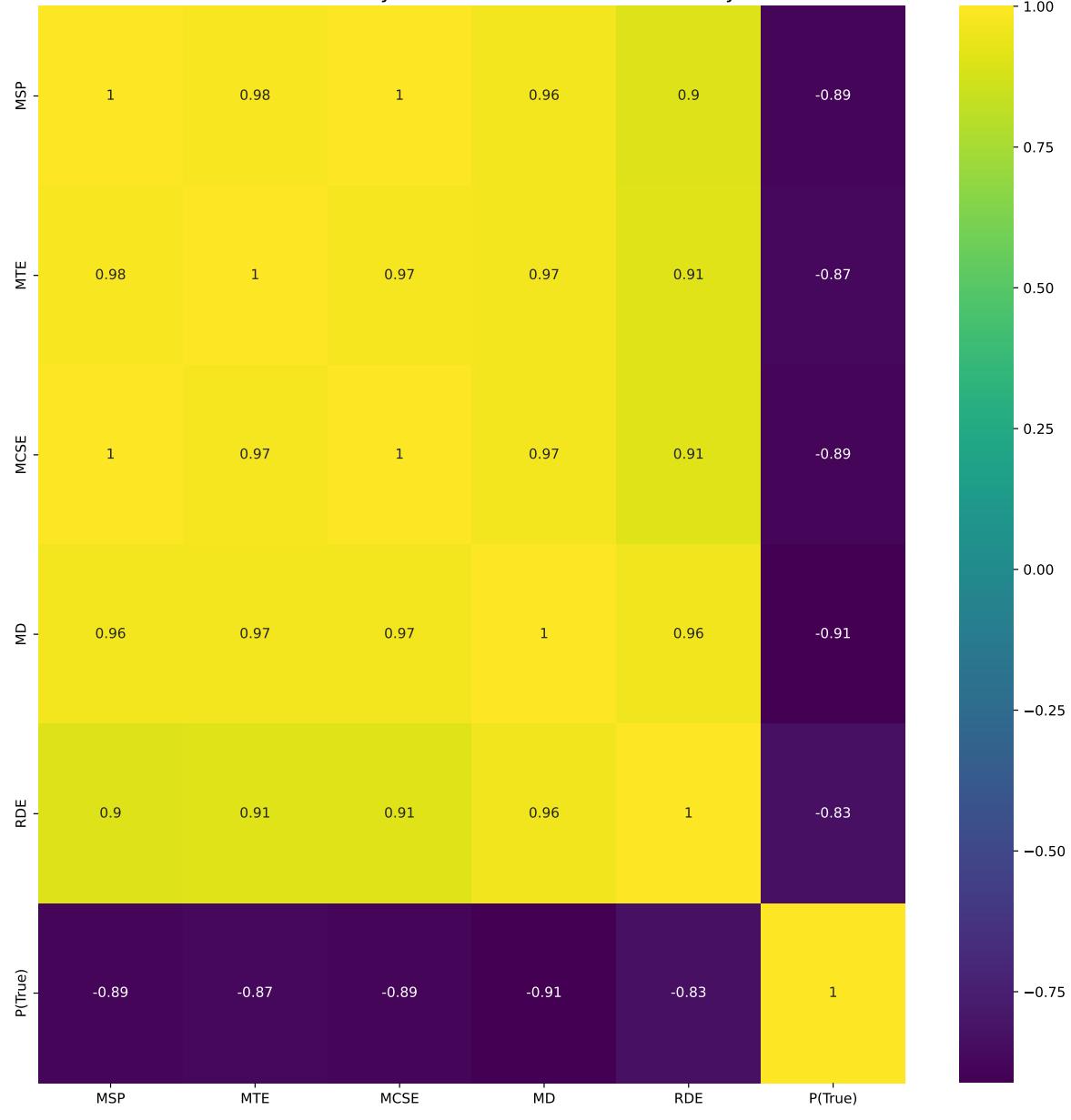
In Figure 14, we see a much stronger block of positive correlation (the yellow block) among the white-box methods (MSP, MTE, MD, RDE) for Llama 2. This suggests that for modern LLMs, different internal uncertainty measurements are more consistent with each other than they are for older PLMs like BART. However, P(True) remains a stubborn outlier, negatively correlated with the math-based methods.
4.4. Consistency Dimension Analysis
The paper dives deep into specific dimensions. Let’s look at Consistency—arguably the most important dimension for preventing hallucinations.
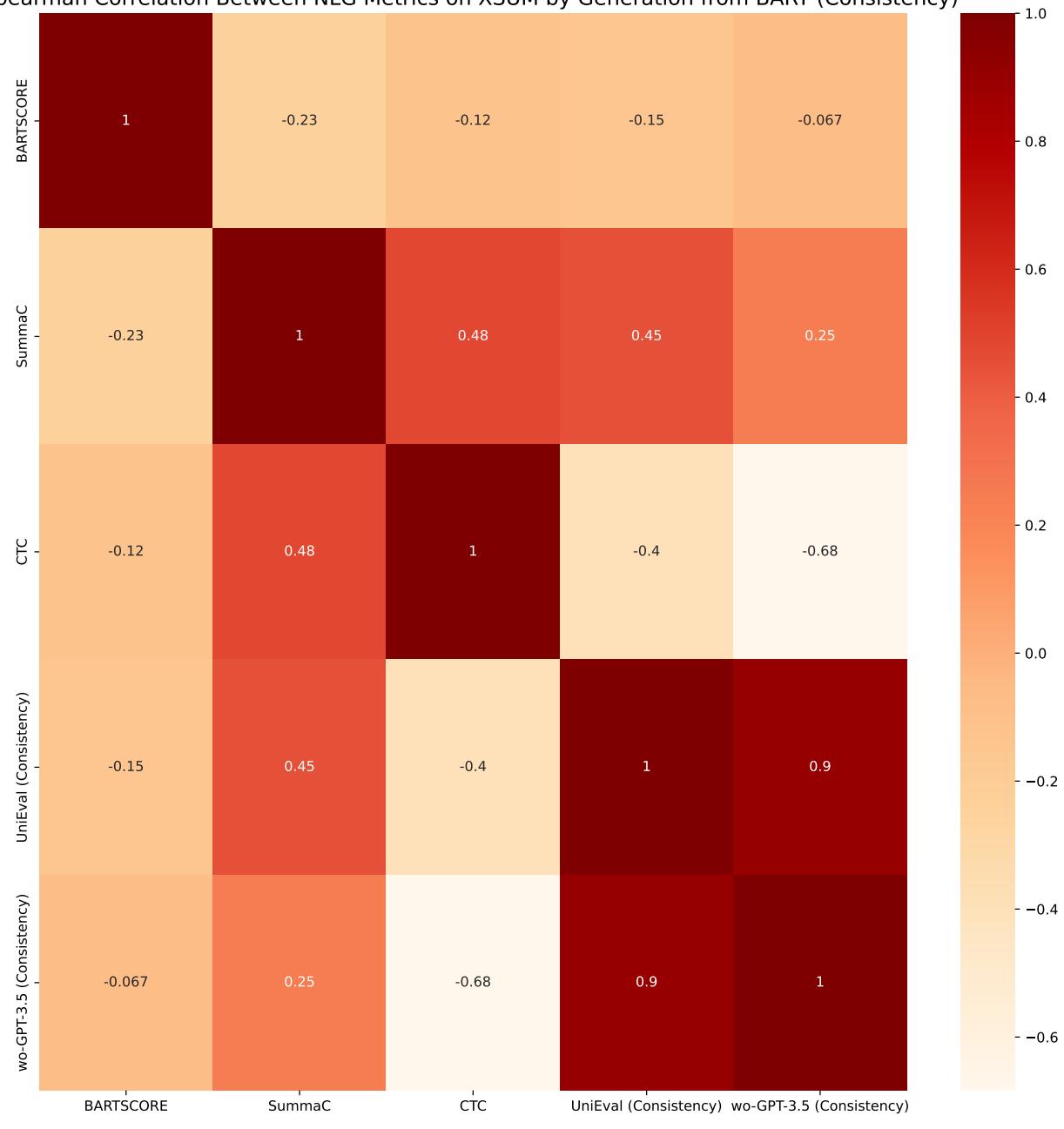
Figure 30 highlights a fascinating split.
- UniEval (Consistency) and wo-GPT-3.5 (Consistency) correlate strongly (0.9).
- SummaC and CTC, which are specialized consistency metrics, correlate well with each other.
- The Gap: However, the correlation between the UniEval group and the SummaC group is much weaker or even negative in other datasets.
This confirms the authors’ fear: “Consistency” is not a single, agreed-upon definition. An uncertainty method tuned to maximize SummaC performance might fail miserably when evaluated against GPT-4 or UniEval.
5. Human Evaluation: The Ultimate Truth?
Given that automated metrics disagree, the authors turned to the “gold standard”: Human Annotation. They used the TofuEval dataset, where humans annotated summaries for errors like contradictions, hallucinations, and formatting issues.
They tested how well uncertainty methods (UE) and NLG metrics aligned with human judgments (HUM).
UE-HUM Results
When comparing uncertainty methods directly to human labels:
- LexSim (Lexical Similarity) performed the best. This method generates multiple summaries and checks how similar they are. If the model generates 5 very different summaries, it is likely hallucinating.
- No single method was perfect across all human error types (e.g., a method good at spotting “Contradictions” might be bad at spotting “Reasoning Errors”).
NLG-HUM Results
This was the most revealing part. The researchers calculated the PRR using NLG metrics as the “uncertainty score” (assuming lower NLG score = higher uncertainty) and compared it to human labels.
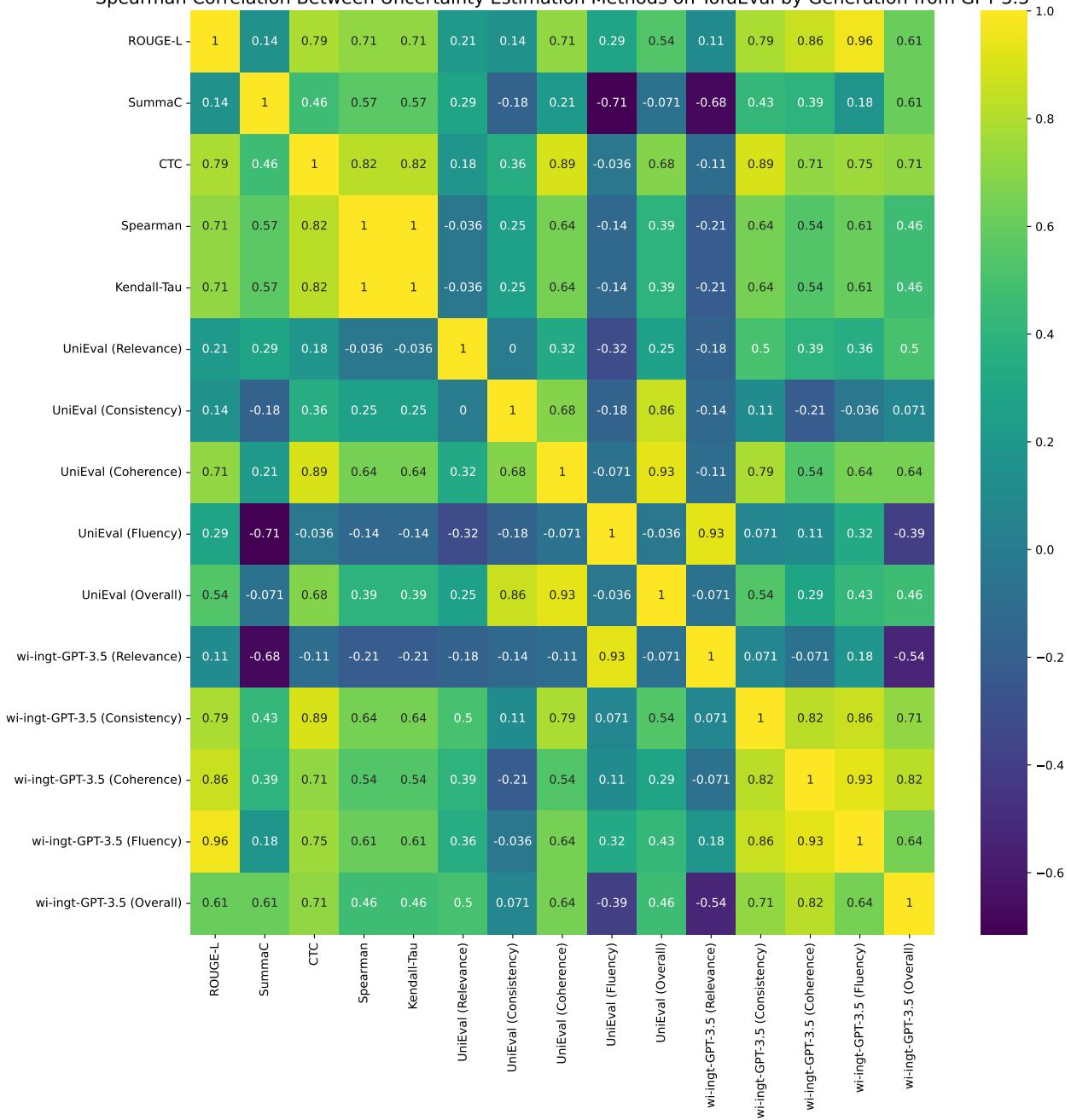
Figure 41 shows the correlation between NLG metrics based on human annotation.
- Discrepancy: While some metrics correlate (dark red blocks), there are vast areas of low or negative correlation.
- Takeaway: NLG metrics do not perfectly proxy human judgment. Relying on them to validate uncertainty methods introduces a layer of noise that can obscure the true performance of the model.
6. Key Takeaways and Implications
This paper serves as a wake-up call for the NLP community. We cannot simply run a benchmark using ROUGE and claim our uncertainty estimation method is “State of the Art.”
Here are the summarized findings from the study:
1. The Metric Matters
The rank of your uncertainty method depends heavily on your choice of NLG metric.
- Action: Researchers should evaluate UE methods against multiple, uncorrelated NLG metrics. Don’t just use ROUGE and BLEU (which are highly correlated). Use a mix of overlap-based (ROUGE), embedding-based (BERTScore), and model-based (UniEval/GPT) metrics.
2. Method Selection
- Ensemble Methods: T-TU (Total Uncertainty) and S-RMI (Reverse Mutual Information) are strong baselines.
- White-box Methods: MSP and MCSE are highly correlated; you likely only need to compute one.
- Black-box Methods: LexSim (generating multiple samples and comparing them) often aligns best with human judgment regarding hallucinations.
3. The “P(True)” Trap
Asking an LLM “Are you sure?” (the P(True) method) often yields results that are negatively correlated with mathematical uncertainty. The model’s verbal confidence is a poor proxy for its actual probabilistic uncertainty.
4. LLMs as Judges
When using GPT-3.5 or similar models as evaluators (NLG metrics), the prompt matters. Interestingly, the authors found that providing the definition of the dimension (e.g., explaining what “Coherence” means) significantly impacts the evaluation, sometimes separating the metric’s performance from those that don’t use definitions. Furthermore, using ground-truth summaries as a reference influences the score more than using the input text.
Conclusion
Can we trust the performance evaluation of uncertainty estimation methods? The answer is: Not blindly.
Trust is a construct we build by verifying results against reality. In Text Summarization, “reality” is hard to define mathematically. This paper demonstrates that our current definitions of reality (NLG metrics) are fractured.
To build truly reliable AI systems for critical domains, we must embrace this complexity. We need multidimensional evaluation frameworks that acknowledge the disagreement between metrics, rather than sweeping it under the rug of a single F1 score. Only by testing our “Check Engine” lights against varied and rigorous standards can we ensure they will actually turn on when we need them most.