](https://deep-paper.org/en/paper/2406.18060/images/cover.png)
Introduction
The rapid evolution of Large Language Models (LLMs) like Llama-2 and RoBERTa has revolutionized natural language processing. However, adapting these massive models to specific tasks—a process known as fine-tuning—presents a significant computational barrier. As model sizes balloon into the billions of parameters, the GPU memory required to train them via standard methods becomes prohibitively expensive.
The culprit is backpropagation. In traditional First-Order (FO) optimization (like SGD or AdamW), the training process requires storing intermediate activation values for every layer to calculate the gradient chain rule. For a multi-billion parameter model, this “memory wall” often requires clusters of enterprise-grade GPUs.
Recently, researchers have turned to Zeroth-Order (ZO) optimization methods, such as MeZO, to bypass this wall. ZO methods estimate gradients using only forward passes, completely eliminating the need to store a backpropagation graph. This can reduce memory usage by up to 8x. However, there is no free lunch: ZO methods are notoriously unstable. They suffer from high variance, slow convergence, and frequently diverge (fail to learn) when applied to very large models.
Enter AdaZeta.
In a new paper titled AdaZeta: Adaptive Zeroth-Order Tensor-Train Adaptation for Memory-Efficient Large Language Models Fine-Tuning, researchers from UC Santa Barbara and Amazon AGI propose a novel framework that stabilizes ZO fine-tuning. By combining ultra-low-parameter tensorized adapters with a smart, adaptive schedule for gradient estimation, AdaZeta achieves the memory benefits of ZO methods while matching or exceeding the performance of traditional fine-tuning approaches.
In this deep dive, we will explore the mechanics of AdaZeta, understanding how it tames the instability of memory-efficient training.
Background: The Challenges of Efficient Fine-Tuning
To understand AdaZeta, we first need to understand the landscape of efficient LLM training and where current methods fall short.
Parameter-Efficient Fine-Tuning (PEFT)
Standard fine-tuning updates every weight in a model. PEFT methods, like LoRA (Low-Rank Adaptation), freeze the pre-trained model and only train small, injected adapter layers. While this reduces the number of trainable parameters, standard implementations still rely on backpropagation, meaning the memory savings are limited by the need to store the computation graph.
Zeroth-Order (ZO) Optimization
ZO optimization treats the neural network as a “black box.” Instead of calculating exact gradients using calculus (backpropagation), it estimates them.
Imagine you are on a rugged mountain (the loss landscape) in the dark. You want to find the bottom (minimum loss).
- First-Order (Backprop): You have a map and a flashlight. You calculate the exact slope under your feet and take a step down.
- Zeroth-Order: You can’t see the slope. You take a small step in a random direction, check if you went up or down, step back, and then use that information to guess the slope.
The mathematical formulation for this “guessing” is often done via Randomized Gradient Estimation (RGE). While memory-efficient, this guessing game introduces noise (variance). As the number of dimensions (parameters) grows, the accuracy of these guesses plummets, making it hard for the model to learn.
Tensor-Train Decomposition
To combat the high dimensionality problem, AdaZeta utilizes Tensor-Train (TT) Decomposition. This is a mathematical technique used to represent large matrices as a sequence of smaller, low-rank tensors.
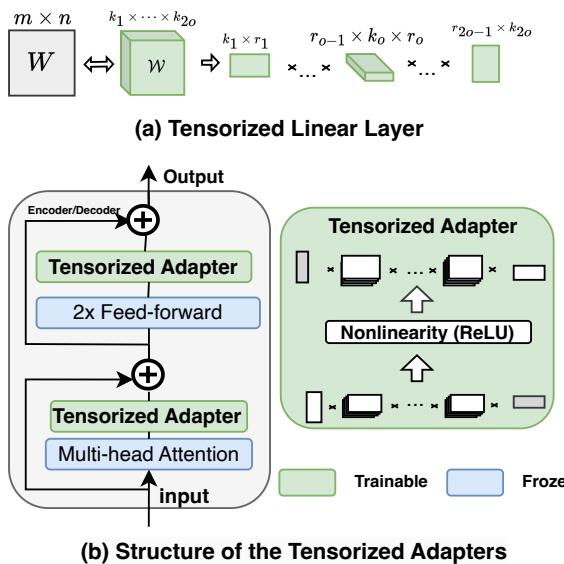
As shown in Figure 2 above:
- (a) Tensorized Linear Layer: A massive weight matrix \(\mathbf{W}\) is factorized into a chain of smaller tensors \(\mathcal{G}\).
- (b) Structure of Tensorized Adapter: These lightweight tensor layers are inserted into the Transformer blocks (Feed-forward and Attention mechanisms).
By using TT decomposition, the number of trainable parameters drops drastically—even more so than with LoRA. This is crucial for ZO optimization because estimating gradients in a lower-dimensional space is significantly more accurate.
The AdaZeta Framework
The core contribution of the paper is the AdaZeta framework, which addresses the two main failure points of previous ZO methods: poor estimation accuracy due to high dimensionality and training divergence due to gradient variance.
The framework consists of two pillars:
- Fast-Forward Tensorized Adapters (to reduce dimensions).
- Adaptive Query Schedule (to reduce variance).
1. Fast-Forward Tensorized Adapters
Standard ZO methods struggle because they try to estimate gradients for millions of parameters at once. AdaZeta mitigates this by using tensorized adapters to compress the trainable space.
In a standard linear layer, weights are stored in a matrix \(\mathbf{W}\). In a Tensor-Train format, this matrix is reshaped into a tensor and decomposed. However, calculating the output of a TT layer involves contracting (multiplying) a sequence of tensors, which can be slow if done sequentially.
Since ZO optimization requires two forward passes for every gradient step, inference speed is critical. AdaZeta introduces a parallel contraction method. Instead of multiplying tensors one by one (\(1 \to 2 \to 3 \dots\)), it divides the tensor factors into groups to process them simultaneously.
The reshaping and contraction process can be mathematically represented as:
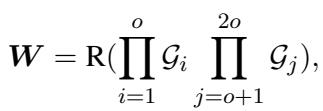
Here, \(\mathcal{G}\) represents the tensor factors. By grouping them (e.g., separating indices \(1\) to \(o\) and \(o+1\) to \(2o\)), the framework avoids high-dimensional intermediate tensors and speeds up the forward pass. This allows AdaZeta to use ultra-compressed adapters without suffering a speed penalty during training.
2. Adaptive Query Adjustment
The second, and perhaps most impactful, innovation is how AdaZeta handles gradient estimation.
In ZO optimization, a “Query” refers to one instance of perturbing the weights and checking the loss.
- 1 Query: Perturb weights once, check loss, estimate gradient. High noise, high speed.
- N Queries: Perturb weights \(N\) times with different random seeds, average the results. Low noise, low speed.
Previous methods like MeZO typically use a fixed number of queries (often just 1). The researchers found that for large models (like Llama-2-7B), a single query is too noisy, leading to divergence (the model stops learning and the loss explodes). Conversely, using a large fixed number of queries (e.g., 10) makes training excruciatingly slow.
AdaZeta proposes an Adaptive Query Schedule. The idea is to start with a small number of queries when the model is in the early stages of learning, and progressively increase the number of queries to refine the gradient estimation as training proceeds.
The schedule follows a sub-linear increase based on the training epoch \(e_k\):

Where:
- \(Q_k\) is the number of queries at step \(k\).
- \(\alpha\) and \(\beta\) are scaling factors (between 0 and 1).
- \(Q_{max}\) is a cap to prevent the process from becoming too slow.
The AdaZeta Algorithm
Let’s look at how this comes together in the training loop. The algorithm performs the following steps for every update:
- Determine Query Count: Calculate \(Q_k\) based on the current epoch.
- Estimate Gradient: Loop \(Q_k\) times to accumulate gradient estimates.
Inside the loop, for each query \(q\), the algorithm performs the classic two-point estimation:
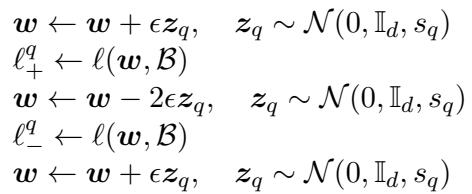
In the snippet above:
- \(z_q\) is a random Gaussian perturbation vector.
- \(\ell_+^q\) is the loss with weights shifted by \(+\epsilon z_q\).
- \(\ell_-^q\) is the loss with weights shifted by \(-\epsilon z_q\).
Finally, the estimated gradient is the average of these \(Q_k\) perturbations, used to update the weights \(w\):
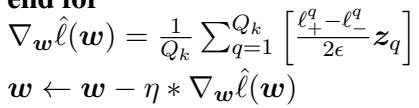
By averaging over multiple queries, the variance of the gradient estimate decreases significantly. By increasing \(Q_k\) adaptively, AdaZeta ensures that the training remains fast in the beginning and becomes more precise exactly when it needs to—preventing the divergence issues that plague standard MeZO.
Theoretical Convergence
Why does this work? The authors provide a theoretical analysis proving that this method guarantees convergence.
The convergence bound of the algorithm is derived as:

Without getting bogged down in the notation, here is the key takeaway: The term on the right-hand side contains \(\sum \frac{1}{Q_k}\).
- If \(Q_k\) is constant (e.g., 1), the error term remains large.
- If \(Q_k\) increases over time (as in AdaZeta), the sum shrinks, tightening the bound and guaranteeing that the gradient approaches zero (convergence).
- Additionally, the term \(C(d, \epsilon)\) depends on the dimension \(d\). Because the Tensorized Adapters keep \(d\) very small, the overall error bound is much lower than applying ZO to the full model.
Experiments and Results
The researchers evaluated AdaZeta on RoBERTa-Large (medium scale) and Llama-2-7B (large scale) across various tasks including sentiment analysis, reasoning, and question answering.
1. Convergence Stability
The most striking visual result is how stable AdaZeta is compared to other methods.
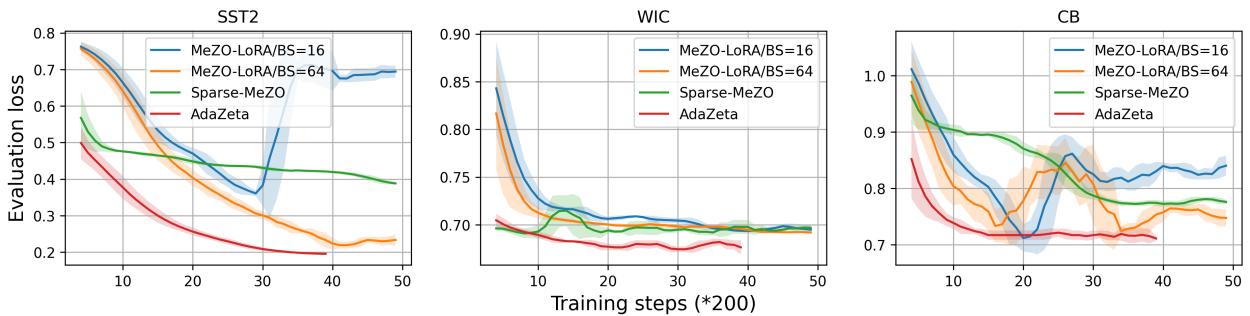
In Figure 1, looking at the Llama-2-7B training curves:
- Blue/Orange lines (MeZO-LoRA): These show significant instability. Notice how the loss fluctuates or barely decreases.
- Green line (Sparse-MeZO): Performs better but still exhibits variance.
- Red line (AdaZeta): Shows a smooth, steep, and consistent drop in evaluation loss, converging to a lower point than all baselines.
This confirms that the adaptive query schedule successfully mitigates the divergence risk.
2. Accuracy on Large Models
When tested on Llama-2-7B with low data resources (SuperGLUE and SQuAD datasets), AdaZeta outperformed the baselines significantly.
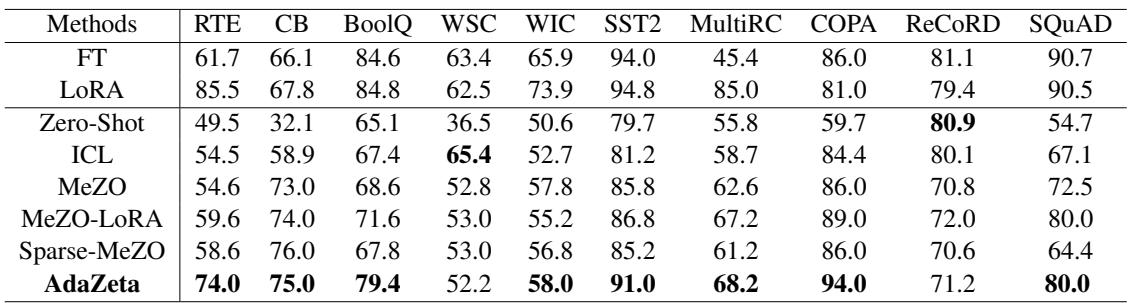
Table 2 highlights:
- AdaZeta vs. MeZO-LoRA: AdaZeta achieves higher scores in almost every task. For example, on the RTE task, AdaZeta scores 74.0 compared to MeZO-LoRA’s 59.6.
- AdaZeta vs. First-Order (FT): Remarkably, in several tasks (like COPA and CB), AdaZeta even outperforms the standard First-Order fine-tuning (FT), despite using a fraction of the memory. This suggests that the regularization effect of the tensor adapters combined with ZO noise might actually help generalization in low-data regimes.
3. Memory Efficiency
The primary goal of ZO methods is memory reduction. AdaZeta excels here.
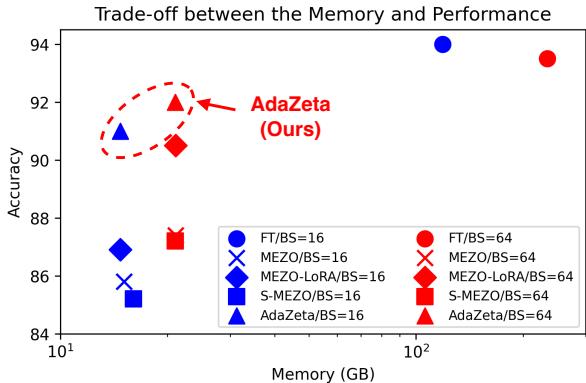
Figure 3 illustrates the trade-off. Ideally, you want to be in the top-left corner (High Accuracy, Low Memory).
- Blue Circles (FT - First Order): High accuracy, but massive memory usage (far right).
- Red/Blue Triangles (AdaZeta): Located far to the left (low memory) but high up on the accuracy axis, surpassing other memory-efficient methods like Sparse-MeZO and MeZO-LoRA.
Detailed memory profiling reveals the extent of these savings:
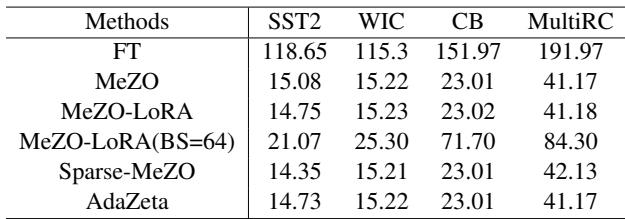
As shown in Table 10, fine-tuning Llama-2-7B on the SST-2 task using standard First-Order methods requires 118.65 GB of memory. AdaZeta requires only 14.73 GB. This creates an 8x memory reduction, making it possible to fine-tune a 7B model on a single consumer-grade GPU (like an RTX 3090 or 4090).
4. Comparison with LoRA
A common question is: “Why not just use LoRA with a batch size of 1?”

Table 4 answers this. Even with a batch size of 1 and Rank 1 (the absolute minimum for LoRA), standard First-Order LoRA requires 35.60 GB. AdaZeta with Rank 8 requires only 14.05 GB.
Because First-Order LoRA still needs to store the activation graph for the backpropagation pass (even if the graph is smaller), it cannot compete with the “forward-pass only” nature of AdaZeta.
Conclusion
The AdaZeta framework represents a significant step forward in making Large Language Model fine-tuning accessible. By addressing the twin challenges of high dimensionality and gradient estimation variance, it transforms Zeroth-Order optimization from an unstable curiosity into a robust, practical tool.
Key Takeaways:
- Tensorized Adapters drastically reduce the search space, making gradient estimation easier and more accurate.
- Adaptive Query Scheduling eliminates the divergence issues that plague large-scale ZO training, offering smooth convergence without a massive speed penalty.
- Efficiency: AdaZeta enables fine-tuning of 7B+ parameter models on hardware with less than 16GB of VRAM, with performance that rivals or beats full-memory methods.
For students and researchers with limited hardware resources, AdaZeta offers a blueprint for how to work smarter, not just harder, when adapting massive foundation models.