](https://deep-paper.org/en/paper/2406.18134/images/cover.png)
Large Language Models (LLMs) have transformed how we interact with information, but they have a well-known flaw: their knowledge is static. They only know what they were trained on, which means they can’t answer questions about current events or private enterprise data.
The standard solution to this problem is Retrieval-Augmented Generation (RAG). In a RAG system, when you ask a question, the system first searches a database for relevant documents (context) and feeds them to the LLM alongside your query. Ideally, the LLM uses this context to generate a precise, up-to-date answer.
But there is a catch. Retrievers are not perfect.
What happens when the retrieval system fetches irrelevant, misleading, or “distracting” documents? In many cases, the LLM trusts the retrieved context blindly and hallucinates an incorrect answer based on the bad information. This dependency makes the entire system only as strong as its weakest link: the retriever.
In this post, we will dive deep into a research paper that assesses “Implicit” Retrieval Robustness. The researchers ask a fundamental question: Do we need complex, multi-step pipelines to filter out bad context, or can we simply train LLMs to instinctively ignore irrelevant information?
The Two Approaches to Robustness
When building RAG systems, engineers generally fall into two camps regarding how to handle the risk of bad retrieval: Explicit and Implicit modeling.
The Explicit Approach
The explicit approach treats relevance as a separate decision-making step. Before the LLM tries to answer the question, a component (either a separate model or a specific prompt chain) analyzes the retrieved context and asks, “Is this relevant?”
- If Yes: The context is passed to the generator.
- If No: The context is discarded, and the LLM relies on its internal training data.
While this sounds logical, it adds latency (time) and complexity. It also introduces a new point of failure: if the relevance judge is wrong, the downstream answer will be wrong.
The Implicit Approach
The implicit approach attempts to be more elegant. It feeds the query and the retrieved context (whether good or bad) directly into the LLM in an end-to-end manner. The goal is for the LLM to learn internally how to weigh the evidence. It should use the context if it helps, and ignore it if it doesn’t.
The researchers visualize this distinction clearly in the diagram below:
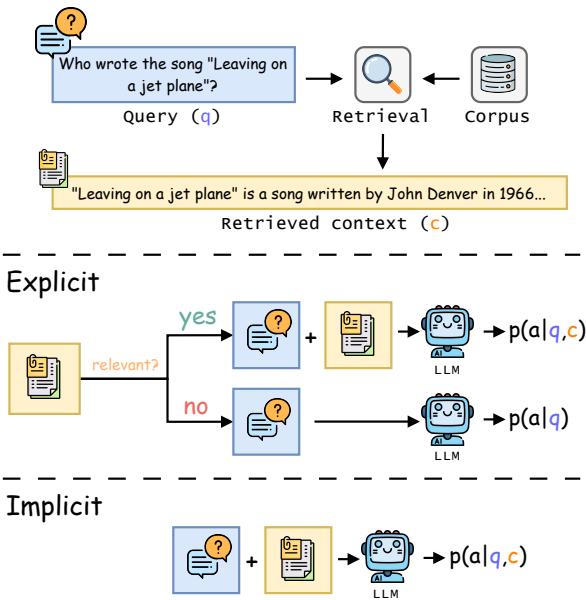
The research paper focuses on evaluating and improving this Implicit Model. The hypothesis is that with the right training, we don’t need the explicit “judge” step.
Defining Retrieval Robustness
To measure success, we need a rigorous definition of what it means to be “robust.” The authors define a retrieval-robust LLM as one that possesses two distinct capabilities:
- Capability I: When the context is helpful (contains the answer), the model must use it to provide the correct answer.
- Capability II: When the context is unhelpful (distracting), the model must ignore it and fall back on its own internal parameterized knowledge.
Mathematically, the researchers describe the ideal probability distribution, \(p_{\mathrm{robust}}\), as follows:
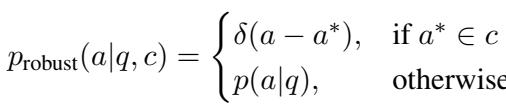
In simple terms, this equation states: If the correct answer (\(a^*\)) is in the context (\(c\)), output the correct answer. Otherwise, behave as if you are only relying on the question (\(q\)), effectively ignoring \(c\).
Experimental Setup
To test these capabilities, the researchers set up a comprehensive evaluation involving multiple model families and diverse datasets.
The Models
They tested open-source models (Vicuna and Llama 2 of various sizes) against closed-source giants (GPT-3.5 and GPT-4). This comparison helps identify whether robustness is just a feature of “smarter” models or something that can be trained into smaller ones.
The Datasets
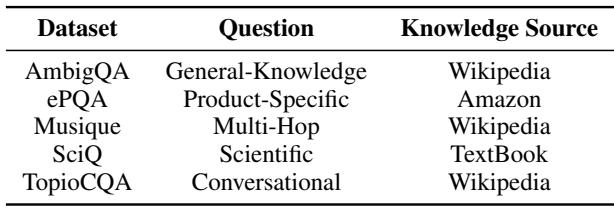
Robustness isn’t one-size-fits-all. A model might be good at ignoring bad Wikipedia articles but terrible at ignoring irrelevant product details. To address this, the study used 5 datasets covering general knowledge, product specifics, multi-hop reasoning, scientific questions, and conversational history.
The Prompting Strategy
Crucially, the prompt used for the models included a specific instruction for robustness:
“The context is retrieved information which may or may not be helpful. When the context is unhelpful, answer it with your own knowledge.”
This gives the model permission to ignore the input, which is vital for testing Capability II.
Results: How Do Models Perform Out of the Box?
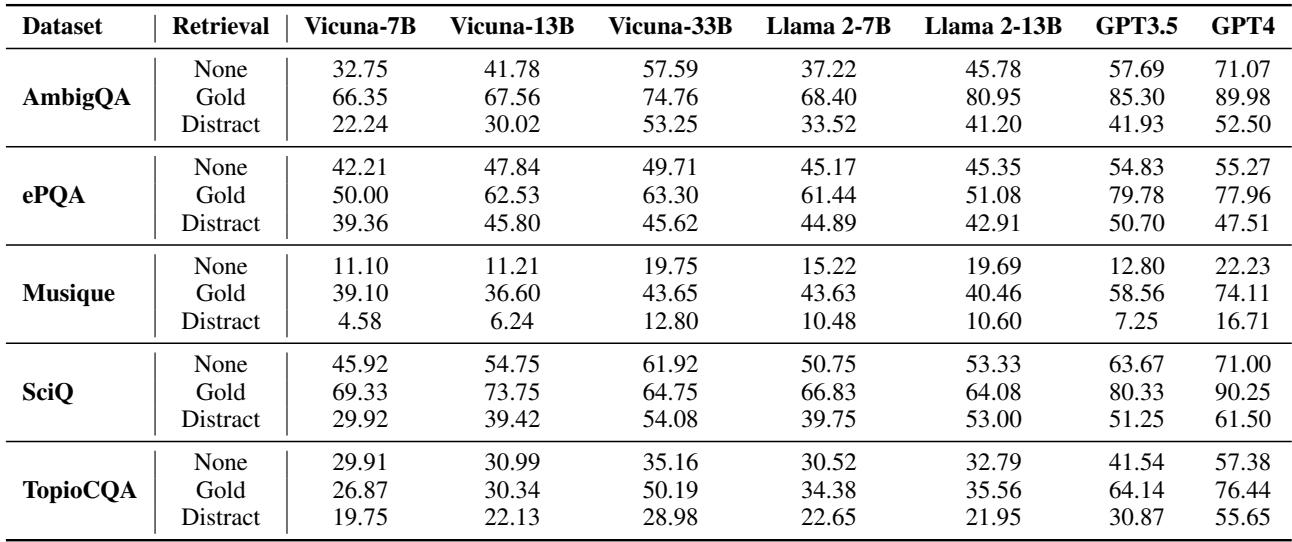
First, let’s look at how these models perform without any specific fine-tuning for this task. They simply took the pre-trained models and prompted them.
The evaluation covers three scenarios:
- None: No context provided (testing internal knowledge).
- Gold: Perfect context provided (testing Capability I).
- Distract: Irrelevant/misleading context provided (testing Capability II).
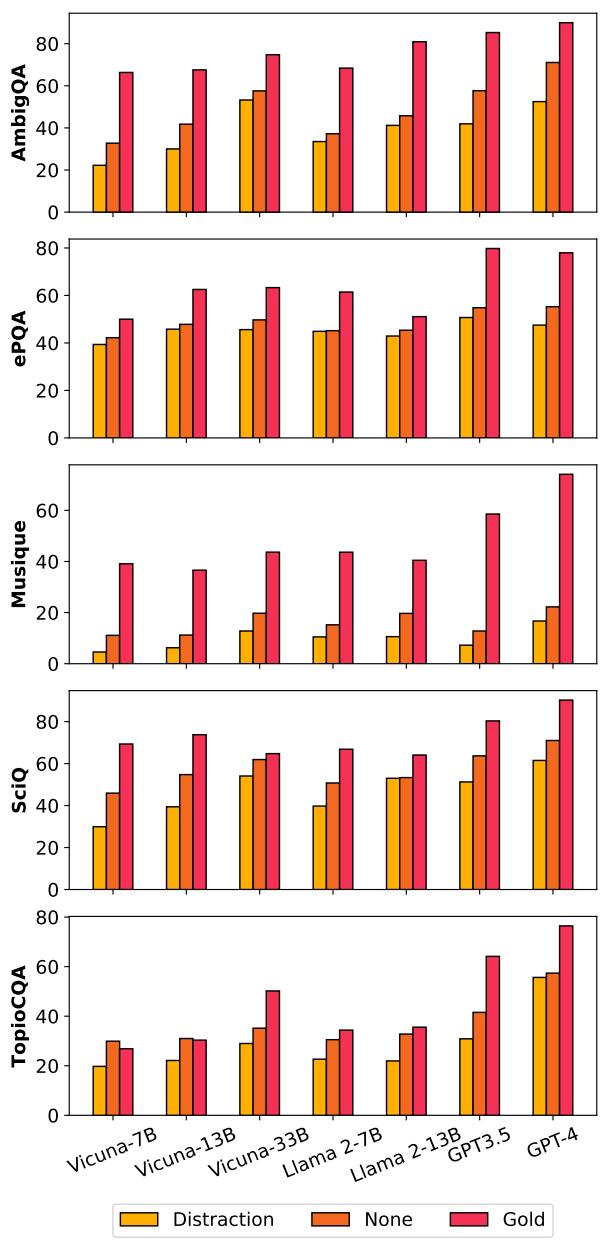
Key Takeaways from Zero-Shot Testing:
- Capability I (Gold Bars): When given the perfect context, GPT-4 significantly outperforms open-source models (Vicuna/Llama). The closed-source models are much better at reasoning over the text to extract the answer.
- Capability II (Yellow Bars): When given distracting context, performance drops for everyone. However, surprisingly, open-source models are often comparable to or even better than GPT-4 at resisting distraction relative to their baseline.
- The Size Factor: Larger models generally handle distractions better. They have better instruction-following capabilities and “realize” they should ignore the bad data.
The conclusion here is that while standard LLMs are okay, they are far from perfect. They are easily swayed by bad context.
The Danger of “Gold-Only” Fine-Tuning
In a typical machine learning workflow, if you want your model to get better at a task (like RAG), you fine-tune it. Usually, developers create a training dataset where every question is paired with the correct (Gold) context.
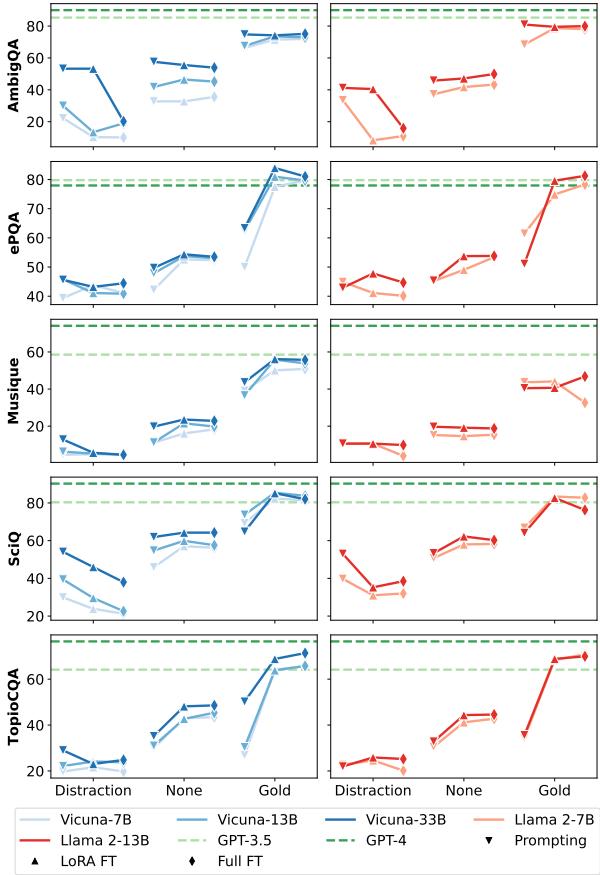
The researchers tested this common approach. They fine-tuned the models using only Gold context and then tested them again on both Gold and Distracting contexts.
The Trap
Fine-tuning on Gold context (the pink bars) massively improves Capability I. The models become experts at extracting answers from relevant documents.
However, there is a hidden cost. Look at the “Distraction” scores (the yellow bars/lines) in Figure 3. By training only on perfect examples, the models learn an incorrect correlation: “The context is always right.”
They lose their skepticism. When later presented with bad context in the real world, these fine-tuned models are more likely to be misled than the original base models. They have sacrificed Capability II (Robustness) to maximize Capability I (Extraction).
The Solution: Training with “Noise”
Here is the core contribution of the paper. To fix the robustness issue, the researchers propose mixing “distracting” (noisy) context into the fine-tuning process.
They created training datasets with mixed ratios of Gold and Distracting context. This forces the model to learn a more complex function: not just “extract from context,” but “evaluate context, then extract or fallback.”
Does Noise Hurt Performance on Good Data?
The first fear engineers might have is that training on garbage data will make the model worse at answering correct questions.
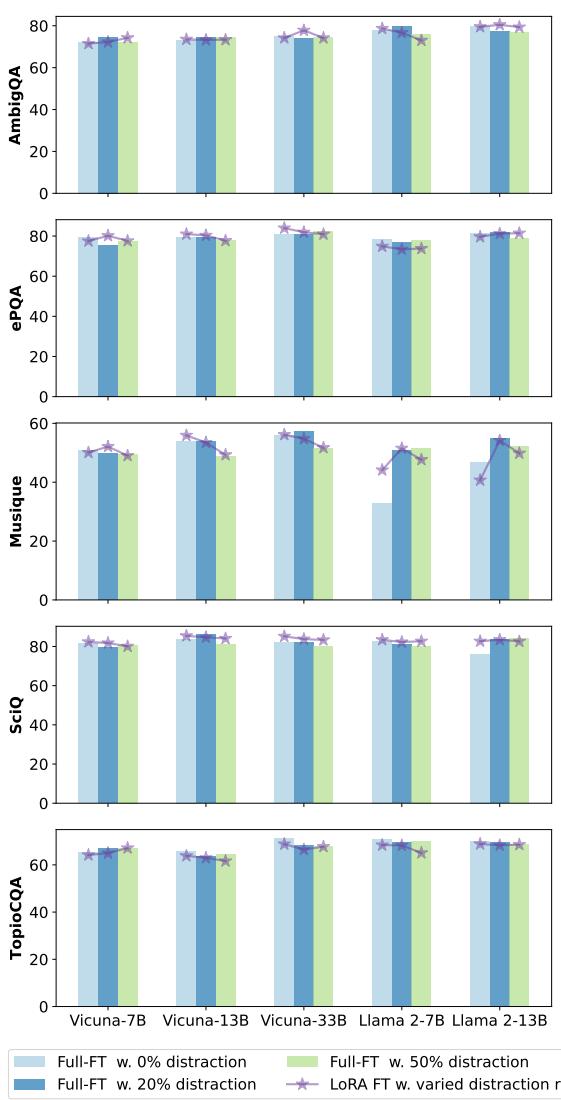
As shown in Figure 4, the answer is No. Even when 50% of the training data consisted of distracting context, the model’s ability to answer questions given Gold context remained high (and in some complex cases like MuSiQue, it actually improved). Capabilities I and II are not mutually exclusive; the model has enough capacity to learn both.
Does Noise Improve Robustness?
This is the moment of truth. Does this training mix actually help the model ignore bad data?
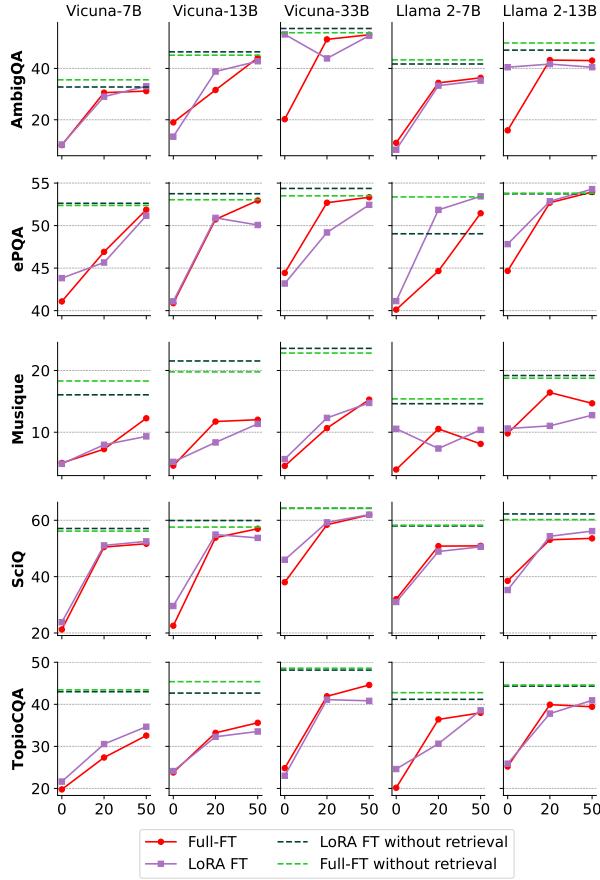
As Figure 5 demonstrates, the improvement is dramatic.
- 0% Noise (Standard Fine-Tuning): The models perform poorly on distracting context.
- 50% Noise: The models effectively “recover” their internal knowledge. Their performance on distracting context rises to match their performance with “No Context.”
This means the model has successfully learned to identify the garbage context, discard it, and rely on its internal training—achieving the ideal “Implicit Robustness” without any external filtering mechanism.
Tables and Detailed Data
For those interested in the specific numbers, the paper provides detailed breakdowns across all datasets and models.
Prompting Performance (Zero-Shot):
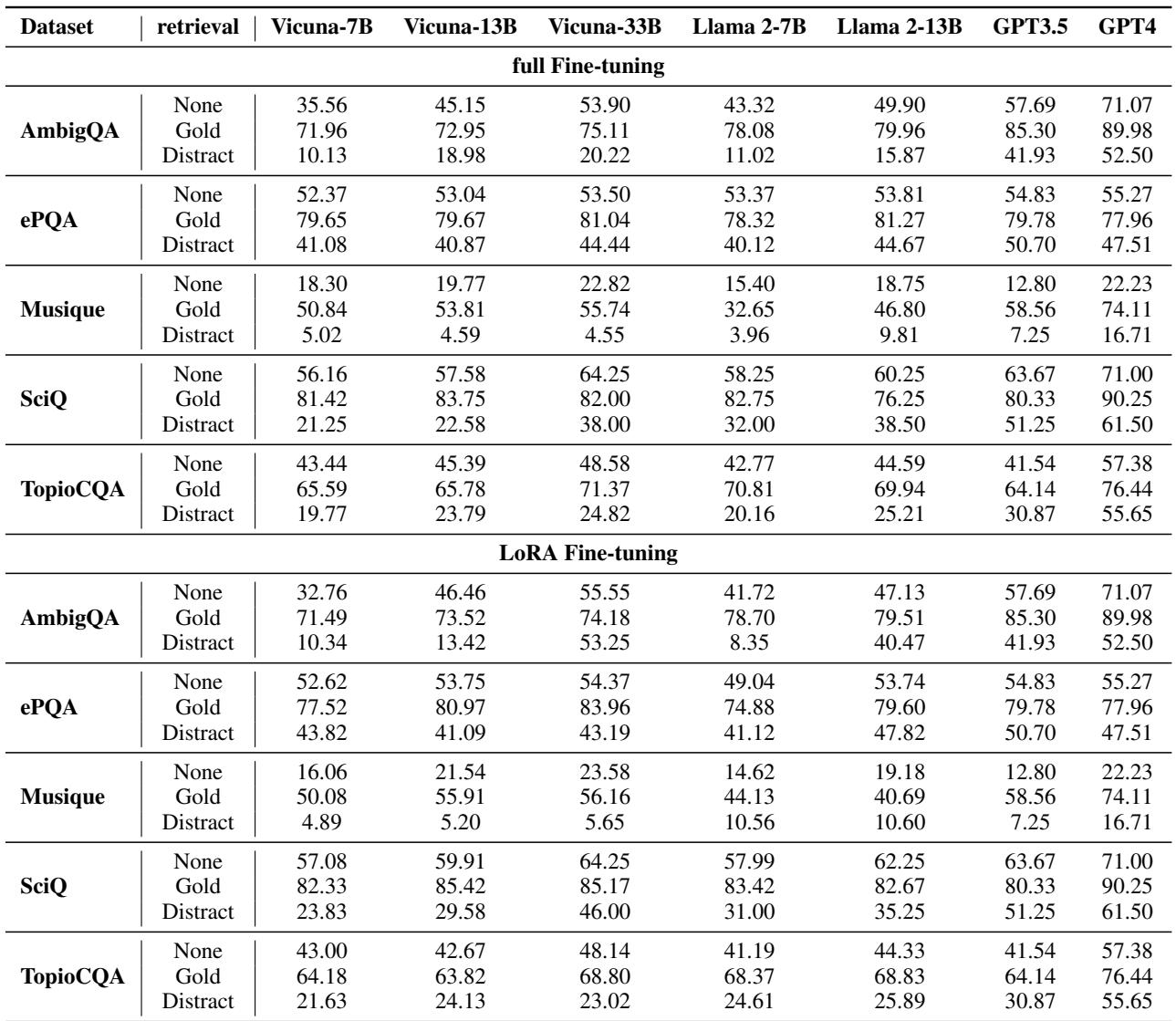
Fine-Tuning on Gold Only:
Fine-Tuning on 50/50 Mix:
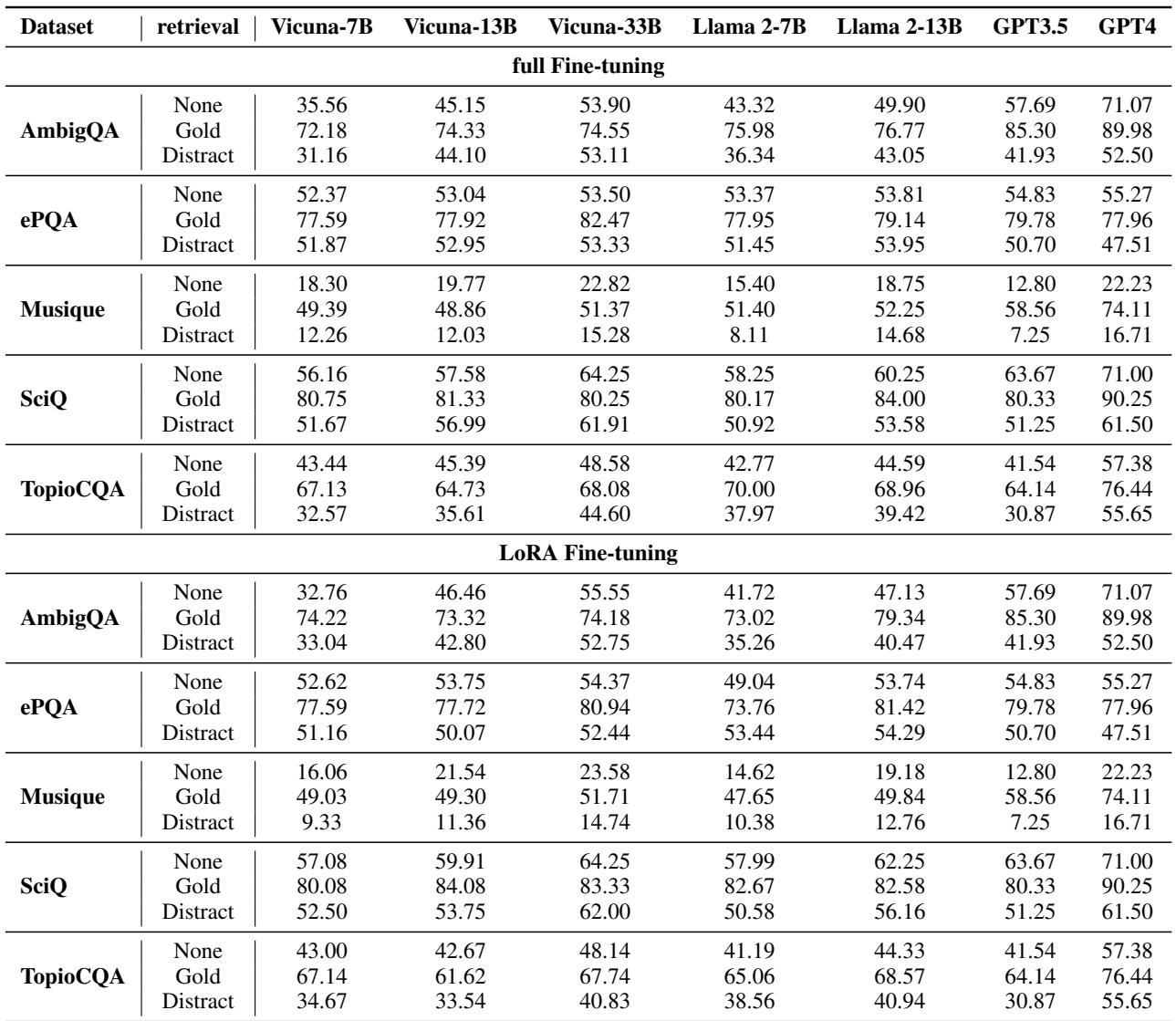
Comparing Table 4 and Table 6 highlights the narrative: Table 4 shows high scores on Gold but lower scores on Distract. Table 6 maintains the high Gold scores but significantly boosts the Distract scores.
Conclusion and Implications
Retrieval-Augmented Generation is a powerful tool, but it is often fragile. This research provides a compelling path forward for making these systems more reliable.
The key takeaways are:
- Implicit Robustness is Possible: We do not necessarily need expensive, slow, explicit pipelines to judge document relevance.
- Standard Fine-Tuning is Dangerous: Training exclusively on “perfect” retrieval data creates gullible models that over-rely on context.
- Noise is Good: Intentionally corrupting your training data with irrelevant context acts as a regularizer. It teaches the model discernment. By including a healthy ratio (e.g., 50%) of distracting documents in the training set, we get the best of both worlds: models that use good data when they have it, and ignore bad data when they don’t.
For students and practitioners building RAG applications, the message is clear: Don’t just curate a perfect dataset. If you want a robust agent, you must teach it what irrelevant information looks like, so it learns the confidence to say, “I’m going to ignore that and answer based on what I know.”