](https://deep-paper.org/en/paper/2406.18403/images/cover.png)
Can We Trust AI to Grade AI? A Deep Dive into JUDGE-BENCH
In the rapidly evolving world of Natural Language Processing (NLP), we are facing a bottleneck. We can generate text faster than ever before, but evaluating the quality of that text remains a slow, expensive, and difficult process. Traditionally, the gold standard for evaluation has been human judgment. If you want to know if a translation is good or if a chatbot is helpful, you ask a human.
However, scaling human evaluation to match the pace of AI development is nearly impossible. This has led to a burgeoning trend: LLM-as-a-judge. The idea is simple—use a powerful model like GPT-4 to grade the outputs of other models. It’s fast, cheap, and scalable. But is it accurate?
A recent paper titled “LLMs instead of Human Judges? A Large Scale Empirical Study across 20 NLP Evaluation Tasks” tackles this question head-on. The researchers introduce JUDGE-BENCH, a massive benchmark designed to scrutinize the reliability of Large Language Models (LLMs) as evaluators. In this post, we will explore their methodology, the nuances of their findings, and why we should be cautious about replacing human judges just yet.
The Problem with “Vibe Checks”
Before digging into the paper’s contribution, it is essential to understand the current landscape. When developers create a new LLM, they need to know if it works. Automated metrics (like BLEU for translation) exist, but they often fail to capture nuance. Human evaluation is better but requires hiring experts or crowd-workers, which takes time and money.
Using LLMs to evaluate other LLMs solves the resource problem. You can feed a prompt and two responses to a “Judge LLM” and ask, “Which response is better?”
The danger, however, lies in trust. LLMs are known to hallucinate, harbor biases, and struggle with reasoning. If an LLM judge prefers a specific writing style or refuses to grade a safe prompt because it misunderstands safety guidelines, our evaluation of the underlying model becomes flawed. Furthermore, with proprietary models like GPT-4 changing behind the scenes, reproducibility becomes a nightmare.
Introducing JUDGE-BENCH
To determine if LLMs are up to the task, the authors created JUDGE-BENCH. This is not just a single dataset; it is an extensible collection of 20 different NLP datasets that already contain human annotations.
The goal was to cover a broad spectrum of linguistic properties. The researchers didn’t just want to know if an LLM could catch grammar mistakes; they wanted to know if it could assess:
- Toxicity and Safety: Is the content harmful?
- Creativity: Is the dialogue engaging?
- Factual Consistency: Does the summary match the source text?
- Reasoning: Is the logical argument sound?
A Diverse Testing Ground
One of the paper’s strongest contributions is the diversity of the data selected. The researchers categorized their datasets into two main buckets based on the source of the text being judged:
- Human-Generated Items: Evaluating text written by people (e.g., assessing the toxicity of a human comment).
- Model-Generated Items: Evaluating text produced by AI systems (e.g., judging a machine translation).
This distinction is crucial because prior research suggests LLMs might be biased toward text that looks like their own output.
They also varied the type of judgment required. Some tasks required Categorical judgments (e.g., “Is this sentence grammatical? Yes/No”), while others required Graded judgments (e.g., “Rate this translation on a scale of 0 to 100”).
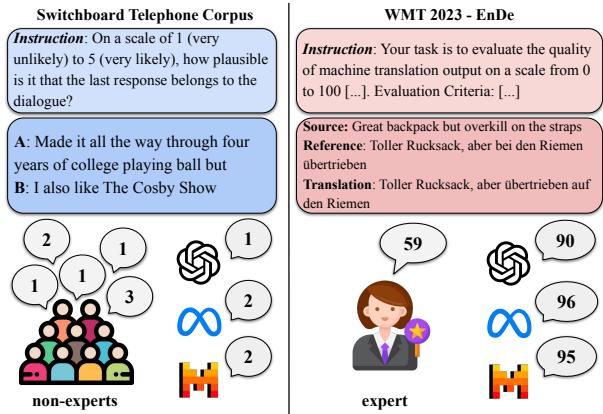
As shown in Figure 1, the evaluation formats can differ significantly. On the left, we see a task involving the “Switchboard Telephone Corpus,” where the model must rate the likelihood of a response belonging to a dialogue on a scale of 1 to 5. On the right, a Machine Translation task (WMT 2023) asks for a granular score between 0 and 100 based on specific quality criteria. The figure also highlights that the ground truth comes from different types of humans: non-experts (left) and experts (right).
The Contenders
The study evaluated 11 current LLMs, mixing proprietary giants with open-weights models to see how accessibility correlates with performance. The lineup included:
- Proprietary: GPT-4o, Gemini-1.5, Command R+.
- Open-Weights: Llama-3.1 (8B and 70B), Mixtral (8x7B and 8x22B), and others.
The researchers used the original instructions provided to human annotators as the prompts for the LLMs. This ensures a fair comparison: the AI is given the exact same criteria as the human judge.
Experimental Challenges: Refusals and Guardrails
Before the researchers could even correlate the scores, they ran into a practical problem: LLM refusals.
Modern models are heavily reinforced with safety guardrails. When asked to evaluate a dataset regarding medical advice or toxicity, many models simply refused to answer, citing safety policies—even if the task was just to evaluate the text, not generate it.
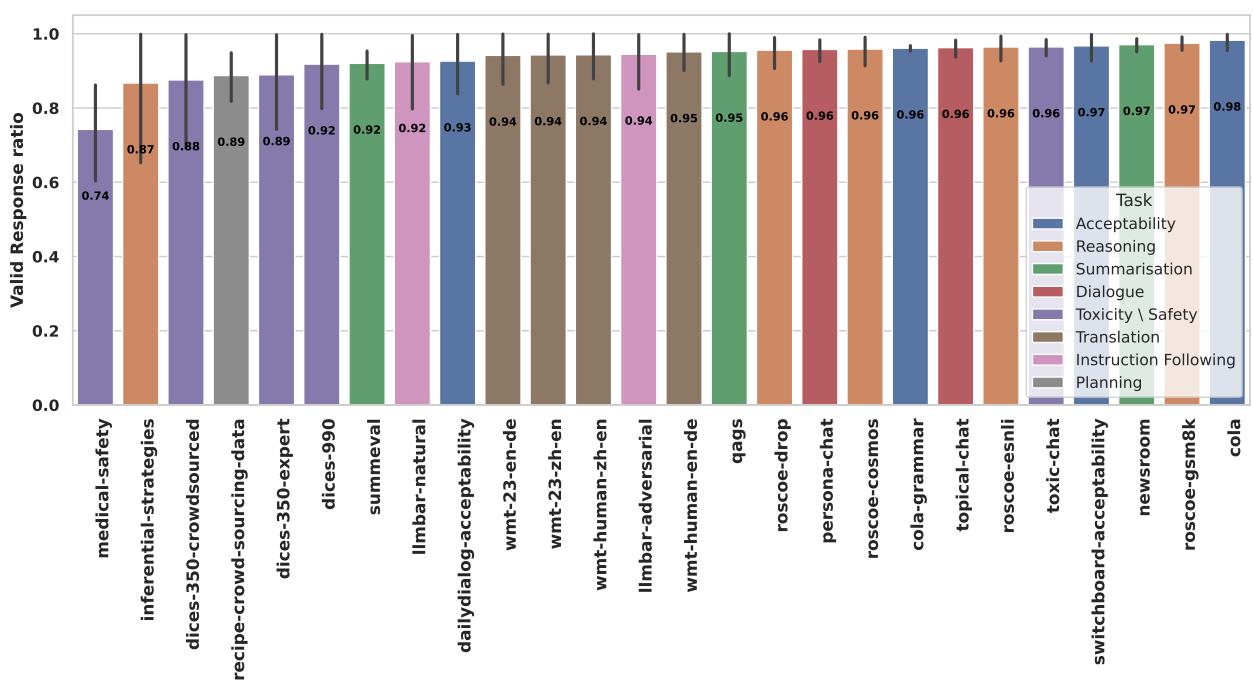
Figure 6 illustrates this issue vividly. While models had near-perfect response rates for neutral tasks like “Summarisation” or “Translation,” the valid response ratio dropped significantly for “Toxicity & Safety” tasks. In the Medical-safety dataset (the left-most green bar), many models struggled to provide a valid judgment.
This creates a blind spot. If an LLM judge refuses to evaluate a response because it deems the topic sensitive, it fails as an evaluation tool for that domain.
Key Results: Are LLMs Good Judges?
To measure performance, the authors compared the LLM’s judgments to the human “ground truth.” They used Cohen’s Kappa for categorical data (checking for agreement beyond chance) and Spearman’s Correlation for graded data (checking if the model ranks items in the same order as humans).
The headline result is mixed: LLMs are inconsistent.
While GPT-4o generally performed best, holding the top rank across several tasks, it was not a universal winner. Open models like Llama-3.1-70B and Mixtral-8x22B were often close behind, and in some specific niches (like sentence acceptability), they even outperformed the proprietary models.
However, the raw scores tell a complex story. The reliability of an LLM judge depends heavily on what it is judging and who it is trying to emulate.
1. The “Vibe” Factor: Which Properties Can LLMs Judge?
Not all linguistic properties are created equal. An LLM might be excellent at spotting a syntax error but terrible at determining if a conversation is fun.
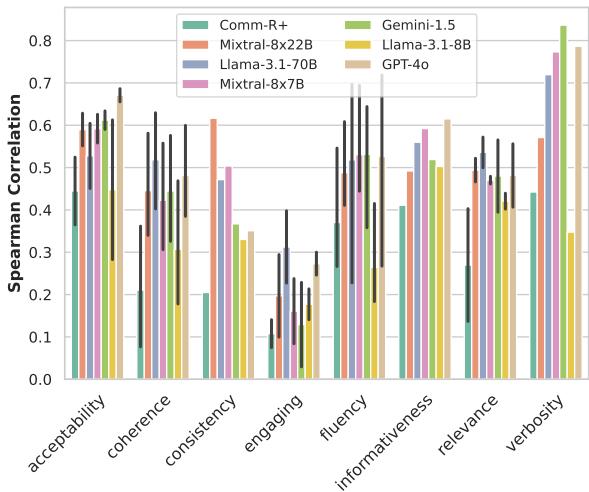
Figure 3 breaks down the correlation scores by the specific property being evaluated.
- High Performance: Look at the bars for “Fluency” and “Coherence.” Models like Gemini-1.5 and GPT-4o achieve respectful correlations here. These are structural properties that LLMs encounter frequently during training.
- Low Performance: Now look at “Engaging.” The correlations are abysmal, hovering near zero for almost every model. Whether a text is “engaging” is a highly subjective, human experience that current models struggle to quantify.
- Inconsistency: Notice the variance. No single model dominates every category. Mixtral-8x22B (the orange bar) performs exceptionally well on “Coherence” but poorly on “Relevance.”
This suggests that using a single “Judge LLM” for all aspects of your evaluation is a risky strategy.
2. The Expertise Gap: Experts vs. Non-Experts
One of the most fascinating findings in the paper deals with the human side of the equation. Human annotators fall into two camps: Experts (linguists, professional translators) and Non-Experts (crowd-workers).
The researchers analyzed datasets where the expertise level of the human annotators was known. They found a striking trend: LLMs correlate much better with non-experts.
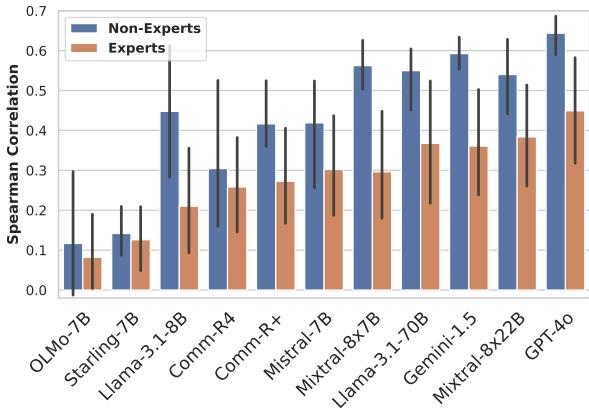
Figure 2 visualizes this gap. For almost every model tested, the blue bar (Non-Experts) is significantly higher than the orange bar (Experts).
Why does this happen? The authors hypothesize that non-expert annotators rely on “surface-level heuristics”—things like sentence length, vocabulary complexity, or simple fluency. LLMs, being statistical engines, are also very good at detecting these surface features. Experts, on the other hand, apply deeper, domain-specific criteria that the models miss.
This implies that while LLMs might be good at predicting what an average user thinks, they are not yet ready to replace professional editorial oversight.
3. The “Machine Bias”
Finally, the study validated a concern often cited in the community: Do LLMs favor machine-generated text?
The researchers compared the models’ performance on datasets containing human-authored text versus machine-generated text.
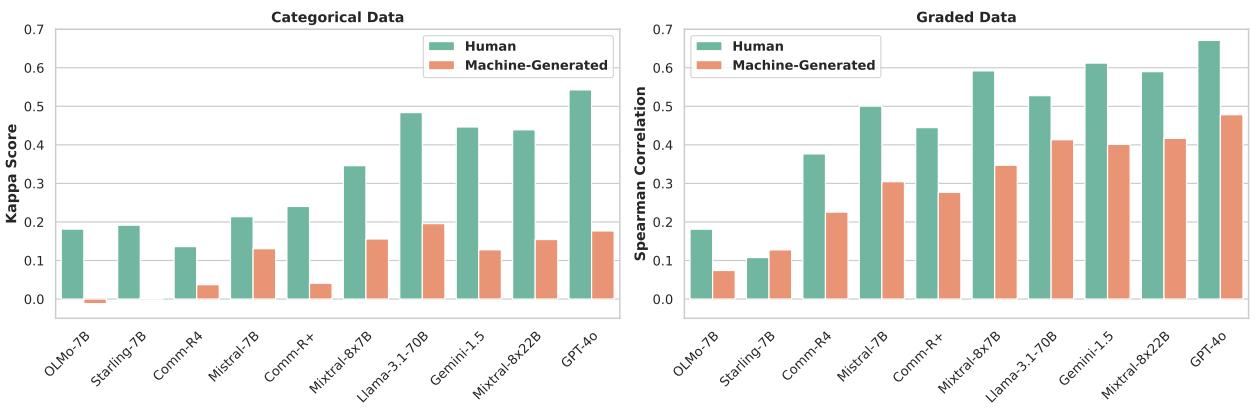
Figure 4 reveals a clear discrepancy. In almost every case, models achieved higher alignment with human judgments when they were evaluating Human text (green bars) compared to Machine-Generated text (orange/red bars).
This is somewhat ironic. The primary use case for “LLM-as-a-judge” is to evaluate other AI models (machine-generated text). Yet, this is exactly the area where they perform worse. The authors suggest this aligns with previous findings on “self-bias,” where models prefer the statistical patterns typical of their own training data or architecture, potentially drifting away from human quality standards.
Conclusion: Proceed with Caution
The findings from JUDGE-BENCH paint a nuanced picture of the current state of automated evaluation. The dream of a universal “AI Judge” that can replace human effort is not yet a reality.
The key takeaways for students and practitioners are:
- Validation is Mandatory: You cannot simply plug in GPT-4o and assume its judgments are valid. You must validate the LLM judge against human annotations for your specific task.
- Know Your Metric: LLMs are reliable for checking instruction following and fluency, but they are unreliable for assessing engagement or safety.
- Open Source is Catching Up: You don’t always need the most expensive proprietary model. Large open-weights models like Llama-3.1-70B are becoming competitive evaluators.
- The “Human” Element Remains: Because LLMs align better with non-experts, they may not be suitable for high-stakes domains requiring expert knowledge (like medical or legal NLP).
The release of JUDGE-BENCH provides a standard tool for the community to track progress in this area. Until models can bridge the gap with expert judges and handle machine-generated text without bias, human evaluation remains the undisputed gold standard.