](https://deep-paper.org/en/paper/2406.18925/images/cover.png)
Introduction
In our daily lives, we are constantly bombarded with images designed not just to be seen, but to be understood. A billboard doesn’t just show a soda can; it arranges ice, sweat droplets, and a blazing sun to persuade you that you are thirsty. A political cartoon doesn’t just show a donkey or an elephant; it uses visual metaphors to critique policy.
Humans possess an intuitive ability to interpret these visual arguments. We look at an image, ignore the irrelevant background details, focus on specific cues, and combine them with our background knowledge to reach a conclusion.
But can Artificial Intelligence do the same?
We know modern multimodal models (like GPT-4-V or LLaVA) are excellent at describing what is in an image (“There is a polar bear,” “There is a smokestack”). However, do they understand why those elements are there?
A recent paper titled “Selective Vision is the Challenge for Visual Reasoning” introduces a fascinating dataset and benchmark called VisArgs. The researchers argue that the main bottleneck preventing AI from truly understanding visual arguments isn’t an inability to “see” or an inability to “read.” It is a lack of selective vision—the ability to identify which specific visual cues support an argument and which are just noise.
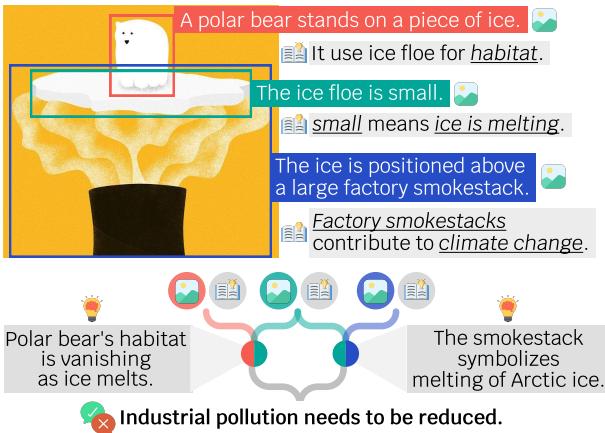
As shown in Figure 1, a human looks at this image and immediately connects the factory smoke to the melting ice, concluding that industrial pollution threatens habitats. The paper investigates whether AI can replicate this reasoning chain.
Background: Seeing vs. Reasoning
To understand why this is a hard problem for AI, we have to distinguish between factual visual understanding and visual reasoning.
Most computer vision training focuses on factual understanding: identifying objects (bounding boxes) or generating dense captions (describing every pixel). If you asked a standard model to caption the image in Figure 1, it might say: “A polar bear standing on a small piece of ice above a smokestack.” This is factually correct, but it misses the point. It misses the argument.
A visual argument is a structure that starts with premises (reasons) and ends in a conclusion.
- Visual Premises (VP): What you see (e.g., the shrinking ice).
- Commonsense Premises (CP): What you know (e.g., smoke implies heat/pollution).
- Conclusion (C): The persuasive message (e.g., stop pollution).
The researchers posit that to understand the conclusion, a model must employ selective vision. It must ignore the irrelevant parts of the image (like the specific color of the sky if it doesn’t matter) and focus strictly on the visual premises that support the argument.
The Data: Introducing VisArgs
To test this hypothesis, the authors created VisArgs, a dataset of 1,611 images comprised of advertisements and editorial cartoons. These genres were chosen because they are explicitly designed to persuade.
The creation of this dataset was a rigorous process involving a “human-in-the-loop” workflow.
- Collection: Images were sourced from Pinterest and cartoon archives.
- Drafting: An AI (GPT-4) generated initial candidates for premises and conclusions.
- Refinement: Human experts extensively corrected these annotations, often rejecting the AI’s interpretation or refining the reasoning steps.
- Grounding: Humans drew bounding boxes around the specific visual elements that constitute the premises.
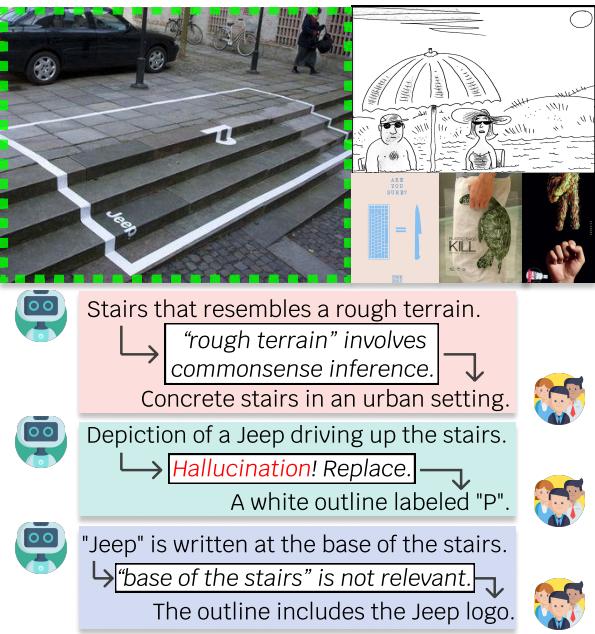
As illustrated in Figure 3, human refinement was critical. Machines often “hallucinated” elements or missed the metaphorical meaning (e.g., confusing a logo for text). The final dataset includes explicit Argument Trees—structured diagrams that map how Visual Premises and Commonsense Premises combine to form Intermediate Conclusions and a Final Conclusion.
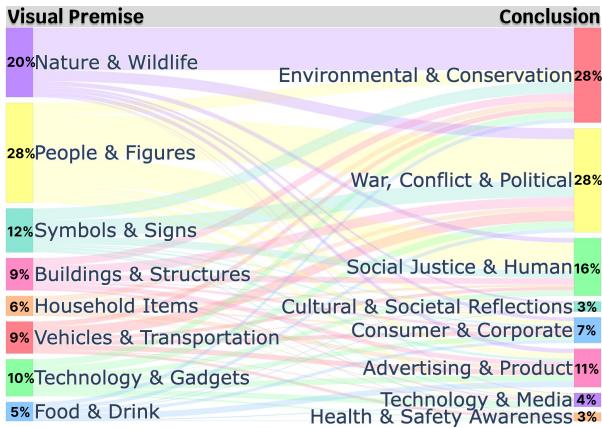
This dataset is diverse, covering topics ranging from environmental conservation and politics to technology and social justice.
The Core Method: Three Tasks to Diagnose AI
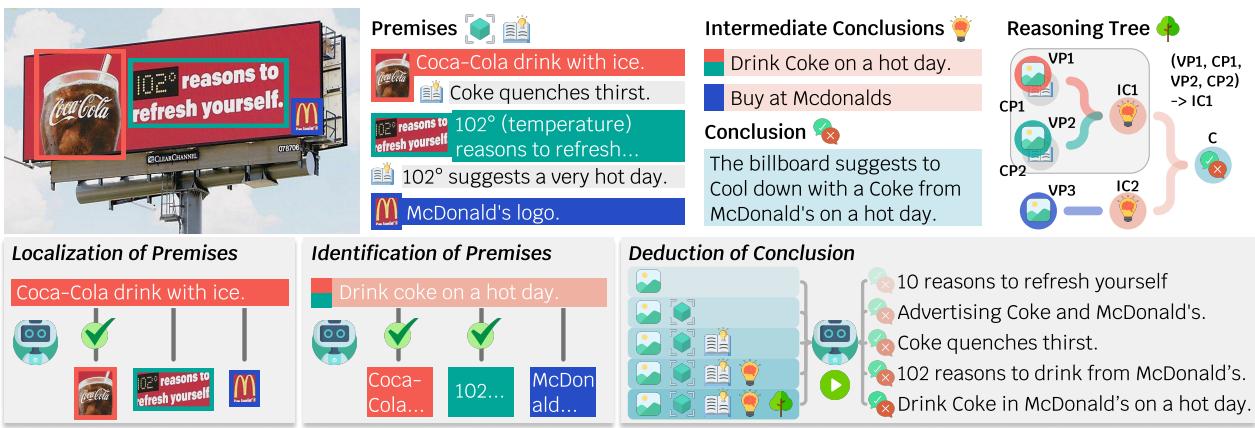
The researchers didn’t just want to know if models fail; they wanted to know where they fail. To diagnose the pipeline of visual reasoning, they proposed three distinct tasks, as outlined in Figure 2.
Task 1: Localization of Premises (Can you find it?)
This is the most basic vision task. Given a text description of a visual premise (e.g., “A Coca-Cola drink with ice”), can the model draw a bounding box around it in the image? This tests if the model has the raw visual capability to “see” the evidence.
Task 2: Identification of Premises (Do you know what matters?)
This is the test of selective vision. The model is given an image and an intermediate conclusion (e.g., “Drink Coke on a hot day”). It is then presented with several visual options:
- The correct visual premise (The Coke bottle).
- Irrelevant objects within the same image (e.g., a McDonald’s logo, if it’s not relevant to that specific sub-point).
- Objects from other images.
The model must select which visual element supports the conclusion. This determines if the model can filter out noise and focus on the relevant argument.
Task 3: Deduction of Conclusion (Can you get the point?)
This is the final test. The model is given inputs of increasing detail—just the image, the image + visual premises, or the full reasoning tree—and asked to generate the final conclusion. By comparing how well the model performs with and without help, the researchers can isolate the bottleneck.
Experiments & Results
The team tested a wide range of state-of-the-art models, including LLaVA, GPT-4-O, and Qwen-VL. The results provided a clear picture of the current state of AI visual reasoning.
1. Machines can “see,” but not specifically enough
In the Localization task, models generally performed well in “closed-set” scenarios (matching text to a region). However, they struggled with “open-set” grounding (drawing the box from scratch).
The issue wasn’t blindness; it was a disconnect between semantic meaning and object detection. Standard detectors are trained on concrete objects (e.g., “person,” “car”). Visual arguments often rely on semantic regions (e.g., “a messy room representing chaos”).
2. The Bottleneck: Identification of Premises
This was the most critical finding. While machines are good at identifying objects generally, they are terrible at distinguishing relevant objects from irrelevant ones within the same image.
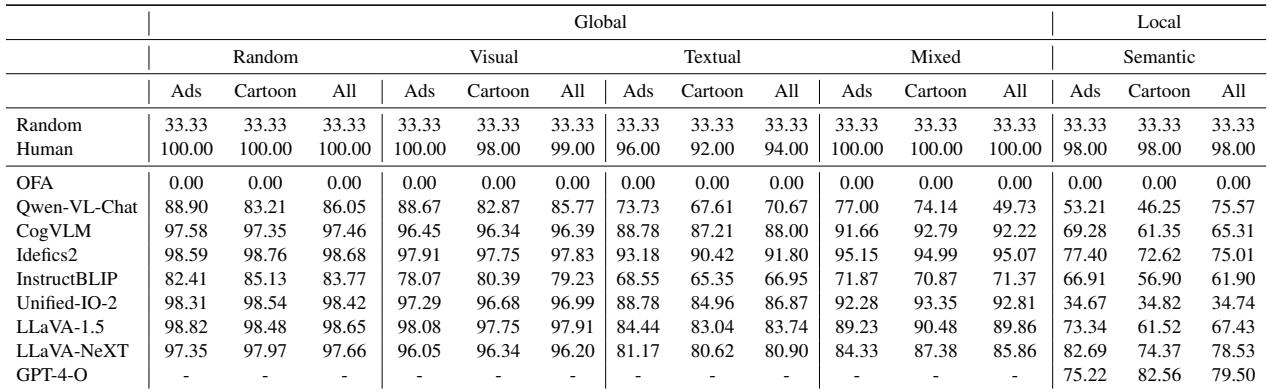
The researchers found that models performed 19.5% worse when they had to choose between a relevant object and a distractor object inside the same image, compared to a distractor from outside.
Table 14 (below) highlights this struggle. Look at the “Local” column (distractors within the image). Models like LLaVA-1.5 drop significantly in accuracy compared to the “Global” columns.
Qualitative analysis shows why this happens. In Figure 5, notice how the model LLaVA-1.5 gets confused.
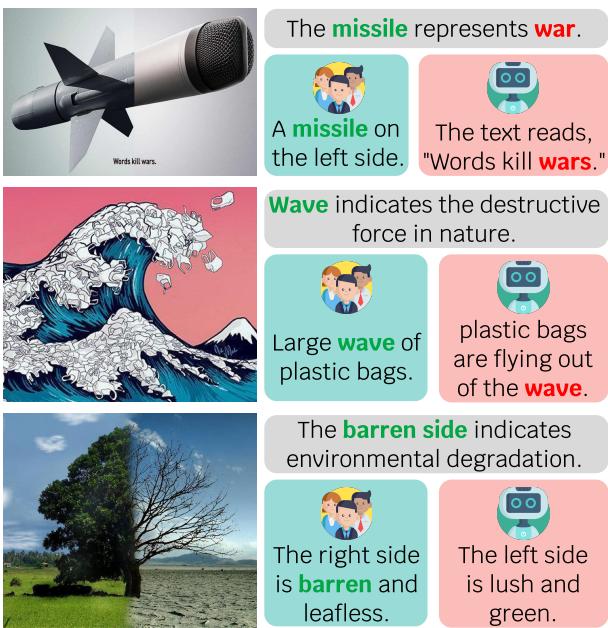
In the failure case above (middle panel), the image shows a wave made of plastic bags. A human connects “wave” + “plastic” to mean “ocean pollution.” The model, however, might fixate on the word “wave” or “bag” individually but fails to identify the plastic composition of the wave as the key premise supporting the environmental argument.
3. Deduction Improves with Help
The final task, Deduction of Conclusion, confirmed the hypothesis. When models were asked to deduce the conclusion from the raw image alone, performance was mediocre.
However, when the researchers explicitly provided the Visual Premises (telling the model “Look at the polar bear” and “Look at the smokestack”), performance jumped significantly.
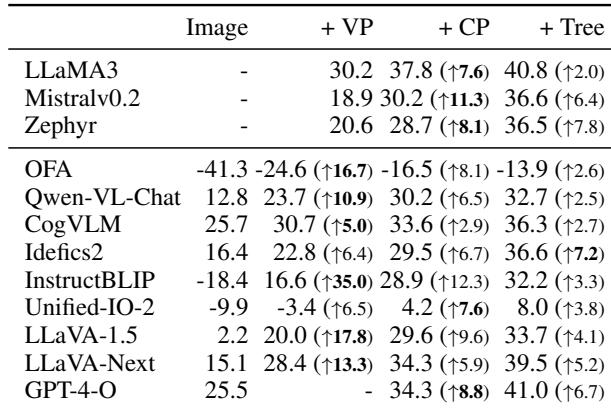
As shown in Table 7, providing Visual Premises (+ VP) offered the single largest performance boost for most models (see the † symbols indicating improvement). This proves that the models can reason effectively if they know what to look at. Their failure lies in the initial step of selecting the right visual information.
Figure 12 provides a qualitative look at this improvement.
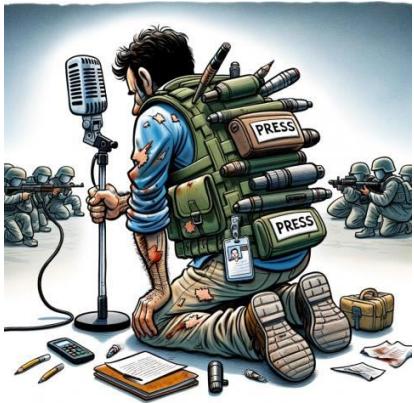
Look at the bottom example (Journalist).
- Image only (I->C): The model says “Journalists are often threatened.” (Generic).
- Image + Visual Premises (I, VP -> C): The model identifies the specific kneeling posture and the soldiers.
- Full Context: The conclusion becomes much more specific about the “vulnerability of press freedom.”
Conclusion & Implications
The VisArgs paper makes a compelling case that we need to rethink how we evaluate multimodal AI. It is not enough for a model to label every object in a photo. True visual intelligence requires selective vision—the agency to decide what is important and what is not.
The key takeaways for students and researchers are:
- Vision \(\neq\) Reasoning: Just because a model “sees” an object doesn’t mean it understands its role in an argument.
- The Bottleneck is Attention: The hardest part of visual reasoning is filtering out the noise within the image itself.
- Future Architectures: Future multimodal models may need specific modules trained on argumentative structures, or “reasoning trees,” rather than just image-caption pairs.
By moving from passive image captioning to active visual argument understanding, we step closer to AI that doesn’t just observe the world, but understands the messages within it.